
We are constantly told not to judge a book by its cover. That it’s what’s inside that counts. That appearances don’t matter and bla bla bla.
Lovely sentiments.
Except I think we need to stop pretending we actually live by them. We judge appearances. I do it, you do it, probably your mum does it while insisting she absolutely doesn’t. And maybe admitting that doesn’t make us terrible people. Maybe the more interesting thing is understanding why we do it.

Because not every judgement we make about someone’s appearance comes from superficiality. Sometimes we are simply reading information.
Think about the last time you had somewhere important to go. A first date, a job interview, a wedding where your ex also happened to be. Would you wear latex to meet your boyfriend’s parents for the first time? Would you pick the risky outfit or the safe one to walk into a party where you barely knew anyone? Seems obvious, right?
Suddenly, it’s just clothes becomes complete bullshit.
You change your trousers four times, the dress you loved yesterday is trying too hard, the other one is too basic. Eventually you leave the house dressed not only for where you’re going, but for how you want to be perceived once you get theree.
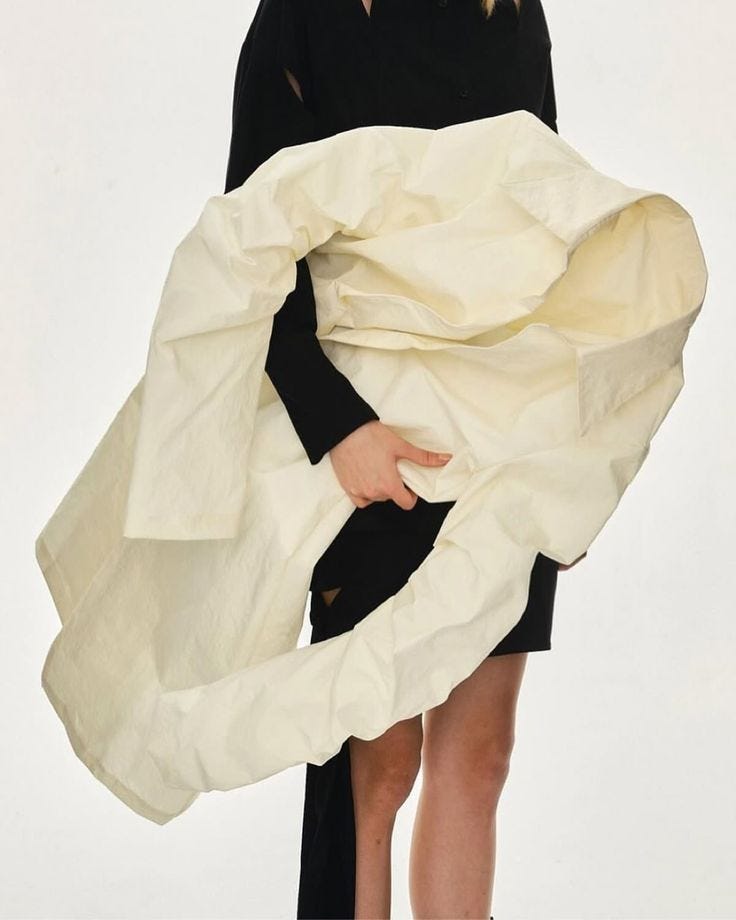
And there lies one of fashion’s greatest contradictions: we carefully use clothes to tell people things about ourselves, then pretend it’s terribly shallow when they read them. I have been thinking about this while reading Elizabeth Wilson’s Adorned in Dreams.Wilson describes dress as the boundary between our bodies and the social world, an idea I haven’t been able to stop thinking about since.
Before someone knows what we do, where we grew up, whether we’re funny, intelligent, unbearable or incredibly kind, they see us. And we don’t particularly like admitting this, but we read clothes constantly.
Don’t believe me? Imagine meeting two people. One arrives in beautifully polished loafers, tailored trousers and a cashmere jumper. The other arrives in dirty trainers, tracksuit bottoms and a hoodie. You know absolutely nothing about either of them, and yet your brain has already written two completely different imaginary characters.
One has a good job, a flat in a cool, super-gentrified area and probably knows the difference between a 2006 Chianti and a 2001 Barolo. The other is a penniless student who woke up twenty minutes ago and has eaten Lucky Charms for dinner three nights this week. You might be completely wrong, but the interesting thing is that your brain wrote the stories at all. And of course, many other biases are to blame to one degree or another, but let’s stay on clothes.There is, annoyingly, actual psychology to back me up here. Researchers who study something called person perception have found that dress helps us make several kinds of assumptions about strangers, from their social identity and status to their state of mind and even their taste. One Princeton study went even further: researchers showed people the same faces wearing clothes that looked subtly richer or poorer. The faces paired with the richer-looking clothes were judged as more competent, even when people saw them for just 129 milliseconds and were specifically told to ignore the clothes. So apparently, before our morally superior conscious brain has had time to say I never judge people by appearances, another part of it has already started writing their whole biography.
Clothing is full of codes we have somehow learnt without ever being formally taught. A uniform signals authority, a white dress turns someone into the bride. A suit can suggest seriousness, profession, conformity or power. Humans have spent thousands of years using clothes to communicate mourning, marriage, occupation, wealth, religion, rebellion, sexuality and social position. So perhaps appearance isn’t the opposite of substance, rather appearance is simply one of the ways we communicate it.
Perhaps this is the fashion-superficiality trap: we might confuse an interest in appearance with an inability to see beyond it. But calling fashion superficial misunderstands what a surface can do: it can carry an extraordinary amount of interpretable information.
Our imaginary man in cashmere might know absolutely nothing about wine. Our penniless student might actually be a professor. Clothes give us clues and our brains enthusiastically fill in the gaps. The problem isn’t that we read appearances. The problem begins when we mistake our interpretation for fact. And we don’t only use clothes to communicate with other people.
There is something interesting in the way we use clothes to compensate for what we feel we lack. When we feel fragile or uncertain, we may gravitate towards clothes that project power, trustworthiness or even a little intimidation. The sharpest of shoulders, broad enough to make us feel balanced. Garments so precisely tailored they could almost give us the physical strength to stay upright.
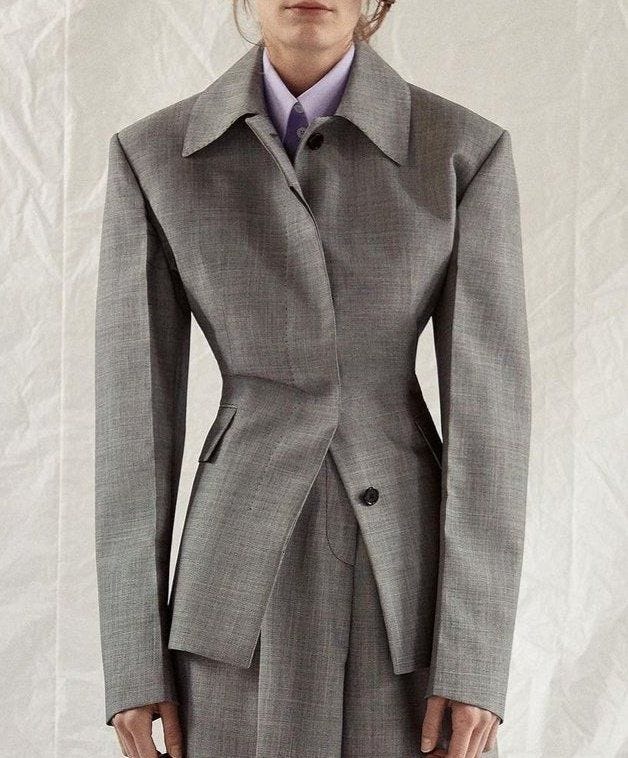
And clothes may be doing something equally strange in the opposite direction. The psychological phenomenon coined enclothed cognition: the idea that what we wear can influence not only how other people perceive us, but how we think, feel and behave ourselves. The research is still evolving, and some of the famous early experiments have struggled to replicate, but newer studies support the broader idea that the symbolic meaning we attach to clothes can affect the person wearing them. Maybe we aren’t simply dressing to look powerful. On some level, we are borrowing a little of the meaning we had already assigned to those clothes.
Wear something you hate to an important meeting and suddenly you’re adjusting your sleeves, thinking about your stomach and wondering whether everybody else can see whatever you have decided is terribly wrong. Wear the thing you feel incredible in and something changes: your shoulders, your posture, the way you walk into the room. Nothing fundamental about you has changed in the five minutes it took to get dressed. And yet somehow, you have.
Clothes don’t only change how other people read us. They change how we read ourselves. And then there is the room itself. You know what to wear to a funeral. You understand that a corporate job interview requires something different from Saturday morning coffee. You know there are restaurants where trainers feel perfectly normal and others where you suddenly look down at your feet and wonder whether you have made a terrible mistake. Nobody sat us down and taught us all of this. We learnt to read the room.
Knowing how to dress, then, isn’t simply a question of taste. It is a form of social knowledge. Of course we get it wrong. Clothes cannot tell us whether someone is kind, intelligent, interesting or good. A clue is not a biography, let me be clear!
But saying clothes shouldn’t determine someone’s worth is very different from pretending they don’t communicate anything at all. We dress to belong, I’d be a fool not to admit it. We use them to stand out, to look serious, unserious, to attract someone, to intimidate someone. And. to convince ourselves we belong somewhere when we’re not entirely sure we do.
So perhaps we don’t need to pretend we have stopped judging appearances. Perhaps we need to become better at understanding why we judge them, what we’re actually reading and where the information in front of us ends and the story we’ve invented begins.
Maybe that’s the distinction we’ve been missing. We tend to treat judgement as a moral failure when sometimes it is simply a cognitive process, our brains doing what they do with the information in front of them.
The moral responsibility comes afterwards: what do we do with the assumption we’ve just made? Do we treat it as a clue, or do we decide it is the whole story?
Don’t forget to follow me on Instagram, I am always down for a chat - @yuliacnu
Comments
Nothing yet. Say the first thing.
Sign in to join the conversation.