
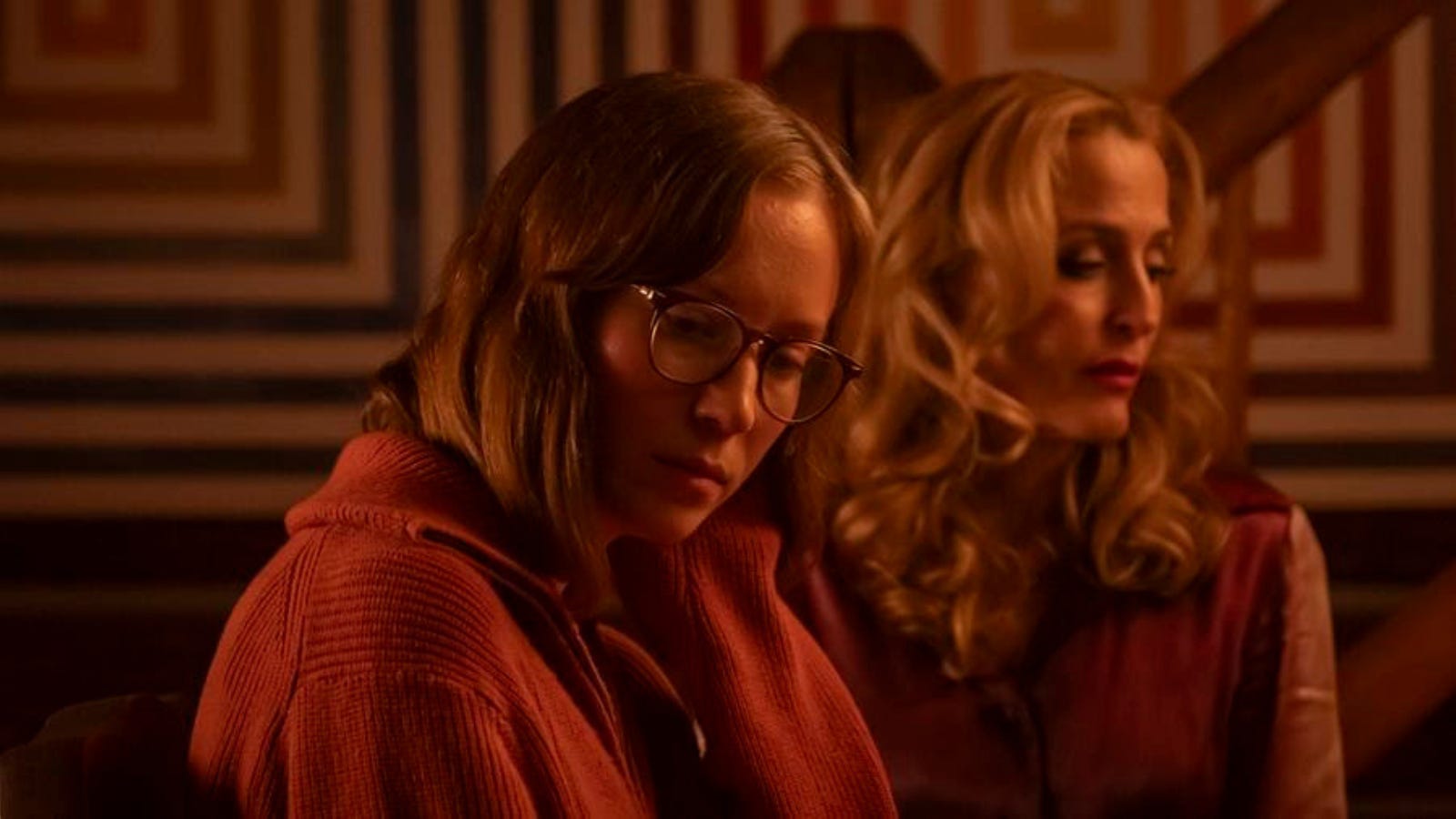
More than actually being a contemporary slasher, Jane Schoenbrun’s MUBI-produced Teenage Sex and Death at Camp Miasma is about the particularly difficult conundrum of making a modern-day franchise installment. Tasked with pitching a reboot of a Sleepaway Camp-esque property named Camp Miasma, “Sundance wunderkind” and Schoenbrun stand-in Kris (Hannah Einbinder) struggles to conceptualize a feature that transcends what she considers “Zombie IP”. A repressed lesbian stuck in an unhappy poly relationship, Kris is confronted by the franchise’s basis in misogyny and homophobia as well as the rich history of academic writing spilled on horror psychoanalysis. As she finds, it’s exceedingly difficult to conceptualize a film that contends with these lineages while retaining the flesh-and-fluid viscera that drew her to the genre in the first place. In this meta-textual film about meta-text, Schoenbrun locates their trademark concerns - disembodiment, the revelatory, anti-social perils of media fandom - within the film’s experience of being trapped under layers of self-consciousness.
Teenage Sex and Death is jumpstarted during a visit to the Camp Miasma set, where Kris stumbles upon Billy (Gillian Anderson), the original final girl who now lives on-location as a not-Gloria Swanson aging star. In their escapist playground, the two form an uneasy romance built upon Billy’s agreement to join the cast of Kris’ reboot, litigating the original film and confronting Kris sexual insecurities in parallel.
As a fictional franchise, Camp Miasma is a contemporary creation, like an ur-slasher that lays bare foundational Freudian elements. The convergence of Eros and Thanatos, as cued in the title, is a human with an HVAC helmet named Little Death, the vengeful spirit of a genderfluid camper drowned in the lake, returning every so often to murder unsuspecting heterosexuals with a spear straight out of Peeping Tom. When we see excerpts of the classic films from the perspective of Kris and Billy, immersion is all but impossible, the charm of the pastiche reduced to blaring signifiers which the characters are all too happy to point out (“split-diopter”, Kris notes). The film-within-a-film is deeply calculated, so when the style drastically shifts from a more faithful grindhouse look to a neon-soaked fanfiction during Little Death’s rampage through the unsuspecting straights, it’s the film’s most earnest reclamation, proposing what a radical re-rendering of this material might look like.
As with so many winking meta-commentaries of late, Teenage Sex and Death’s calculation is somewhat the point. If Kris’ childhood encounter with Billy and “Little Death”, mediated by the screen, inspired her sexual awakening, Billy’s manifestation into dream-life flesh liberates Kris’ desires into the material world. Admitting that she considers her work to be her real partner, Kris’ aching inability to articulate her desires outside of media sublimation provides the film’s most direct interpretation of Camp Miasma’s intellectual web. This bleeding-heart, confessional aspect of the film is both emotionally potent and fittingly at odds with the overall academic slant. The YA nature of Kris’ sexual awakening does cohere with the scenes of Little Death’s return of the repressed, and something about that embarrassingly earnest, almost kitschy tone feels true to the depiction of fandom and self-actualization.
Frankly, I found Teenage Sex and Death a frustrating watch. My experience never transcended the intellectual, even as I could feel Schoenbrun moving towards emotional catharsis. I have little familiarity with any of the media Schoenbrun builds their work around. I’m not horror-literate, nor could I name more than two Counting Crows songs, and it’s easy to credit my reaction to that fundamental hurdle, but I also question the forcefully didactic nature of the past two films. Of course, the self-conscious, analytic nature of these films is part of what they’re about, but I can’t help but feel that art about self-identification and personal liberation should be more spiritual, whereas Teenage Sex and Death, and especially I Saw the TV Glow function as blunt force instruments.
Throughout Teenage Sex and Death, Schoenbrun likens the film to junk food, turning a fetishistic eye towards KFC, Raisinets, and various assortments of guilty pleasures. There are a number of obvious metaphors here, but there’s also a self-destructive rush towards the boxed, artificial foods that feels equally appropriate. That the film ends with Billy and Kris surrounded by piles of candy is part of my frustration. I admire Schoenbrun’s films, and recognize that they’re miles better than run-of-the-mill Stranger Things backwash, but as their characters progressively open up to the wider world, I wish the films did as well.
Teenage Sex and Death at Camp Miasma is distributed by MUBI and in theaters now.
Comments
Nothing yet. Say the first thing.
Sign in to join the conversation.