
The Great Indian FMCG industry™ is not over competed. It is under strategised. Join here.

Seven people aboard the Challenger Space Shuttle died because NASA leaders valued deadlines more than the truth.
Florida, in 1986, was unusually cold and the morning of the launch was going to be the coldest in NASA’s history. Engineers at Morton Thiokol (NASA’s rocket booster supplier), had spent months worrying about a tiny rubber seal called the O-ring. In freezing weather, it stiffened, and lost its ability to stretch and seal booster joints. This could crash the shuttle, so they recommended postponing the launch.
But the NASA leaders were impatient. Commitments had been made. Millions were watching. And for the first time in history, a civilian was going to space. The story was juicy and the media was salivating.
As we do in corporates when a conference call isn’t going our way, the NASA leaders ‘took it offline’. When the engineers refused to back off, a leader said, “Take off your engineering hat and put on your management hat.”
The engineers dutifully ‘changed hats’ and cleared the launch. Seventy-three seconds after take-off, seven people died.
This was a strategy blind system™. A system that incentivised optics and built a culture that shut down dissent.
Sounds familiar? It should.
Every day, in conference rooms from Calicut to Chandigarh, experts don’t speak truth to power because they see that their leaders are more interested in protecting themselves than protecting the business.
The only difference is that here, people don’t die, companies do.
We believe that companies are rational machines - people gather data, debate strategies, and choose the best course of action. Like a perfect HBR case study.
But reality looks very different. Most organisations, especially large powerful ones, start to resemble a royal court. And courts are organised around two main characters - the Prince and the Courtier.
In the 1500s, two books described them. Machiavelli wrote The Prince, a manual for acquiring and holding power and Castiglione wrote The Book of the Courtier, a manual for winning approval from those in power.
In theory, a Prince’s job is to serve his subjects, and because subjects follow the powerful, power looks like a noble means to a noble end. But history has proven time and again that power becomes a goal by itself.
Machiavelli says a Princes must leave no stone unturned to grab and retain power. He must manipulate, mistrust and verify, and be feared rather than loved.
Just like Machiavelli’s Prince, modern leaders hoard power so they can win boardroom battles.
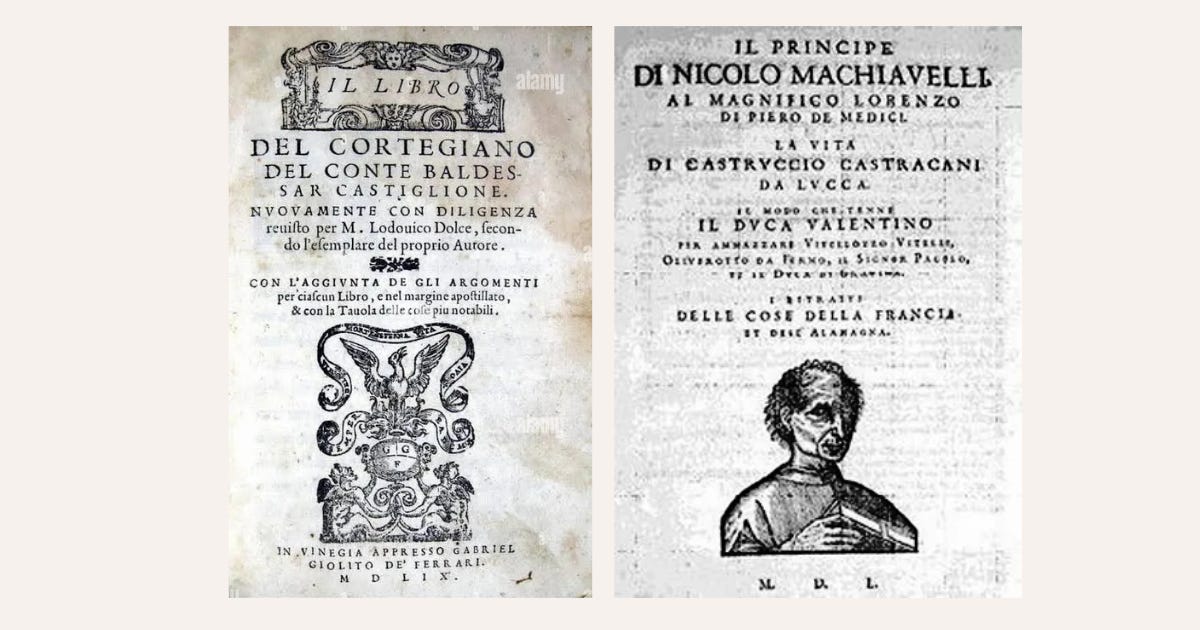
Castiglione said a Courtier’s only job is to stay as close to power as possible. For this he must impress the Prince, win favours, and survive the politics of the court. He must first understand what the Prince wants to hear, and then say it with sprezzatura - make difficult things appear effortless.
Modern workplaces breed a special class of courtier - managers who rarely deliver bad news. They soften, edit, reframe, and postpone uncomfortable conversations, until little by little, the Prince starts to see an altered reality.
People who caused The Challenger tragedy weren’t evil. Everyone believed they were acting responsibly. But the final decision came from a perfectly rational system of incentives within a highly functional culture. And these incentives were optimised for optics, and not for doing what’s right for the business.
Think about who gets ahead in companies.
At the leadership level, it’s not always the most competent, but the powerful one, who has managed optics well. They back each optics-driven move with business logic in well-designed strategy decks, presented by sharp, intelligent MBAs.
the new CEO who cancels Nielsen in his first week by saying that Nielsen must ‘first fix its market coverage’
the VC that pushes the startup to scale a bad product, because ‘live feedback will tell us what to repair’
the startup that ‘pivots’ into a holding company of brands (because their original brand stopped growing),
Such leaders promote managers who display courtier-like behaviours. One, they are likeable, agreeable, and easy to manage. Two, they help orchestrate their leader’s optical illusions.
paying hundreds of crores as listing fees for vanity key accounts, knowing it won’t convert to sales outside
coaching Indian leaders to speak ‘American’ for meetings with the global leadership (in a multinational whose raison d’etre is multi-country)
turning business presentations into high budget production theatre, with interactive stalls, posters and audio-visuals
These are real events where optics trumped business impact. Yet, people will go hoarse defending these as legitimate strategy, when in reality, this were staged to raise valuation, or to protect reputations and jobs.
Having participated in such events myself, let me tell you that from inside the system, this feels like the most rational thing to do. This happens because we become what our context makes of us. And in companies, Incentives (what is rewarded) and culture (which behaviours are overlooked and which are encouraged) make up the context.
Companies declare that ‘ownership’ or ‘having skin in the game’ is a core value and they design bonuses, RSUs, and performance-linked hikes to reward it. These are valid incentives in a HBR case study but in reality, they fail because incentives are decided through performance appraisals - a broken artefact from the past. Here’s what no body talks about.
i) Cog in the wheel feeling: So many uncontrollables impact a company’s results, that most managers don’t feel they influence the outcome. All they can control is their immediate work. Even here, their rating is at the mercy of busy managers with weak memories and recency bias - another uncontrollable. So they focus on what they can control → pleasing their manager. With the result that their day-to-day work becomes courtier-like.
ii) Appraisals are likability contests: Courtiers who please Princes get rewarded with ‘land and livestock’. People understand that performance alone does not guarantee a high rating, because behind the scenes, Princes enter into a tacit agreement, “you support my person’s rating and I will support your’s”.
iii) Beyond a certain level, increments stop mattering: A colleague in the global office of an FMCG giant told me, “even if I kill myself for a 3/3 rating, I will earn $2,000 more per year. Not worth it”. The pyramid narrows as you get senior. Those who know they won’t be CEO anytime soon (or ever), settle into well-paying jobs and try to extend their tenure until retirement. The motivation slowly but surely shifts away from business impact to self-preservation.
iv) Ultimately, the CEO bears consequences most directly: The company’s performance shapes the career of the CEO most directly. The company grows, or you exit. Given that the CEO’s biggest lever is culture, their main job is to build a culture of honest action, and staying watchful that teams don’t kill good ideas because they ‘don’t look good on a CV’, or because of power-mongering.
i) Tall poppy syndrome: A senior leader who retired from a globally renowned FMCG company after a long successful tenure once confided, “the best way to survive here is to not call attention to yourself. Don’t try to change too many things, it will put you in the spotlight.” We all know what happens to poppies that grow taller than the rest.
ii) Don’t create more work: There comes a time when people get so comfortable that any new idea or work stream looks like more work. So the average employee tries to ‘kill’ all new ideas.
iii) To survive, don’t strategise: When leaders can get away with putting their careers above the company’s good, they start gagging and bullying experts to ‘fall in line’.
In a category where competitors used celebrities, a leader blocked my thesis on celebrity endorsement because for nearly a decade, he had told his bosses that celebrities were the wrong strategy. He was afraid to reopen the debate incase it shook his hard-won power.
iv) Cult of mediocrity: Managers clog their thinking bandwidth to anticipate what the leader wants, until they can no longer think independently. It looks like this:
managers can’t respond to a strategy in meetings because they’re too busy second-guessing what their leader wants
managers reject a sound point of view simply because it comes from a rival power centre
managers reduce laminate thickness of a product, risking its quality on the shelf, because leadership cares more about cost-cutting, than about decades of earned trust
The truth dies → Courtiers stop sharing it, and Princes lose touch with reality.
Fear and insecurity lives → Princes fears losing power and Courtiers fear losing the Prince’s favour.
Many companies have fallen victim to this culture of fear and sycophancy. Nokia is one of the famous ones.
When researchers dissected why Nokia lost the smartphone war, they found that Nokia did not lack smart people or strategic insight. It lost because of a culture of fear.
… this organisational fear was grounded in a culture of temperamental leaders and frightened middle managers, scared of telling the truth.
This is what fear looked like.
Protect optics at all cost: Top management was afraid to hear bad news because it meant changing course. It would take years to build a new operating system, and they would miss goals they had announced publicly. Worse, admitting that their technology was inferior would mean looking ‘stupid’ in front of investors, suppliers, and customers.
Fear-based silence: Middle managers knew their technology was not good enough, but were too afraid of top management to say it.
All of this sounds bleak. So, let me drag us both out of this funk. There is hope. Often, the self-serving and business-serving paths intersect, and everyone wins.
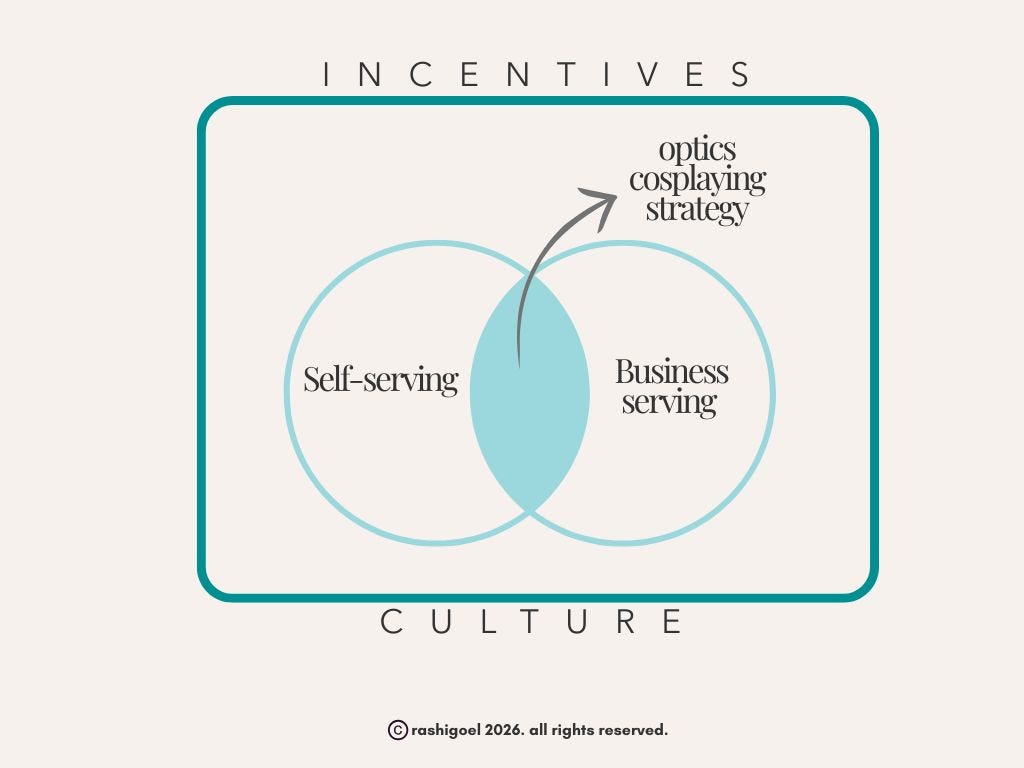
When they don’t intersect, the best CEOs dissolve the incentive or cultural structures in support of the most critical decisions. Here are two that inspired me.
In 1961, John F. Kennedy’s brilliant, Ivy-pedigreed advisors approved the Bay of Pigs plan. They privately thought it was a bad plan, but no one wanted to ‘stand out by disagreeing’.
Kennedy learnt from his mistake. When he faced the Cuban Missile Crisis a year later, he gave his brother the official role to attack every option. He even physically left the room, so his team could solve the problem independently, instead of reading his expressions to guess what he wanted.
In 1985, Intel was bleeding money in the memory-chip business it had invented. Andy Grove he asked his partner, Gordon Moore, “If the board fired us and brought in a new CEO, what would he do?” Moore didn’t hesitate, “He’d get us out of memory-chips.”
They did exactly that. Killed the memory business, and doubled down on microprocessors. Today, we know Intel because they were willing to sacrifice optics to do the right thing.
The real tragedy of a strategy blind™ company isn’t a shortage of good people. It’s that the incentives and culture favour managing the seen and overlooking the unseen, because managing the unseen starts with saying, I don’t know - a death knell for the optics a Prince chases and the sprezzatura a good Courtier is known for.
My advice? Add one more word - yet - and you might protect yourself while also doing the right thing for the business.
https://en.wikipedia.org/wiki/Space_Shuttle_Challenger_disaster
https://theinnovationshow.io/episode/who-killed-nokia-how-fear-and-emotion-derail-strategy-innovation-and-truth-telling/
Every example in this essay is real
Comments
Nothing yet. Say the first thing.
Sign in to join the conversation.