
11k+ operators across Substack and Linkedin, read The India Playbook™ → my thesis on why The Great Indian FMCG industry™ is not over-competed but under-strategised and how to grow strategically. Join them here.

July 2026, thousands of students from all over India travelled by trains, buses and on foot, to join the Jantar Mantar protest. They braved Delhi’s torturous humidity, lathis and tear gas. And worse, social media hazing, and threats to their families.
They had put their lives on hold for a belief → every student deserves fair examinations.
The ambition? The education minister must resign.
The aspiration? The government must take accountability.
These students chose to participate. No-one forced them. There were no guarantees. No awards. No medical seats.
But these 8 weeks rebranded Gen Z from lazy and entitled to intelligent, woke citizens with a spine and a weird vernacular.
This my dear readers, is a prefect example of a belief-based strategy, executed at scale.
Strategy is a set of choices you make because you believe they will get you to your aspiration and ambitions - there are four parts to any strategy - miss one, and you don’t have a strategy.
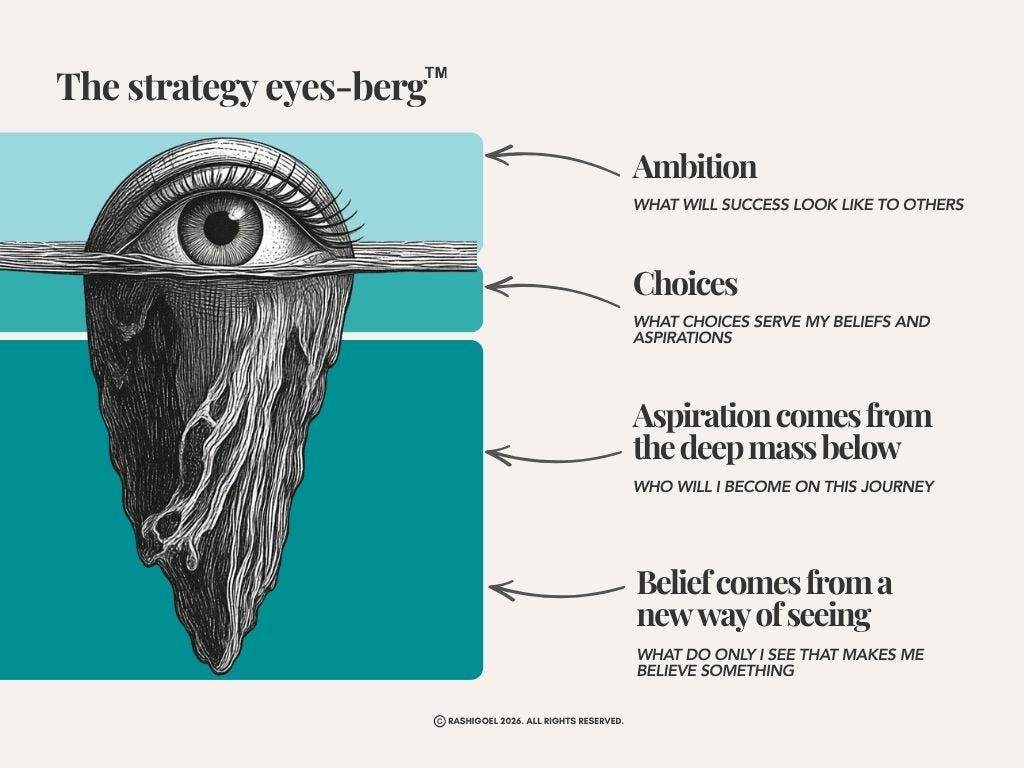
A belief system is nothing but your way of seeing world. We all look at the same things, but we don’t see the same things. Biases, upbringing, education, even our insecurities give us a belief system that’s uniquely ours.
We don’t see things as they are, we see them as we are
Anaïs Nin
Now every company began as a small, founder-led startup. And each founder had a belief.
A belief to right a wrong, (Tribhuvandas patel started Amul to protect farmers from exploitative middle men)
To solve a problem others didn’t see, (Jamsetji Tata started Taj Hotels to put Bombay on the map and attract global visitors)
To solve old problems in new ways, (Karsanbhai Patel started Nirma to make good quality detergent accessible to the common Indian)
Most often, chemists, designers and physicists just wanted to make better products. (Dyson, Phil Knight, Chanel, Kellogg, Eugene Schueller, Pemberton, Lever Brothers … the list is endless). If consumers adopted their products, they built billion dollar companies.
To be fair, belief is not the only way to start. Many more companies start just to make money - a margin opportunity, a license, a government tender.
And books are full of success/failure stories of both, belief and profit based companies. (Later in this article, I will share why I think it becomes easier for a belief-based business to rally teams, and stay in business.)
The problem is that few of us ever self-reflect and articulate our beliefs.
Fewer still have the drive to convert them into companies.
And the few who do, put their lives on hold to build companies. So they want ROI for their efforts.
That’s where aspiration and ambition comes in.
When the ROI is external, it is an ambition → the growth rate, the position, or the award. Maybe even that Padma Bhushan or The Economist cover.
When the ROI is personal, it is aspiration. Aspiration is less tangible than ambition. It is a hunch, a feeling that answers, who do you want to become when you reach the destination?
Whenever we do something hard, our identity changes.
If you climbed The Everest Basecamp. Finished writing that book, even if it took 10 years, and sold 33 copies. If you organised oxygen tanks for strangers during Covid.
Even if you fail, just immersing yourself in something bigger than yourself gives you a quiet confidence that reminds you, I am this kind of person now… I have become something more, something different. All that pain was worth it.
Both aspiration and ambition are important.
Aspiration starts with a future you believe should exist. Ambition is how you count the steps along the way.
Ambition is how you measure a strategy’s success along the way. Ambition without aspiration feels Sisyphean. But aspiration without ambition to ground its milestones is like a 3-minute ‘purpose’ film that only satisfies the director and makes money for the producer.
A founder or CEO is absent when hundreds of employees are executing strategy, daily, in big and small ways.
That’s why a clear strategy must transmit a choice algorithm across the company.
Lenskart founder Peeyush Bansal wants to give a pair of spectacles to every child who struggles in class because their vision is impaired and they don’t know it.
This leads them to invest in home eye tests, build branches all over India (not just metros) and keep prices low so that every Indian can afford spectacles.
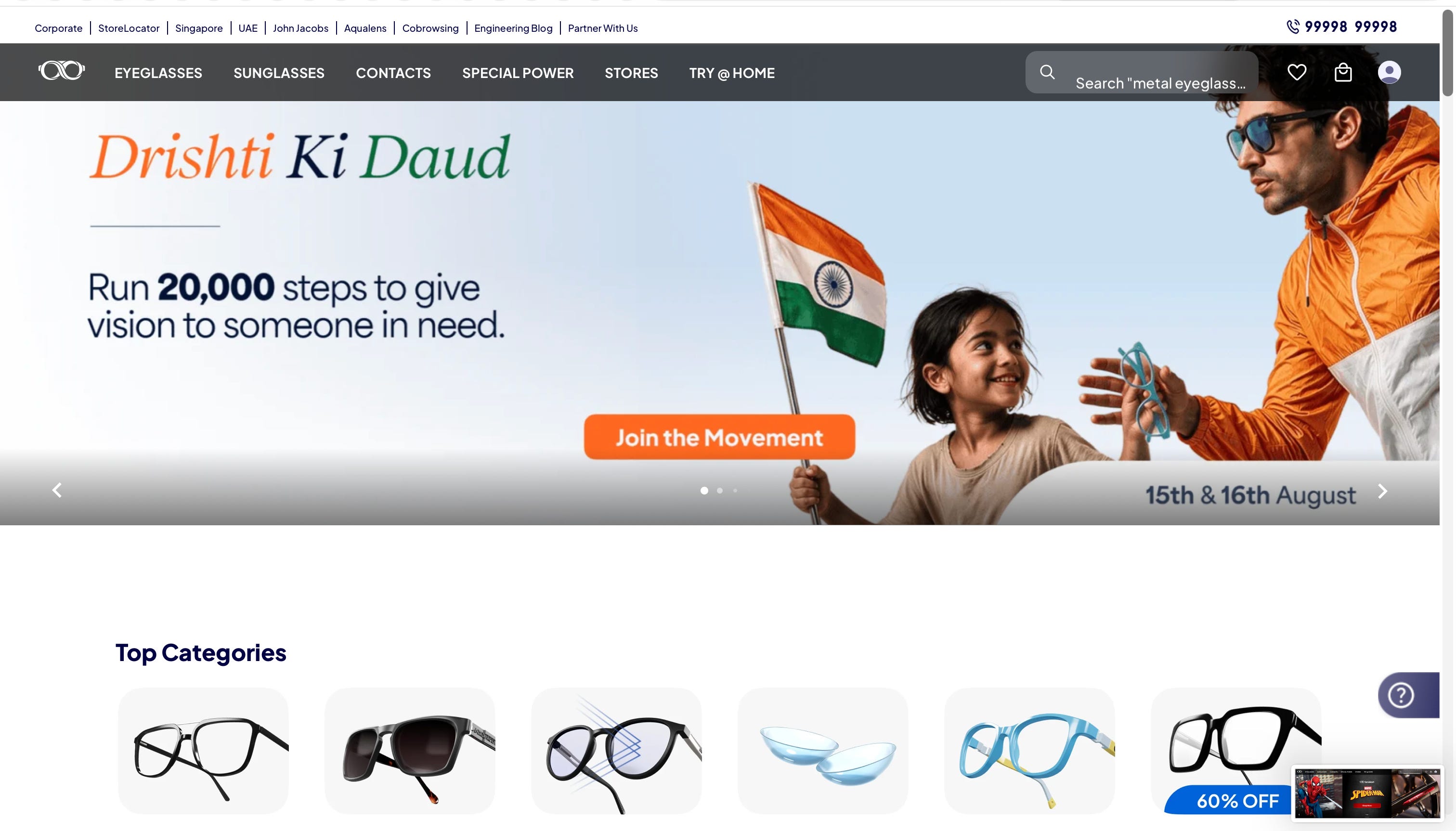
Once Peeyush Bansal’s belief and aspiration becomes clear, everything downstream aligns - hiring, incentives, org structure.
Much like the bricklayer who believed he was building the House of God, the Lenskart store manager in Guwahati is not selling spectacles, but helping a child see.
No activity can escape being coloured by a belief-based strategy.
L’Oréal Sales officers wear a formal shirt and tie to the market. They spend the first 20 minutes of every sales call cleaning their products, and merchandising the shelf.
This is a manifestation of the company’s pride in the technology that went into each product. The uncompromising belief in aesthetics; and that premium products must look premium everywhere.
Tell me the L’Oréal sales officer does not feel differently about his job from the ones that are just chasing daily targets!
When companies don’t spend the time to extract their beliefs, they fall into the trap of chasing their ambitions. The surest sign of this is a series of superlatives and comparatives strung together, into a ‘strategy sentence’.
We want to be the fastest growing F&B business in India
We will outgrow the category each year
We will be market leaders by 2027
We will dominate the masstige skincare category
We will be the best namkeen brand in India
We will offer the best quality mattresses to Indians
Don’t get me wrong, all belief-based strategies have ambitions, and quarterly results matter. But there are four problems with running a business based on ambition alone.
Anyone can have your ambition. Strategic aspiration should lead to a unique set of choices that only you can make. When ambitions are similar, everyone targets the same consumer with the same products, and complains that Indian FMCG is over-competed.
Ambition is more of the same, only bigger. An ambition-based strategy is not a strategy, it is a business plan. Ambition is like a hammer in search of a nail. It makes your choices rigid and unimaginative.
Ambition alone does not give a North Star. What does an employee do when the CEO is not in the room? Without a belief or aspiration based North Star, employees will take the easy way out, cut corners, or choose short-term wins.
Ambition alone is win-lose. If you are the market leader, everyone else must lose. On the other hand, a belief-based strategy is unique to you. You play your game your way and not feel crowded out.
Read any FMCG annual report, or watch a founder’s interview, and they all start sounding the same.
D2C wants to grow offline. Legacy FMCG wants to grow online. Everyone wants profitable, volume-led growth. Cost cutting. Data and AI based forecasting. Consumer centricity. Launch new products.
Reads like ambition-based strategy.
Everyone is fighting over the visible tip of the iceberg. Maybe if they articulate their beliefs and the change they want to bring into the category, their employees will feel more motivated and will stop feeling that their category is over competed.
As for the students and the CJP, they got their ambition - education minister’s resignation. Let’s hope they don’t lose sight of their aspiration - the government (any government) must take accountability.
https://www.kelloggs.ie/en_IE/who-we-are/our-history.html
Thanks for reading The India Playbook™! Feel free to share it.
Comments
Nothing yet. Say the first thing.
Sign in to join the conversation.