
In this week’s edition of The Indian Radius, we break down the Quad Foreign Ministers’ Meeting held in New Delhi.
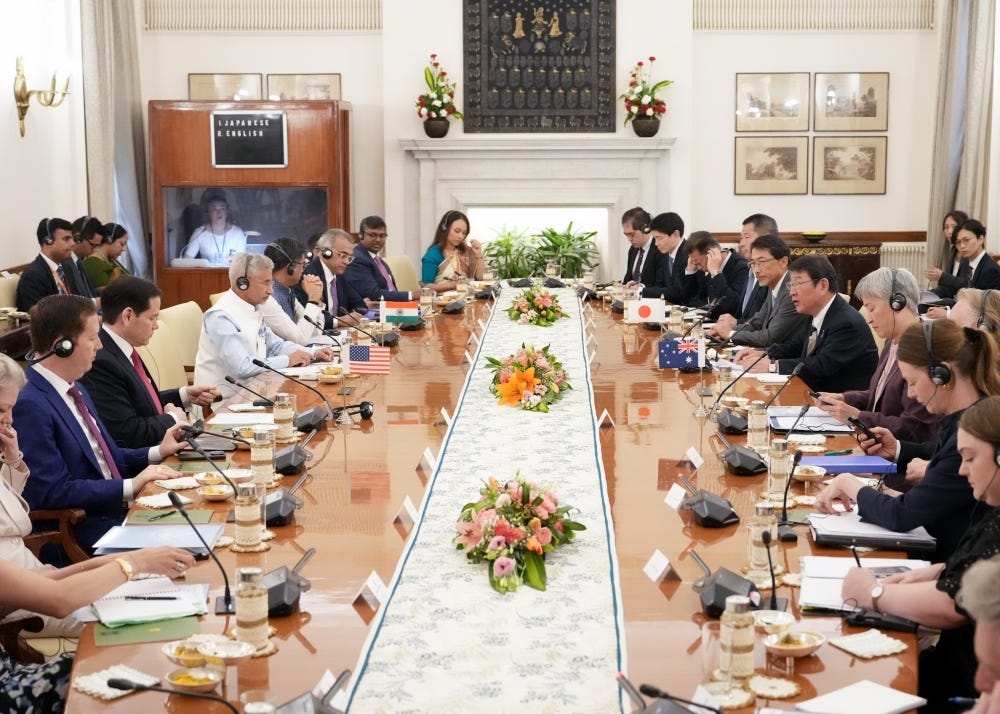
Credits: Ministry of Foreign Affairs, Japan
After months of remaining in limbo, the Quad group finally saw some high-level activity. As host, India was unable to secure a leader-level summit it had hoped to convene, but a second Foreign Ministers’ meeting on Indian soil nevertheless bore fruit. Let’s take a look at the main outcomes from the meeting, across the four main pillars of cooperation:
Maritime Security
A new initiative, the Indo-Pacific Maritime Surveillance Collaboration (IPMSC), was launched. Fusing the latest tracking technologies and satellite data, it aims to integrate the maritime surveillance capabilities of all four nations to share real-time tracking data, initially focusing heavily on the Indian Ocean Region.
Common Operational Picture (COP): The ministers agreed to expand the existing Indo-Pacific Partnership for Maritime Domain Awareness (IPMDA) to build a unified, unclassified, near-real-time digital map of the Indo-Pacific region to track illegal fishing, maritime militias, and dark vessels.
The Quad formally welcomed India’s operationalisation of the IPMDA Indian Ocean program through the Information Fusion Centre - Indian Ocean Region (IFC-IOR) in Gurugram. India is also committed to hosting the next iteration of the Quad-at-Sea Coast Guard ship observer mission.
Infrastructure and Digital Connectivity
Fiji Port Pilot Project: Under the Quad Ports of the Future Partnership, the grouping announced its first-ever joint physical infrastructure project - to upgrade and advance port capacity in Fiji. Australia described this as the Quad’s “strongest ever commitment to the Pacific.”
Undersea Cable Deliveries: The Quad successfully met its target of providing tangible support, ensuring that all Pacific Island Forum countries are securely connected via subsea telecom cables to protect their digital futures.
Anti-Scam Crackdown: The group will work together on a coordinated law-enforcement capacity-building program to combat rampant transnational cyber-scam centres operating in Southeast Asia.
Economic and Energy Security
A new Quad Critical Minerals Initiative Framework was launched to guide the four nations in leveraging economic policy tools and coordinating joint investments. The framework secures and diversifies supply chains for advanced manufacturing by focusing on the mining, processing, and recycling of rare earth elements.
Indo-Pacific Energy Security: Triggered by recent volatile disruptions in global energy corridors (specifically naming concerns regarding the Strait of Hormuz and the Red Sea), this framework establishes a collective engagement plan for emergency response exercises and fuel security. A Quad Fuel Security Forum will be convened to facilitate cooperation on strengthening energy resilience.
Cybersecurity and Counterterrorism
The ministers advanced blueprints for next-generation telecommunications (5G, 6G, and Open RAN), announced a collaborative workshop on digital identity standards, and created a Track 1.5 standards workforce development initiative.
The joint statement explicitly called out cross-border terrorism and condemned the terrorist attacks at Pahalgam, India (April 2025) and Bondi Beach, Australia (December 2025).
Here are some takeaways from the meeting outcomes:
On maritime security, it is important to understand that the IPMSC and the IPMD are not competing initiatives but complementary layers of the Quad’s maritime security architecture. IPMDA has helped build broader maritime domain awareness by monitoring illegal fishing, dark shipping, and other unlawful maritime activity. IPMSC appears designed to strengthen surveillance coordination, expert exchanges, tabletop exercises, and real-time information sharing among the Quad members.
A key distinction, however, remains unclear. Under IPMDA, vessel-tracking data has been shared with partner countries across the Indo-Pacific. By contrast, it is not yet evident whether information generated through the IPMSC will also be made available to third-party countries, or whether it will remain primarily within the Quad framework.
In terms of information sharing, the above initiatives can be enormously beneficial. First, the West Asian War has revealed the vulnerability of maritime chokepoints. In this regard, tracking vessel transits through the Malacca, Sunda, and Lombok straits would be of vital interest to the region.
Second, the collection of deep-sea sonar mapping data, thermal and salinity data would be critical for submarine warfare. All four nations are interested in understanding China’s long-range naval ambitions and protecting underwater data cables.
Beyond the oceans themselves, surveillance includes monitoring activity on the docks of regional ports. Any high-resolution optical satellite imagery and data detailing cargo volumes and fuel storage would help distinguish standard commercial operations from overseas military logistics hubs.Despite the war in West Asia, domestic political churn, and persistent trade frictions, the United States is not withdrawing from the Indo-Pacific theatre. Coming soon after the Trump–Xi summit, the meeting also indicates that Washington continues to view the Quad as a useful platform for managing strategic competition with China.
China’s reaction
Beijing opposed what it described as exclusive cliques and bloc confrontation, arguing that cooperation between countries should promote regional peace and stability and should not target any third party. The Quad’s official language avoids naming China directly, but its agenda clearly addresses concerns about China’s coercive maritime behaviour, supply-chain dependence, and competition in strategic infrastructure.
The gap between the Quad’s self-presentation and China’s interpretation will remain a tension. The Quad will continue to describe itself as open, inclusive, and rules-based. China will continue to frame it as exclusionary and destabilising.
A leader-level summit would have helped the Quad’s optics, but its absence does not necessarily mean the grouping is adrift. What matters more is whether the four partners continue to maintain political understanding and advance the underlying work. On that count, the direction remains positive. The Quad may have missed a moment of symbolism, but it has not lost its operational momentum.
What We’re Reading and Listening to
[Brief] Read Abhishekh Kadiyala’s latest issue brief analysing US Congressional oversight on the Iran war
[Podcast] Tune into this episode of All Things Policy, where Vanshika Saraf discusses the recent escalation between China and Japan, and its impact on regional stability
Thank you for reading this edition of the Indian Radius.
Comments
Nothing yet. Say the first thing.
Sign in to join the conversation.