
In this week’s edition of The Indian Radius, we track a busy week in global diplomacy - Prime Minister Modi’s five-nation outreach across Europe and leader-level meetings involving the US, China, Russia, Japan and South Korea.
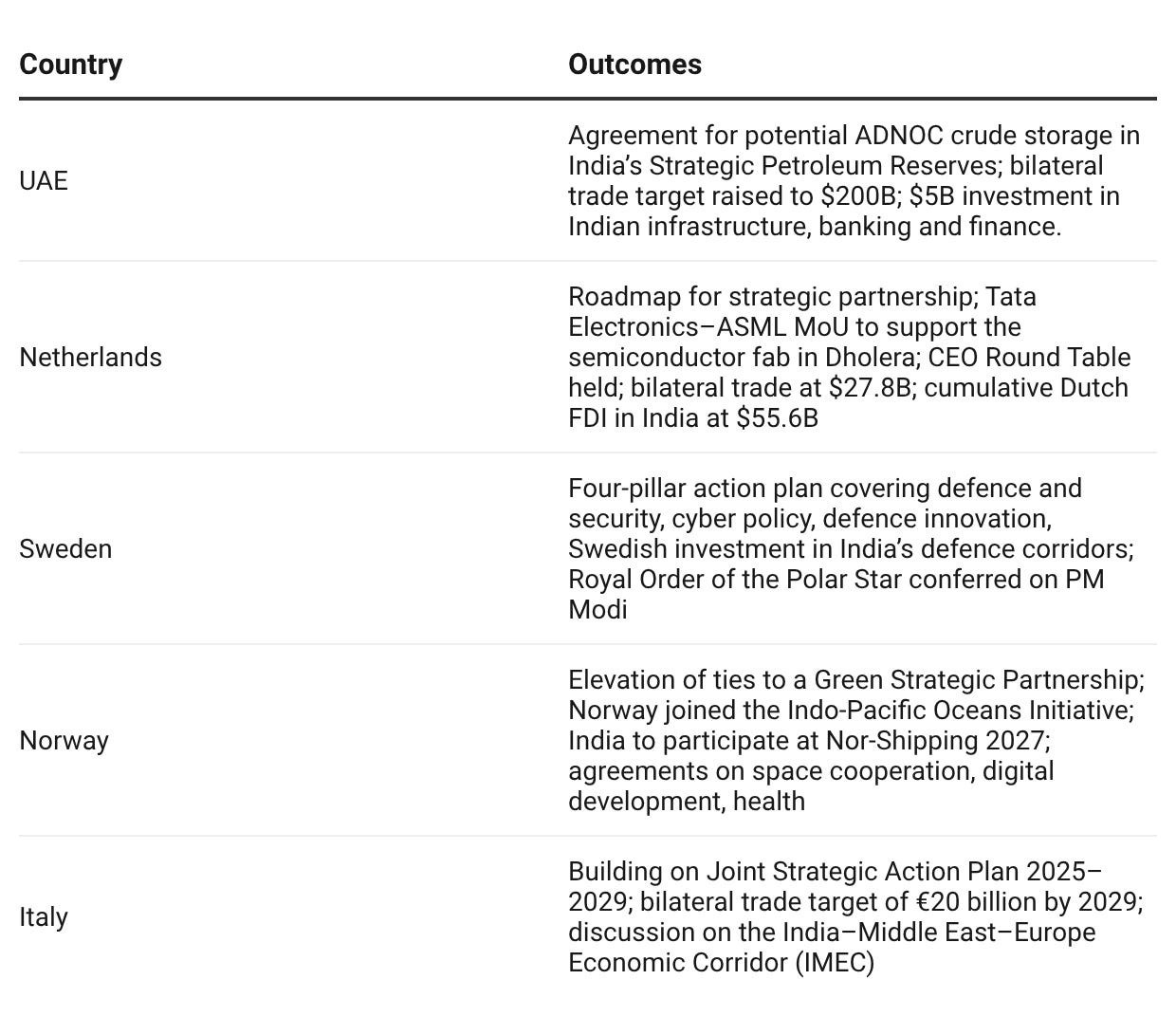
PM Modi’s five-nation tour is wrapping up today in Rome. The tour comes amid the West Asian crisis, which continues to drive up global oil prices and strain India’s foreign exchange reserves. It follows up on the recently concluded India-EU Free Trade Agreement. The overarching themes across all five stops have been energy security, clean technology, trade diversification, and strategic supply chain resilience.
Here’s how it unfolded:
Apart from individual country visits, the 3rd India-Nordic Summit in Oslo brought together the PMs of Norway, Denmark, Finland, Iceland, and Sweden. It elevated India-Nordic ties to a “Green Technology and Innovation Strategic Partnership.” The joint statement explicitly references Article 2 and Article 9 of the Paris Agreement, Common But Differentiated Responsibilities and Respective Capabilities (CBDR-RC), and the importance of affordable climate finance and technology transfer for developing countries.
In the space domain, India welcomed the Framework Agreement between the Indian Space Research Organisation and the Norwegian Space Agency on the peaceful uses of outer space. Sweden’s proposal to contribute a payload to India’s Venus Orbiter Mission further underscored the growing depth of high-technology cooperation.
Defence ties also received greater emphasis, with Nordic firms invited to explore opportunities in India’s defence industrial corridors, including in areas where up to 100 per cent FDI is permitted under applicable conditions. Arctic affairs formed another important pillar of the summit. Nordic leaders welcomed India’s continued observer status in the Arctic Council and called for deeper joint research on polar climate and environmental science.
Three observations emerge from the tour.
First, India is systematically building a European supply chain and technology architecture. The ASML-Tata deal and the India–Sweden Joint Action Plan 2026–2030 constitute an emerging European pillar of India’s economic security strategy.
Second, India’s aim with these partnerships is capability acquisition. Each stop represents an opportunity: semiconductor technology from the Netherlands, defence innovation with Sweden, blue economy cooperation with Norway, and Mediterranean connectivity through Italy.
Third, the tour reveals India’s emerging minilateral strategy in Europe. Rather than engaging Europe primarily through the EU as a bloc, India is building dense bilateral and small-group relationships. The India-EU FTA provides the macro framework, whereas bilateral relationships provide the flexibility needed for implementation.
Great Power Competition at Play
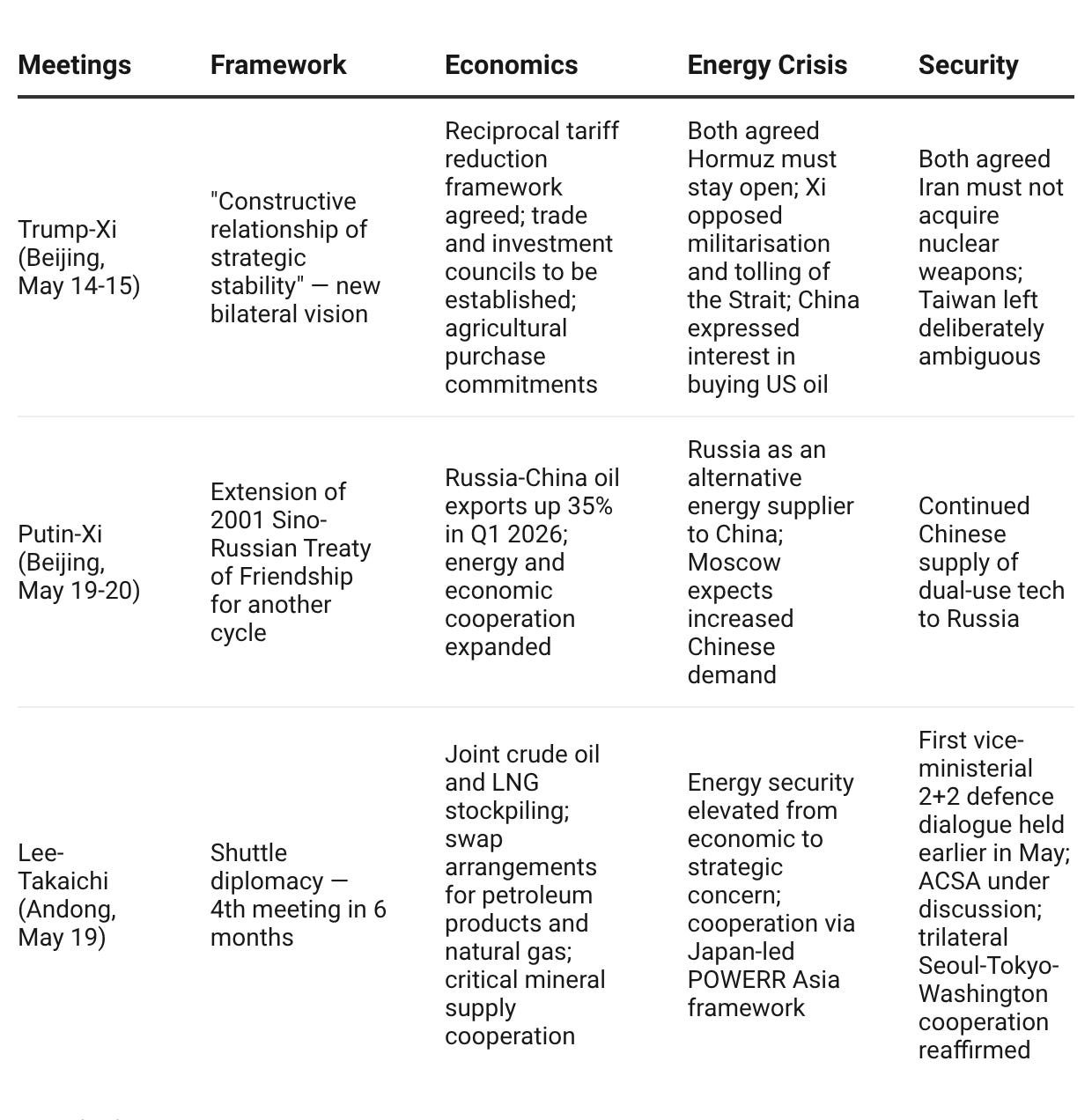
Three leader-level summits also took place this week. Here’s a snapshot:
US-China: Managed competition
Trump’s state visit, the first by a US president to China in nine years, produced a new bilateral framework: a “constructive relationship of strategic stability,” defined by Xi as combining positive stability with cooperation as the mainstay, sound stability with moderate competition, manageable differences, and enduring peace.
The two sides discussed expanding market access for American businesses, increasing Chinese investment in US industries, ending flows of fentanyl precursors, and boosting Chinese purchases of American agricultural products. China’s top diplomat, Wang Yi, confirmed that the two economic teams will work under a reciprocal tariff-reduction framework, with new trade and investment councils to be established.
China-Russia: In the Shadows
Putin arrived in Beijing on Wednesday, May 20, barely days after Trump’s departure. Within six months, the leaders of all four other permanent UN Security Council members have visited China — France’s Emmanuel Macron in December 2025, the UK’s Keir Starmer in January, Trump in May, and now Putin. Beijing has positioned itself as the diplomatic gravitational centre that all major powers must orbit.
Putin framed the relationship as a stabilising force on the world stage, saying Moscow and Beijing do not wish to align against any country but work together for “peace and universal prosperity.”
Japan-South Korea: Continued Drumbeat
Lee and Takaichi have now met four times in six months. On average, they have met once every two months since Lee’s inauguration, and the visibly warm rapport between the two leaders is promising for bilateral relations despite early concerns over their ideological distance.
The two leaders agreed to strengthen supply chain cooperation and boost efforts to secure crude oil and LNG, with a cooperative framework for procuring and stockpiling crude oil. A bilateral Acquisition and Cross-Servicing Agreement (ACSA) was also on the agenda. An ACSA would allow reciprocal provision of military supplies and services, a foundational agreement for interoperability.
There are two factors driving this engagement. First, the war in West Asia has created shared vulnerability. Energy security is gradually becoming part of the overlapping strategic thinking of Japan and South Korea, rather than simply remaining a commercial issue. Second, anxiety around US reliability is a bonding agent. Trump’s America-first policy and the economic damage from the war have reinforced the sense in both Seoul and Tokyo that the alliance framework, while valuable, cannot be the sole foundation of their national security strategy.
What We’re Reading and Listening to
[Podcast] Tune into the latest episode of The Great Power Show, where Manoj Kewalramani has a conversation with Kei Koga on the political changes that have resulted in the rise of Sanae Takaichi and are altering Japan’s strategic trajectory
[Brief] Read our latest issue brief on how India has responded to the West Asia War[Opinion] Read Vanshika Saraf’s recent piece on the recent state visit of the Vietnamese President to India
Thank you for reading this edition of the Indian Radius.
Comments
Nothing yet. Say the first thing.
Sign in to join the conversation.