
There is an exchange in the fifth episode of Yes, Prime Minister, “A Real Partnership”, which has stuck in my mind for the nearly 40 years since I first watched it. Jim Hacker, the eponymous Prime Minister, is discussing the tribulations of his recent Cabinet meet with his wife, Annie. His immediate challenge is that he has told his ministers that all spending departments are expected to find cost savings, but he is also due to receive a deputation of Members of Parliament to whom, in a moment of weakness, he has promised a pay rise (this was before the days of IPSA).
Jim Hacker: The public will never stand for an MPs’ pay rise when we cut back on nurses and teachers.
Mrs Hacker: Oh, that’s a much more serious problem.
Jim Hacker: No, darling, much LESS serious. They can’t vote against me till the next election. Backbenchers can do it at 10 o’clock tonight.
I’ve mentioned this scene before, partly because it is funny, but also because it encapsulates something of the relationship between the House of Commons and the government. In our system, of course, the Westminster model, there is no strict separation of powers, that fetish of some constitutional thinkers, and the government is drawn from and therefore partly sits in the legislature. The House of Commons Disqualification Act 1975 stipulates that not more than 95 holders of ministerial office may sit and vote in the House of Commons, which usually leaves between 25 and 30 ministers in the House of Lords.
It is a necessary function of this system the government will generally control the House of Commons: that is how it becomes the government. The principal qualification for being Prime Minister is not at root being the leader of this or that political party, though that will usually be the mechanism, and it is certainly not being “elected” as such or having some nebulous “mandate”, two ideas which have been much tossed around with Andy Burnham’s succession to the premiership in July.
It is the very strong convention that the Prime Minister will be a member of the House of Commons, a convention established in May 1923 when Stanley Baldwin, Chancellor of the Exchequer, was chosen to succeed Andrew Bonar Law in favour of the much more experienced Foreign Secretary and Leader of the House of Lords, the Marquess Curzon of Kedleston. One reason that King George V was advised to send for Baldwin—there were several others, tacit and explicit—was that it was seen as increasingly unacceptable for the head of government to sit in the unelected House of Lords. It was especially difficult at that moment in time, because the Labour Party had become the Official Opposition after the general election of November 1922; it won 142 seats, more than the 114 secured together between the Liberal Party (61 and David Lloyd George’s short-lived breakaway National Liberal Party (53). But Labour had no representation in the House of Lords at all, so Curzon as a Conservative Prime Minister would have been in a chamber where there were no members of Official Opposition.
However, that is a convention, not a rule. In 1940, there were certainly plans being sketched out for Viscount Halifax, the Foreign Secretary, to be Prime Minister if Neville Chamberlain was forced to resign (of course Winston Churchill took over in the end). There is not even any obligation on law for the Prime Minister, or any other minister, to be a member of either House, though it is the universally observed practice. The qualification for the premiership, and the reason someone will be invited by the sovereign to form an administration, is that he or she is regarded as the person best placed to deliver a sustainable majority in the House of Commons, and thereby guarantee the two basic needs of any administration, confidence and supply.
Given that central requirement, it will generally be the case that the House of Commons will support the government. If it does not, however, the power it can wield, or could, in some cases, theoretically wield, is very extensive.
I set out some of these powers in essay last July. The Commons must pass bills of supply and appropriation, which authorise the government’s raising of money through taxation and other means, and permit that money’s expenditure according to the Estimates which the Commons also agreed. The government is also dependent on the Commons, and on the House of Lords, as I explained in another essay, for its ability to maintain the armed forces. The Bill of Rights 1688 is quite clear that “the raising or keeping a standing Army within the Kingdome in time of Peace unlesse it be with Consent of Parlyament is against Law”, and to obtain the “Consent of Parlyament”, current practice is that the government must pass an Armed Forces Act every five years, with yearly extensions of permission within it. There is currently a Armed Forces Bill before Parliament which has been agreed by the House of Commons and given a Second Reading by the House of Lords; it will be considered in Committee by the Lords in the first week of September and will no doubt be gramted Royal Assent before the end of the year.
Armed Forces Bills have always been passed, and it is almost impossible to conceive of circumstances in which such a bill would be rejected by the Commons, but the theoretical power remains: it is the “Consent of Parlyament” which allows the armed forces to exist, to be maintained and to enforce service discipline. I’m sure some especially gloomy civil servant in the Ministry of Defence has quietly sketched out precisely what would happen if the worst came to the worst, but it remains possible for Parliament to say to His Majesty’s Government, no, you may not maintain standing armed services.
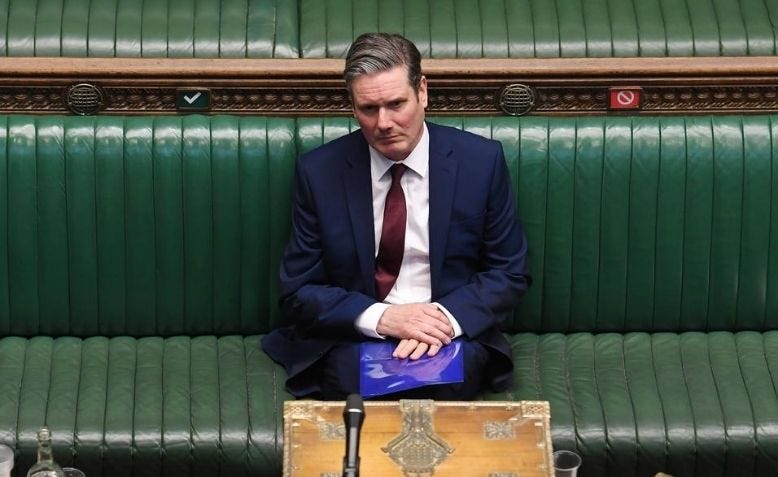
The exchange between Jim and Annie Hacker came into my mind and suddenly made me think of the recent resignation of Sir Keir Starmer in a different way. Although I said earlier that the Prime Minister need not be an MP or even a parliamentarian at all—which is true—the Labour Party is more exactly. Its Rule Book states:
There shall be a Leader… of the Party who shall, ex-officio, be Leader… of the PLP [Parliamentary Labour Party]. The Leader… shall be elected or re-elected from among Commons members of the PLP.
So the Leader of the Labour Party is required to be an MP. Readers will recall that when Andy Burnham began openly to express interest in replacing Sir Keir Starmer, the incumbent’s strongest line of defence was Burnham’s absence from the House of Commons. He had relinquished his Leigh constituency in 2017 to be Labour’s candidate for Mayor of Greater Manchester, and was elected then re-elected twice, in 2021 and 2024. Burnham sought the Labour nomination for February’s by-election in Gorton and Denton but was denied permission to stand by the party’s National Executive Committee. He was, however, then allowed to seek the nomination for June’s by-election in Makerfield, winning comfortably to qualify, at last, for the leadership of the Labour Party.
Starmer had initially talked in bullish terms about putting up a fight for his twin positions as Prime Minister and Leader of the Labour Party. He was “hellbent” and “determined to fight” any challenge to him; he would “fight Andy Burnham”and was “very determined”; he “will not walk away from the mandate he was given”; he told journalists, “Yes, I will run, I will stand… I’ve said repeatedly I’m not going to walk away from that”.
In the end he did not. Burnham won the Makerfield by-election on 18 June, and as he travelled to London to be sworn in as an MP on 22 June, Starmer announced he would resign, staying in office only long enough for the Labour Party to choose a new leader. By chance it was the feast of St Thomas More, patron saint of politicians, statesmen and lawyers.
Starmer’s displacement and replacement by Burnham was a strange process. Apart from the by-election in Makersfield, no vote or ballot was ever held. There was no vote of confidence in Sir Keir Starmer, no formal challenge by Andy Burnham, no contest, even, for the leadership of the Labour Party, since no-one challenged Burnham and he was the only candidate. It was a phoney war (perhaps the French term is more appropriate, drôle de guerre, “strange war”). But it was a war nonetheless, and when it was over, it was very obvious who had won and who had lost.
And for all that it was phoney or strange, it was a parliamentary coup against a sitting Prime Minister. For all the shadow boxing, the “what ifs” and “maybes” and “probablys”, it was a consideration of membership of the Parliamentary Labour Party, and numbers within the PLP. When Wes Streeting, then Health and Social Care Secretary and now Defence Secretary, was weighing up his chances of challenging Starmer, the magic number was 80: that was how many Labour Members of Parliament he would need to nominate him, representing 20 per cent of the total number, for his candidacy to be valid. It is true, of course, that a leadership contest itself would have been fought out among party members on the basis of one-member-one-vote, but it was the PLP which acted as both a clearing house and a trigger.
It was Labour’s Members of Parliament, principally, whose mood determined the end of Starmer’s premiership. Of course they will have pored over the opinion polls which showed the Prime Minister’s almost unbelievably poor approval ratings: Ipsos recorded a dissatisfaction rate of 61 per cent in December 2024; according to YouGov, he hit his worst performance in January 2025, when his net favourability was -57; and the only mitigation was whether or not Liz Truss had been more unpopular, a metric on which no-one should have to rely. They will also have studied the regular polling of Labour Party members by LabourList to measure the popularity of Cabinet ministers. But these have a habit of being wildly at variance with the views of the wider electorate: Ed Miliband has consistently been at or near the top of LabourList’s polls, while strong performances have been recorded by Hilary Benn, the former Northern Ireland Secretary who was the oldest minister in the Cabinet and holding a portfolio in which very few are interested, and by Lisa Nandy, the almost-invisible Culture, Media and Sport Secretary who was criticised by colleagues for spending too much time and her department’s Northern hub in Bloc, in central Manchester.
There remains one irreducible truth which Jim Hacker identified and which is such a vital part of the Westminster model. We can fret about a “presidential” style of government, of the Prime Minister having too much power and control—although the modish anxiety among think tanks and academics is that the Prime Minister does not have enough power (see, for example, this report from the Institute for Government). We can (and certainly should) strongly deprecate the government’s habit of leaking or simply announcing to the media major policy changes or decisions before they have been presented to the House of Commons. But, no matter how hard he tries, no Prime Minister can survive losing the support of his Members of Parliament (and usually, therefore, the House).
As Margaret Thatcher—who, apart from her candidacies in Dartford at the general elections of 1950 and 1951, never lost an election for any public office—discovered in November 1990, you can be cheek by jowl with world leaders agreeing a Charter for a New Europe at the Élysée Palace one day and counting individual votes of obscure backbenchers the next. Boris Johnson, typically, tried to defy political gravity as his administration fell apart in July 2022 but failed.
As Jim Hacker said, backbenchers can vote against a Prime Minister at 10 o’clock that evening. It can be swift and brutal justice. But MPs could consider that power, and the other ways in which it could be leveraged. A spineless House of Commons has removed the vertebrae by itself. They don’t need to.
No posts
Comments
Nothing yet. Say the first thing.
Sign in to join the conversation.