
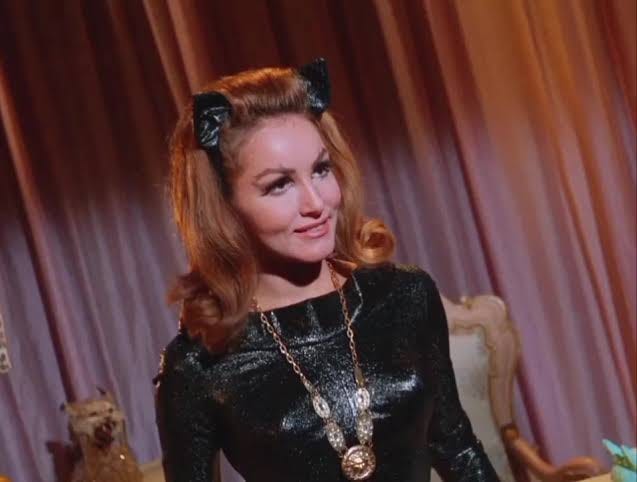
Today is the day of days for actress, dancer, singer and definitive Catwoman Julie Newmar (93), actor, singer, raconteur and baronet John Standing (Sir John Leon) (92), former Archbishop of Armagh Seán Cardinal Brady (87), journalist, iconic newsreader and de minimis moustache wearer Sir Trevor McDonald (87), director, screenwriter, producer and Australian New Wave pioneer Bruce Beresford (86), President of the Kurdistan Democratic Party Masoud Barzani (80), actress and singer Lesley Ann Warren (80), former United States Senator and Ambassador Carol Moseley Braun (79), earnest, subtle-as-a-half-brick fashion designer Katharine Hamnett (79), director, producer, screenwriter and possessor of no chill whatsoever James Cameron (72), loathesome, pseudo-articulate, cat-impersonating, dignity and integrity shredding, dictator-inclined, militant Islamist-fixated multiple MP and self-licking ice cream George Galloway (72), singer-songwriter, producer, director, actress(-ish) and not at home to self-awareness and sense of humour Madonna (68), actress, singer and long-serving Courtney B. Vance spouse Angela Bassett (68), Academy Award-winning actor, director and producer Timothy Hutton (66), actor, director, producer and screenwriter Steve Carell (64), meteorological presentation executive, broadcaster, author and Shooting Stars team captain Ulrika (Ulrikakakakakaka) Jonsson (59), (Dixie) Chicks co-founder, singer and multi-instrumentalist Emily Burns Strayer (54), singer-songwriter Vanessa Carlton (46), Franz Ferdinand bassist Bob Hardy (46) and actress and nepo baby Rumer Willis (38).
Lost birthday celebrants, for good or ill, include socialite, Little Holland House salonista and patroness Sara Monckton Prinsep (1816), diplomat, soldier, writer and archaeologist T.E. Lawrence (1888), cartoonist and Felix the Cat creator Otto Messner (1892), author Georgette Heyer (1902), former Prime Minister of Israel Menachem Begin (1912), poet and novelist Charles Bukowski (1920), pianist and composer Bill Evans (1929) and singer and virtuoso banjo player Eric Weissberg (1939).
Meeting their Peterloo
Napoleon’s defeat at the Battle of Waterloo on 18 June 1815 had been followed by his abdication four days later and his eventual surrender on 15 July to Captain Frederick Maitland, commanding officer of the 74-gun ship of the line HMS Bellerophon, at Rochefort in western France. The Napoleonic Wars, which had begun with the United Kingdom’s declaration of war on France on 18 May 1803, and which had flowed almost seamlessly from the French Revolutionary Wars of April 1792 to March 1802, were finally over, but Europe had spent a generation and more sporadically at war. The losses had been catastrophic: estimates are extremely variable but something like a million people, soldiers and civilians, had been killed during the Revolutionary Wars and the Napoleonic Wars had cost the lives of perhaps five million. That was in a continent the total population of which had yet to exceed 200 million.
In the period after Waterloo, Europe experienced a sharp economic downturn. As I mentioned in the round-up for 12 July, the eruption of Mount Tambora in the Dutch East Indies in April 1815 produced so much gas and debris that it had a significant effect on the global climate, and 1816 experienced low summer temperatures and heavier than normal rainfall which led to it being known as the “Year Without A Summer”. Poor harvests that year caused food shortages and the worst famine of the 19th century, after a succession of disappointing yields, and had knock-on effects: a series of typhus epidemics between 1816 and 1819 originated in Ireland and struck Scotland, Switzerland and Italy, claiming 65,000 lives; widespread flooding make major waterways like the Rhine difficult to navigate, causing the transportation of what foodstuffs were available challenging; the scarcity of food inevitably caused prices to rise; and the uneven nature of the food shortages, combined with the lack of any obvious causation, led to rioting in many parts of Europe.
In the United Kingdom, there were additional factors exacerbating the economic crisis. Textile manufacturers, who supported much of the economy of northern England with cotton in Lancashire and wool in Yorkshire, were especially badly affected by the end of the Napoleonic Wars and a fall in consumption saw wages plummet. In addition, the Earl of Liverpool’s Tory government began introducing tariffs on imported foodstuffs in order to keep prices high and support domestic producers. The first of the so-called Corn Laws was the Importation Act 1815, and it would be followed by the Importation Act 1822 and the Importation of Corn Act 1828.
This mercantilist legislation was hugely damaging for the large majority of the population and designed to protect the incomes of landlords and producers. But there was also a malign synchronicity with growing demands for political and electoral reform. The population of the United Kingdom by the late 1810s was approaching 20 million; it had been 18 million in 1811 and would be 21 million or so in 1821. (England, Wales and Scotland had risen from 12.6 million in 1811 to 14.4 million in 1821, but the latter year was the first time a census was conducted in Ireland and its results were more rudimentary and imprecise than that of Great Britain.) However, the elctorate was only about half a million, as it was restricted to adult male Protestants who met a certain income or asset level.1
This made the electorate and therefore the legislature deeply unrepresentative, though that was hardly unique in contemporary Europe. What was particularly damaging was that some of the worst inequalities, and the largest populations yet to be enfranchised, were in northern England where the economic downturn was most severe. Most of the large industrial towns had developed relatively recently; Manchester had been a modest market town of fewer than 10,000 residents in 1700, by the time of the first census in 1801 had grown to 78,727 and had a population of 81,989 by 1811, which grew to 113,375 by 1821.
In parliamentary terms, however, the county of Lancashire was represented by two Members of Parliament, the old knights of the shires, and there were six borough constituencies which each returned two MPs: Clitheroe, Newton, Wigan, Lancaster, Liverpool and Preston. Manchester, with a population coming up hard on 100,000, had no separate representation but was simply part of Lancashire. So were Bolton, approaching a population of 50,000, Salford, with more than 40,000 inhabitants, and Blackburn and Oldham, at around 18,000 each. The total population of Lancashire was one million; the electorate was 17,000. Moreover, the Tories and the Whigs had for decades agreed tacit deals to divide up the 14 constituencies, and most had not had a contested election within living memory.
This was thrown into relief by the rotten boroughs which had virtually no electorate at all and were controlled by wealthy patrons and landowners. The most notorious, the constituency of Old Sarum in Wiltshire, returned two Members of Parliament and had one voter, who was not resident. The settlement had been razed in 1322 and completely depopulated. But the franchise was afforded to inhabitants of designated houses known as burgage tenements, who need not be resident and whom the local landowner could nominate, thereby controlling the election.
Equally, Dunwich in Suffolk had been a flourishing port and market town when it was enfranchised in 1296, perfectly deserving of representation in the House of Commons by two MPs, but by 1670 the sea had encroached and almost entirely submerged and destroyed the port. All that remained was a tiny village of 44 houses and half a church. The franchise in Dunwich was for freemen of the borough, the number of which, by the beginning of the 19th century, was capped at 32. The constituency had two patrons, Lord Huntingfield, a wealthy merchant who occupied one of the seats himself from 1790 to 1816, as his title was in the Peerage of Ireland and therefore did not disqualify him from being an MP, and Snowdon Barne, a barrister and Member for Dunwich from 1796 to 1812 until he was appointed to the Customs Board and his younger brother Lieutenant Colonel Michael Barne succeeded him. Each patron could nominate eight freemen, so together they only needed the support of one more freeman to determine the election between themselves.
This meant that the House of Commons was not just unrepresentative but had its composition substantially decided by a handful of wealthy and aristocratic figures. In 1816, reformer Thomas Oldfield published his six-volume The Representative History of Great Britain and Ireland; being a History of the House of Commons, and of the Counties, Cities, and Boroughs of the United Kingdom from the earliest Period, and in it he claimed that of the 515 Members representing England and Wales, 351 owed their places to the favour of 177 patrons, while another 16 were dependent directly on the patronage of the government; all 45 MPs in Scotland were nominated through patronage rather than anything like free elections.
It was hardly surprising that the demands for parliamentary reform were growing louder and angrier. The vast majority of the population was experiencing extreme, in some cases unprecedented, economic hardship which in some places had become starvation. They had no representation in the legislature, no parliamentary champions nor any real way to hold to account those in power; and, worse, the measures which were being taken, like the Importation Act 1815, were positively damaging to their interests and well-being, designed to entrench privilege and the prosperity of the already-wealthy.
The government of Lord Liverpool was relieved to see the restoration of order and stability in Europe after 1815, but it remained, as British governments throughout the 19th century would periodically be, deeply anxious about unrest and revolution. The execution of Louis XVI of France was, after all, still very much within living memory—the King and his Austrian Queen, Marie Antoinette had fallen to Madame Guillotine in 1793—and there had been worrying outbreaks of violence in the preceding decades.
There had been armed opposition to the clearance of Highland estates at Strathrusdale in the late spring and early summer 1792, and a major rebellion organised by the Society of United Irishmen in various places across Ireland in 1798, supported by Revolutionary France. From 1811 to 1816 the Luddites, textile workers who saw new automated machinery as danger to their livelihoods, attacke ed factories in Nottinghamshire, then spreading to Yorkshire and Lancashire, against which Parliament passed the Destruction of Stocking Frames, etc. Act 1812, the Destruction of Stocking Frames, etc. Act 1813 and the Destroying Stocking Frames, etc. Act 1817. The final flourish of Luddite violence had been an armed, albeit abortive, uprising at Pentrich in Derbyshire in June 1817.
The man in charge of maintaining law and order was the Home Secretary, Viscount Sidmouth, appointed to the post in June 1812. His career path had been a singular one. Born Henry Addington, he had been a childhood friend of William Pitt the Younger, as his father, Dr Anthony Addington, was Pitt the Elder’s physician. A barrister educated at Winchester College, Brasenose College, Oxford and Lincoln’s Inn, he had been elected to the House of Commons for Devizes just before his 27th birthday in 1784. At 32, in the summer of 1789, he succeeded William Grenville as Speaker of the House of Commons, and while Grenville had occupied the Speaker’s chair for just five months, Addington held office for nearly 12 years, overseeing the transition from the House of Commons of Great Britain to the House of Commons of the United Kingdom after the Union with Ireland Act 1800 and the Act of Union (Ireland) 1800 had brought Great Britain and Ireland together.
In February 1801, having been Prime Minister for 18 years, exhausted, in poor health and with a fractious and divided Cabinet, Pitt resigned. Both he and George III, between whom Addington had attempted to broker a rapprochement following their breach over Catholic emancipation, insisted that Addington should replace Pitt at the head of the ministry. He duly kissed hands as Prime Minister on 17 March 1801, but lasted only three years. He oversaw the signing of the Treaty of Amiens in March 1802 which brought peace with France and undertook domestic and economic consolidation of the nation’s finances, coastal defences and others. By early 1803, the country was ready to resume hostilities with France, as it became increasingly apparent there was no hope of an agreement over the defences of Malta. By May 1804, however, it was clear that Addington no longer had the degree of control over Parliament he required—he had never been especially able at management of the House of Commons, despite his long period as Speaker—and he was replaced by a slightly revived William Pitt.
Addington had not reached the heights of British politics without attracting friends and allies, however, and he retained a following large enough to make him a significant figure. He was approaching his 47th birthday when he left the premiership but could not simply be ignored. At the end of 1804, he and Pitt were reconciled, and it was agreed that Addington would go to the House of Lords so that he and Pitt did not have to sit together in the Commons, and in January 1805 he was created Viscount Sidmouth and appointed Lord President of the Council. He resigned in July when Pitt reneged on a promise to appoint one of Sidmouth’s allies to Cabinet, but Pitt then died suddenly in January 1806. Sidmouth’s predecessor as Speaker, William (now Lord) Grenville was made head of what was called the “Ministry of All The Talents”, and Sidmouth returned to Cabinet as Lord Privy Seal, then reverted to his old office of Lord President in October. He left office when the ministry broke up over Catholic emancipation, and did not hold office under the Duke of Portland (1807-09).
Although no-one knew it, when Sidmouth returned to office as Lord President of the Council in April 1812, the Prime Minister, Spencer Perceval, had only five weeks to live: he was shot and killed in the lobby of the House of Commons on 11 May 1812, the only Prime Minister ever to be assassinated. When the Earl of Liverpool emerged as Perceval’s successor, he appointed Sidmouth as Home Secretary. Only four more peers would hold the office—the Marquess of Lansdowne (1827-28), Viscount Melbourne (1830-34), Lord Duncannon (July-November 1834) and the Marquess of Normanby (1839-41)—before it became the preserve of the Commons.
Sidmouth proved a hard-line and authoritarian Home Secretary, determined to stamp out disorder and violence. He was responsible for the Habeas Corpus Suspension Act 1817 and the Habeas Corpus Suspension (No. 2) Act 1817, which allowed the detention of those suspected of conspiring against the King and the government. He warned the House of Lords of “a traitorous conspiracy… for the purpose of overthrowing… the established government”, and said of the proliferation of clubs campaigning for parliamentary reform, “a very large proportion of them indeed had parliamentary reform in their mouths, but rebellion and revolution in their hearts”. He referred to “enemies of the constitution”, “evil[s] to be corrected” and “pestilence”, and asked the House “not to exaggerate, but not to under-rate the dangers to which we were exposed, and the difficulties with which we had to contend”.
Mass meetings of reformers kept taking place and mass petitions being signed, and Manchester was a particular hotbed of radicalism. One petitioned gathered more than 30,000 signatures, and on 10 March 1817 a crowd of 5,000 gathered in St Peter’s Field in Manchester, announcing their intention to petition the Prince Regent to force Parliament to undertake measures of reform. The local magistrates read the Riot Act 1714 to the assembled crowds, and the 1st King’s Dragoon Guards then without injury, the ringleaders being detained for several months since Habeas Corpus had been suspended. But it would not always be that way.
In January 1819, another mass meeting, this time of of 10,000 people, was held in St Peter’s Field. Henry Hunt, a prosperous farmer who had embraced radical politics, gave a speech urging the Prince Regent to dismiss the government and appoint ministers who would repeal the Corn Laws. Although cavalry were present as a precaution, the meeting passed off without incident, save for the hustings collapsing. But the meetings continued, in Manchester, Birmingham and London. The government was increasingly agitated, not reassured: ministers ticked off not another meeting passed of peacefully, but yet another before the inevitable conflagration.
Sidmouth wanted violence now, actively sought a confrontation, not for its own sake but because he believed that would be the tipping point: a meeting that spilled over into violence and which could be forcefully put down and punished would stand as an exemplar, a warning to radicals and reformers and agitators of all kind, a demonstration of the state’s power so overwhelming that no-one would dare risk provoking it again. In March he wrote to the magistrates in Lancashire, “Your county will not be tranquillised until blood shall have been shed, either by the law or the sword”.
If there had to be violence, the government must be prepared with the force of law as well as sheer physical force. Sidmouth worked with his Permanent Secretary, Henry Hobhouse, and the law officers, Attorney General for England and Wales Sir Samiel Shepherd and Solicitor General Sir Robert Gifford, trying to find legal justification for magistrates to order soldiers to break up a meeting when riot was expected by had not actually broken out. The magistrates were getting desperate. In July 1819 they wrote to the Home Secretary warning that a “general rising” was very likely, because the “deep distress of the manufacturing classes” was being stoked by the “unbounded liberty of the press” and “the harangues of a few desperate demagogues” week after week. Yet they were powerless, they explained. They had no authority to prevent peaceful gatherings, nor any means of preventing the inflammatory rhetoric and ideology from being propagated.
That was enough for Sidmouth. The Home Office responded privately to the magistrated, advising them that in “an extreme case a magistrate may feel it incumbent upon him to act even without evidence, and to rely on Parliament for an indemnity”. In other words, break skulls first, ask questions later, and the government will have your back legally. It could barely have been a more explicit invitation to the forces of law and order, alarmed and feeling helpless as they were, to overreact.
The Manchester Patriotic Union had written to Henry Hunt, inviting him to chair a “great assembly” at St Peter’s Field on 2 August. The Secretary of the Union, Joseph Johnson, was especially florid in his language when writing to Hunt.
Nothing but ruin and starvation stare one in the face, the state of this district is truly dreadful, and I believe nothing but the greatest exertions can prevent an insurrection. Oh, that you in London were prepared for it.
The letter was intercepted and copied by government agents, then allowed to reach its intended recipient, and the tone of the communication persuaded the Home Office that a full insurrection was imminent.
At that point, the Union postponed the meeting for a week, declaring its intention that the assembled people should elect someone to represent them in Parliament. This suited the magistrates perfectly: the government’s initial view was that to elect a “Member of Parliament” without a writ of election signed by the monarch was a criminal offence, so the magistrates declared the meeting illegal. On 3 August, however, the government amended its stance. The magistrates were told that the opinion of Sir Robert Gifford, promoted from Solicitor General to Attorney General nine days previously, was more nuanced: the intention to elect an MP without a proper writ of election was not illegal, but carrying out the intention would be an offence. Consequently the magistrates should not attempt to prevent the meeting taking place unless a riot actually began.
Even if they should utter sedition or proceed to the election of a representative Lord Sidmouth is of opinion that it will be the wisest course to abstain from any endeavour to disperse the mob, unless they should proceed to acts of felony or riot. We have the strongest reason to believe that Hunt means to preside and to deprecate disorder.
The radicals of the Manchester Patriotic Union had legal advice too, and they were not spoiling for a fight. They postponed the meeting once more, to 16 August, and clarified that its purpose was “to consider the propriety of adopting the most LEGAL and EFFECTUAL means of obtaining a reform in the Common House of Parliament”. They were desperate to ensure a peaceful assembly which would carry the greatest possible moral force, and issued a prohibition on “all weapons of offence or defence”. The organisers went so far as to have contingents of protestors drill and practice so that large numbers of people could move swiftly and in good order. But this backfired: hearing reports of men drilling, the magistrates were more certain than ever that an insurrection was planned and the situation was sufficiently serious that pre-emptive action was warranted. They therefore began taking oaths from local loyalist men of standing, swearing that they believed the town to be in danger.
Monday 16 August was a hot, cloudless day. The magistrates met at the Star Inn on Deansgate at 9.00 am, to take breakfast and decide how they should reacy when Henry Hunt arrived to preside over the assembly. By 10.30 am they were still to come to a conclusion, but they moved to a house on the south-eastern corner of St Peter’s Field: from here they intended to observe the gathering and react as necessary. They were not optimistic, however, and expected violence and disorder, so had deployed a significant military force.
They had assembled 600 mounted men of the 5th (The King’s) Regiment of (Light) Dragoons (Hussars), a regular cavalry regiment; more than 500 infantrymen, drawn from the 31st (Huntingdonshire) Regiment of Foot and the 88th Regiment of Foot (Connaught Rangers); two six-pounder guns of the Royal Horse Artillery; 400 troopers of the Cheshire Yeomanry; 120 of the Manchester and Salford Yeomanry; and 400 special constables appointed under the provisions of the Poor Relief Act 1662.. That amounted to more than 2,000 men, under the overall command of Lieutenant Colonel George Guy L’Estrange; his superior, Major-General Sir John Byng, Commander-in-Chief, Northern District, was absent at the York Races.
By now the demonstrators were starting to arrive, and arrive in numbers. They marched peacefully and in good order, carrying banners of “No Corn Laws”, “Annual Parliaments”, “Universal suffrage” and “Vote By Ballot”. The only banner to survive is made of green or silk with painted gold lettering: one side of the banner says “Liberty and Fraternity”, while the other is inscribed “Unity and Strength”. It is the oldest political banner in the world.
Exactly how many people came to St Peter’s Field as the day burned its way towards noon, and from where they came, is very difficult to establish. One of the most hardline magistrates, the Revd William Hay, Chairman of the Salford Hundred Court of Quarter Sessions, said later that “the active part of the meeting may be said to have come in wholly from the country”, but it seems that the majority were from Manchester and the immediately surrounding area.
There seems to have been a group of 10,000 from Oldham Green, including a sizeable number of women, 6,000 from Middleton and Rochdale and a contingent from Stockport of between 1,500 and 5,000. Contemporary estimates of the total range from 30,000 all the way to 150,000 (which would have been larger than Wellington’s army at Waterloo). Modern estimates have been between 50,000 and 80,000; recent analysis has produced a relatively reliable figure of 20,000 demonstrators from outside Manchester, but establishing how many came from the local area remains a challenge. Settling on a total of between 50,000 and 60,000 seems plausible, and certainly gives a sense of the large numbers involved. Remember that the population of Manchester was somewhere around 100,000.
At noon, hundreds of special constables came on to the field and formed two lines, a few yards apart from the house where the magistrates were watching to the makeshift hustings of two wagons lashed together. Some in the crowd believed the corridor they had formed was going to be used as passage for those sent to arrest the speakers, and began to push back against the constables, while others formed a human barricade around the hustings. However peaceful the demonstrators’ intentions, the atmosphere was tense and volatile. It was dry kindling, lacking only a spark.
Henry Hunt’s carriage arrived at 1.00 pm. With him was Mary Fildes, President of the Manchester Female Reform Society, and several of its members, dressed in white, accompanied Hunt to the hustings. Also present were John Knight, a reform-inclined cotton manufacturer, Joseph Johnson of the Manchester Patriotic Union, John Thacker Saxton, Managing Editor of The Manchester Observer, radical publisher Richard Carlile and a shoemaker and reformer called George Swift. There were also reporters from The Times and The Liverpool Mercury. The crowd, however large, was densely packed: St Peter’s Field was only 14,000 square yards, and those nearest the hustings were so close that “their hats seemed to touch”.
Hunt and the others were greeted with huge enthusiasm by the demonstrators. 31-year-old William Hulton, Chairman of Lancashire and Cheshire Magistrates and Constable of Lancaster Castle, watching with his colleagues, had seen all he needed to. He was an especially authoritarian magistrate with little or no sympathy for the idea of peaceful protest: in 1811, when High Sheriff of Lancashire, he had ordered the arrest of 12 Luddites for arson, of whom four had been hanged outside Lancaster Castle. The youngest had been a boy of 12. Seeing the enthusiasm of the crowd, he issued arrest warrants for Henry Hunt, Joseph Johnson, John Knight and James Moorhouse; the Chief Constable, Jonathan Andrews, suggested that it would be impossible, given the size of the crowd, for him to execute the warrant without military assistance.
That was no obstacle for Hulton. He quickly wrote two notes, one to Colonel L’Estrange and the other to Major Thomas Trafford, commanding officer of the Manchester and Salford Yeomanry and a local landowner (as well as a Roman Catholic, strangely enough). The notes were very similar in content, that to Trafford reading:
Sir, as chairman of the select committee of magistrates, I request you to proceed immediately to no. 6 Mount Street, where the magistrates are assembled. They consider the Civil Power wholly inadequate to preserve the peace. I have the honour, & c. Wm. Hulton.
The Yeomanry was stationed in Portland Street, close to St Peter’s Field, so Trafford received his communication first. The troopers immediately drew their sabres and galloped towards the field; one, briefly delayed and hurrying to catch up, collided with a woman called Ann Fildes in the narrow Cooper Street. She was carrying her two-year-old son William, but he fell to the ground when his mother was knocked over, and was trampled to death under the hooves of the cavalry horse. William Fildes was the first fatality of 16 August 1819. The killing had begun.
Sixty of the Yeomanry under the command of Captain Hugh Hornby Birley, a 41-year-old Tory mill owner, arrived at the house from where the magistrates were watching at about 1.40 pm. It was alleged some of the troopers were drunk. Andrews explained he needed to execute an arrest warrant and asked that Birley take his men to the hustings to allow those charged to be arrested. The troopers had to make their way between the two lines of special constables, and the crowd pressing on them had narrowed this line further. But the horses were inexperienced and panicky, rearing and bucking as the demonstrators pressed in on them. As the troopers drew close to the hustings they simply became stuck and immobile, and they too began to panic. They started to hack left and right with their sabres, desperate to get free. The situation was rapidly degenerating.
Joseph Nadin, the Deputy Constable, managed to get to the hustings and served the arrest warrant, following which the Yeomanry attempted to tear down and destroy the flags and banners on the platform. But to get to the hustings, the troopers continued to hack and slash at the crowd around them. At that point, the crowd’s peaceful intentions snapped, and bricks and rocks were thrown at the cavalrymen. John Tyas of The Times recorded in lapidary fashion: “From this point the Manchester and Salford Yeomanry lost all command of temper.” Disaster was now unavoidable.
Colonel L’Estrange reported to Hulton at 1.50 pm. The magistrate believed the Yeomanry was under deliberate attack and that further insurrection would follow according to some plan. There was only one response: the demonstration had to end. To L’Estrange, he exclaimed:
Good God, Sir, don’t you see they are attacking the Yeomanry; disperse the meeting!
L’Estrange lined up the 15th Hussars at the eastern end of St Peter’s Field, and charged the crowd. At the same time, the Cheshire Yeomanry carried out a charge from the southern side of the field. Demonstrators tried to scatter and flee before the noise and weight and terror of a cavalry charge, but the field was too crowded at first; the main exit into Peter Street was blocked by soldiers of the 88th Regiment of Foot with fixed bayonets. Like water from a leaking vessel, however, the crowd pushed and surged and found ways to get away from the bloodied field.
Within an astonishingly brief 10 minutes, as two o’clock struck, the crowd had dispersed, or at least those who could, had. Once they had gone, there were about 11 dead and more than 600 wounded left at St Peter’s Field, and there was blood everywhere. Six men and one woman had been killed sabre blows and trampled; another man had been shot by a musket; a Salford mother-of-seven had been beaten fatally around the head wth a special constable’s truncheon. Another man died of sabre wounds later at the Manchester Infirmary, while a pregnant mother-of-six was trampled by cavalry, suffered almost daily fits as a result of her injuries and died in premature childbirth four months later. An ex-soldier and Waterloo veteran died on 9 September of sabre wounds; shortly before his death he said to a friend,” At Waterloo there was man to man but there it was downright murder”.
James Wroe, Editor of The Manchester Observer, was at St Peter’s Field with his colleagues Joseph Johnson and John Thacker Saxton, and reported on the day’s events in the next edition of the newspaper on 28 August. With an ironic nod to the Duke of Wellington’s victory just four years before, Wroe gave the clash the name by which it would be universally known.
PETER LOO MASSACRE ! ! !
Just published No. 1 price twopence of PETER LOO MASSACRE
Containing a full, true and faithful account of the inhuman murders, woundings and other monstrous Cruelties exercised by a set of INFERNALS (miscalled Soldiers) upon unarmed and distressed People.
There was widespread shock at the level of violence. Wroe also wrote a series of pamphlets entitled The Peterloo Massacre: A Faithful Narrative of the Events, which sold out of every print run for 14 weeks, and national newspapers like The Times, a reporter from which had been present, covered the story extensively. It was the bloodiest political disturbance in England during the 19th century and the apparent unprovoked degree of force appalled many.
For Sidmouth, Lord Liverpool and the government, however, it was vindication. On 27 August, the Home Secretary conveyed to the magistrates the thanks of the Prince Regent for their efforts in “the preservation of the public peace”.
Wroe was arrested and charged with producing a seditious publication. He was sentenced to 12 months’ imprisonment and fined £100, while other employees of The Manchester Observer were pursued at law, and those against whom there were outstanding cases moved to the top of the list. The paper closed in February 1820.
Henry Hunt and eight others were tried for sedition at York Assizes on 16 March 1820. The trial lasted a fortnight, after which five were found guilty: Hunt was sentenced to 30 months’ imprisonment; Samuel Bamford, Joseph Johnson and Joseph Healey received sentences of 12 months; and John Knight was jailed for two years on a subsequent charge.
The public revulsion and anger prompted the government not to compromise or address grievances but to shore itself up against more serious unrest. It passed the Six Acts to clamp down on displays of disorder and disobedience: the Unlawful Drilling Act 1819, the Seizure of Arms Act 1819, the Pleading in Misdemeanour Act 1819, the Seditious Meetings Act 1819, the Criminal Libel Act 1819 and the Newspaper and Stamp Duties Act 1819. Although the Whig Opposition in Parliament secured some amendments to the original proposals, they made it on to the statute books, and the government proved that invoking the spectre of the French Revolution, as it did repeatedly in debate, still worked.
Reform came eventually. The Representation of the People Act 1832 brought in by the Earl Grey’s Whig administration regularised the franchise, swept away the rotten boroughs and redrew the electoral map to enfranchise newly grown towns and cities like Manchester. But it still left the electorate at around 18 per cent of adult men: it brought in middle-class professionals and businessmen, but the working classes remained wholly disenfranchised (and, as mentioned above, it clarified an existing lacuna by specifically excluding women). The Representation of the People Act 1867 expanded the franchise to male householders and some lodgers, and the Representation of the People Act 1884 gave the vote to agricultural and rural working-class men. Even then, 65 years after the Peterloo Massacre, only two-thirds of adult men, and no women, could vote.
One member of the government was perhaps unfairly traduced over Peterloo. In response to the tragedy, Percy Bysshe Shelley wrote The Masque of Anarchy: Written on the Occasion of the Massacre at Manchester. Because of restrictions on the press, it was not published until 1832, but the second verse refers to a government minister by name:
I met Murder on the way—
He had a mask like Castlereagh—
Very smooth he looked, yet grim;
Seven blood-hounds followed him:
Viscount Castlereagh, heir to the Marquess of Londonderry, was Foreign Secretary at the time of the Peterloo Massacre, and had been since 1812. He was not particularly involved in the decisions Sidmouth had taken before, during and after Peterloo, but for 10 years, from 1812 until his death, he was Leader of the House of Commons. Moreover, he was one of only six Cabinet ministers, and by far the most senior, sitting in the Commons: George Canning, President of the Board of Control; Nicholas Vansittart, Chancellor of the Exchequer; Charles Bathurst, Chancellor of the Duchy of Lancaster; Frederick Robinson, President of the Board of Trade; and William Wellesley-Pole, Master of the Mint.
As Leader of the House, it was Castlereagh who was called on to defend the government’s increasingly strict and coercive policies, including the Six Acts, and the pressure wore him down. He was an indifferent speaker—and had a ‘day job’ as Foreign Secretary—and his popularity plummeted. Castlereagh had good relations with the Prince Regent, and when the latter acceded as George IV in 1820, he was prepared to dismiss Lord Liverpool and appoint Castlereagh as Prime Minister in his place. But Castlereagh’s relations with his colleagues were deteriorating; in March 1821, he told his brother that his parliamentary duties were “difficult to endure”.
Castlereagh was deeply unwell. In April 1821, his father died and he succeeded as 2nd Marquess of Londonderry, but as an Irish peer was able to remain in the House of Commons, but he was succumbing to paranoia and stressed beyond his endurance. He may also have been subject to blackmail for an incident of homosexual sex. At 7.30 am on 12 August 1822, almost three years to the day after Peterloo, Castlereagh sent for his physician, Dr Charles Bankhead. When the doctor arrived, he found Castlereagh had cut the carotid artery in his throat with a small knife, and died seconds later.
It makes for a comforting national myth that the people of Britain were wholly determined, resolute and at their best during the Second World War—and often they were—but there was also a characteristic streak of British orneriness and caution towards “mainstream media”. From 1937 onwards, the organisation Mass-Observation monitored UK public opinion through a mixture of questionnaires, face-to-face interviews and overheard anecdotes to create a sophisticated picture of public opinion. When the news arrived that Adolf Hitler was dead and had committed suicide on 30 April 1945, a quarter of the population dod not believe it to be true.
We also think of the Royal Air Force’s bombing campaign against Germany as huge, devastating and even morally questionable: Operation Millennium, the first 1,000-bomber raid, against Cologne on 30-31 May 1942; Operation Gomorrah, the series of bombings of Hamburg from 24-25 July to 2-3 August 1943 which caused firestorms killing 40,000 people; Operation Thunderclap, the series of raids against cities in eastern Germany which included the bombing of Dresden on 13-14 and 14-15 February 1945, with a death toll of up to 25,000 amid genuinely hellish conditions on the ground. But the RAF’s first five-and-a-half-year bombing campaign started rather more ignominiously and on a smaller scale. At 4.00 pm on 4 September 1939, the day after the United Kingdom declared war on Germany, 15 Bristol Blenheim Mk IV light bombers from No. 107 Squadron and No. 110 (Hyderabad) Squadron of RAF Bomber Command set off from RAF Wattisham to attack Wilhelmshaven on the western side of the Jade Bight, the German Navy’s principal naval base with a huge shipbuilding yard. Reconnaissance flights the previous day had identified several surface ships: the armoured ship Admiral Scheer, the heavy cruiser Admiral Hipper and the light cruiser Emden were at anchor in the Schillig Roads, the approach to Wilhelmshaven harbour. Visibility in the English Channel was very poor due to thick cloud, and five aircraft became lost, failing to find the target. Those that arrived had flown across the Channel and the North Sea at a hair-raising 50-100 feet. 10 Blenheims attacked the ships at low level with 500-lb general purpose bombs, and were met by intense anti-aircraft fire. One aircraft hit the Admiral Scheer with four bombs but they failed to explode: fitted with 11-second fuses, it’s likely they bounced off the ship’s armoured deck and into the water. One Blenheim was hit by anti-aircraft fire from the Emden and subsequently crashed into the cruiser, killing 11 and injuring 30 on board. Three other Blenheims were shot down over the Schillig Roads; while the raid was notable for considerable bravery and tenacity on the part of the RAF crews involved, militarily it was little short of a disaster, mitigated only by its small scale.
Although some doubts have been raised as to the identity of the aircraft, it is widely believed that the Blenheim which crashed into the deck of the Emden was N6199. If so, it was piloted by 25-year-old Flying Officer Henry Lovell Emden (yes, Emden). He had graduated from the LSE the previous year with a BSc in economics. Emden had married Jocelyn Mary Bishop in 1938, and she was four months pregnant when she was widowed. The child, a boy, was named Henry after his late father. F/O Emden is buried in Sage War Cemetery in northern Germany, where the inscription on his headstone reads “GREATER LOVE HATH NO MAN THAN THIS, THAT A MAN LAY DOWN HIS LIFE FOR HIS FRIENDS”.
The day after the attack on Wilhelmshaven, Bomber Command requested permission to strike a munitions factory at Essen. The Secretary of State for Air, Sir Kingsley Wood, who had ministerial responsibility for the RAF, refused the application, on the grounds that the factory was private property.
An entirely whimsical and inappropriately light-hearted coda (but, readers, you knew what you were signing up for): the Vice Chief of the Air Staff from 1943 to 1946 was an Australian-born officer, originally commissioned into the Royal Navy, called Air Marshal Sir Douglas Evill.
Margaret Mitchell, the writer and journalist whose 1,000-page Civil War epic Gone With The Wind was her only novel published during her lifetime, died today in 1949, aged 48, having been struck by a speeding motorist, Hugh Gravitt, in Atlanta five days previously. Taken to Grady Memorial Hospital immediately after the accident, she had never fully recovered consciousness.
Mitchell was run over crossing Peachtree Street at 13th Street with her husband, John Marsh, a former journalist and advertising executive to whom, as “J.R.M.”, Gone With The Wind was dedicated. He died three years later, in 1952, aged 56. The couple were on their way to see A Canterbury Tale, Michael Powell and Emeric Pressburger’s strange, mystic, almost eerie film about Kent during the Second World War and the collision of the mediaeval past and the then-present. At the behest of the studio, Powell had to re-edit the film substantially for its release in the United States, removing 30 minutes to make it faster paced and adding a narration by Raymond Massey. The film had been released in the United Kingdom on 11 May 1944, but the re-edited version was not released in the United States until 21 January 1949. It is not known whether Marsh ever saw the film.
Starting in her 20s, Mitchell developed a great interest in erotic fiction and sexually explicit prose. Describing herself as “an unscrupulous flirt” who at one point was engaged to five different men at the same time, she was fascinated by all forms of sexual expression, and collected erotica from New York bookstores when travelling to the city. In correspondence with her friend Harvey Smith, she numbered among her favourite explicit works John Cleland’s Fanny Hill: Memoirs of a Woman of Pleasure, The Perfumed Garden of Sensual Delight, Muhammad ibn Muhammad al-Nefzawi’s 16th-century Arabic sex manual, and Aphrodite: mœurs antiques by Pierre Louÿs.
It is 23 years today since Idi Amin, President of Uganda from 1971 to 1979, died in exile in Saudi Arabia at the age of (probably) 75 after suffering kidney failure. From 1946 to 1962, when Uganda became independent, he served in the King’s African Rifles, starting as an assistant cook, transferring to infantry service as a Private in 1947 and being promoted to Corporal in 1952 and Sergeant in 1953. In 1959, he became an Effendi Class 2, the equivalent of a Warrant Officer and the highest rank to which a black soldier could at that time be promoted, but two years later, on 15 July 1961, he was awarded a short-service commission as a Lieutenant, one of the first two Ugandans to become commissioned officers. Amin was Ugandan light heavyweight boxing champion from 1951 to 1960 and excelled at swimming and rugby, playing for Nile RFC; one report by a commanding officer noted bluntly, “Idi Amin is a splendid type and a good (rugby) player, but virtually bone from the neck up, and needs things explained in words of one letter”. In 1949, with the 21st Battalion, King’s African Rifles, he was deployed to northern Kenya to fight Somali rebels. His home unit, the 4th (Uganda) Battalion, KAR, was part of the 21st (East Africa) Brigade which operated under East Africa Command during the Kenya Emergency; Amin’s battalion was tasked with undertaking long, gruelling infantry patrols through the Aberdare Range and the forests around Mount Kenya to track and sweep out units of the Kenya Land and Freedom Army, a guerrilla group comprising mostly Kikuyu people and known as “Mau Mau” (the etymology is uncertain and contested).
Amin was an eccentric and volatile character who became more grandiose and detached from reality as his presidency went on. He was also apt to award himself titles and medals, and his final style was “His Excellency, President for Life, Field Marshal Al Hadji Doctor Idi Amin Dada, VC, DSO, MC, CBE, Lord of All the Beasts of the Earth and Fishes of the Seas and Conqueror of the British Empire in Africa in General and Uganda in Particular”. His claims to the Distinguished Service Order and the Military Cross were wholly spurious, the “VC” represented the “Victorious Cross”, a medal he invented and gave himself inspired by the Victoria Cross, the “CBE” stood for “Conqueror of the British Empire” and his doctorate (in law) was self-awarded from Makerere University in Kampala. He also claimed to be the uncrowned King of Scotland, having served under Scottish officers in the King’s African Rifles; he sometimes wore a kilt, played the bagpipes to visiting foreign dignitaries (admittedly not his most horrific behaviour) and supported the cause of Scottish independence.

“Nigel Farage’s self-centred victim politics has no answers on how to fix Britain”: Lord Moore of Etchingham in The Daily Telegraph gave me some comfort by articulating a lot of what I’d been thinking. I’ve always acknowledged, sometimes grudgingly, that Nigel Farage is a first-rate campaigner with the ability to appeal to parts of public opinion no-one else can and in ways no-one else can. But in all his manifestations, including that of Reform UK, he has never produced, nor been forced to produce, serious, detailed, practical policy solutions for the very many woes he had enumerated. This could never go on for ever; as Moore says, “Surely what we are longing for now is not a stream of yet more ‘broken Britain’ complaints, but a serious analysis by politicians of how to put it together again”. I say “campaigner” rather than “politician” deliberately. Farage is a one-man band who will happily accept an entourage but not equals. In the Anti-Federalist League, the UK Independence Party, the Brexit Party and now Reform UK, every party in which he has had serious involvement, there have been arguments, clashes, departures and conspiracies, and the roadside is littered with the political dead who have challenged him. Moore concludes, I think rightly, that this is a mark of fundamental egoism. “Mr Farage is a charismatic chancer, not the leader of a team capable of government. The drama really is about him.”
“What is the point of the new ‘Muslim NATO’?”: my Defence on the Brink colleague, the excellent Simon Diggins, in The Spectator examines the Mecca Joint Defence Agreement recently signed by Saudi Arabia, Pakistan and Turkey, and dubbed “the Muslim NATO”. There are some obvious differences from NATO: when the North Atlantic Treaty was signed on 4 April 1949, it already had 12 signatories, from the United States and Canada to Norway in the High North and Italy in the Mediterranean; NATO now has 32 member states. But, as Simon rightly says, one of the key points is mutual defence: the joint press release says that the new agreement “stipulates that any armed attack against any one of the three states shall be regarded as an attack against them all”. This is obviously very close to the critical Article 5 of the North Atlantic Treaty, which says that “an armed attack against one or more of them in Europe or North America shall be considered an attack against them all and consequently they agree that, if such an armed attack occurs, each of them… will assist the Party or Parties so attacked”. But Simon points to a central conundrum of the new pact. “Unlike NATO, there is no clear threat nor a unified, single, recognised world view between them.” All three countries have complex and multilayered networks of regional and global relationship, and negotiating a world as unstable as ours currently is without any of those networks becoming entangled will not be easy.
“The British Army Officer’s Mess”: an excellent guest post on Stephen Webb’s Substack Wallenstein’s Camp, by the pseudonymous “Esclavier”, a serving officer in the British Army. The author provides a robust but well-meaning and fair critique of the officer corps, looking in particular and excessive numbers and over-rated jobs. Fifteen years ago, commissioned officers made up 13.9 per cent of the army’s personnel; now it is 16.8 per cent. Even I was astonished to read that there are 211 “starred” officers, that is, Brigadiers, Major-Generals, Lieutenant Generals, Generals and our handful of remaining Field Marshals. In an army of not much more than 70,000, which would struggle to generate a war-fighting armoured division in a time of crisis (despite having a commitment to our NATO allies to do just that), it is an exceptional number. Esclavier details potential reforms which would slim down the officer corps, better reward excellence, give officers the kind of experience they need and produce a more effective fighting force. Persuasive and well worth reading.
“Navy weighs major warship redesign to match Trump’s preferences”: this story by Noah Robertson and Tara Copp in The Washington Post would be laughably incredible if we knew nothing about President Donald Trump. In short, he is reported to have expressed a desire for the island superstructure on the United States Navy’s new Gerald R. Ford-class aircraft carriers forward towards the midline of the ship because—wait for it—“Trump’s preference… is for the new aircraft carriers to look more like those that were in service during World War II.” Now, let us acknowledge that the sources on which this is based are anonymous or confidential (they would have to be) and that, as with any idea of Donald Trump’s, it could be a passing fancy or a project on which he is in deadly earnest. The redesign would cost many billions of dollars and introduce significant delays into the production of the carriers, and anyway, surely no-one is stupid enough to demand this sort of thing on a passing aesthetic whim? But we know Trump unofficially restyled the Department of Defense as the “Department of War” because of an ignorant, lazy, nostalgic and mistaken belief that the old Department of War had been “rebranded” as “Defense” in some kind of woke-avant-la-lettre move (it wasn’t) and he has openly admitted that watching the 1952-53 documentary Victory at Sea, about America’s naval war in the Pacific, has inspired his idea of how warships would look. This takes madness or brazen contrarianism to a new level, but I don’t know what to tell you.
“The Complete Tudor. Part 1: Central London”: a delightful and engrossing guide from Matt Brown’s Substack Londonist: Time Machine, featuring surviving Tudor buildings in central London. As he admits, Tudor-era construction in the capital’s centre is hard to find, thanks to the 1666 Great Fire (and other less well-known conflagrations), the Second World War bombing of London by the Luftwaffe and the inevitable march of development and “progress”. Nevertheless, this is a useful guide to some wonderful buildings which are worth exploring on the page and in real life.
… as Lord Castlereagh said in his last breaths, let me fall upon you; it is all over.
But not for us. The beat goes on.
In fact, women were not explicitly disqualified from voting until the Great Reform Act 1832, though it was almost universally assumed that they were ineligible.
No posts
Comments
Nothing yet. Say the first thing.
Sign in to join the conversation.