
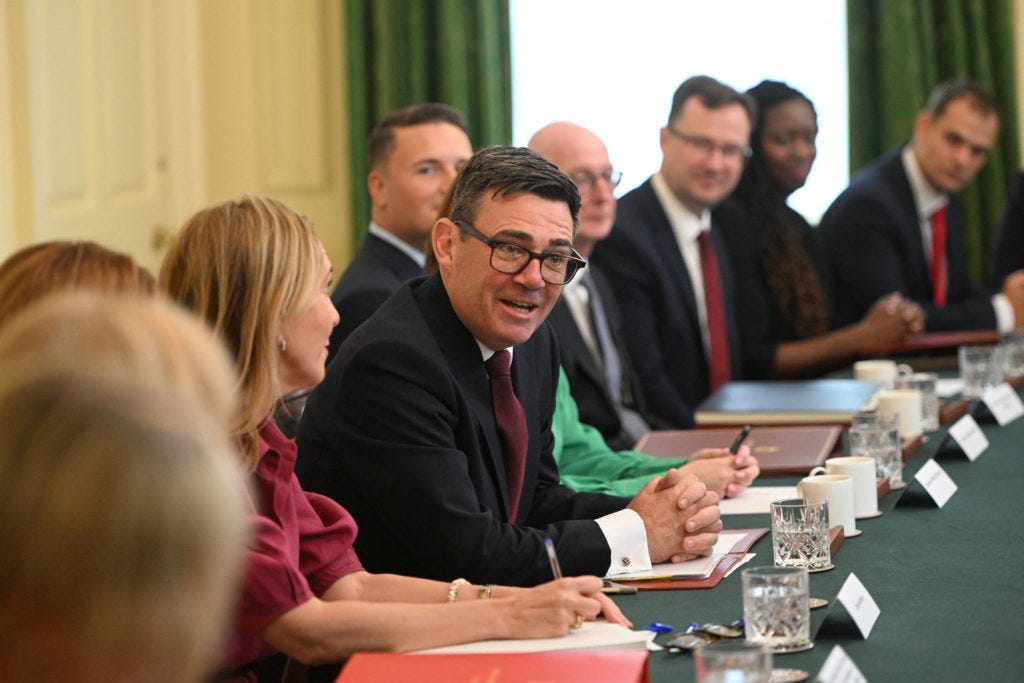
With the United Kingdom’s sixth Prime Minister in seven years kissing hands on Monday and beginning to construct a checks notes “new political model and a new economic model”, not to mention the “new economy where we put life’s essentials back under stronger public control to make them affordable to you again”, I thought it was worth a few pensées about the new régime and what we might expect from it.
The phraseology of the constitution still insists that a Prime Minister “kisses hands” when the monarch invites him or her to form an administration after a general election or a change in the leadership of the governing party. It is not a literal description of the encounter but it remains in use. The Court Circular for Monday stated:
His Majesty received in audience the Rt Hon Andrew Burnham MP and requested him to form a new Administration. The Rt Hon Andrew Burnham MP accepted The King’s offer and kissed hands upon his appointment as Prime Minister and First Lord of the Treasury.
There was more osculation the following day, when His Majesty The King held a meeting of the Privy Council at Buckingham Palace.
There were present: the Rt. Hon. Sir Alan Campbell MP (Acting Lord President), the Rt. Hon. Andrew Burnham MP (Prime Minister), the Rt. Hon. John Healey MP, the Rt. Hon. Edward Miliband MP, the Rt. Hon. Louise Haigh MP, the Rt. Hon. Yvette Cooper MP, the Rt. Hon. Angela Rayner MP, the Rt. Hon. Jonathan Reynolds MP, the Rt. Hon. Lucy Powell MP, the Rt. Hon. Lisa Nandy MP and the Rt. Hon. Wesley Streeting MP.
Mr. Alexander Norris MP, Dame Angela Eagle MP, Ms. Miatta Fahnbulleh MP, the Hon. Stephen Kinnock MP, Sir Christopher Bryant MP, Ms. Anneliese Midgley MP, Mr. Kanishka Narayan MP, Mr. Matthew Pennycook MP and Mr. Hamish Falconer MP were sworn in or made affirmation as members of His Majesty’s Most Honourable Privy Council.
The King declared in Council the Rt. Hon. Sir Alan Campbell MP Lord President of the Council, who was sworn and kissed hands on his appointment.
The Rt. Hon. Andrew Burnham MP was sworn First Lord of the Treasury.
The following took the Oath of Office or made affirmation, kissed hands upon appointment and received the Seals of Office: the Rt. Hon. John Healey MP (as Chancellor of the Exchequer), the Rt. Hon. Edward Miliband MP (as Secretary of State for Foreign, Commonwealth and Development Affairs), the Rt. Hon. Louise Haigh MP (as First Secretary of State), the Rt. Hon. Yvette Cooper MP (as Secretary of State for Health and Social Care), the Rt. Hon. Angela Rayner MP (as Secretary of State for Housing, Communities and Local Government), the Rt. Hon. Jonathan Reynolds MP (as Secretary of State for Business, Innovation, Science and Trade), the Rt. Hon. Lucy Powell MP (as Secretary of State for Education), the Rt. Hon. Lisa Nandy MP (as Secretary of State for Digital, Culture, Media and Sport), the Rt. Hon. Wesley Streeting MP (as Secretary of State for Defence), the Rt. Hon. Alexander Norris MP (as Lord High Chancellor of Great Britain and Secretary of State for Justice), the Rt. Hon. Dame Angela Eagle MP (as Secretary of State for Environment, Food and Rural Affairs), the Rt. Hon. Miatta Fahnbulleh MP (as Secretary of State for Energy Security and Net Zero), the Rt. Hon. Stephen Kinnock MP (as Secretary of State for Wales) and the Rt. Hon. Sir Christopher Bryant MP (as Secretary of State for Northern Ireland).
Two things were happening here. Those members of the new Cabinet who were not already Privy Counsellors—as all Cabinet members must be, because the Cabinet is technically nothing more than a sub-committee of the Privy Council—were being appointed as “members of His Majesty’s Most Honourable Privy Council”, upon which they kiss hands. That done, all ministers moving to new positions were taking their oaths of office and receiving their seals of office; this process of appointment also involves kissing hands.
Not all of this this actually involves kissing the sovereign’s hand. Broadly, new Privy Counsellors do kneel after they have taken the statutory Oath of Allegiance, and take the King’s hand as a vestige of mediaeval demonstrations of homage: the King will offer his right hand, palm downwards and fingers closed, which the new Privy Counsellor will take in his or her right hand and touch or brush it with the lips. He or she then stands, takes the non-statutory Privy Counsellor’s oath and shakes hands with the King.
Although it is described as such, and is perhaps the most prominent usage of the phrase, a new Prime Minister does not even perform the ritualistic kissing of hands when he is invited to form a government (though he does when sworn in as First Lord of the Treasury). It seems to be the case that practice varies when other ministers take their oaths of office: some seem literally to have kissed (or brushed) the sovereign’s hand with their lips, other did not.
The actual kissing of hands by Prime Ministers seems to have died out in Edward VII’s short reign. When A.J. Balfour resigned in December 1905 to force the opposition Liberals to take office, their leader in the House of Commons, Sir Henry Campbell-Bannerman (“CB”), was invited by the King to form an administration, but the encounter was fraught and awkward. Margot Asquith, wife of H.H. Asquith who was to take office as Chancellor of the Exchequer and succeed Campbell-Bannerman as Prime Minister in 1908, recorded the meeting in her diary.
Knowing that he ought to kneel and kiss hands, CB advanced and waited but the King interrupted by some commonplace remark; when he had finished speaking, CB again advanced meaning to kneel, but the King only wrung his hand, at which he felt the interview was over, as have had another try would have been grotesque. He retired… to Lord Knollys’s room and told him he feared he had never kissed hands at all, to which Lord Knollys replied that it did not matter, as he would see that it was properly published… next day.
Lord Knollys was Private Secretary to the Sovereign from 1901 to 1913. When Campbell-Bannerman resigned in April 1908, his health rapidly deteriorating, Asquith was the unopposed choice to succeed him, but the King was on holiday in France. Asquith therefore travelled alone and incognito to Biarritz, where he was appointed Prime Minister on 8 April 1908 in Edward VII’s room at the Hôtel du Palais. He related to his wife that he had “knelt down and kissed [the King’s] hand”, making no reference to a purely symbolic gesture, so presumably he did indeed kiss Edward VII’s hand.
(Viscount Esher, a courtier, favourite of Edward VII and what I shall call in a family essay a decidedly rum cove, would occasionally kiss the King’s hand as a spontaneous gesture of fealty. It is unlikely that Edward VII regarded this with great enthusiasm.)
The sharp-eyed among you may have noticed that former Transport Secretary Louise Haigh, a close ally of the new Prime Minister, has returned to Cabinet following her resignation in November 2024, after just four-and-a-half months in Sir Keir Starmer’s government. She had failed to disclose a fraud conviction over an allegedly stolen mobile phone in 2014. After her resignation, she began to stake out positions on same “soft left” section of the party as that to which Burnham seemed most directly to appeal, revitalised the Tribune Group of Labour MPs and eventually oversaw Burnham’s by-election campaign in Makersfield.
Haigh is now regarded as one of Burnham’s inner circle, and has rejoined the government as First Secretary of State, Chancellor of the Duchy of Lancaster and Minister for the Cabinet Office. Essentially she will perform a kind of consigliere or special representative role for the Prime Minister, chasing progress, co-ordinating discussions, managing the political aspects of the Cabinet committee system and acting as an honest broker across Whitehall. Viscount Whitelaw perfected this status alongside Margaret Thatcher to such an extent that she declared “every prime need a Willie”.
It is a role most prime minsters think they need to fill. Whitelaw and Thatcher were perfectly suited—something which could not necessarily have been predicted—and John Major found Michael Heseltine a source of strength and support after he appointed the latter First Secretary of State and Deputy Prime Minister in July 1995. David Lidington was a surprisingly effective “fixer” for the last 18 months of Theresa May’s premiership. Sir Keir Starmer relied first on Pat McFadden (whom I profiled in The Critic) and then on Darren Jones in the new position, now abandoned, of Chief Secretary to the Prime Minister.
But why, you ask, does Haigh have so many titles? Follow the money. In any Cabinet you will have at least two jobs which must be done but which do not attract a salary: Leader of the House of Commons and Leader of the House of Lords. Before the Second World War, the Prime Minister would be Leader of whichever House he sat in, while the leadership of other House would often go to a senior departmental minister: Marquess Curzon of Kedleston was Leader of the Lords and Foreign Secretary from 1919 to 1924, Viscount Hailsham, Leader of the House of Lords 1931-35, was also Secretary of State for War. After the Second World War, however, it became accepted that each role was full-time and should generally no longer be combined with a full ministerial portfolio.
Happily, the Ministerial and other Salaries Act 1975 provides no fewer than four paid sinecures, that is, positions for which a salary can be paid but to which few or no formal duties attach. These are Lord President of the Council, Lord Privy Seal, Chancellor of the Duchy of Lancaster and Paymaster General. In the general run of things, the Lord President of the Council and the Lord Privy Seal will be the Leaders of the two Houses, leaving two other sinecures to which duties can be attached as the Prime Minister wishes.
Since 1997, the Chancellor of the Duchy of Lancaster has more often than not been Minister for the Cabinet Office. Formally the senior minister in the Cabinet Office is the Prime Minister, but frequently now it is regarded as useful for the Prime Minister’s Whitehall fixer to hold a(n unpaid) ministerial position in the Cabinet Office combined with a sinecure so that he or she need not work for free.
But Haigh is also “First Secretary of State”. This title was invented for Rab Butler in July 1962 to assuage his feelings at being moved from a great office of state, Home Secretary, to essentially a free-floating non-departmental minster with only the small Central Africa Department under his control. As “First” Secretary of State it acknowledged his seniority in the government, and placated the Royal Household which at that time would not countenance a formal usage of “Deputy Prime Minister”.
Haigh is the 12th person to be granted the title First Secretary of State: George Brown (1964-66), Michael Stewart (1966-68), Barbara Castle (1968-70), Michael Heseltine (1995-97), John Prescott (2001-07), Lord Mandelson (2009-10), William Hague (2010-15), George Osborne (2015-16), Damian Green (2017) and Dominic Raab (2019-21). It has no function except to bestow status, and there are other ways of doing that; and it is also unpaid, which is why every holder of the title, excepting the self-made multimillionaire Heseltine. The Cabinet Manual says:
A minister may be appointed First Secretary of State to indicate seniority. The appointment may be held with another office. The responsibilities of the First Secretary of State will vary according to the circumstances.
One should, of course, remember that in general terms any statutory powers or duties bestowed on “the secretary of state” can be exercised by any secretary of state, the constitutional theory being that it is one office, His Majesty’s Principal Secretary of State, subdivided among as many ministers as deemed necessary (excepting Haigh, there are currently 16 secretaries of state). In fact it was first divided in 1540, which I think even Whitehall must regard as relatively established usage.
We have not quite reached the Pooh-Bah levels of the late Brown government, when Lord Mandelson was First Secretary of State, Lord President of the Council, Secretary of State for Business, Innovation and Skills and President of the Board of Trade, with 36 eatss old. Each of Haigh’s titles has a purpose: First Secretary of Stake affords her status, Chancellor of the Duchy of Lancaster provides a salary and Minister for the Cabinet Office gives executive power and a degree of definition.
There is one other observation worth making. Louise Haigh is not Deputy Prime Minister, though in practice she may well emerge as the second most senior minister of Burnham’s administration. Burnham has chosen not to use the title of Deputy Prime Minister, and there is no obligation on him to do so. Indeed, until the 1980s it was very rarely used, its legitimacy and constitutional propriety often contested, and scholars of government today cannot even agree how many people have held the title. The minimalist list is: Clement Attlee (1942-45), Michael Heseltine (1995-97), John Prescott (1997-2007), Nick Clegg (2010-15), Dominic Raab (2021-22, 2022-23), Dr Thérèse Coffey (2022), Oliver Dowden (2023-24), Angela Rayner (2024-25) and David Lammy (2025-26).
Herbert Morrison was Attlee’s more-or-less recognised deputy when he was Lord President of the Council 1945-1951 and Foreign Secretary 1951, and also Deputy Leader of the Labour Party. But it was a Cabinet of huge, experienced characters who were unlikely to yield to pressure: Ernest Bevin, Hugh Dalton, Sir Stafford Cripps, Harold Wilo]sohet
Willie Whitelaw, Home Secretary 1979-83 and Lord President of the Council 1983-88, was one of the most effective and influential, but was never formally in usage; he was, however, Deputy Leader of the Conservative and Unionist Party from 1975 to 1991. Of Sir Geoffrey Howe, Lord President of the Council 1989-90), it was said he “will act as Deputy Prime Minister” rather than occupying the spot.
The Labour Party has an additional factor in that it has an established position of Deputy Leader, unlike the Conservative Party. When Labour is in power, its Deputy Leader is not automatically made DPM. Indeed, of the 15 holders pff the title since the Second World War, only two have formally been named Deputy Prime Minister, Prescoi (1997-07) and Rayner (2024-25). Some held no front bench office at all, like George Brown from 1968 to 1970 and Lucy Powell from last September till now. Equally, any Prime Minister is entitled to grant offices may as he sees fit; David Lammy was Deputy Prime Minister from last September until this week.
Lucy Powell had quite a time of it last autumn. When Angela Rayner was forced to resign at the beginning of September, Sir Keir Starmer decided to use the opportunity to make wider changes to his Cabinet. One was the dismissal of Powell as Leader of the House of Commons, a position she’d held since the formation of the government in July 2024 and shadowed since September 2023. Her performance had been patchy: clumsy and avoidable errors like claiming the spending cuts in the Budget in October 2024 had been necessary to avoid a run on the pound, and dismissing references to rape gangs as a cynical “dog whistle”, had cost unnecessary political capital and caused Starmer to consider her future in Cabinet.
Powell’s sacking, however, coincided with Rayner’s resignation as Deputy Leader of the Labour Party; within days, Powell let it be known she was considering standing for the position and had been semi-endorsed by Burnham who said the successful candidate should be “someone from these parts”, that is, the North West. That most obviously pointed to Powell, MP for Manchester Central, born in Moss Side and educated in Didsbury and Rusholme. Early in her career, she had also worked for Baroness Hughes of Stretford, who was then MP for Stretford and Urmston and went on to be a minister under Blair and Brown then Burnham’s Deputy Mayor for Crime and Policing from 2017 to 2023.
The election for Deputy Leader boiled down to a choice between Powell and Bridget Phillipson, the Education Secretary. Despite a career punctuated by errors, verbal hostages to fortunes, brittle defensiveness and an occasional ability to speak nonsense, Powell won the contest 54-46, having pitched herself both as a unifier and as a shop steward for party members because, unlike Phillipson, she was not a member of the government.1
With her patron Burnham now in Downing Street, Powell finds herself, with a certain irony, replacing Phillipson as Education Secretary (though in fairness she was Shadow Education Secretary in Corbyn’s first Shadow Cabinet in 2015-16 and had previously been Shadow Minister for Childcare and Early Years 2013-14). She remains Deputy Leader of the Labour Party, but she has not been named Deputy Prime Minister (the titled was denied to Harriet Harman under Gordon Brown between 2007 and 2010, she she was extremely offended by the omission).
Until the last few years, it would have been hard to imagine the Deputy Prime Minister also being in charge of an “ordinary” Whitehall department. Excepting the first 18 months of Clement Attlee’s tenure, when he was also Secretary of State for Dominion Affairs, the Deputy Prime Minister tended to have broader supra-departmental responsibilities. Attlee became Lord President of the Council in September 1943 and chaired the Lord President’s Committee, a Cabinet committee to which was devolved many of the issues of normal peacetime domestic politics like economic affairs, industry, trade and export and social policy. It was maintained until 1951, for most of the post-war Labour government under Herbert Morrison as Lord President of the Council. Morrison was not formally styled Deputy Prime Minister but had many of the attributes and responsibilities of the role.
Michael Heseltine, Deputy Prime Minister from 1995 to 1997, had no departmental duties; he chaired four Cabinet committees, including on the Coordination and Presentation of Government Policy (EDCP), which met every weekday at 8.30 am, and could attend any Cabinet committee he chose. He also had cross-government supervision of “competitiveness”, most of which lay with his previous ministry, the Department of Trade and Industry, but his successor, the silky-smooth Cambridge Footlights alumnus Ian Lang, understood the pointlessness of turf wars and amour propre.
John Prescott, the longest-serving Deputy Prime Minister from 1997 to 2007, used the role in a variety of ways. For the first four years of the Labour government, he was in charge of a super-ministry as Secretary of State for the Environment, Transport and the Regions (DETR); this merged the Department of the Environment, the Department for Transport and parts of the Department of Trade and Industry dealing with regional development. In acknowledgement of the new department’s size—though in truth it was very similar to the original, Heath-era Department of the Environment set up under Peter Walker in 1970—Prescott had two senior “junior” ministers: Gavin Strang became Minister of State for Transport with a seat in the Cabinet, while Michael Meacher was Minister of State for the Environment and would attend Cabinet when matters within his portfolio were discussed.
After the 2001 general election, DETR was broken up again: the environmental responsibilities were combined with the Ministry of Agriculture, Fisheries and Food to form the new Department for Environment, Food and Rural Affairs and the remainder became the Department for Transport, Local Government and the Regions, both with their own secretaries of state. Prescott was named First Secretary of State as well as Deputy Prime Minister, but in terms of direct executive responsibility he was left with only the Office of the Deputy Prime Minister (ODPM), based within the Cabinet Office. In a Written Answer, Prescott set out:
I will oversee the work of the Social Exclusion Unit, which reports to the Prime Minister through me. I am also responsible for the Regional Co-ordination Unit and the nine Government offices of the Regions… In addition, I will chair new Cabinet Committees on Domestic Affairs and on Nations and the Regions; and new sub-Committees on Social Exclusion and Regeneration and on Energy Policy. I will continue to chair the Committee on the Environment. The Minister of State in the Deputy Prime Minister's Office [Barbara Roche] … [will] oversee the work of the Regional Co-ordination Unit and the Government Offices in the Regions, reporting to me on the development of their role and on the work of the regional network of the COI. She will lead on projects arising out of the work of the Social Exclusion Unit, be responsible for the work of the Business Co-ordination Unit, and will be sponsor Minister for a number of PIU projects… the Chancellor of Duchy of Lancaster [Lord Macdonald of Tradeston]… has day-to-day responsibility for the work of the Delivery Unit, which supports the Prime Minister on matters to do with the delivery of public services. He will work closely with me as appropriate on related cross-cutting issues covered by the Cabinet Committees under my chairmanship. He is also responsible for the work of the Regulatory Impact Unit; and the e-envoy’s unit’s work on e-government.
This was a more traditional supervisory and coordinating role, with the formalisation of ODPM feeling like a consolation for the loss of the “super-ministry” DETR.
In May 2002, however, the Department for Transport, Local Government and the Regions was broken up, (re)creating a stand-alone Department for Transport and moving responsibility for local government and regional policy into ODPM, which was taken out of the Cabinet Office and made a separate department. Prescott was named Secretary of State for Local Government and the Regions, but as head of ODPM rather than there being a full corresponding department. In May 2006, at a Cabinet reshuffle, ODPM was transformed into the Department for Communities and Local Government, with its own Secretary of State (initially Ruth Kelly). Prescott was left merely as First Secretary of State and Deputy Prime Minister, with duties standing in for the Prime Minister when necessary and playing his part in the system of Cabinet committees. It was reported that this slimming-down of duties came at Prescott’s request, following revelations that he had had an affair with an assistant private secretary in his office, Tracey Temple. Prescott was also approaching 68 and had, like Blair, been in office for nine years. He retired from Cabinet at the same time as Blair stepped down, in June 2007.
Regarding Nick Clegg as sui generis as Deputy Prime Minister in the Conservative/Liberal Democrat coalition government from 2010 to 2015, all the DPMs since then have also had departmental responsibilities (admittedly Dowden only in a relatively minor way as head of the Cabinet Office). Dominic Raab (2021-22, 2022-23) was Secretary of State for Justice and Lord High Chancellor, Dr Thérèse Coffey (2022) Health and Social Care Secretary, Angela Rayner (2024-25) was Housing, Communities and Local Government Secretary and David Lammy (2025-26) was Justice Secretary. None was oustandingly successful in the role of Deputy Prime Minister, whether through personal shortcomings, difficult relationships with the Prime Minister or the shadow of encroaching ambition. Coffey genuinely did enjoy a very close relationship with the Prime Minister, but Liz Truss’s 49 days in office make it impossible to draw any conclusions about how the relationship between the two would have played out.
There seems to be a problem in the Deputy Prime Minister also heading a “mainstream” department: it could be interpreted as privileging that department and therefore its policy area above others. In spending rounds, for example, can a Secretary of State who is also Deputy Prime Minister honestly say her or she has exactly the same experience as any other departmental chief in negotiating with the Chancellor of the Exchequer and the Chief Secretary to the Treasury, or do they receive slightly different treatment—better or worse?
There is also the basic logic of time. If running a Whitehall department is a demanding, stressful full-time job—and it is—then how much time and energy can be devoted to the role of Deputy Prime Minister, and to what end? It would be difficult to identify occasions on which Rayner or Lammy had made a real difference to the way the government was run in that specific role. The same mostly hold true for Raab; he was important if only as a contingency plan when Boris Johnson was moved to intensive care while suffering from Covid-19 in April 2000, as there were genuine fears the Prime Minister might die., but at that point he was not officially Deputy Prime Minister, only First Secretary of State and Foreign Secretary.
It was becoming almost invariable practice over the last 10 years to appoint a Deputy Prime Minister, almost as if it was believed to be an obligation. It isn’t and shouldn’t be regarded as one. I examined this in an essay on Oliver Dowden’s appointment. Essentially my conclusion was that a Deputy Prime Minister can be useful if they have a clear role and a close relationship with the Prime Minister. If they don’t, you merely create an alternative centre of power and increase the potential for internal divisions. I cannot read Andy Burnham’s mind but my guess is that Louise Haigh will perform most of the tasks usually expected of a Deputy Prime Minister—though how much time she sp ends in Manchester at No 10 North remains to be seen—but Burnham realised that giving her the formal title bestowed little added value and only risked tension with Lucy Powell as elected Deputy Leader of the Labour Party. Powell, as a close ally, will probably have more clout and more reach than most departmental ministers, but the Department for Education will likely consume most of her energy. The three may form a powerful and close-knit trinity (I could hardly say triumvirate), but that kind of closeness without friction is rare in politics.
Just for the record, Andy Burnham is 56; Lucy Powell is 51; Louise Haigh has just celebrated her 39th birthday.
Ed Miliband’s appointment as Foreign Secretary on Monday means that both he and his elder brother David Miliband (2007-10) have held the post. However, this is not, as you may have supposed, a unique occurrence. The 1st Marquess Wellesley, Sir Richard Wellesley, was Foreign Secretary from December 1809 to March 1812, almost all of the premiership of the ill-fated Spencer Perceval, the only British Prime Minister to die at the hands of an assassin. Later on, from November 1834 to April 1835, the Foreign Secretary was Field Marshal The 1st Duke of Wellington, Sir Arthur Wellesley, who served for three weeks in his own caretaker ministry in which he was Prime Minister, Leader of the House of Lords and Secretary of State tout court, acting as Foreign Secretary, Home Secretary and Secretary of State for War and the Colonies. King George IV has asked the Duke to be Prime Minister for the second time (after 1828-30), but Wellington refused and recommended instead Sir Robert Peel, Tory leader, twice Home Secretary and creator of the Metropolitan Police.
Peel was on holiday in Rome and had to be summoned back. Once he was in London, he appointed a full-time administration, but Wellington agreed to remain as Foreign Secretary and Leader of the House of Lords. Having improved its electoral standing in the general election of December 1834 but still far short of the Whigs in terms of seats, Peel’s party—now rebranded the Conservative Party along the lines of his “Tamworth Manifesto”—was unable to form a sustainable government and resigned when it was defeated on a resolution on Church of Ireland finances on 7 April 1835.
As was noted at the time, when the Miliband brothers sat together in Cabinet between 2007 and 2010 (David as Foreign Secretary, Ed as Chancellor of the Duchy of Lancaster 2007-08 then Energy and Climate Change Secretary 2008-10), it was an unusual but not unique feat.
From May to October 1938, Lord Stanley was Dominions Secretary alongside his brother Oliver Stanley (President of the Board of Trade 1937-40).
The 4th Marquess of Salisbury was Lord President of the Council 1922-24 and Lord Privy Seal 1924-29 while his brother Viscount Cecil of Chelwood was Lord Privy Seal 1923-24 and Chancellor of the Duchy of Lancaster 1924-27.
Sir Austen Chamberlain was Foreign Secretary 1924-29 while his half-brother Neville Chamberlain was Minister of Health. (Austen had also served in Cabinet with his father Joseph Chamberlain, Colonial Secretary 1895-1903, when he was Postmaster General 1902-30.)
Sir Eric Geddes was Minister without Portfolio January-May 1919 and Minister of Transport 1919-21 when his younger brother Sir Auckland Geddes was President of the Board of Trade 1919-20.
A.J. Balfour was First Lord of the Treasury 1900-05 and Prime Minister 1902-05 when his brother Gerald Balfour was President of the Board of Trade 1900-05 and President of the Local Government Board.
The 1st Duke of Wellington was Master-General of the Ordnance 1819-27 while his elder brother William Wellesley-Pole (Lord Maryborough from 1821) was Master of the Mint 1814-23.
Richard Ryder served as Home Secretary 1809-12 at the same time as his elder brother the 1st Earl of Harrowby was Minister without Portfolio 1809-12.
When Lord Grenville was Prime Minister 1806-07, his brother Thomas Grenville was President of the Board of Control July-October 1806 and First Lord of the Admiralty 1806-7.
When William Pitt the Younger was Prime Minister 1783-1801 and 1804-06, his elder brother the 2nd Earl of Chatham was First Lord of the Admiralty 1788-94, Lord Privy Seal 1794-98, Lord President of the Council 1796-1801 and Master-General of the Ordnance 1801-06.
In March 2020, Boris Johnson persuaded Sir Gerry Grimstone, Chairman of Standard Life and Group Deputy Chairman of Barclays plc, to join the government: he would be nominated for a peerage and appointed as a minister of state sitting across the Departments of International Trade and Business, Energy and Industrial Strategy and bear the title of Minister for Investment. In addition, he would have responsibility for the Office for Investment in 10 Downing Street.
Grimstone has a formidable reputation in international finance, and the Conservatives no doubt hoped to co-opt that; but they also hoped to harness his abilities. He oversaw a series of sovereign investment partnerships with the UAE and Saudi Arabia, organised the first Global Investment Summit in 2021 and was responsible, by one estimate, for an additional £50 billion of foreign investment in the UK. Grimstone stepped down to return to the private sector in July 2022 as Boris Johnson’s premiership imploded.
The post of Minister for Investment was somehow set apart from others. Although occupants were not free of party affiliation, it has a technocratic element to it, and there was a tacit understanding that a successful and senior figure from the business world might come in for a set period of time, almost as a matter of duty and inevitably at some immediate personal financial cost, then return to the private sector after a few years. It has not proven an iron law but a reasonable rule of thumb.
The leadership ructions in the Conservative Party meant that there was no Minister for Investment from July to October 2022, when an already-beleaguered Liz Truss chose financier Dominic Johnson, who was co-founder with Sir Jacob Rees-Mogg of Somerset Capital Management, for the job. Unlike Grimstone, he was a minister of state jointly at the Department for International Trade and at the Cabinet Office. Lord Johnson of Lainston, as he had become, was then removed 26 days later when Rishi Sunak became Prime Minister; but Sunak then reappointed him four weeks later. He served until the general election in 2024.
Sir Keir Starmer struggled initially to appoint a Minster for Investment and the post lay empty for more than three months. It was reported that Benjamin Wegg-Prosser, co-founder with Peter Mandelson of advisory firm Global Counsel, turned down the position. Eventually, four days before a much-heralded investment summit in October 2024, Poppy Gustafsson, former CEO of AI cybersecurity business Darktrace, was unveiled as the new Minister for Investment, this time straddling the Department for Business and Trade and HM Treasury.
Baroness Gustafsson was in post for 11 months before stepping down during Starmer’s wider reshuffle in September 2025. It was reported that she had never felt comfortable in the role, that she lacked a strong relationship with Number 10, that she had been boxed in and allowed only to take on relatively minor tasks, that she disliked Parliament. Certainly her public profile was low and she effectively abandoned LinkedIn, which she had previously used frequently.
Jason Stockwood, formerly Managing Director of Travelocity and Match.com then CEO of digital insurance broker Simply Business, was ennobled and appointed as Gustafsson’s replacement, again jointly between DBT and HM Treasury. He had been the Labour Party candidate in May 2025’s election for Mayor of Greater Lincolnshire, trailing third behind Reform UK winner Dame Andrea Jenkyns and Conservative candidate Rob Waltham with only 12 per cent of the vote. Stockwood had considerable experience in investment, and was outwardly bullish about his role, talking enthusiastically about the government’s Modern Industrial Strategy. However, as Andy Burnham made ministerial appointments last week, it was announced that Stockwood was leaving government, and his LinkedIn page disappeared.
With the creation of the new Department for Business, Innovation, Science and Trade underway, six dedicated or shared ministers have been appointed under Jonathan Reynolds as Secretary of State, and it seems that there will no longer be a designated minister for investment: Kanishka Narayan, serving jointly at the Cabinet Office, is Minister for Artificial Intelligence; Anas Sarwar, the Scottish Labour leader who will shortly be given a peerage, will be Minister for Trade; Chris McDonald is Minister for Industry; Kate Dearden is responsible for the future of work. With two Parliamentary Under-Secretaries of State, Blair McDougall and Lord Leong, there seems to be no spare capacity for the investment portfolio.
Labour has struggled with the role of Minister for Investment. Sir Keir Starmer should not have left Baroness Gustafsson’s appointment take so long given the importance he and the Chancellor of the Exchequer, Rachel Reeves, placed on the International Investment Summit; perhaps Starmer waited too long hoping that Wegg-Prosser would accept the job (though given his business partnership with Lord Mandelson and the closure of Global Counsel in light of later events, that may have been a bullet dodged). Equally, whether it was foreseeable or not, Gustafsson seems not to have been a good fit for the job. That put Starmer’s administration forever on the back foot.
If it is the case that Andy Burnham has scrapped the role of Minister of Investment, that will say something about his approach to economic, trade and industrial policy. As I wrote last week, his language and narrative in these areas is extremely conservative, talking about “re-industrialisation” and regarding the whole direction of Britain’s economic development since 1980 as mistaken and an exercise in “failed neoliberalism”. His beau idéal seems to be an utopian, never-was version of the 1970s, with the private sector kept in check by government and trades unions: prosperity is somehow uniformly distributed (does any country in the world have completely equal wealth distribution?), and a self-important, superficial, occasionally magic bean-selling London set is matched by a shrewd, commonsensical, deeply rooted Northern sensibility, founded on making things.
His priorities and what we can think of as his policy comfort zone were clearly set out when he made his first speech after being confirmed as Leader of the Labour Party on 17 July:
This Labour movement, the Trade Union movement, was forged in the steel works and iron works of Sheffield, Scunthorpe, Port Talbot and Teesside. In the coalfields of South Wales, Central Scotland, Nottinghamshire, Derbyshire, Yorkshire and Lancashire. In the mills across the Pennines, west and east. In the shipyards on the Clyde and the Tyne. And in the dockyards of Liverpool and here in London. The people of these proud places made Labour.
With the exception of shipbuilding on the Clyde, where BAE Systems retains significant facilities at Govan and Scotstoun, these industries are all defunct or dying. The current government has spent more than £1 billion on subsidies and assistance to the steel industry in Port Talbot and Scunthorpe, and the recent Steel Industry (Nationalisation) Act 2026 took British Steel, which owns the Scunthorpe facility, into public ownership; but there is no clear indication of how nationalised British Steel will operate more efficiently or profitably than it did under the ownership of Chinese giant Jingye Steel.
It may only have been five years ago, but the days of Lord Grimstone flying around Gulf states negotiation with sovereign wealth funds seem far distant from Burnham and his “Manchesterism” as translated into national policy. The new Prime Minister has provided few detailed or concrete plans yet, which can leave commentators engaging in political haruspicy, with speeches and interviews standing in for the sacrificed animals. The decision—if one has been taken—to discontinue the post of Minister for Investment, however imperfect it was, may say much about the new administrations’s view on the global economy and the UK’s place in it.
Machinery of government changes can be much less important and influential than Prime Ministers think, and the disruption and cost which inevitably accompany them are often, conversely, underestimated; the merger of the Foreign and Commonwealth Office and the Department for International Development in 2020, while I think it was the right thing to do in terms of policy and delivery, is estimated to have cost £25 million in direct terms, and perhaps very much more in indirect costs. Meanwhile, since the Department of Trade and Industry was created in 1970 as one of Edward Heath’s “super-ministries”, its responsibilities have been shuffled and its name changed 13 times including last week’s reorganisation into the Department for Business, Innovation, Science and Trade.
(This includes its rebranding in May 2005 as the Department for Productivity, Energy and Industry. Some stakeholders were worried about the disappearance of the word “trade”, some pointed out that DPEI would likely be mangled to “Dippy”, while the new Secretary of State, the deeply sensible, shrewd and down-to-earth Alan Johnson, refused to become Productivity, Energy and Industry Secretary because it spelled “PEnIS”. The change of name was rescinded within a week, and had cost between £30,000 and £40,000.)
Equally, while it is wounding to individual egos to think so, choices of ministerial personnel often make little or no difference to a government’s or even a department’s direction of travel. Burnham’s choice of John Healey as Chancellor of the Exchequer rather than Ed Miliband or Shabana Mahmood is a significant one, but that is likely to be an exception. It is difficult to imagine that Dame Angela Eagle’s leadership of the Department for Environment, Food and Rural Affairs will mark a dramatic departure from that of Emma Reynolds (as it happens, both are Oxford PPE graduates, both were elected to the House of Commons—Reynolds for her second time—by defeating incumbent ministers, both have been junior Treasury ministers and both have been pensions ministers). Change tends to be most noticeable when the incoming or outgoing minister is extremely good or extremely bad.
That notwithstanding, given how early on in Burnham’s premiership it is, we are entitled to examine what signs are available. In terms of the area of business, trade and science, the dismissal of Peter Kyle, Business and Trade Secretary, and Liz Kendall, Science, Innovation and Technology Secretary, and the appointment of Jonathan Reynolds as Business, Innovation, Science and Trade Secretary does seem to indicate a more enthusiastic embrace of state intervention and attempted activism in the economy, and the continuation of the retrospective industrial nostalgia I’ve written about and criticised again and again and again and again.
Equally, the departure of the previous Attorney General for England and Wales, Lord Hermer, Sir Keir Starmer’s own ECHR-compliant Jiminy Cricket, will almost certain quieten some of the more obsessive and slavish, performative obedience of the nebulous, quicksilver niceties of international law. His replacement by Ellie Reeves, younger sister of the departing Chancellor of the Exchequer and previously Chair of the Labour Party (2024-25) and Solicitor General for England and Wales (2025-26), may not shake the legal world; Reeves was a trades union and unemployment rights barrister for less than 15 years and only became King’s Counsel before of her political role as law offcer. Nevertheless, she represents the absence of Hermer just as importantly as any other factor.
It was never easy to characterise the Starmer government, perhaps because Starmer so fundamentally lacked a coherent vision for the country. There are clearer clues as to Burnham’s general direction in the formation of his government and appointment of ministers: more dirigiste still than Starmer and Reeves, and less inclined to disguise that fact; an even stronger certainty that the state is the primary engine of prosperity and that a government is only “at the mercy “ of private wealth if it lacks political will or a clear purpose; a very strong conviction that relative as well as absolute economic inequality is corrosive, can be blamed on the governments of the past 40 years (including those in which Burnham uncomplainingly served) and is due in no small part to London and the South-East “unfairly” dominating the economy.
There may still be a long way to go. The latest date on which the next general election must be held in 15 August 2029, more than three years away, although it is very unlikely it will be that late. At the moment, we have snapshots, whispers, glimpses of the beginnings of the Burnham government. But they are worth keeping in mind.
At the general election in 2010, she failed by 1,850 to dislodge Liberal Democrat John Leech in Manchester Withington, experiencing a marginal swing away from Labour; she was acting Chief of Staff then Deputy Chief of Staff to Ed Miliband as Leader of the Opposition 2010-12, when Labour established then largely lost a modest polling lead over the Conservatives; when Miliband’s key policies were carved into what became known as the “EdStone”, she nonsensically responded “I don’t think anyone is suggesting that the fact that he’s carved them into stone means that he is absolutely not going to break them or anything like that”; she was responsible for Miliband’s disastrously awkward interview with comedian Russell Brand just before the 2015 general election; she resigned from Jeremy Corbyn’s Shadow Cabinet in the mass exodus of June 2016 but when the general election the following year resulted in a hung Parliament and a respectable performance by Labour she quickly declared, “We did get it wrong on Jeremy Corbyn. I’m really glad that we got it wrong”; ahead of the Gorton and Denton by-election in February 2026, she described Reform UK as “poison and cancer”, phraseology which colleagues were strikingly reluctant to repeat; last month she overreacted to media speculation about the personnel in a potential Burnham government as “horrible”, “unedifying”, “tittle-tattle”, while also promoting the candidacy of her former boss Ed Miliband as Chancellor of the Exchequer; and having demanded a general election when Liz Truss became Prime Minister in September 2022, she argued it was not necessary for Burnham to seek a fresh mandate because “what people need to see now is us getting on with the job, delivering on the manifesto we were elected on only two years ago” and “we live in a parliamentary democracy where the prime minister is chosen by MPs”.
No posts
Comments
Nothing yet. Say the first thing.
Sign in to join the conversation.