
This investigation took months to produce. If you value this kind of reporting, you can support me by becoming a paid subscriber. Thank you.
Editor’s note: Updates to add comment from NCIS agent Mike Garzon, who appeared on the SpyCast podcast after publication on July 7 to discuss the Pedicini case.
On a morning in May 2023, Chief Petty Officer Bryce Pedicini did something he had never done in 15 years of naval service: he walked into a classified space aboard the USS Higgins with his personal phone. What he did next would get him arrested and convicted of attempted espionage and sentenced to 18 years in prison. What he says he was trying to do is considerably more complicated.
Pedicini gave me the first interview he has ever given about his case. I met him one morning in February at the Naval Consolidated Brig at Miramar in San Diego, the Navy’s confinement facility for the entire Southwest region. Wearing a brown T-shirt and a khaki jail-issued uniform, with square glasses perched on his nose, Pedicini, 36, told me his story. For a man with a release date of 2041, he seemed surprisingly upbeat.
Pedicini’s case has largely been forgotten since he made headlines two years ago, and it appears that the military would like it to stay that way. The Navy made fewer than 100 pages of court documents from United States v. Pedicini available under the Freedom of Information Act and rejected my request for additional records, including trial transcripts. I obtained a lightly redacted, 618-page record of trial from the public docket of the Navy-Marine Corps Court of Criminal Appeals, where Pedicini has a pending appeal. Details from that record, some of which the Navy had previously withheld as classified, are reported here for the first time.
Together, the record and interviews with Pedicini, his family, and his attorneys fill in the missing parts of the story. It starts with the man at its center. Pedicini was born in Cleveland to young parents who placed him for adoption. A Christian family that lived its faith—11 children, seven of them adopted—raised him across Ohio, Atlanta, and Nashville. Pedicini told me he falls somewhere on the autism spectrum and struggled to find his footing. He spent a year in homeschool, then attended a Christian private school. His father, Chris Pedicini, described him to me as impulsive but loyal to a fault. He had excelled at sports and earned a full-ride scholarship to play football in Florida, his father later told the court, but turned it down because he lacked the maturity and discipline to stay academically eligible.
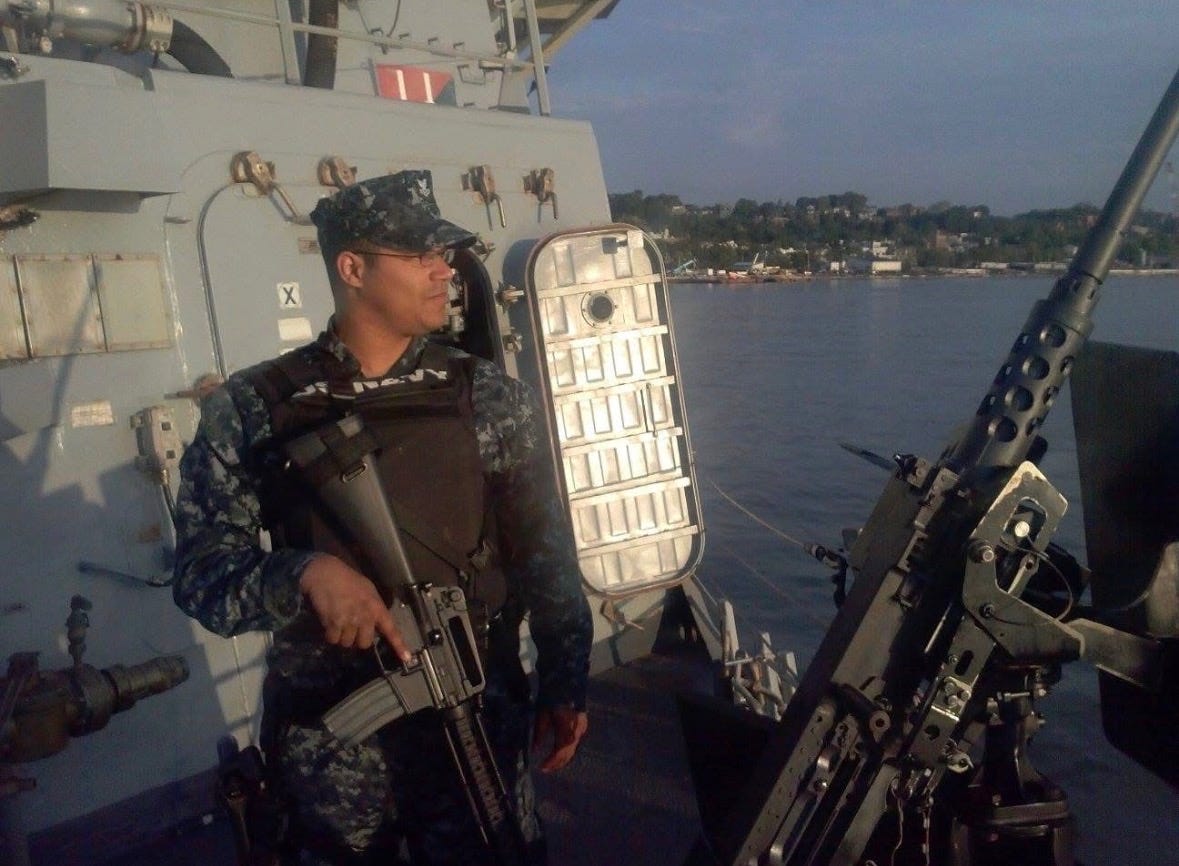
He joined the Navy in January 2008, seeking to use GI Bill benefits to pay for college down the road. He wanted to be a cook, but he tested so high on entrance exams that the Navy initially considered him for the nuclear program. His recruiter, his father says, told him he had never seen scores like that. As the nuclear track would have required him to wait another year, Pedicini opted for the AEGIS program, a computerized battle-management system designed to shoot down multiple incoming missiles simultaneously. Pedicini soon found a home in the Navy.
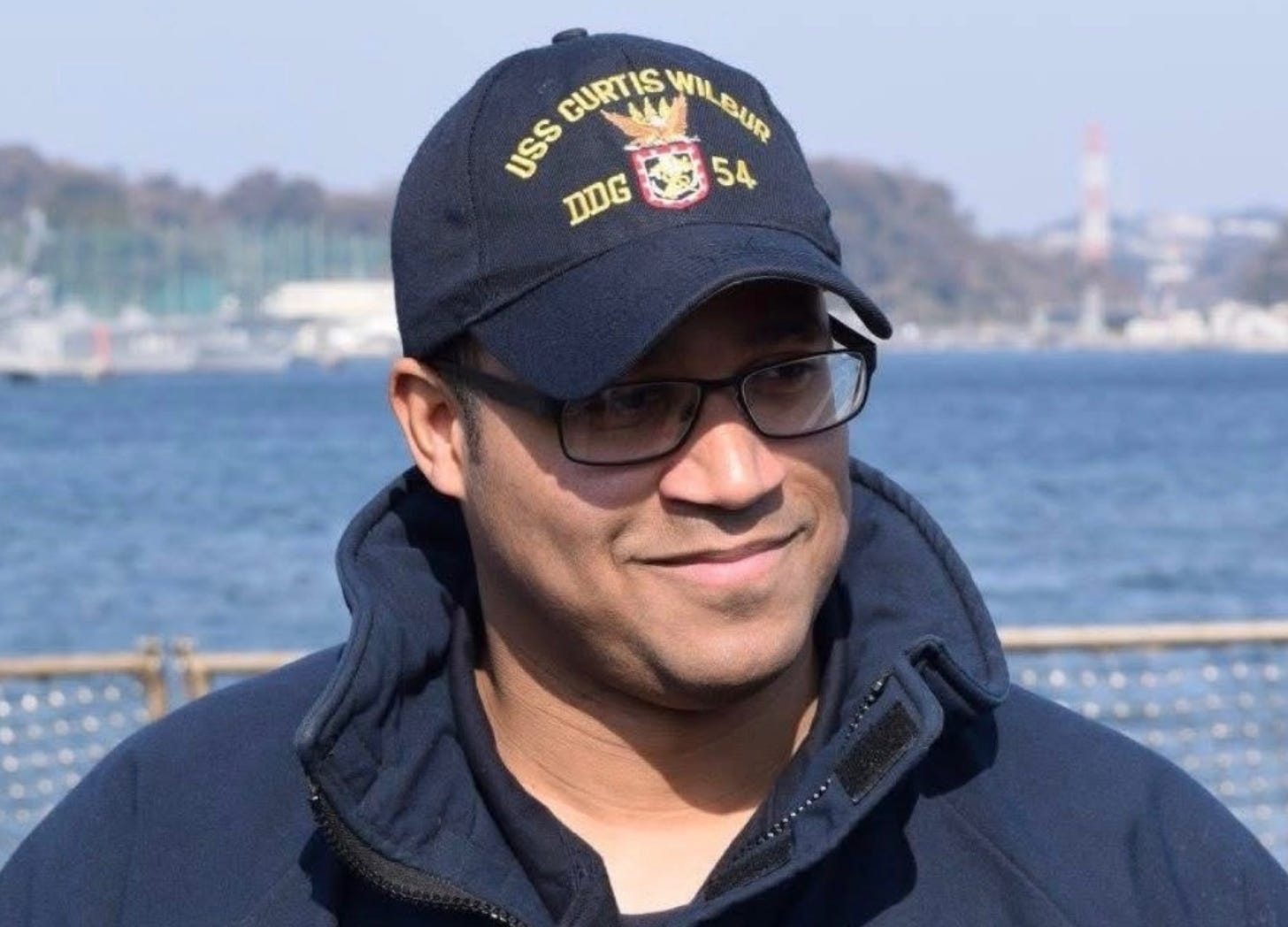
He spent roughly 15 months in Norfolk before deploying in 2010 to Spain and Morocco aboard the USS McFaul, an AEGIS destroyer with a crew of three hundred. In 2016, he transferred to the USS Curtis Wilbur, another AEGIS destroyer stationed in Yokosuka, Japan. There, he fell in love with Japanese culture: video games, anime, Final Fantasy, Dragon Ball Z. He rented a four-bedroom house in Yokohama, met Tiare, the woman he would marry, and bought a sedan for $5,000. He had found his place. His work ethic, he says, soared.
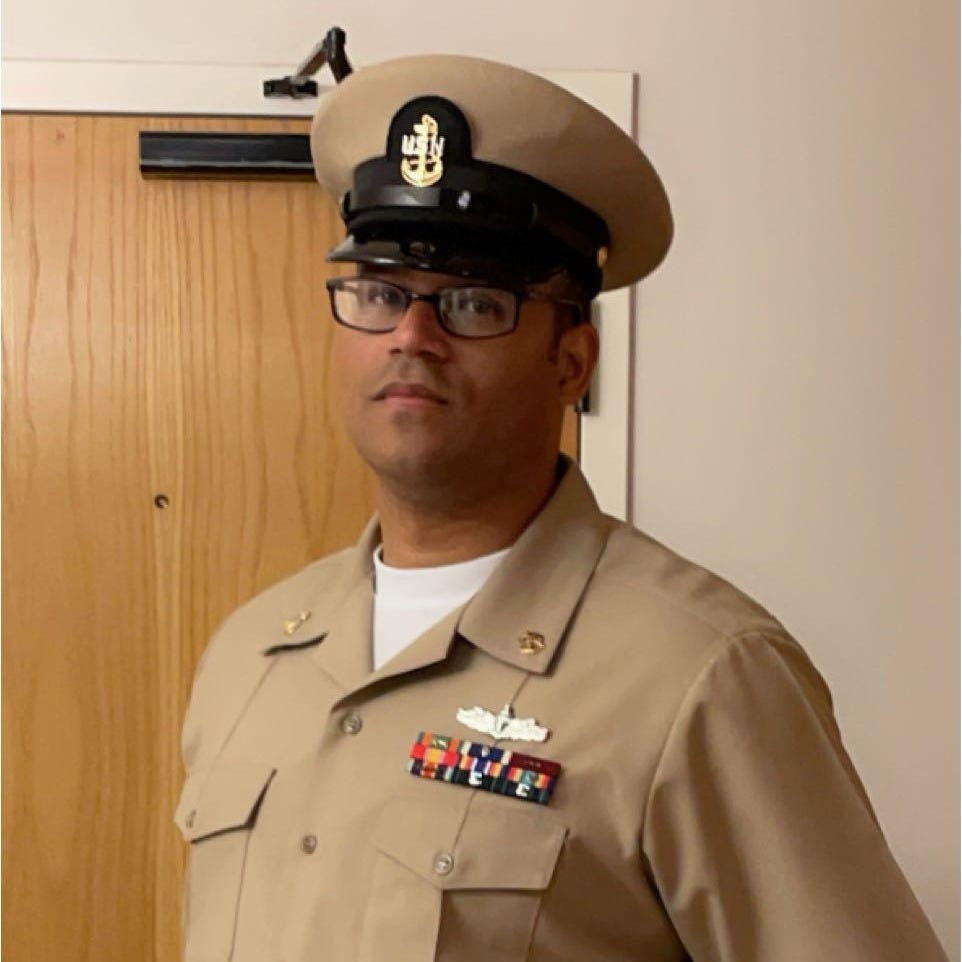
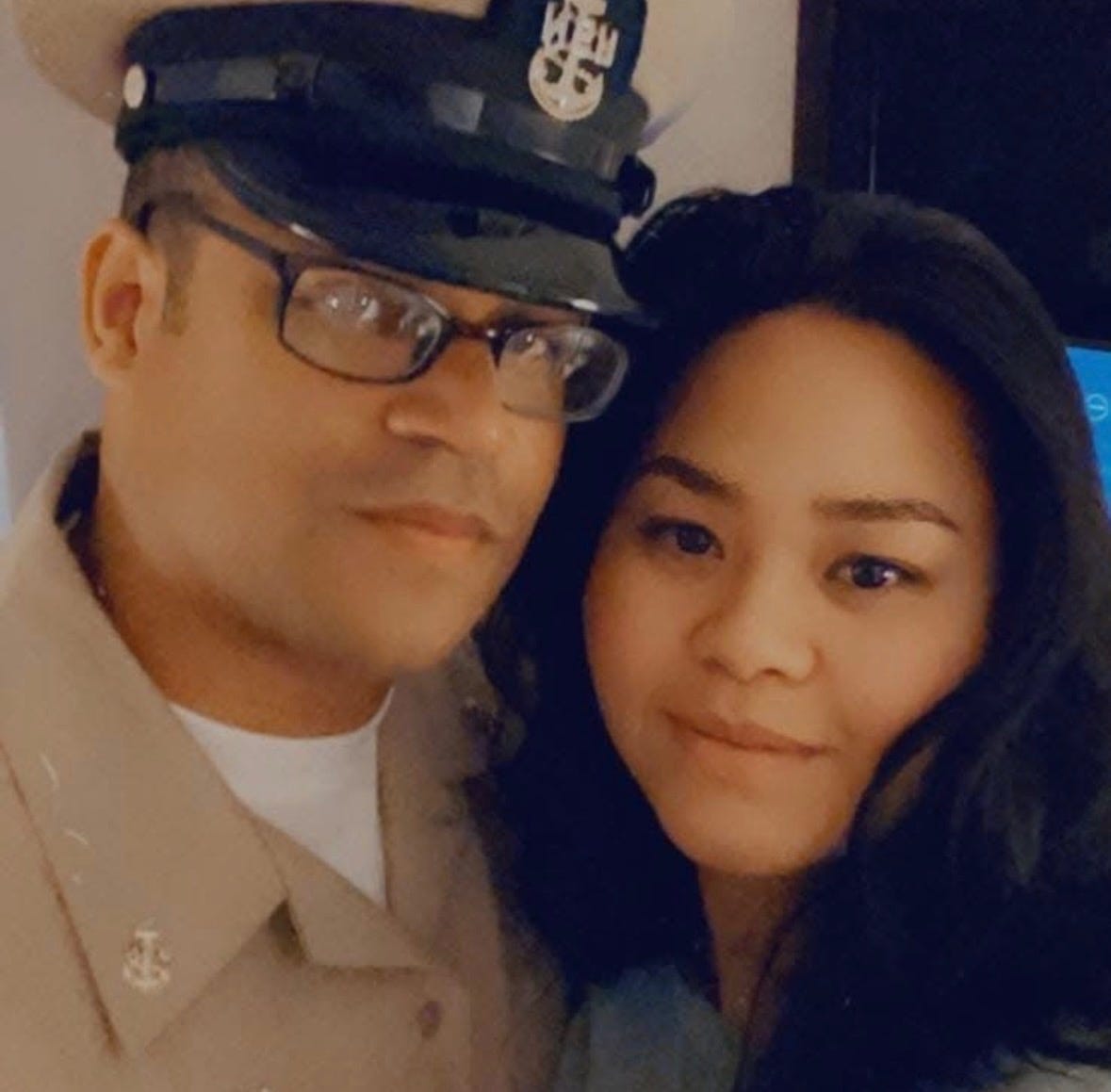
COVID arrived in 2020. He returned to school, earned higher qualifications, and became a Chief Petty Officer (E-7), Chief Fire Controlman (AEGIS). He and Tiare married in October 2021. He then underwent leadership training for Navy chiefs at Dahlgren, Virginia, followed by a brief limited-duty public affairs posting. He reported aboard the USS Higgins based in Yokosuka. One month later, he was arrested.
On October 24, 2022, while Pedicini was still at Dahlgren, he got a Facebook job offer. It was from a woman who claimed to represent a Japanese nonprofit called Genron NPO, a well-regarded Tokyo-based policy think tank whose work on Japan-China relations has been cited by major international news outlets. She called herself “Miyuki,” a common Japanese woman’s name, and offered him $500 per article and asked him to write research papers: two to three pages on topics such as what American servicemen think about North Korea and opinion pieces on defense matters. The company had a website. She made it sound like she had a team behind her. It all seemed legitimate. (Genron did not reply to requests for comment.)
With only a few years left before he could retire with a full pension, Pedicini said he saw Miyuki—and, more importantly, the Genron think tank she said she worked for—as a possible post-Navy civilian career writing policy papers in Japan. When she returned a week or two later seeking another research paper, Pedicini was happy to oblige.
When Pedicini told his wife, Tiare, that a research company wanted him to write articles on the US military presence in Japan, she was not pleased. Tiare told me she had a bad feeling. “It sounds like a CIA trap. This sounds like somebody is fishing for you,” she says she told her husband. “You either get scammed of your money, or this is an undercover operation.”
Tiare told me she watched Bryce write some of the papers. At night, sitting in bed next to her, he would open his laptop and Google things like “local Japanese opinions on military presence in Japan.” Tiare would watch him open websites, highlight passages, and copy and paste them into a research paper. Sometimes he would ask her to help make the copied text flow like an essay he had written. She says she never saw him access classified systems or materials. She says NCIS agents, prosecutors, and defense counsel never asked her about any of this.

Pedicini and Miyuki never met face-to-face. All communications began through Facebook Messenger and later moved to Telegram. Over time, the requests escalated. Miyuki wanted information on ships transiting the Taiwan Strait, sonar systems, submarine detection, satellites, underwater salvage vessels, and Arctic research capabilities. She offered more money for “new private threats”—data no one else had access to, the same sort of thing that the Chinese spy operation had been fishing for from me.
At some point, the language in Miyuki’s messages shifted noticeably. More sophisticated vocabulary appeared, words like “specificity” and “granularity.” Pedicini began to suspect he was no longer talking to the same person.
When Pedicini got orders to relocate to Japan, he hoped that being in the same country would let him meet Miyuki in person. But she put him off. Around his second week in Japan, the requests turned operational. She asked him to get a new phone, which she offered to pay for in advance. He declined, described the one he had, and kept the money. Then she asked him to leave the base and use a hotel Wi-Fi connection to communicate. He ignored that too.
“That’s when I started thinking she wasn’t who she said she was,” Pedicini told me. “Everything prior to that, including asking for secret/classified stuff, seemed like things a nosy research journalist would want, which is why I made sure my articles satisfied her research but did not have classified details in them.”
He kept engaging anyway, even as his suspicions grew. His plan, as he explained it, was controlled deception: satisfy her requests with material that appeared sensitive but wasn’t, keeping her on the hook without crossing into genuinely classified territory. He was clearly playing in dangerous waters.
Between November 2022 and May 2023, he sent seven documents. Miyuki paid him via PayPal after each submission. At trial, the government introduced Pedicini’s bank records and his PayPal transaction history to argue that financial need was a motive. According to court records, Pedicini once asked for $5,000 for three documents, but Miyuki paid him less because she said the information was publicly available. Pedicini told me he received about $3,500 in total.
He said he assembled the papers almost entirely from open sources or AI and that he simply made up some material. He estimated he copied and pasted 70 to 80 percent of one response from web articles about Chinese submarine operations. When he submitted material on submarines taken from open-source materials, the response came back: “Thanks. This is exactly what I was looking for.”
Pedicini noted in some of his papers that there were things he could not discuss, writing phrases like “I need to be careful what info I give because you are a foreign agency,” “There are some things I can’t say,” and “I’ll do my best, but I can’t give out things that are classified.” Prosecutors said those statements imply guilt. Daphne Silverman, his new defense attorney, says they show the opposite: Pedicini’s goal wasn’t espionage, but a career in public policy writing.
According to court documents, Miyuki told Pedicini she knew he had been sharing publicly available information, and she wanted more. She wanted secrets. To show him what she meant, she sent him a document marked Secret. In court records, it became known as the “Mitch document.” Court records say Pedicini told Miyuki he would be able to access documents like that when he arrived in Japan in April.
What the government’s own filings would later confirm was that Miyuki wasn’t a researcher at all. At a November 2023 preliminary hearing known in the military court as an Article 32 hearing, prosecutors described Miyuki as “a known intelligence officer of a foreign country” and “a citizen and employee of a foreign government.” The country of origin is classified. Court documents suggest the country name is China.
The Facebook messages from Miyuki continued to arrive in Pedicini’s inbox until July 5, 2023, six weeks after his arrest.
On May 8, 2023, Pedicini made his fateful decision. He brought his personal phone into a classified space on the USS Higgins and photographed cover pages of secret documents displayed on a classified computer terminal. His stated plan was deception: the cover pages weren’t classified but attached to packets of unclassified, publicly sourced, or fabricated information; they would make it look like he was delivering classified material when he wasn’t.
Cover pages for classified documents aren’t themselves classified. The government uses a standard, red-bordered form with the word SECRET or TOP SECRET printed in large type used to identify documents containing classified information. The form is publicly available.
“My plan was to take a picture of unclassified cover pages—the combat systems officer even testified by affidavit they were unclassified—but have secret stickers on the monitor displaying those pages to fool Miyuki into thinking she was getting what she wanted,” he told me. “Then, as with all previous articles, I planned to Google public information on the topics, put my deceptive cover pages on the front, and give her those.
The defense obtained an affidavit from a combat systems officer asserting that the photographed cover pages were unclassified, but ultimately failed to present it at trial.
After this story was published, Mike Garzon, an agent with the Naval Criminal Investigative Service, told Sasha Ingber on the SpyCast podcast that Pedicini mostly copied and pasted publicly available information into his reports but added some classified details.
“What got him hung up was that while all that information is publicly available, unclassified, what he did was that in certain portions, when there's a particular metric or range or depth that's omitted, he would add in a bit of information there,” Garzon said. “So if the website just says, ‘This submarine can go pretty deep into the ocean,’ he would write out specifically how deep it could go or something of that nature.”
Daphne Silverman, Pedicini’s attorney, strongly disputed Garzon’s account. “That entire paragraph is lies,” she said.
Pedicini pleaded guilty to one charge arising from that day: violating Article 92, the UCMJ provision covering failure to obey a lawful order, for bringing his personal phone into a classified space. Everything else—the espionage charges, the failure to report a foreign contact—he contested at trial.
On May 13, Pedicini sent the photos of the cover pages via Telegram. Someone clearly was watching because less than a week later, he was arrested.
Agents with the Naval Criminal Investigative Service interrogated Pedicini on May 19 in their offices in Yokosuka. Court records show the session was recorded on a battery-powered portable Zoom video camera rather than the regular NCIS recording equipment because the agents feared a classified information spill. A few minutes into the recording, an agent warned Pedicini he was suspected of unauthorized removal and retention of classified material—not espionage. Pedicini waived his rights.
Pedicini believed he was being questioned because he had taken pictures of the unclassified front pages of two classified documents on his phone, according to a motion to suppress his statements to NCIS agents that was filed by Pedicini’s defense attorney before trial.
He described writing research papers for someone claiming to be from a Japanese research company, using Wikipedia and Google as sources. “As long as it was something that was available to the public, I wasn’t really doing anything wrong,” he says he told the agents. “They’d ask about things that are classified or classified adjacent and I would just Google stuff and then take from some public documents and put in there like here, here’s what I have.”
The questioning focused almost entirely on his relationship with Miyuki — how much he had been paid, what the company had asked for, whether he had met anyone in person. As Pedicini told the agents, “My plan was just fuck with them.”
After an hour, one of the agents finally warned Pedicini that he was suspected of espionage, a charge that carries the death penalty.
In the 80th minute of the interview, the tape stopped recording. Agents later said they hadn't noticed that the brand-new batteries they installed in the camera before the interview had failed until they reviewed the footage after the interrogation ended.
The agent’s written summary of the unrecorded portion states that Pedicini agreed the information he had provided “could be used to harm the United States government,” that his contact had been requesting classified information for the past year, and that the contact had instructed him not to use base Wi-Fi or nearby Wi-Fi to send documents or photographs.
With the recorder out of batteries, the NCIS agents reported that Pedicini “surmised” that the person he had been communicating with “could be Japanese working for the Chinese,” although he wasn’t sure. When asked directly whether the information he provided could be used to the detriment of the United States government, Pedicini replied: “Absolutely.”
That statement—unrecorded, unverifiable, summarized by the same agents whose equipment had just failed—offered the only evidence that Pedicini had acknowledged his actions could harm national security.
Pedicini has been in custody ever since.
In April 2024, following a weeklong general court-martial at Naval Base San Diego, Pedicini was convicted and sentenced to 18 years in prison, reduced in rank to E-1, and dishonorably discharged. Had he been convicted on all counts, court records show, his maximum exposure would have been seven life sentences plus 90 years.
When the verdict came in, Tiare Pedicini says she was sitting in the gallery trying not to cry. “I was devastated,” she said. She noticed one of the prosecution’s attorneys doing what she describes as a small celebratory jig in her seat. Even some of the chiefs assigned to escort Pedicini to the brig were taken aback by the severity of the sentence. “He did a dumb thing and he should be punished for doing the dumb thing,” she recalls one of them saying, “but this is ridiculous.”
Pedicini waived a jury trial and put his fate in the judge's hands. The military judge who heard and decided Pedicini’s case was an experienced former Navy prosecutor. Commander Andrea Lockhart had prosecuted Abd al-Rahim al-Nashiri, the suspected mastermind of the 2000 USS Cole bombing, at Guantanamo Bay, and led the 2018 court-martial of three Navy SEALs accused of abusing detainees in Afghanistan, one of whom later died.
Lockhart convicted Pedicini of five counts of the lesser-included charge of attempted espionage rather than of espionage outright. She found the government had failed to prove espionage, which required it to show beyond a reasonable doubt that Pedicini had delivered information to a citizen and employee of a foreign government. She also dismissed five of seven counts of the charge of communicating defense information, finding that they were an “unreasonable multiplication of charges” already covered by the attempted espionage convictions.
It was a curious finding. Espionage under military law requires the accused to have provided information to an employee of a foreign government. As the fuller trial record obtained by The After-Action Report shows, the government failed to prove that Miyuki was actually a foreign government operative, and the judge knew it.
The prosecution’s theory was that Pedicini had committed espionage by knowingly transmitting national defense information to a hostile foreign actor. The full trial record shows that prosecutors referred to Miyuki throughout the proceedings as a “Known Intelligence Officer,” or KIO.
That label, however, overstates what the government actually knew. Miyuki’s real name, according to prosecutors, was Qingyu Gao—the name on the PayPal account that sent payments to Pedicini. Prosecutors classified Gao’s name and country of origin as Secret. To allow discussions at trial, Gao was referred to as “Individual Number One,” a substitution that concealed how little information the prosecution had.
To make the case that this was an intelligence operation, prosecutors called Nicholas Eftimiades, a former intelligence officer turned academic and author of a book on Chinese espionage operations. Eftimiades testified that Gao fit the “standard modus operandi for Chinese espionage.” (Eftimiades did not return a message left seeking comment.) They also called an AEGIS master chief, who gave classified testimony about the damage that disclosing information about the weapons system could cause if it fell into the hands of a foreign adversary. China was identified as “Country Number One” in court proceedings.
Silverman, Pedicini’s new attorney, disputed the government’s theory in court papers. “The government suggested—without evidence—that the intended recipient ‘Qingyu Gao,’ was affiliated with a foreign intelligence agency,” she wrote. “The government implied that Gao’s name indicated Chinese nationality and suggested that Genron NPO, the organization Gao claimed to represent, was acting as a proxy for a foreign government. These assumptions were never supported by the trial record.” In addition, she pointed out, suspecting espionage on the basis of a last name alone is also “racist.”
The military judge agreed, at least in part. In her written findings issued after trial, Lockhart noted that “the government had failed to prove beyond a reasonable doubt the identity of Individual Number One or what country Individual Number One was a citizen or employee of.” The government “only provided a 90 percent opinion this person was from a particular country,” she wrote. Even so, Lockhart found that Pedicini knew he was dealing with Miyuki, a foreign national working for Genron NPO, a foreign entity, and convicted him of attempted espionage on that basis.
Lockhart’s decision threaded the needle. It was enough that Pedicini believed Gao was, as she put it, “at a minimum a Japanese foreign national” working for a Japanese nonprofit, even if the government couldn’t prove that she or he was really a spy. How she reached that finding is unclear. Lockhart had reviewed the Top Secret evidence in the case. What she found there and what it says about who Gao really is remains classified. All of the information about Gao found in the fuller record of trial obtained by The After-Action Report was withheld by the Navy under the Freedom of Information Act.
The ongoing secrecy surrounding Pedicini’s trial highlights how unusual the proceedings are. The Justice Department almost always handles espionage prosecutions involving military personnel in federal court. Navy Petty Officer Jinchao Wei, a machinist’s mate on the USS Essex, was tried in US District Court in San Diego in 2025 and sentenced to more than 16 years after selling approximately 60 technical and operating manuals about US Navy ships, along with dozens of photographs and documents, to a Chinese intelligence officer who recruited him via social media. Army Intelligence Analyst Korbein Schultz was sentenced in 2025 to seven years in federal prison for conspiring to sell documents on US missile systems and rocket artillery to a contact linked to Chinese intelligence.
Similar cases in military court are “extremely rare,” said Brenner Fissell, vice president of the National Institute for Military Justice and a professor at Villanova University School of Law who litigates in military court. “In the modern era, this is sort of a one-off.” Fissell noted that the current pattern runs in the opposite direction. “We have noticed in this administration that in complex cases, they have chosen to take them through the Department of Justice instead of the military,” he said.
One exception was Private First Class Chelsea Manning, who was court-martialed under the Espionage Act in 2013 for leaking massive amounts of documents to WikiLeaks—an organization that published leaked documents, not a foreign government—and sentenced to 35 years, later commuted by President Obama. Even so, Manning’s case attracted enormous public attention. Pedicini’s did not.
Philip Cave, a former Navy judge advocate and experienced civilian military defense attorney, said the decision to court-martial Pedicini rather than prosecute him in federal court was deliberate. The Justice Department and the Defense Department operate under a memorandum of understanding that gives the DOJ first choice over whether to prosecute a case or leave it to the military. “I’m reasonably certain that because of the espionage aspect and the foreign national involvement, there would have been a conversation” between the Navy’s legal staff and the Justice Department about who would handle the case, Cave said.
Mike Garzon, the NCIS case agent on the Pedicini investigation, told SpyCast that a major factor in the decision to try Pedicini in military court was that federal prosecutors, in another case his agency investigated, had opted not to bring espionage charges against Petty Officer Wenheng Zhao. A Chinese intelligence officer cultivated Zhao, who entered restricted installations and photographed sensitive military information and activities. But according to his plea agreement, the specific documents Zhao was convicted of transmitting were marked as controlled unclassified information (CUI), or "UNCLASSIFIED//FOUO," not classified. Prosecutors charged him with conspiracy and bribery rather than espionage, and he pleaded guilty in October 2023 to those counts, admitting he took at least 14 bribes totaling roughly $14,867. He was sentenced to 27 months.
“The unfortunate part about that investigation was that the Justice Department was reluctant in pursuing espionage charges, which would have upped the ante, so to speak,” Garzon told host Sasha Ingber. “So once that case, the Pedicini case, opened up, we thought, hey, let’s bring in our trial prosecutors from within the military justice system and see if they’re willing to really pursue this and go at them hard and go after espionage.”
That decision to court-martial Pedicini had consequences beyond the courtroom. According to Fissell, the legal framework for handling classified evidence in military courts mirrors that of civilian courts, but the practical barriers to public access remain significant. “The more important distinction is public access. Court proceedings are supposed to be open,” he said. “That was hotly litigated in the USS Bonhomme Richard case, also in San Diego. But as a practical matter, when court is held on a military base, it’s just harder to get there. The dockets aren’t public. And at the appellate level, there’s no functioning docket at all.”
The defense had also been kept in the dark. When it requested Gao’s address, phone number, and email address—the basic information needed to rebut the government’s contention that Gao was a citizen and employee of a foreign government—the government said it didn’t possess that information. A US intelligence agency did, but had refused to hand it over. The judge ordered the relevant intelligence agency to disclose whatever it had on Gao’s identity. On April 8, that unidentified agency asserted Top Secret privilege over the responsive records through a classified declaration.
Despite the constraints, Pedicini’s initial defense attorney had planned to mount a vigorous defense. His assigned counsel, Commander Jason Pfiel, intended to argue that the sonar, radar, and other strategic concepts in Pedicini’s white papers were all in the public domain. He called it The Hunt for Red October defense, after Tom Clancy’s 1984 novel, which the Navy had once suspected of containing classified information, before it emerged that Clancy had assembled it almost entirely from reading open technical journals. After the book came out, Navy Secretary John Lehman reportedly told Clancy: “If you were a naval officer, I would have you court-martialed because of all the classified information in your book.”
According to court documents, Pfiel was prepared to submit side-by-side comparisons of Pedicini’s papers and The Hunt for Red October. The same technical subjects that “formed the basis” of the government’s case against Pedicini—passive sonar operations, submarine acoustic detection, frequency masking, the identification of submerged vessels through background noise discrimination—were the same topics that had appeared in the book and the blockbuster 1990 film of the same name, which was made with help from the Navy.
Before the case came to trial, however, Pfiel was appointed as a military judge, creating an apparent conflict of interest, and he was removed from the case. His successor abandoned the public domain defense. Government and academic materials that Pfiel had found that mirrored the technical content of Pedicini’s writing were never submitted. Pedicini’s new attorneys, John Cole and Mark Jessup, a pair of Navy JAGs assigned to the case, did not even present a defense. Pedicini didn’t testify. “I wasn’t given much of a choice,” he said. (Jessup did not return a message seeking comment; Cole, who is stationed in Japan, did not respond to a request for comment sent through the Naval Legal Service Office in Yokosuka.)
Pedicini’s wife, Tiare, dutifully attended the court-martial every day and took notes. She noticed something during the trial that the defense never raised. The prosecution displayed a message referencing a large radar system. Sitting in the gallery, she looked it up on her phone. Everything about it—how it was built, where it was located, what materials were used, what it cost—was publicly available from the manufacturer’s own website. “Nobody made that point,” she said.
The judge never heard his explanation that he wrote the papers by Googling open-source materials and that he hoped to land a job with a legitimate Japanese think tank. The search history from Pedicini’s laptop that was introduced at trial was, according to Silverman, “partial and misleading.” Investigators redacted searches showing his reliance on open-source materials, and the court never reviewed them.
“The lack of defense blew my mind because it didn’t make any sense,” Pedicini told me. He was convinced the prosecution was, in his words, “so incompetent as to seem ridiculous — or malicious.” He also says the Navy had institutional reasons for the prosecution. “The Navy needed my case to land as a predicate to get other cases,” he told me.
The Navy declined to address most of the specific allegations raised by this story.
On the key question of how the Navy justifies an espionage prosecution in which the judge found the government had failed to prove the recipient of the information was actually a foreign government operative, Navy spokeswoman Patty Babb said in an emailed response that military judges “sometimes disagree with litigants” and that the military justice system “relies on independent military trial judges and an independent appeals process to guarantee due process and the rights of an accused.”
Asked to explain why Pedicini was prosecuted by court-martial rather than in federal court, Babb said, “prosecution decisions are made in every case following a careful review of the facts and available evidence and in accordance with the disposition guidance found in Appendix 2.1 of the Manual for Courts-Martial. It would be improper for the Navy to comment on prosecution decisions or any ongoing litigation.”
Asked how the government could call Gao a “Known Intelligence Officer” in light of the judge’s finding that it had failed to prove Gao’s identity or country of origin, Babb said that it was the government’s job to offer testimony and the judge’s responsibility to determine whether elements of the offense were met. “Military judges, like their civilian counterparts, sometimes disagree with litigants,” Babb wrote.
On the inconsistency between withholding the trial record under FOIA while simultaneously posting it on a public appellate docket, the Navy acknowledged that “different regulations impact the release of information under a Freedom of Information Act request and under Article 140a of the Uniform Code of Military Justice..”
The Navy declined to address the failure of the recording equipment during Pedicini’s interrogation, the admission of the unrecorded “absolutely” statement, the combat systems officer’s affidavit that was never presented at trial, saying it would be improper to comment on “legal or tactical decisions” made by prosecutors or the judge regarding evidence.
After his conviction, Daphne Silverman, a former Navy JAG who served as assistant staff judge advocate at US Strategic Command, took on Pedicini. Silverman read about the case in the Navy Times, concluded something was wrong, and wrote to him offering to represent him.
A testimonial on Silverman’s website quotes a Mississippi judge describing her as a “pit bull.” Her email signature reads: “If standing up for your clients burns a bridge, I have matches. We ride at dawn.” She showed what she meant by representing Pedicini pro bono. Battling Stage IV metastasized breast cancer, Silverman threw herself into the case, filing broad motions requesting all materials relating to the initiation of the investigation, along with motions to suppress and a sweeping discovery list.
Something she requested in that list—Silverman is not sure what—has caused problems ever since. Thirty minutes before she was set to file the list, she received a message from the prosecutor: a country name in her filing might be classified. Silverman said a court order prevented her from disclosing the country, but court documents point to China.
The next sign that Silverman was on to something came in military court in San Diego. Commander Lockhart refused to read her motions, saying she did not want classified information in her system. She yelled at Silverman, saying something to the effect that “We made it through the trial without a leak, and then you did this,” without explaining what Silverman had done wrong.
In June 2025, Silverman drafted a clemency package and submitted it to Vice Admiral Brendan McLane, commander of Naval Surface Force, US Pacific Fleet in San Diego, who had convened Pedicini’s court-martial. She requested deferment and suspension of Pedicini’s reduction to E-1 and asked that his sentence be reduced to time served. Silverman added the troublesome discovery list to the classified portion of the defense file.
Some time later, however, Silverman learned the clemency package had not been included in the trial record, so she went to fetch a copy from the locked defense file in the command security office. The entire paper clemency package had disappeared. Likewise, all clemency documents except one had been deleted from the defense account on the secure computer system. Silverman says the only person besides herself who had accessed the files was a court reporter attached to Commander Lockhart.
To find out what happened, she went to the JAG office at the San Diego Navy base. A staff lawyer showed her the command’s copy of the file—both unclassified and classified, including the troublesome discovery list—and asked her to return to speak with her boss, the Force Judge Advocate. Capt. Brian Ellis Jr. is the Force Judge Advocate for US Naval Surface Force, Pacific Fleet, according to his LinkedIn profile.
When she returned, she met with Captain Ellis. Silverman says Ellis summoned his entire staff and told them no one was ever to speak to her again. He then ordered Pedicini transferred immediately to Fort Leavenworth in Kansas, home to the military’s only maximum-security prison. “He’s causing us this problem,” Silverman recalls Ellis saying. The clemency request was denied. Pedicini remains at Fort Leavenworth today. No explanation was ever provided by the judge, prosecutor, or investigating agency for the disappearing documents. (Ellis did not respond to questions sent to his personal and Navy email addresses.)
Asked for comment, the Navy offered no direct response on the disappearance of the clemency package from a locked defense file, the allegation that a court reporter or the judge accessed the documents, and Silverman’s account of being told by the Force Judge Advocate that no one was ever to speak to her again. Babb, the Navy spokeswoman, said only that an accused may “raise issues related to interference with their right to seek clemency” through the appellate process.
Tiare Pedicini learned about her husband’s transfer to Leavenworth the hard way. She had flown to San Diego for a pre-approved extended visit. She got a chance to see her husband on April 7, but when she returned four days later on April 11, she was told all visitation had been canceled due to his “current status.” No one would tell her why or what his status was. She later learned that Bryce had been placed in solitary confinement on April 8 and kept there for eight days before being transferred to Leavenworth.
Silverman believes the government’s refusal to disclose information about Gao reflects something more than routine classification. Gao, she suspects, is an active undercover operative whose exposure would compromise ongoing intelligence operations and who may still be active, used by the government to target other service members. It would explain, she argues, why the intelligence community asserted Top Secret privilege over records as basic as an email address, and why the judge, who had access to Top Secret information about Gao, found Pedicini guilty of attempted espionage instead of espionage, even though she acknowledged the prosecution had failed to prove that Gao was actually a spy.
Silverman maintains that if Gao was an undercover US government operative, the government should have established some basis for believing he was predisposed to comply before subjecting a sailor with no prior record of misconduct to seven months of escalating requests for classified information. Whether that argument prevails on appeal is another matter, but it raises a legitimate question about how the operation was run and who ran it.
The government’s decision to charge Pedicini with espionage may come back to bite it. Others who have reviewed the case share Silverman’s doubts about the prosecution. Philip Cave, who spent decades as a prosecutor in the Navy, said the government may have overreached on the charges. Had prosecutors charged Pedicini only with violating classified handling regulations—the phone in the SCIF, the photographs of a classified computer—they still could have introduced all the espionage-related evidence as aggravation at sentencing. A conviction on those charges alone would have been straightforward. “It’s a clean case,” Cave said. “And I bet he would have negotiated a plea bargain.”
An appellate decision is still months away. When I spoke to Pedicini, he said he would ultimately be vindicated. “I still believe in the integrity of the American justice system, even if it was tampered with at these low levels,” he said.
His parents and in-laws have been supportive, and his wife has been steady throughout, he says. Tiare told me she had been a single mother before Bryce came along. “It’s nothing too harsh for me,” she said, “but it does affect our son. He had every intention of adopting him once we got settled in Japan, but we were never given that opportunity.” She has spent most of what should be her savings traveling to see him.
“There’s no doubt in my mind that he would never do anything to put this country’s security at risk. It’s just not who he is,” his father, Chris Pedicini, told me. “Now, would he try to Google some sources and make a few bucks selling a story where he publicly sourced all the information? Yeah. Is that smart for him to do? No. But would he do that? Yeah. In his mind, he might think there’s really nothing wrong with this. This is all publicly available information.” What Bryce would never do, his father says, is sell his country out, and certainly not for a few thousand dollars. “It’s just not who he is.”
Pedicini says he continued engaging with Miyuki after growing suspicious because he believed he was in control—that his deception was working, that he was feeding her material she couldn’t actually use. He thought he was running the operation. He is now serving his sentence at Fort Leavenworth.
“I still believe all of the Navy I experienced prior to being confined was incredible,” he said. “I wouldn’t be the man I am today without that.”
No posts
Comments
Nothing yet. Say the first thing.
Sign in to join the conversation.