
In what feels like another lifetime, I used to write for the now-defunct RecruitingDaily, which included curating an annual International Women’s Day piece. It wasn’t anything particularly deep. I would ask women from around the HR and HR technology spaces to weigh in on the year’s theme and share what it meant to them. For the most part, the themes are innocuous, usually three words that serve as a global rallying cry for women everywhere. Break the Bias. Dare to Be. Choose to Challenge.
While I won’t get into the long history behind March 8 and what it stands for, know that the roots of IWD trace back to 1908, when roughly 15,000 women protested for voting rights, better pay, and shorter hours, setting this whole thing in motion. Which brings me to 2026’s theme: “Give to Gain.” The IWD site has a whole page about what that means, noting “When people, organizations, and communities give generously, opportunities and support for women increase.” A rising tide lifts all boats. Yada, yada, yada.
Look, I understand where this sentiment comes from. However, when I mentioned the 2026 theme to friends, the general reaction was nearly unanimous: “Don’t we give enough? When do we get?” Living in patriarchal societies, the answer is: we don’t. Women remain responsible for the bulk of invisible labor. Layer in the complexities of late-stage capitalism, and in many households, they’re contributing to the visible labor, too. The combination has created circumstances in which women are too busy, tired, and burned out to give anything more than they already do.
Which leads me to the artist Patti Maciesz’s project, “Bill the Patriarchy,” a tool that lets you build an itemized invoice for unpaid domestic and emotional labor. I have played with it more than once, plugging in conservative and liberal estimates of my own efforts as a white woman in a high-cost-of-living state. The former puts my annual salary just under $70,000. The latter came in over $100,000. You can see what a sample breakdown looks like below. That’s without running a business, supporting a second one, attempting some semblance of a social life, and my existing extracurriculars, which include mentoring and non-profit board work. And I’m in a two-person household with two pets.
Look, I am an ardent supporter of gender equality. Full stop. But putting additional onus on women to fix structural and systemic problems by giving more ain’t it. We’ve been doing our part, credited and uncredited, for as long as humans have existed –more than our part. And a show of open hands isn’t going to change what’s really wrong here. So, I’m adopting a new theme for the rest of Women’s History Month and beyond, lifted from Kyla Cobbler, and staying feral, furious, and jacked.
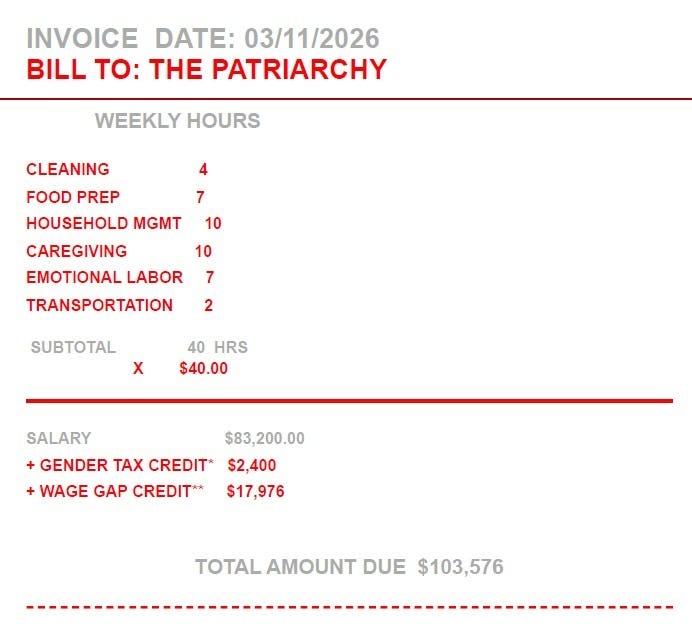
Visit BillThePatriarchy.com to create your own.
Dear Laura,
It’s no secret that men and women have different earning capabilities, but as someone who owns their own business, what advice do you have for a woman looking to increase their worth?
Thanks for your help,
Feeling lesser
Dear Feeling lesser,
Self-worth. It’s the basis of everything. I have often heard that owning your own business is the best therapy you’ll ever have, because it forces you (whether you like it or not!) to identify where your insecurities and areas of development show up.
Worthiness often shows up in ‘hustling for worthiness’ (an amazingly accurate phrase coined by Brene Brown). As a business owner myself, I totally get what you’re feeling. At the start of my entrepreneurship journey, I was lucky enough to have external influences help me with this (clients who would often say, ‘Raise your fees and send me back this contract. Your competitors are charging more and doing less.’).
A humbling realization that maybe I was undervaluing and thereby underpricing my services. Over the years, it’s gotten more comfortable. The key is practice. The first time you send a contract over and feel a bit uncomfortable, work on self-soothing. Remind yourself that they need you more than you need them (meaning you are adding enormous value to them! They see the worth in this investment.).
Let that external validation support you until you believe it internally. Eventually, you’ll start to notice you feel worthy of every cent you charge. You’ll realize you know, in your body, how valuable your expertise is. You’ll realize that earning money isn’t something to be ashamed of, but rather celebrated. This all takes time and practice (for most of us!). And, if you happen to be lucky enough to have a woman friend who is inherently amazing at this, keep soaking up their wisdom! We all have to surround ourselves with women who get it, can empathize and root for our rise.
You are worthy! I see it. I know you will soon, too.
Your friend,
The American Institutes for Research (AIR) announced the AI Century Study, a 100-year initiative examining how AI is reshaping daily life in American society. AIR posits that they will follow the first generation of AI-native children as they grow up and move through the world as humans, though one (me) could argue that we’re already beyond that point with the Alphas.
Likewise, we’ve apparently entered the “Great Millennial Career Crisis.” As a Millennial, this is news to me because I think most of us have felt our entire careers have been one long crisis, or at least marked by a series of external crises. I think what’s actually happening now is called “middle age,” but sure, we can give this latest stage a cute name.
Since we seem to be leaning into generational news this go-around, and we’re now six years out from the pandemic, here is an op-ed from a Gen Z-er proclaiming that experience as her generation’s before and after moment. Reductive? Yes. Melodramatic? The author openly admits this. Still, there’s no denying the world looks very different today than it did in March 2020.
In recent conversations, I’ve been hammering home the point that the “future of work” is a dying concept, given the current pace of technological advancement. Jill Barth wrote about what’s happening to workforce planning in this moment.
I also can’t stop yammering on about the impact of what’s being modeled at the top and how that’s trickling down into daily life. Prime example? Whatever toxicity is happening within the Department of Labor.
Over at the Directionally Correct Newsletter, Zach Williams and Cole Napper asked the question, “What Did We Even Write About Before AI?” Don’t be intimidated. I promise you still have the attention span for in-depth content.
Top HR Products of the Year (submissions due March 27)
2026 MISHRM State Conference (CFP closes April 3)
Stevie® Awards for Great Employers (final deadline May 7)
Reading: “At Home with Richard Hell” via The New York Times. A bit voyeuristic, but I always enjoy these features, especially since I can trace my interest in his work to a term paper I wrote in high school titled “Blank Generation.”
Watching: Despite running for 51 seasons, people still like to debate whether Saturday Night Live is as funny as it “used to be,” and while I’m not sure how we would measure that, the last two episodes had me in stitches.
Listening: Georgia Maq. A fan of her band Camp Cope, her solo album “Pleaser” got me through quarantine, and more recently, I’ve been digging her latest EP, “God’s Favourite” and cover of the AI-assisted track “10 Drunk Cigarettes.”
Exploring: Navii. On the enterprise side, it seems like another AI hiring companion. On the candidate side? After a 30-minute conversation, Navii creates a custom agent to represent “who you actually are” in the job search process.
I’ll leave you with the following quote as food for thought: “This is the first time in history nobody has any idea what the world will look like in 10 years – what the job market will look like, what social relations will look like, et cetera. So hedge your bets. Don’t focus on a narrow subject like coding. Give equal importance to your head, your heart, and your hands. It is the combination of these three that humans still have a large advantage over AI.”
Until next time.
- Katie
No posts
Comments
Nothing yet. Say the first thing.
Sign in to join the conversation.