
Welcome back to our course on Women in Late Medieval England! This course is available for all level of paying subscriber to The Historian’s Desk.
You can watch today’s lecture in the above video (click “watch now” to pull up the page for this lecture) and you can adjust the playback speed of the lecture using the arrows in the bottom righthand corner of the video player.
You can also find the written copy of the lecture below, just in case you’d like to follow along with the recording. You can find a list of suggested readings at the bottom of the written lecture. Please feel free to post any thoughts, questions, or ideas you’d like to discuss in the comments.
I hope you enjoy learning about medieval beauty standards!
Just as they did for clothing, as the lecture last week discussed, women had several options for hairstyles and headgear in the later medieval period. Women could wear their hair in a variety of designs and styles, with young unmarried women being able to wear theirs loose and uncovered while married women typically used elaborate styles or coverings to tightly bind or conceal their hair entirely.
If women preferred an up-do with exposed hair, they could gather their hair into golden cauls or nets, or they could utilise one of the most popular hair techniques of the Middle Ages: plaiting. Plaited hairstyles could range from unadorned braids (like those featured in the top image below) to elaborately ornamented plaits framing the face (like those in the lower image).
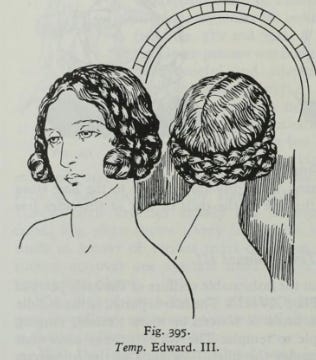
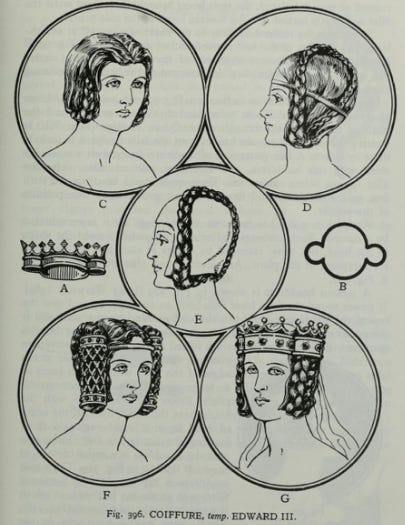
In most of these styles, hair was parted in the middle before being divided into braids, with fake hair sometimes being used to achieve particular looks, with some women even using hair from a horse’s mane to give them the appearance of having a fuller head of hair.
Noblewomen usually used maidservants to help them achieve these styles, with each noblewoman having at least one or two maidens in her employ who would have been known for her hairstyling skills. These styles would often take considerable time to accomplish, with women waking up early to ensure they had time to achieve the complicated – but desired – looks.
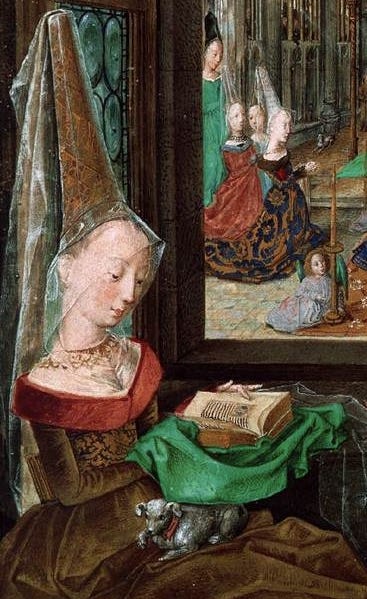
In addition to creating elaborate designs with hair itself, medieval women could also wear headdresses and other fashionable headgear. Women of the upper classes are often depicted wearing hennins – the seemingly gravity-defying headdresses often depicted with veils attached that appear in so many medieval portraits from the fifteenth century, like that of Mary of Burgundy and her ladies, below.
Proper crowns were of course limited to the use of royal women, with queens and princesses often wearing their jewels on formal occasions like weddings, holidays, and state occasions.
The oldest surviving royal crown known to have been used by royalty in England dates to this period. The Crown of Princess Blanche, below, likely first belonged to Anne of Bohemia – the beloved wife and queen of Richard II – before it passed into the hands of the House of Lancaster when Henry IV usurped the throne from his cousin, Richard, in 1399.
Comments
Nothing yet. Say the first thing.
Sign in to join the conversation.