
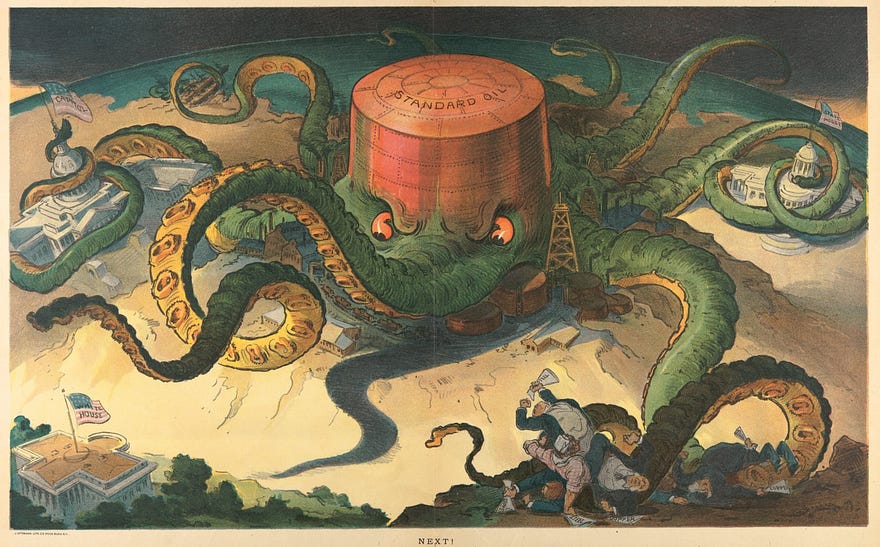
Grim Reminder: A Grim Historian is a reader-supported newsletter and depends on your 5$ donations to keep the most depressing politics and history in your inbox. Please consider becoming a paid subscriber or sharing with someone who loves misery.
Sometime around the sixth century BCE, the people of Miletus made the mistake of mocking the philosopher Thales for being poor.
Thales was apparently very clever, very broke, and surrounded by the ancient Greek equivalent of guys asking why a smart guy wasn’t driving a nicer chariot.
So he decided to make a point.
According to a story Aristotle tells a couple of centuries later, Thales predicted that the next olive harvest would be unusually large. While it was still winter, and nobody particularly cared about olive presses, he quietly secured control of the presses in Miletus and nearby Chios.
Then he waited. The bumper crop arrived. Suddenly everyone had olives.
But now everyone also needed a press. Unfortunately, some asshole philosopher had all the presses.
So Thales generously rented out his presses…on whatever terms he pleased. He made a fortune and proved that philosophers could get rich perfectly well when sufficiently annoyed.
Aristotle told this story for a reason. Thales had not grown better olives, invented a faster press, or founded OlivePress.ai. He had simply acquired control of the thing everyone else needed to do business.
The Greeks had a word for this little arrangement: monopoly. Monos meant alone. Pōlein meant to sell. Humanity apparently needed a word for “one bastard owns everything” quite early.
More than two thousand years later, monopolies are making quite the Gilded Age comeback. Let’s start with the obvious one — Amazon. The mammoth company found a particularly clever way to own the olive press. Millions of shoppers begin their search there, which means sellers cannot easily afford to leave its marketplace.
Amazon then uses that market dependence to discourage merchants from offering lower prices elsewhere. Every vendor knows that if you cut your price on another website, Amazon can make your product harder to find on Amazon. Naturally, if lowering the price on your own website could cost you access to Amazon’s enormous customer base, the safer choice is to keep the price high everywhere.
In 2023, the FTC and 17 state attorneys general filed a landmark antitrust lawsuit against Amazon. The main federal monopoly trial is scheduled to begin in March 2027. With the FTC currently declawed by the Trump regime, we can place our bets on how that trial will go.
Let’s take a simpler example — concerts. I am old enough to remember when going to a show did not eat your entire paycheck. According to Pollstar, the average concert ticket in 1996 was just under $26; adjusted for today’s inflation, that would be $54. When was the last time a concert ticket only cost you $54? Now fees breed fees until the checkout price barely resembles the one you clicked on.
So what happened to drive ticket prices upward? Two words: Live Nation. The company promotes shows and has a hand in venues across the country. Meanwhile, its subsidiary Ticketmaster handles primary ticket sales at roughly 80 percent of major concert venues. When one company controls the promoter, the venue relationship, and the ticket gate, competition has little chance to restrain the tolls.
Then there are pharmacy-benefit managers, or PBMs, because apparently buying medicine was not complicated enough. CVS Caremark, OptumRx, and Express Scripts sit between drugmakers, insurers, pharmacies, employers, and patients, helping decide which drugs get covered and what pharmacies get paid. Their corporate parents also own some of the insurers and pharmacies on either side of those decisions. The three largest PBMs now process nearly eight out of every ten prescriptions in America.
Real estate monopolies are especially grim. Private-equity firms and institutional investors buy apartment buildings and thousands of single-family homes. A housing monopoly means tenants have fewer landlords to choose from while those landlords have more room to raise rents and pile on fees. The effect is strongest where corporate ownership becomes concentrated. Suddenly the “market rate” starts looking suspiciously like whatever the biggest landlords’ algorithm decides it should be.
Monopolies don’t stop at housing. Firms like Blackstone, KKR, Apollo, and Carlyle have bought into veterinary practices, nursing homes, and funeral businesses. You gotta hand it to the oligarchs. They have even managed to consolidate death into a single provider, which is very efficient if you are not the customer.
Media consolidation uses a more classic monopoly trick and arguably the most chilling. Skydance finished acquiring Paramount in 2025. Now the enlarged Paramount wants to gobble up Warner Bros. Discovery (WBD). The proposed $110 billion deal would bring CBS, CNN, HBO, Paramount, Warner Bros., Nickelodeon, and Paramount+ under the same corporate roof. California and eleven other states sued to stop it.
To get their merger through, several media companies have bent the knee to Trump. For example, CNN shoved Jim Acosta toward a midnight time slot shortly after Trump returned; Acosta quit instead, warning against bowing to a tyrant.
CBS was worse. 60 Minutes executive producer Bill Owens resigned after saying he had lost editorial independence. CBS News chief Wendy McMahon followed. Paramount then paid $16 million to settle Trump’s lawsuit while its Skydance merger awaited federal approval. Days after Stephen Colbert called the settlement a “big fat bribe.” Because it was. So CBS canceled The Late Show.
Then in June 2026, CBS fired longtime 60 Minutes correspondent Scott Pelley after he clashed with the network’s new leadership under Bari Weiss. Pelley accused the new owners of trying to curry favor with the Trump regime and “murdering the show.” He has no reason to lie. He has every reason not to bend the knee.
Thales would recognize the strategies immediately. We have simply given the olive press better branding.
And once you start looking for the press, a strange amount of modern American economic life starts making sense. We experience the consequences separately: a copay, a service fee, a subscription increase, a concert we suddenly cannot afford, news that looks suspiciously like propaganda, a local business that used to exist and suddenly does not.
Each industry supplies its own explanation. Drugs are expensive because innovation is difficult. Housing is expensive because there are not enough houses. Concerts are expensive because artists and touring are expensive. Insurance is expensive because everything else is more expensive.
Some of those explanations are partly true.
But Americans once understood something we seem to have forgotten: no amount of ingenuity can solve an economic problem when one company owns the olive press.
To understand how America once figured that out, forget the famous men. Set aside J. P. Morgan, John D. Rockefeller, Theodore Roosevelt, Woodrow Wilson, and the other names of the Gilded Age.
Instead, let’s begin with ordinary people discovering that they were not losing separately.
In 1885, George Rice owned oil wells and a refinery in Marietta, Ohio. He was not John D. Rockefeller.
That was the problem.
Rice made oil people wanted to buy. He found customers. He shipped his crude over the Cleveland and Marietta Railroad. Then the railroad doubled his freight rate from 17½ cents to 35 cents per barrel.
Standard Oil paid ten.
The math was even more obscene than the difference suggests. The railroad charged Standard’s competitors 35 cents per barrel and secretly rebated much of that money…back to Standard Oil.
That meant that every time George Rice shipped a barrel, he helped finance the corporation trying to destroy him. Rockefeller had achieved a remarkable advance in free enterprise: his rival paid him.
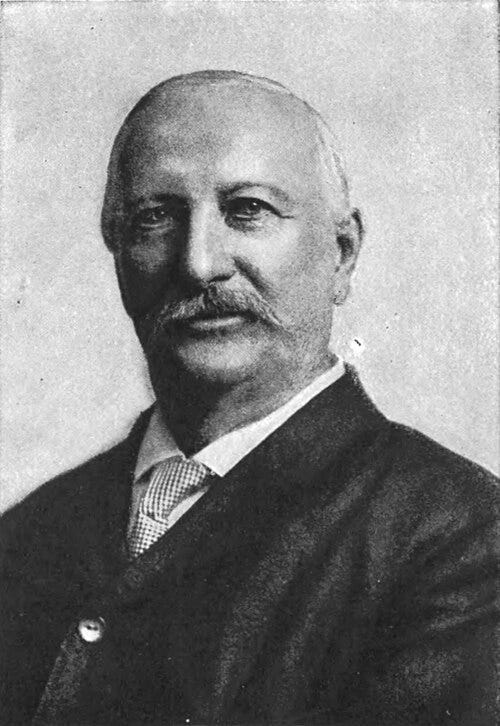
Rice did everything capitalism tells us a businessman should do. He sued, testified before Congress, and participated in this little prosocial experiment of ours called democracy. He also adapted. When the railroad became unusable, he laid his own pipeline to the Muskingum River and moved his oil by boat.
But here was the trap: Rice remained perfectly free to compete with Standard Oil, provided he first built his own transportation infrastructure. That was like being told you can enter a footrace as soon as you finish building the track the other runner already controls.
And still Rice lost.
Standard could lower prices where Rice had customers, absorb the temporary losses, pressure buyers, exploit favorable railroad rates, and use its enormous size to squeeze him from multiple directions. Rice spent years chasing Standard through courtrooms, congressional committees, and newspaper columns. In 1898, the New York World published his account under a title that left little room for interpretation:
“How I Was Ruined by Rockefeller.”
He was not the only one.
Farmers watched railroad companies determine what their crops were worth by controlling the cost of moving them. Shopkeepers found themselves squeezed by trusts that could dictate wholesale prices. Workers could leave a dangerous employer only to discover that the same company owned the next mine, mill, or factory in town. Independent businesses were technically free to compete with corporations that controlled the railroad, the pipeline, the bank, the warehouse, or all four.
This is the part of the Gilded Age Americans tend to flatten into a morality play about greedy men. Greed was not new. You could even argue that capitalism and greed move in lockstep. No, the danger came from infrastructure that failed to rein in the greed.
The railroad was not merely another company. It was the road every other company needed. Control the road, and you did not have to defeat your competitors by making a better product. You could simply charge them more to reach the customer. You could delay their freight, deny them cars, learn where they shipped, and undercut them when they arrived.
Today’s monopolists are more omnipotent because they do not even need to own the railroad. They own the marketplace, the app store, the social graph, the advertising exchange, the search engine, the payment system, and the algorithm deciding whether a customer ever discovers that George Rice exists.
Eventually, the public got fed up. One George Rice could be dismissed as a socialist crank. Thousands became a political problem.
So farmers and workers organized. Small businesses testified. State governments created railroad commissions. Journalists began connecting grievances despite powerful companies doing their best to keep the public ignorant.
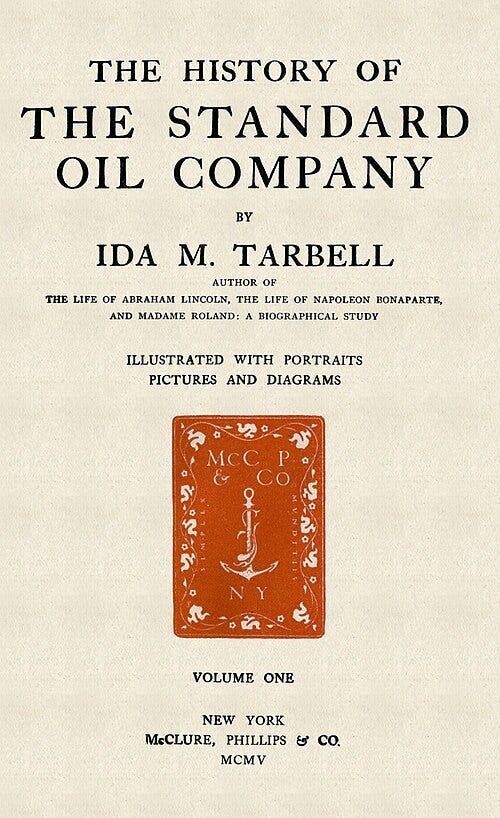
Then writers like Ida Tarbell made the pattern impossible to ignore.
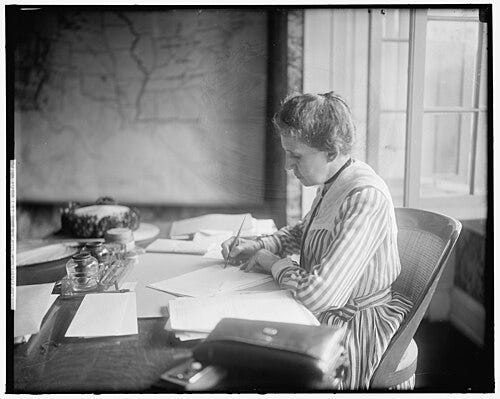
Tarbell did not invent the case against Standard Oil. People like Rice had been building it for years. What she did was gather the rebates, contracts, acquisitions, testimony, and ruined competitors into a story ordinary Americans could understand.
Everyone had been receiving a different bill and was being told a different story. The muckrakers made the bills add up and kept the story simple — Corporations were robbing the little guy. (Democrats should pay attention: a simple message almost always wins.)
Eventually, private frustration became public understanding, and public understanding became political pressure.
In 1890, Congress passed the Sherman Antitrust Act, prohibiting monopolization and restraints of trade.
And that solved everything.
If only. America entered its ugly baby stage. It now had to first discover that passing a law and enforcing it are separate hobbies.
Early enforcement was inconsistent. Courts often interpreted the statute narrowly. By the time the federal government finally brought some of the great cases Americans remember, the monopolies were already enormous.
Eventually, the tides turned. I am using the plural for a reason. It took a tsunami of everyday citizens to break the monopolies. However, all that complaining, organizing, suing, testifying, and muckraking became impossible for politicians to ignore. Farmers, workers, independent businesses, state regulators, and journalists had turned monopoly from a private grievance into a national political issue. Ida Tarbell’s reporting of Standard Oil exposed Rockefeller’s tricks, and Theodore Roosevelt’s administration sicked the federal government on them.
In 1906, the Justice Department sued Standard Oil under the Sherman Act.
Five years later, the Supreme Court ordered Standard Oil broken into 34 companies. American Tobacco was dismantled the same year.
However, Americans learned something more valuable: prosecuting one fully grown monopoly at a time was rather like waiting for a python to finish swallowing the goat before convening a committee on livestock protection.
So Congress created the Federal Trade Commission in 1914. The FTC’s job was not simply to punish monopolies after they had conquered an industry. The FTC received broad authority to stop “unfair methods of competition.” (We will discuss the FTC’s strengths and weaknesses in Part Two.)
The country had finally created a permanent institution devoted to watching the olive presses.
And sometimes breaking the gatekeeper worked exactly as advertised. AT&T spent much of the twentieth century controlling America’s telephone system and deciding what could connect to it. Government action gradually opened that network to outside devices, and the Justice Department ultimately forced the Bell System breakup in 1984. Competition expanded. New companies entered. Technologies once dependent on Ma Bell’s permission suddenly had room to grow.
We remember the corporation being broken. We forget the innovation that grew in the cracks.
That is the larger point of trust-busting. Competition creates room for somebody else to do something better.
George Rice never defeated Standard Oil. Sorry, I have no happy ending for George. It’s why I chose him. His tale is sufficiently grim.
However, his failure became evidence. His testimony joined other testimony. His grievance joined other grievances. Journalists connected the stories and reformers named the grift. Voters demanded laws. Government eventually acquired tools no isolated refinery owner could build for himself.
Rice was only one man. He could not break Standard Oil.
The public eventually could.
That is what Americans forget when they look at Amazon, pharmaceutical giants, hospital systems, media empires, private-equity firms, and other enormous corporations and conclude that they are simply too powerful to challenge.
Monopolies are not weather systems. Their power depends on laws, courts, regulators, mergers, contracts, political choices, and our willingness to keep treating every outrageous bill as an unrelated act of God.
The work begins the same way it did before: people compare notes and then act.
First we stop worshiping billionaires. They are not special. They are not smarter. They simply have higher Machiavellian intelligence. Sorry to be the one to wreck the American dream of becoming a billionaire, but most billionaires have psychotic tendencies. You have to have that personality type to worship money over people.
Next we get organized — workers, patients, tenants, consumers, small businesses, lawyers, journalists. We do not need another lone Ida Tarbell. We need an Ida Tarbell army finding the George Rices and showing millions of people that their private frustration has a public cause.
For a while, America understood that. Then we started forgetting that democracy was a participation sport. Even in the high-turnout 2024 presidential election, 34.7 percent of voting-age citizens did not cast a ballot. The people who own the olive press have every reason to hope the rest of us stay home.
Today, the olive presses have quietly reassembled. The laws did not disappear. However, the Federal Trade Commission can still rein in monopolies.
And that is where the fearless Lina Khan enters the story…
In Part Two, we will examine how Lina Khan woke the watchdogs and how Republicans may have accidentally made it easier for the next president to unleash them.

Carlyn Beccia is an award-winning author and illustrator of 13 books. The Grim Historian is a reader-supported publication. To receive new posts and support my work, consider becoming a free or paid subscriber.
No posts
Comments
Nothing yet. Say the first thing.
Sign in to join the conversation.