
Grim Reminder: A Grim Historian is a reader-supported newsletter and depends on your 5$ donations to keep the most depressing politics and history in your inbox. Please consider becoming a paid subscriber or sharing with someone who loves misery.
In January 2017, a Yale law student published a 96-page paper with the seemingly demure title “Amazon’s Antitrust Paradox.”
This would not ordinarily be how one begins a revolution.
Her name was Lina Khan, and she argued that generations of very serious people had forgotten what monopoly meant.
For decades, American antitrust enforcement had connected the dots from monopolies to consumer prices. So if a gigantic corporation was giving customers cheap products, economists and judges were inclined to see functioning competition. Amazon posed an awkward problem for that logic because Amazon was extremely good at making things cheap.
Khan asked everyone to look somewhere else.
Khan’s revolution began with a hard question: What if the danger was not what Amazon charged customers? What if the danger was that Amazon was simultaneously a retailer, marketplace, logistics network, advertising platform, infrastructure provider, and competitor to businesses dependent upon those systems? A company could keep prices wonderfully low while positioning itself at the center of commerce, collecting information from the businesses passing through it, and acquiring the power to determine who could compete tomorrow.
That was the central challenge in Khan’s paper. Modern antitrust had become so fixated on short-term prices that it was failing to recognize the architecture of market power. Khan argued competition should protect the competitive process, not merely produce a cheap toaster every quarter.
As discussed in Part One, Khan was describing the monopoly olive press.

Four years later, Joe Biden handed her the Federal Trade Commission. Khan became FTC chair in June 2021 at age 32. That alone was unusual. Washington generally prefers its regulators old enough to require a proof-of-life photo.
Maybe that’s why Republicans never saw her coming.
One of her biggest kills was bloodless. Khan’s FTC sued to block the $24.6 billion merger of Kroger and Albertsons — the largest supermarket deal in American history. She won, and by December 2024, a federal judge killed the merger. (The two chains immediately turned on each other, with Albertsons suing Kroger for billions.)
One of Khan’s cleaner victories came against Nvidia. In 2021, the chip giant tried to buy Arm for $40 billion. The problem was that Arm licenses the basic chip designs that many of Nvidia’s own competitors rely on. Let Nvidia buy Arm and suddenly one competitor would own the technology everyone else needed to compete.
Khan’s FTC sued to block the deal, arguing that Nvidia could use control of Arm to hobble rivals and choke off future innovation.
Two months later, Nvidia walked away.
Thales would have understood the temptation perfectly. Nvidia was trying to buy the olive press.
Khan kept on swinging. She gutted noncompetes. She dragged the three pharmacy-benefit managers who ransom your insulin into court. And she went straight for the jugular of the private-equity firms devouring entire medical specialties whole.
Some of it stuck. Some of it got shredded in court. All of it terrified an industry that had spent decades enjoying a docile FTC that mostly filed paperwork and went home.
But to understand the battles Khan faced, it helps to remember why and how the FTC was formed. Let’s break for some grim history…
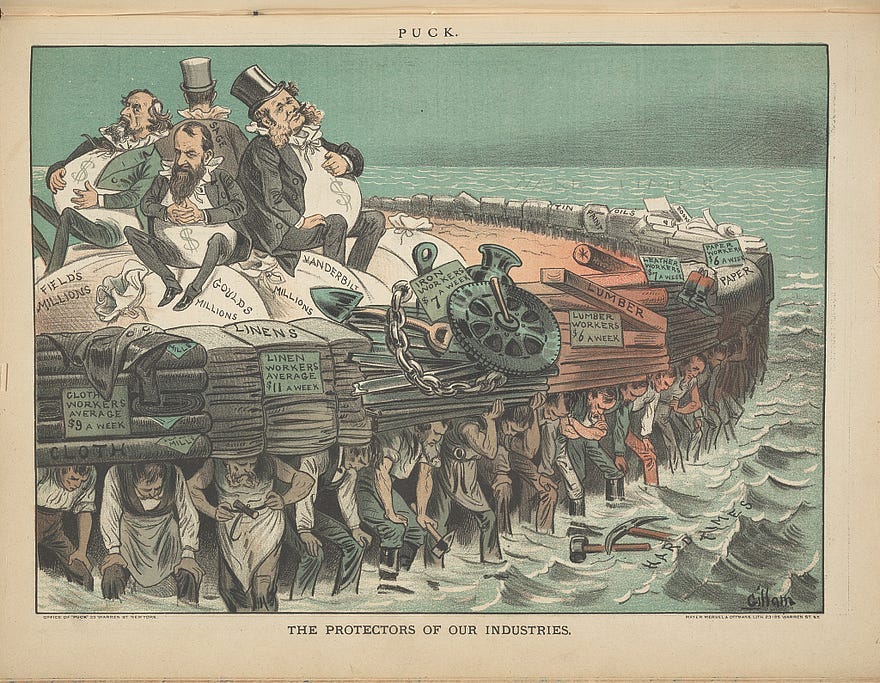
As discussed in Part One, in 1890, Congress passed the Sherman Act. Then Americans discovered the same problem that appears whenever Congress congratulates itself for passing something: legislation is considerably less intimidating when nobody enforces it.
By the early twentieth century, the country had watched trusts acquire competitors, manipulate transportation, and control supply chains. Many had grown large enough that suing them after they reached maturity seemed absurd.
So in 1914, Congress created the Federal Trade Commission specifically as part of the campaign to bust the trusts. President Woodrow Wilson signed the FTC Act on September 26, 1914. The agency opened the following March.
Originally, Congress gave the FTC authority to prevent “unfair methods of competition.” The phrase — unfair methods of competition —was wonderfully broad because Congress had finally learned something about monopolists.
They innovate too.
That’s the part people forget. The FTC was designed to investigate commercial conduct and act before every new corporate trick required its own special act of Congress. Write a law prohibiting Trick A and a sufficiently motivated corporation will have Trick B through legal review before lunch. The FTC existed partly because government needed an institution capable of recognizing the strangling of competition even when the strangulation technique had not been specifically named in 1890.
On paper, the FTC’s structure has not changed much since 1914. The agency runs differently from a normal cabinet department. Five commissioners serve staggered terms, and no more than three may belong to the same party. More importantly, for ninety years, a commissioner could not be fired simply because a president disliked their rulings.
There was a reason for that insulation.
An agency empowered to investigate the richest and most politically connected corporations in America probably should not become the personal enforcement squad of whoever happens to occupy the White House. Put a pin in that ideal.
During the late twentieth century, competition policy increasingly revolved around the consumer-welfare standard, with particular attention to prices and output.
There was logic to this. Antitrust law should not exist merely because regulators find a corporation offensively large.
But something important got lost in the size debate.
A company could control infrastructure without immediately raising prices. It could buy a future competitor before the competitor became dangerous. It could dominate a labor market and suppress wages rather than raise consumer prices. It could operate the marketplace while competing against the businesses inside it. It could offer a free service while accumulating extraordinary power over advertising, data, information, or access to customers — what Cory Doctorow coined “enshittification.”
The olive press had become invisible because no one charged admission to see it.
Khan’s 2017 paper landed because she exposed the weakness so clearly. Her argument was not that consumers had received nothing from Amazon. Quite the opposite. Amazon had delivered enormous benefits to customers. Her point was that cheap prices alone could not tell us whether a market remained competitive.
That sounds obvious once someone says it. Apparently, we needed a Yale Law Journal article to shine a black light on it.
Khan’s tenure was messy. I don’t want to sugarcoat it. She lost important cases. Judges rejected some of the FTC’s more ambitious arguments. She made mistakes and enemies. Critics accused her of stretching antitrust law beyond what courts would permit. A regulator challenging decades of settled doctrine was always going to accumulate bruises, and Khan took her share of hard knocks.
But evaluating her solely by a courtroom win-loss record misses what made her threatening.
She was trying to change the question.
Instead of asking only whether a merger would make something five dollars more expensive next week, the FTC asked what happened to the market’s structure. For example, would workers have fewer employers, as the FTC argued would happen if Kroger swallowed Albertsons? Could a company suppress wages by preventing workers from taking better-paying jobs, as Prudential Security did with low-wage guards? Was private equity quietly buying up local competitors, as Welsh Carson did with anesthesia practices across Texas? Could a dominant corporation simply purchase tomorrow’s rival, as Facebook did with Instagram and WhatsApp?
In other words, she was reviving the older American idea that concentrated economic power can be dangerous before the monopolist sends you the bill.
The noncompete rule was a particularly revealing example. In 2024, Khan’s FTC declared most employer noncompete clauses an unfair method of competition. Essentially, Khan’s FTC argued that workers should be able to leave one employer and work for another, rather than discovering that their boss owned an invisible fence around their careers.
Sounds reasonable, right? Hold that thought.
Courts later blocked the rule, and the subsequent FTC under Trump abandoned the fight. But the policy illustrated what Khan thought competition law was for: not merely keeping prices low, but keeping markets open enough that ordinary people could actually move through them.
Khan’s eagle-eyed FTC saw concentrated power elsewhere — in places most consumers never see. That is why Lina Khan became every American corporation’s worst nightmare. So Republicans fought back the only way they knew how…they changed the rules.
Khan’s term as chair ended on January 20, 2025. Trump designated Republican commissioner Andrew Ferguson to replace her. Unlike most of the watchdogs Trump dislikes, Khan was not fired. Her term as commissioner had simply expired.
Then Trump went further.
In March 2025, Trump fired the FTC’s two Democratic commissioners, Rebecca Slaughter and Alvaro Bedoya. For ninety years, Humphrey’s Executor had protected FTC commissioners from being fired simply because a president disliked their policies.
Ah, the good ole’ days.
Of course, Trump could have replaced those vacant seats with just more agreeable Democrats and restored at least the appearance of bipartisan balance. But what fun would that be for an oligarchy? So instead he simply left their seats empty and ran the FTC with all Republicans.
Bedoya eventually resigned his claim. But Slaughter fought her termination all the way to the Supreme Court. Unfortunately, she lost. On June 29, 2026, the Court ruled in Trump v. Slaughter that the old protection could no longer stand. Presidents could fire FTC commissioners over policy differences.
Today, the FTC has only two commissioners — Andrew Ferguson and Mark Meador, both Republicans. Three seats are vacant. So far, the Trump regime has made no plans to fill those seats.
The outcome is chilling for a free market. Now, a president can fire commissioners from the opposition and operate the agency without replacing them.
There is just one small complication.
Presidential power changes owners.
For the moment, the decision gives Trump far greater ability to shape the FTC around his agenda. That is precisely what his pay-to-play, mob rule regime wanted.
But constitutional rules do not expire when Democrats win elections.
A future Democratic president would inherit the same removal power. Heck, that future president might even grow a pair. Now imagine an incoming administration determined to revive aggressive antitrust enforcement. That Democratic controlled Congress could decide it doesn’t need to spend years waiting for staggered FTC terms to expire.
Of course, there are still constraints. FTC nominees require Senate confirmation, and federal law still limits the number of commissioners from the same political party to no more than three. Courts still decide cases. Congress still controls statutes and money. Corporate defendants will continue arriving with enough attorneys to constitute their own municipal government.
However, Republicans have demolished one of the biggest obstacles facing the next Democratic president: the clock.
Under the old system, a president who inherited an FTC full of commissioners appointed by the previous administration might have to wait years for their staggered terms to expire.
Not anymore.
A Democratic president could do exactly what Trump did: fire commissioners whose antitrust agenda conflicts with the new administration’s, leave those seats vacant, and run the FTC with the commissioners who remain while a friendly Senate confirms replacements.
In other words, federal law still says no more than three commissioners may belong to the same political party. But it does not require all five seats to be filled. Nor does it require the other two commissioners to believe monopolies are wonderful.
So imagine three Democratic commissioners chosen because they share Lina Khan’s appetite for trust-busting. Then imagine two independents or Republicans who happen to agree with them about concentrated corporate power.
Do the math. That’s five Lina Khans.
The irony is almost Aristotelian. Republicans wanted a president who could remove regulators blocking its agenda. They persuaded the Supreme Court to give presidents a much freer hand. Now they have done the same with the FTC.
They may have assumed the hand would always belong to them.

Carlyn Beccia is an award-winning author and illustrator of 13 books. The Grim Historian is a reader-supported publication. To receive new posts and support my work, consider becoming a free or paid subscriber.
No posts
Comments
Nothing yet. Say the first thing.
Sign in to join the conversation.