
Last Sunday, while spending time on the only social-media platform I use these days, Substack, I came across this: You actually need the money first to discover it wasn’t really about the money.
So, I shared with few of my friends and family. Now, if you see this is bit funny because most of us recognise the sequence. We often assume meaning is something we can identify first and then organise our lives around. But the obsessive search for meaning can itself get in the way. Meaning often appears later, as a by-product of being fully engaged in the work, the relationship, in the pursuit itself.
You do not always find meaning and then act. Sometimes you act long enough to discover what the meaning was.
Then, I started extending the core, across other vertical of life.
Like, you need to build the company before understanding whether you wanted wealth, independence or the pleasure of making something exist. You sometimes need to obtain what you were pursuing before discovering that you had misunderstood the desire itself.
As we grow older, and especially as we become more successful, we accumulate confidence faster than we discard old explanations.
And with confidence come opinions.
The corporate world has an almost instinctive preference for addition. More revenue, customers, products, employees, markets, responsibilities. Careers themselves are described additively: larger teams, larger financial rewards.
A Bartleby column in The Economist once argued that managers systematically underappreciate subtraction. Good management can mean deleting meetings, killing mediocre projects and shrinking product ranges. Peter Drucker called for “planned abandonment”: regularly asking whether, knowing what you know today, you would still choose to enter an activity you are already in.
Well, we have been here before in another form. In Age of Abundance, I argued that abundance does not remove scarcity; it moves it.
Perhaps opinions are going through the same transition. We are producing more of them, faster and at lower cost.
As we grow older, we accumulate positions. On politics. Parenting. Work. Markets. Technology. What young people are doing wrong. What makes companies successful. Which professions AI will replace.
There is status in having an answer. “I don’t know enough about this” sounds strangely inadequate coming from someone important.
Now, these opinions/views keep accumulating. Each seemed reasonable when added. But then, few are periodically reviewed.
I also wrote recently that a good failure damages the original fantasy. A good piece of contradictory evidence should do something similar to an opinion.
“This is why failure is more interesting than foresight. Foresight flatters the planner. Failure corrects the plan.” Read More
As theGreySwan is growing, I often get approached for few things, like cross posting, and at time for coming on podcasts. Last month, when someone asked if I would come on her show, I declined. My answer was: I don’t think I have enough settled views to play that role. She asked why.
See, when you are writing something, you are exploring, thinking, and learning from second-order effects, i.e. changing the shape of the argument as readers push back or add something I had missed. A podcast is different. Guest has arrived with opinions. You are there to explain it, defend it, make it memorable or controversial.
And, the difficulty is that opinions change character once we announce them.
Before I tell anyone what I think, contradictory evidence is cheap. I can absorb it, change direction and move on. Once I have written the article, made the investment, defended the strategy to the board, recommended the person or spent two years arguing the same position, the evidence arrives with another variable attached: what does accepting this now cost me?
The belief has acquired a social balance sheet. Reputation may be tied to it. Money, career decisions, colleagues, followers, perhaps an entire group that knows which side you took. The sunk cost is no longer only financial. It is autobiographical. Changing your mind can mean admitting that an earlier version of you, perhaps a very successful one, no longer has the right map.
This creates an intellectual cul-de-sac -a line of thought, theory, or research that leads to a dead end.
We can keep going further in because every additional argument increases the mental cost. Each defence makes retreat harder because more of our judgment, reputation and past decisions now sit behind it. Intelligence offers less protection than we like to think.
Do read Bonhoeffer’s idea of stupidity. His concern was not low intelligence, rather what happens when independent judgment gets surrendered to authority, identity or the group.
Companies do a version of this most of the time. A belief works, gets repeated, then gets embedded in hiring, incentives and strategy. Customers want branches. High-value clients need a relationship manager. Our distribution is the moat. None of these had to be foolish when first formed. Some may have been right for years. That success is what makes them difficult to question later. Because yesterday’s successful opinion often becomes today’s operating system.
During Covid, I read a book- Deep Survival by Laurence Gonzales, while I will NOT recommend the book, but the core of the book is an interesting plot to bring here:
In life-threatening situations, the people who survive are rarely the strongest or most experienced, rather the ones who can abandon their mental model when reality contradicts it.
So, maturity may require deliberate subtraction.
There is a real difference between I believe this, this is my current working hypothesis, and I don’t know. We often collapse all three because adult life rewards certainty and penalizes hesitation.
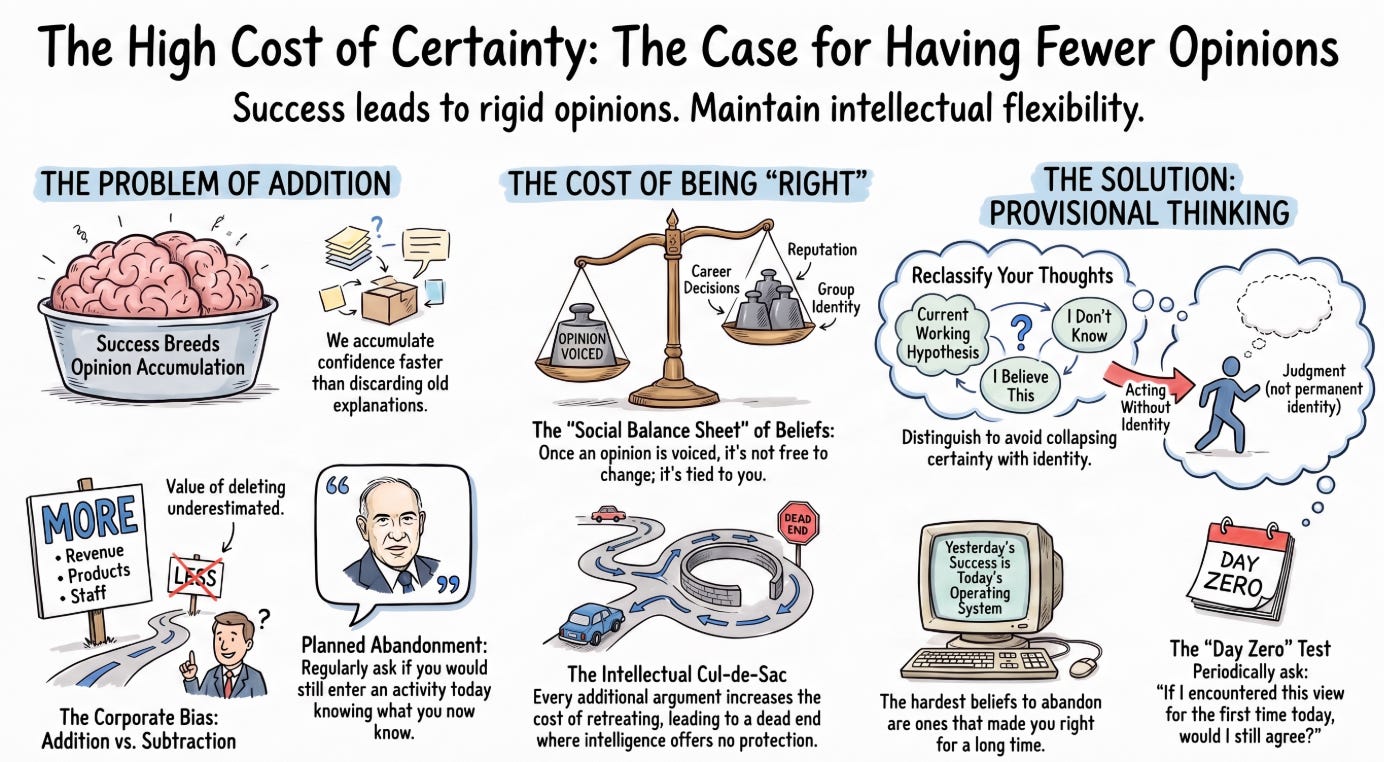
We have to keep some beliefs provisional, especially the ones that have started becoming part of how we describe ourselves. By detaching our ego from our past judgments, we remain open to new evidence and personal evolution.
Perhaps the real game is: to act without converting every judgment into identity.
And keep asking, from time to time:
If I encountered this view for the first time today, would I still agree with it?
It’s me, Sid. You can connect with me at sid@enrichdata.in, or LinkedIn, X.
No posts
Comments
Nothing yet. Say the first thing.
Sign in to join the conversation.