
Last summer, I faced a decision no one ever wants to face: the possibility of a third open-heart surgery in a row.
After my second operation, I developed a staph infection. When that appears after cardiac surgery, the consequences can be devastating. So, the debate began:
Was the infection inside the graft? the artificial tubing replacing my swollen aorta.
Or was it in the sternal hardware? the wires, plates and screws holding my chest together.
If it was the graft, surgery was the only path. But another option existed: a long, intensive course of antibiotics that might, just might, be enough to eradicate the infection without re-opening my chest. Either way, we would never truly know.
It became a high-stakes medical standoff. It was surgery versus science and intervention versus patience.
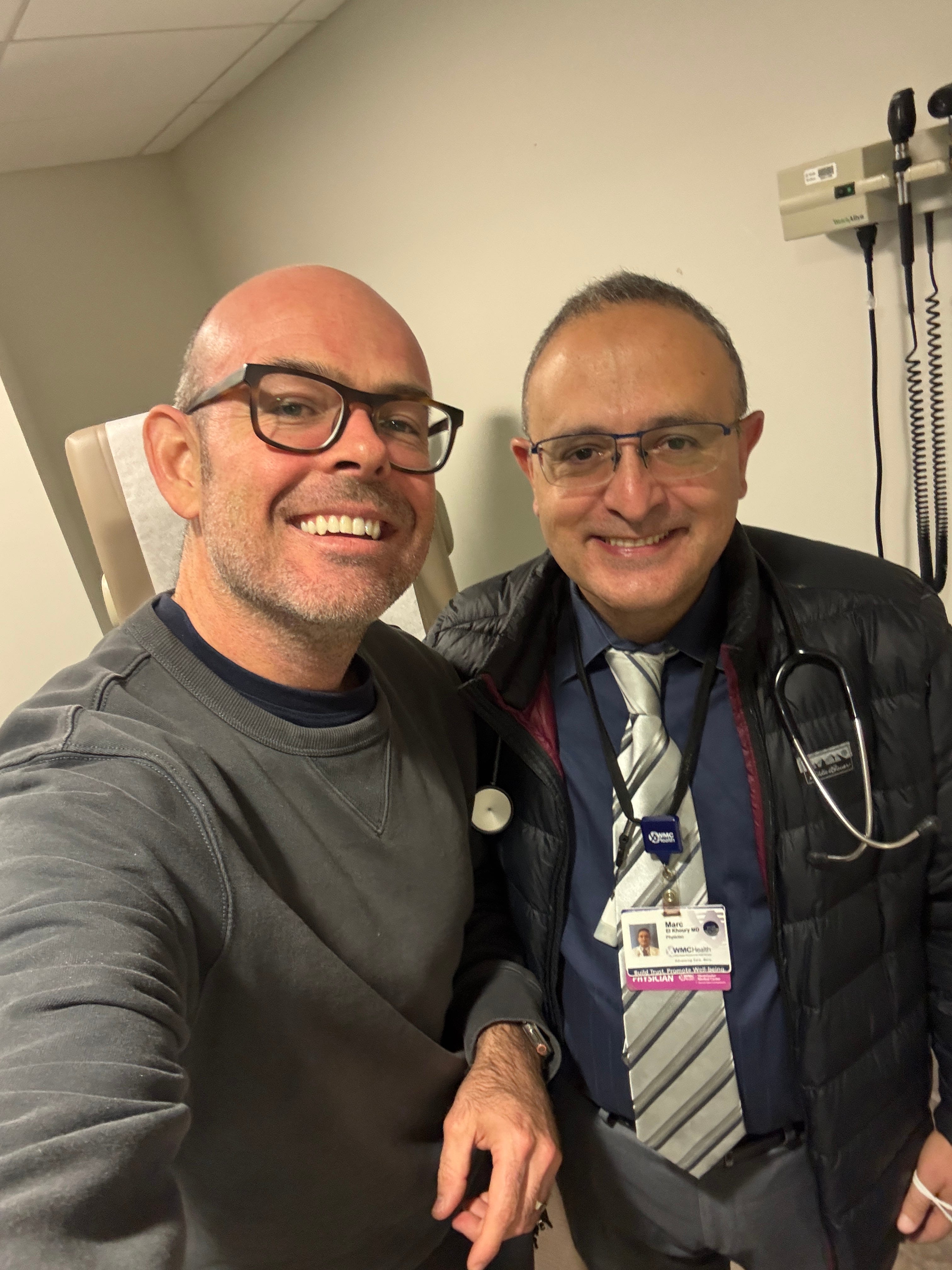
Enter Dr. Marc El Khoury, Chief of Infectious Disease at Westchester Medical Center, NY. He was calm, thoughtful, and quietly certain. While my Cleveland Clinic surgery team and Dr. El Khoury both believed another surgery wasn’t necessary, the Westchester surgeons saw it differently and leaned toward operating again. Even though it would ultimately be my decision, the surgeon’s recommendation carried enormous weight. Dr. El Khoury stood firm, he was convinced the infection could be treated with an intensive, targeted antibiotic plan. His approach was precise, layered, and aggressive:
Broad-spectrum antibiotics first, then targeted ones once cultures came back, followed by six weeks of home IV infusions, and then twelve months of oral antibiotics to complete the mission.
It wasn’t the easy route. It required endurance, discipline, and alot of trust. But he saw something that others didn’t. He saw a path to healing that didn’t require another trip to the operating table.
Today, that decision looks prophetic.
I’ve been off antibiotics for four months. My latest bloodwork showed no sign of inflammatory markers, indicators of an infection. One absolute final test in two months will confirm the all-clear, but our confidence is high.
And the truth is, I might not be here, or at least not here in the same way, if not for Dr. El Khoury’s conviction.
In that moment, I had to find my own conviction too.
When the question of a third surgery was raised, I remember saying to both my surgeon and Dr. El Khoury:
“I will not go through a third open-heart unless you tell me my life depends on it.”
That wasn’t about me trying to rebel. It was self-preservation. It was informed partnership. It was trust. Trust in myself, in the data, and in the doctor willing to think differently.
This experience became a lesson in self-advocacy. Patients often feel powerless in the hospital setting, swept along by clinical protocols that seem immovable. But informed advocacy doesn’t mean fighting your care team… it means joining it. It means asking the right questions, exploring the alternatives, and standing firm when you know your body and your limits.
Here’s the twist I only shared with Dr. El Khoury last week, a year and a half later.
During that same debate, I ran the scenario through the AI I had built. A system trained on my complete medical history, surgery notes, radiology reports, and bloodwork. I described both options clearly:
A third open-heart surgery to replace the graft.
An extensive course of intravenous and oral antibiotics.
AI’s conclusion?
Do not operate. Treat the infection.
It matched Dr. El Khoury’s recommendation exactly.
When I told him that last week, he laughed and said simply, “Good.”
That one word, good, carried an entire philosophy within it. Because what saved me wasn’t just medicine. It was the combination of human wisdom and machine insight working in harmony, both grounded in compassion and reason.
This is what The Future Patient stands for … humans and technology working together to strengthen care, compassion, and connection.
Healing isn’t just about the right medicine, to me it’s about the right voices in the room. Informed voices that question. Voices that collaborate. Voices that care enough to consider what’s possible before deciding what’s necessary.
Dr. El Khoury didn’t just treat an infection with this, he protected a body that had already endured enough. And AI didn’t just analyze data, it confirmed a path that was both medically sound and humanely right for me.
When I think about what the next generation of healthcare should look like, I think about that moment:
- a patient saying no to unnecessary trauma,
- a doctor saying yes to a thoughtful alternative,
- and an AI system quietly validating the wisdom of both.
Is that the care model of the future? I hope so, because in my case, it quite literally saved my life.
John Duffield
TheFuturePatient
No posts
Comments
Nothing yet. Say the first thing.
Sign in to join the conversation.