
Happy Tuesday! The Rule of 40 has become one of the most widely used frameworks for evaluating software companies, but most discussions rely on public company data. Standard Metrics Private Market Report: Rule of 40, Revisited analyzes more than 1,300 venture-backed private companies with at least $1 million in annualized revenue to examine how the framework actually looks in today’s private markets. The report finds that relatively few venture-backed companies currently clear Rule of 40, and those that do usually achieve it through growth rather than profitability. It also shows that AI companies continue exhibiting operating profiles that differ from the broader private market. More below!
AngelList - As VC firms scale their institutional LP base, finance is no longer just back-office hygiene—it’s a strategic advantage. AngelList’s fund admin operates like an outsourced COO, streamlining operations, meeting institutional diligence standards, and delivering timely, accurate reporting. See why 25k funds and syndicates trust AngelList.
Pliancy - Experience the freedom of IT that just works. Partnering with Pliancy means regaining the time & energy to focus on your mission—without having to worry about the day-to-day tech that makes it possible. Discover why VC firms from coast to coast choose Pliancy (or ask about us in VCBC).
Airstream Alpha CFO - Modern CFO support for venture funds and investment firms. With 50+ CFO mandates, Airstream Alpha brings structured, tech-forward oversight and guidance to fund finance, from reporting and compliance to service-provider coordination, so partners stay focused on investing and LP relationships. Learn how funds work with Airstream Alpha from first close through scale.
Before looking at the report, it’s helpful to define the framework.
What Rule Of 40 measures:
Rule of 40 combines a software company’s annual revenue growth rate and profit margin into a single performance metric.
A combined score of 40% or higher is commonly used as a benchmark for balancing growth and profitability.
For example, a company growing 50% annually with a -10% profit margin would score 40, as would a company growing 20% with a 20% profit margin.
While originally popularized for public SaaS companies, the framework is now widely used across software investing.
What this means:
Rule of 40 provides a simple way to evaluate whether a company is generating enough growth to justify its current level of profitability. The Standard Metrics report examines how this framework applies across more than 1,300 venture-backed private companies, helping investors understand how Rule of 40 looks in today’s private markets.
What the data shows:
Standard Metrics analyzed 1,377 private companies with more than $1M in annualized revenue.
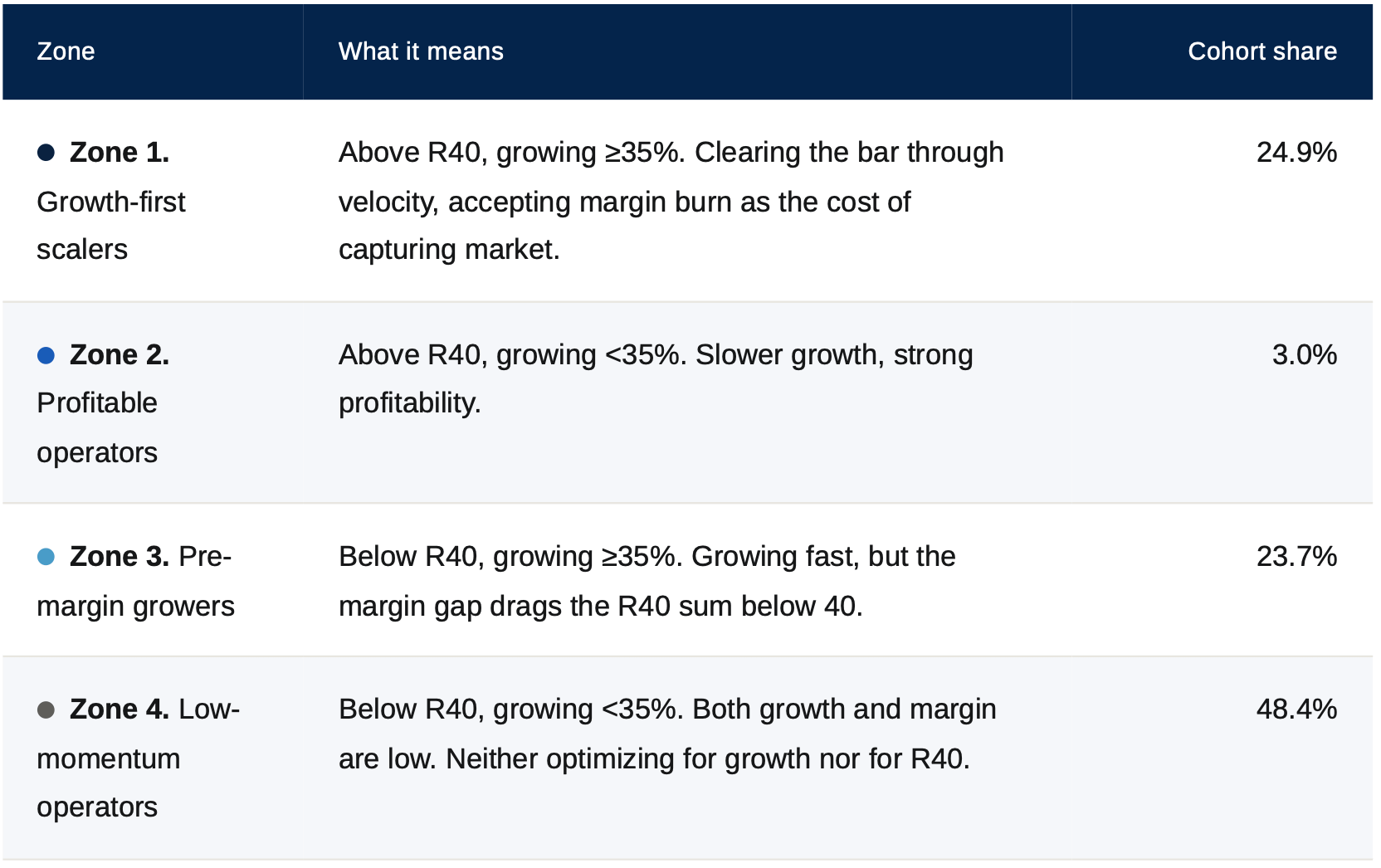
Only 27.9% cleared Rule of 40 (Zone 1 & Zone 2).
Nearly 90% of those companies reached Rule of 40 through growth rather than profitability.
Only 3% qualified as “profitable operators.”
What this means:
Passing Rule of 40 is still the exception rather than the rule among venture-backed private companies. Companies that clear the threshold typically do so by sustaining strong revenue growth while accepting lower margins rather than balancing both equally.
The score alone doesn’t explain how companies achieve it.
What the data shows:
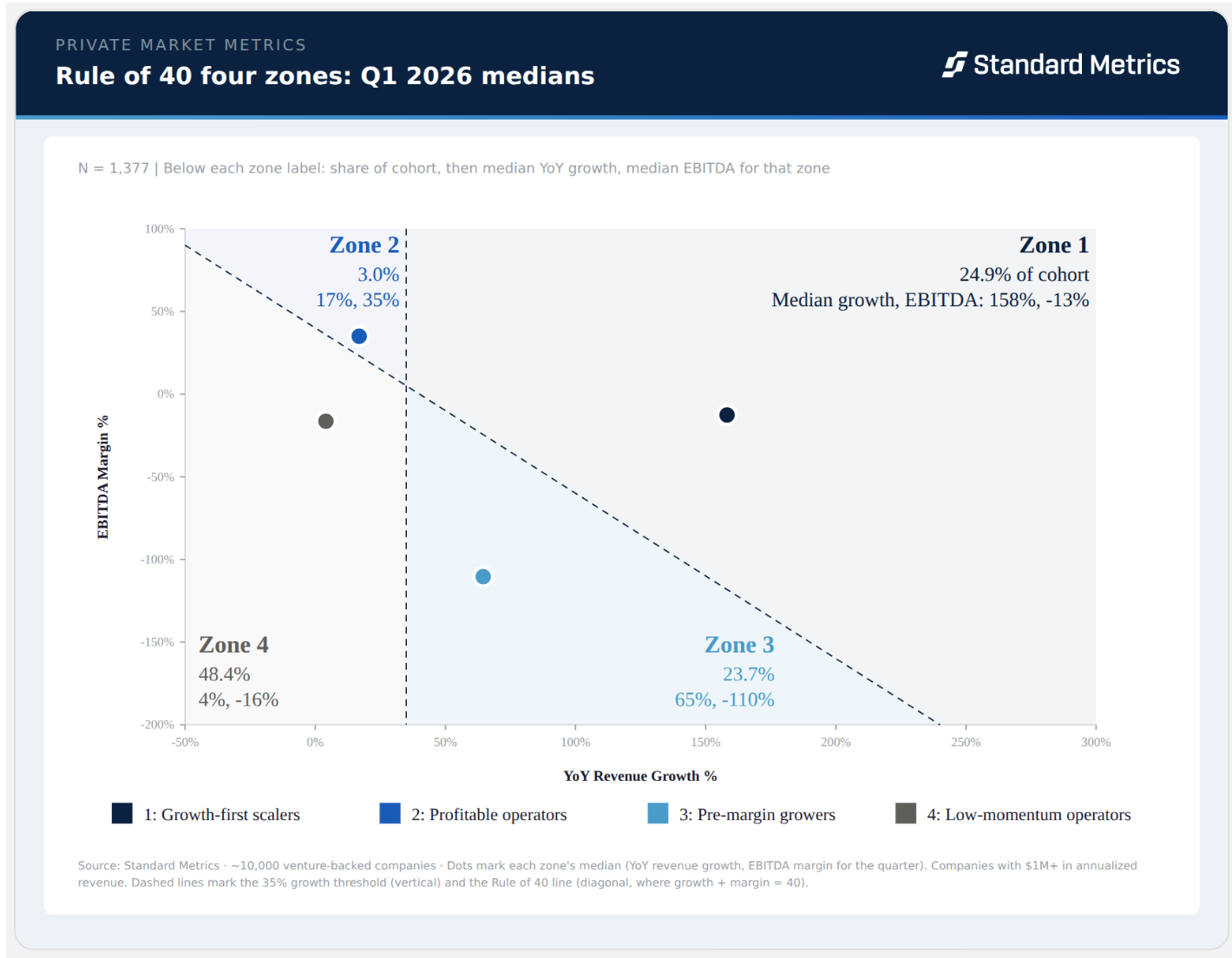
24.9% of companies fell into the Growth-First Scalers category.
Only 3.0% reached Rule of 40 primarily through profitability.
Nearly half of companies (48.4%) remained below the threshold with both slower growth and weaker margins.
Among companies that passed Rule of 40, 89% did so through growth rather than balanced profitability.
What this means:
Two companies can post the same Rule of 40 score while looking very different operationally. One may be growing rapidly with negative margins, while another grows more slowly with much higher profitability.
AI companies aren’t simply growing faster. They’re operating differently.
What the data shows:
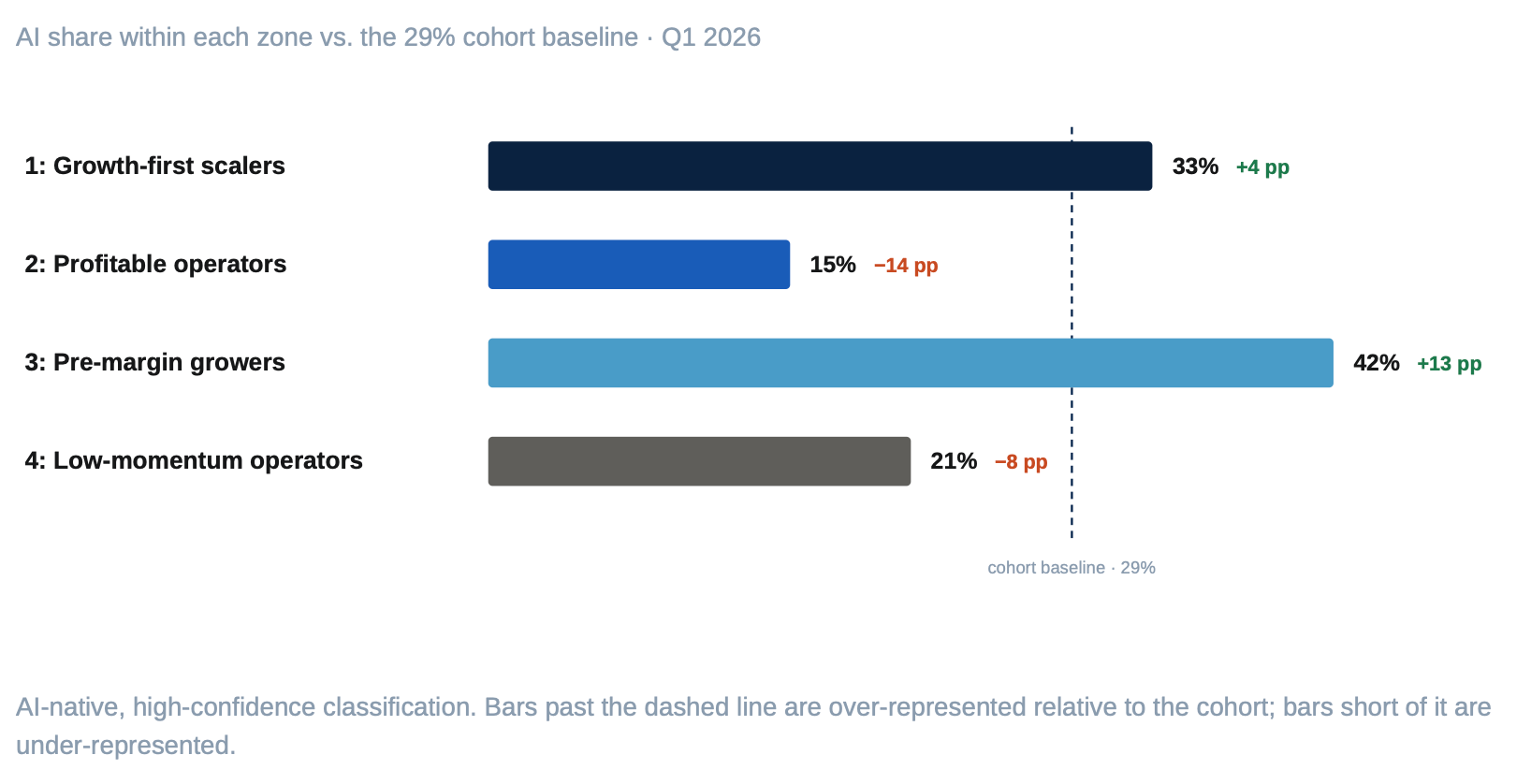
AI companies represented 29% of the companies analyzed.
AI companies accounted for 33% of Zone 1 (Growth-First Scalers).
They represented 42% of Zone 3 (Pre-Margin Growers).
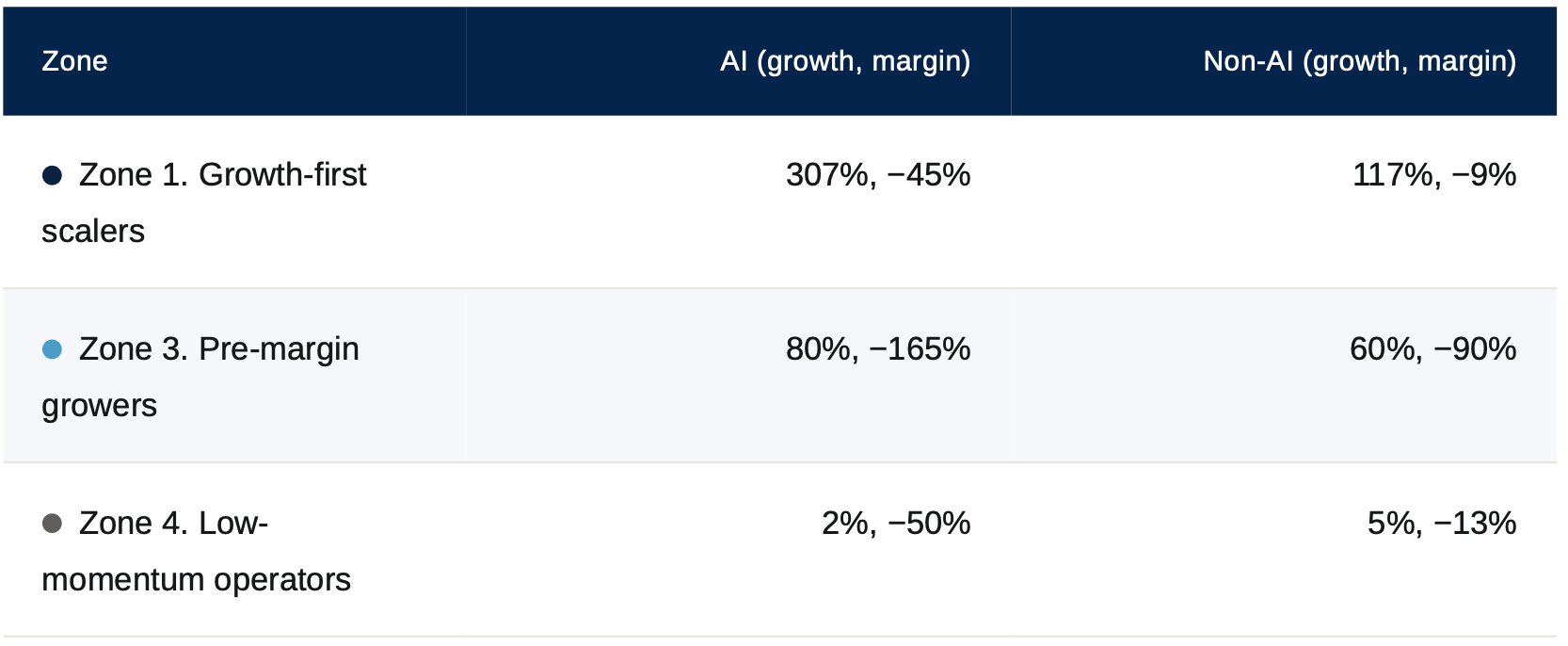
Within each zone, AI companies generally posted faster growth alongside deeper margin burn than non-AI companies.
What this means:
The report suggests investors should expect different operating profiles when evaluating AI companies. Faster growth often comes with higher investment levels and lower margins, particularly among companies still prioritizing expansion.
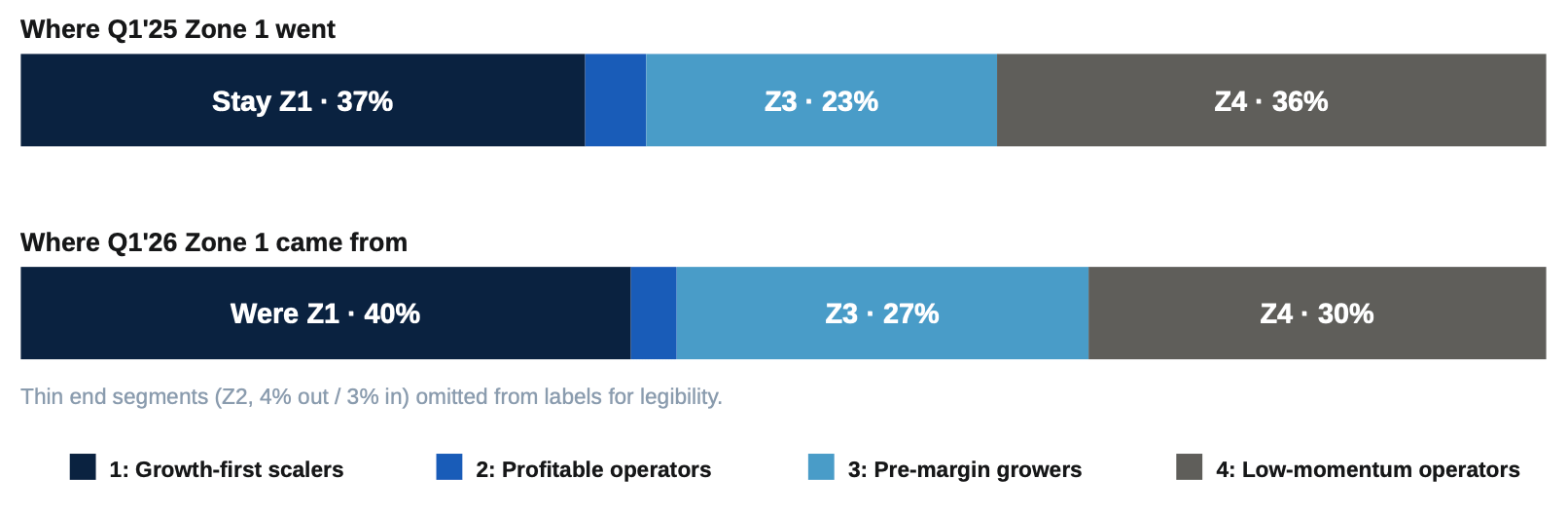
One of the report’s more interesting findings is how frequently companies move between performance groups.
What the data shows:
Only 37% of Zone 1 companies remained there one year later.
36% moved all the way to Zone 4.
23% shifted to Zone 3.
Nearly 60% of today’s Zone 1 companies were not in Zone 1 a year earlier.
What this means:
Operating performance changes more frequently than many investors assume. Companies frequently move between growth and profitability profiles, reinforcing the importance of monitoring operating trends over time rather than relying on a single snapshot.
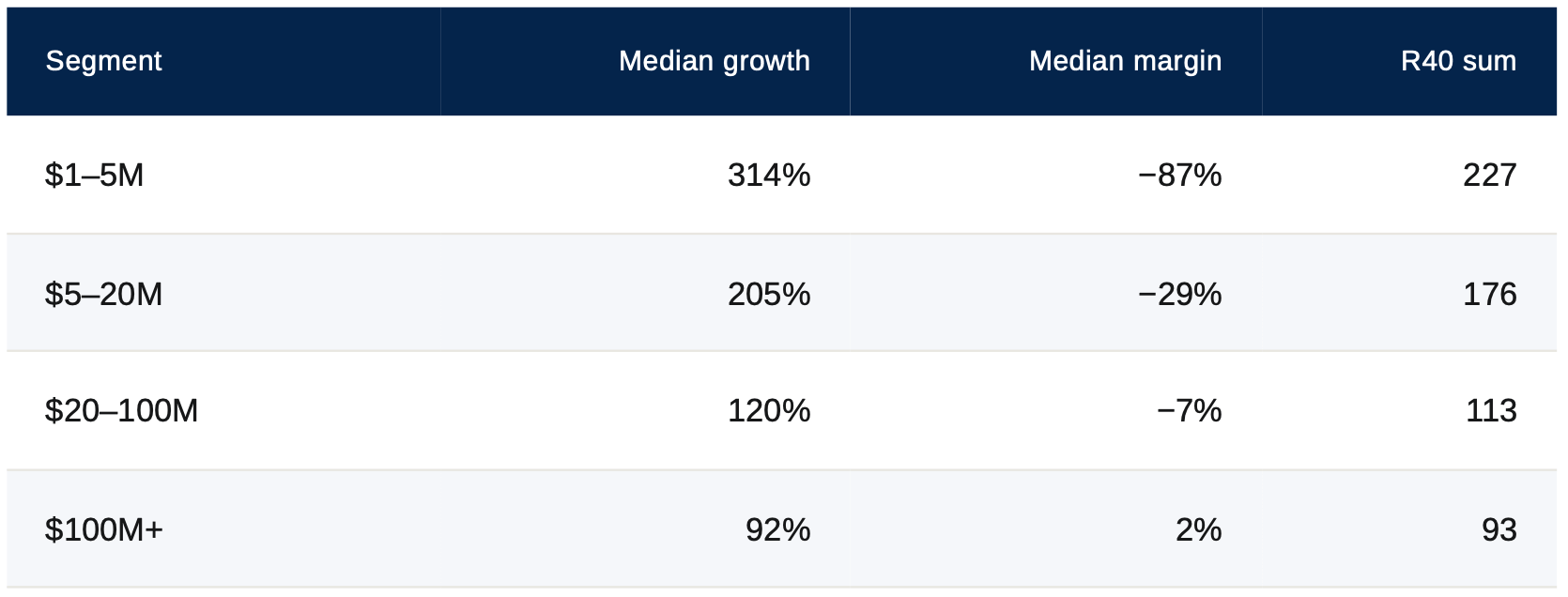
The report also shows that Rule of 40 looks different as companies mature.
What the data shows:
Companies with $1–5M in annualized revenue posted median growth of 314% with an EBITDA margin of -87%.
Companies above $100M in annualized revenue posted 92% growth with a positive 2% EBITDA margin.
Growth slowed as companies scaled, while margins generally improved.
What this means:
Companies do not follow the same operating model throughout their lifecycle. As businesses mature, growth naturally moderates while profitability becomes a larger contributor to overall performance.
Only 27.9% of companies cleared Rule of 40.
Nearly 90% of those companies achieved it through growth rather than profitability.
Rule of 40 changes as companies scale.
Company performance groups shift significantly over time.
AI companies remain concentrated in the highest-growth operating profiles.
Bottom Line: Rule of 40 remains a useful benchmark, but this report suggests the score alone rarely tells the full story. Companies can reach the same Rule of 40 through very different combinations of growth and profitability, and those operating profiles change as businesses mature. For investors, understanding how a company generates its Rule of 40 may be as important as the score itself.
That’s all for today folks! Thanks for your support and spreading the word! Share this on Twitter or LinkedIn to help grow “the crew!”
Every Tuesday/Thursday, we publish VC/CFO insights that matter - highlights from notable VC GPs, LPs, and CFOs/finance pros. Check out our VC Fund Playbooks, Models, Budgets, & Compliance Checklists @ AirstreamAlpha Products!
Need more help? Check out Fund CFO Support provided by the Airstream Alpha Team.
Love what we’re doing? Consider upgrading to paid for deeper dives on Thursdays (most paid subscribers expense these insights!). Top recent posts:
No posts
Comments
Nothing yet. Say the first thing.
Sign in to join the conversation.