
Happy Thursday! Earlier this week we reviewed CB Insights’ Q2 report (#355: Q2 Venture: Record Funding, Narrow Recovery), which showed record funding alongside slowing deal activity. PitchBook and NVCA reach a similar conclusion from a different perspective. H1 2026 investment has already exceeded all of 2025, yet much of that activity remains concentrated among AI companies, mega-rounds, and a small group of established firms. Here are several takeaways from the Q2 2026 PitchBook-NVCA Venture Monitor. More below!
AngelList - As VC firms scale their institutional LP base, finance is no longer just back-office hygiene—it’s a strategic advantage. AngelList’s fund admin operates like an outsourced COO, streamlining operations, meeting institutional diligence standards, and delivering timely, accurate reporting. See why 25k funds and syndicates trust AngelList.
Pliancy - Experience the freedom of IT that just works. Partnering with Pliancy means regaining the time & energy to focus on your mission—without having to worry about the day-to-day tech that makes it possible. Discover why VC firms from coast to coast choose Pliancy (or ask about us in VCBC).
Airstream Alpha CFO - Modern CFO support for venture funds and investment firms. With 50+ CFO mandates, Airstream Alpha brings structured, tech-forward oversight and guidance to fund finance, from reporting and compliance to service-provider coordination, so partners stay focused on investing and LP relationships. Learn how funds work with Airstream Alpha from first close through scale.
What the data shows:
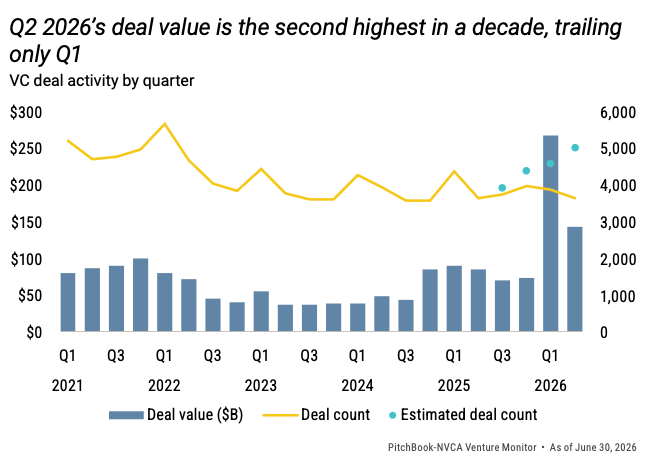
H1 2026 venture investment reached $412.7B, already exceeding the full-year total for 2025.
SpaceX completed the largest IPO in venture history at approximately $1.7T.
OpenAI and Anthropic have confidentially filed for public listings.
What this means:
Funding accelerated, valuations improved, and IPO activity returned. Much of that improvement, however, was driven by a relatively small number of exceptional companies.
The strongest headline numbers tell only part of the story.
What the data shows:
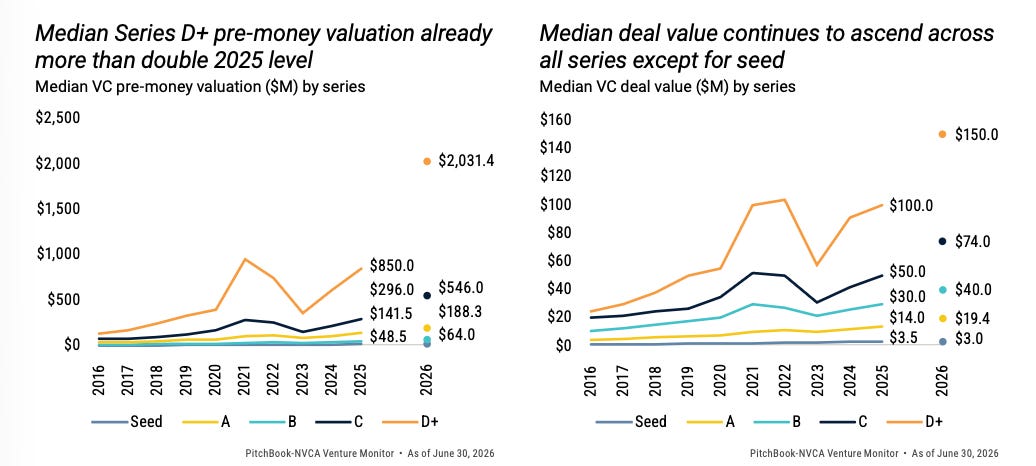
Median Series D+ valuations have already more than doubled 2025 levels.
Median deal values continued increasing across nearly every venture stage.
PitchBook estimates that 87.5% of deployed capital went into $100M+ financings, with AI accounting for the majority of investment.
What this means:
Capital remains available, but it is flowing to a much narrower group of companies than aggregate funding numbers suggest. The recovery continues, but participation remains concentrated among largest venture-backed businesses and the largest venture-backed businesses.
The same concentration appeared in fundraising.
Fundraising Concentrated At The Top
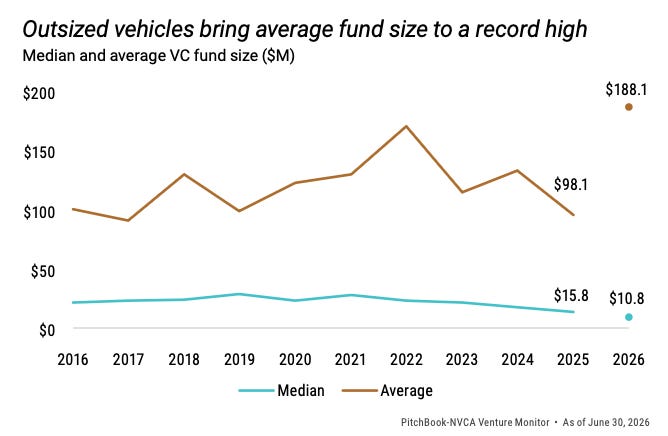
Andreessen Horowitz, Thrive Capital, and Founders Fund accounted for 48.1% of all venture capital raised during H1 2026.
First-time fund formation is on pace for its lowest level since 2016.
Emerging managers continue facing longer fundraising cycles despite improving market conditions.
What this means:
Fundraising has improved, but the benefits remain concentrated among established franchises.
As we discussed in #354: Emerging Manager Expectations (from LPs), institutional LPs continue committing capital to private markets, but manager selection has become increasingly selective.
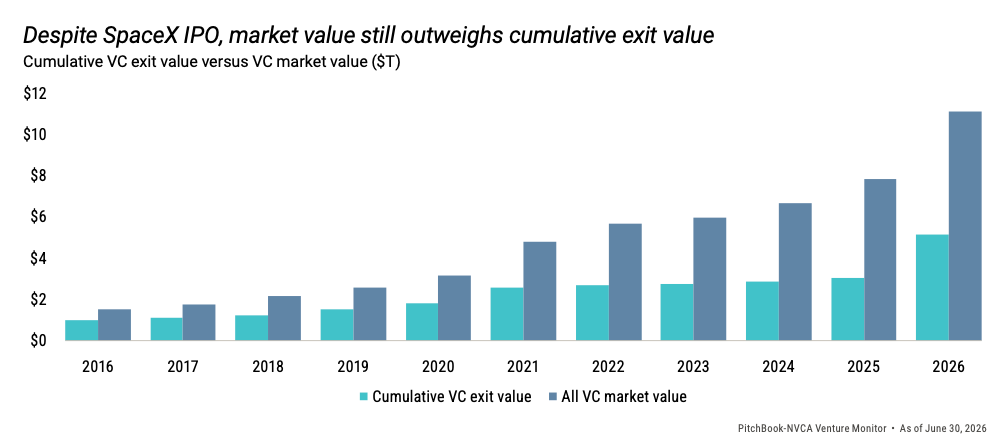
The reopening IPO market is encouraging, but distributions remain the industry’s biggest question.
What the data shows:
SpaceX generated record exit value.
OpenAI and Anthropic may further strengthen the IPO pipeline.
PitchBook notes that unrealized private-market value continues building faster than capital is returning to LPs.
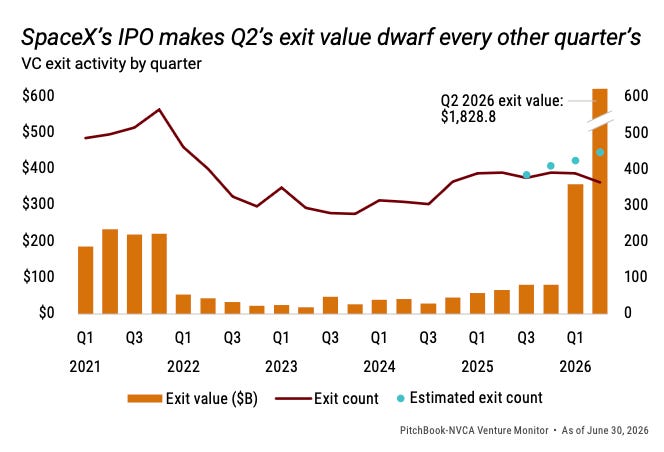
As we discussed in #347: SpaceX IPO & DPI Timeline and #349: The Rise of GP-Led Secondaries, liquidity continues improving through IPOs, secondaries, and other liquidity channels.
What this means:
Exit activity has improved, but much of venture’s value remains unrealized. Until additional companies complete IPOs or acquisitions and distributions reach LPs, fundraising conditions will likely remain uneven.
The PitchBook report reinforces a theme we’ve discussed throughout 2026: the recovery is real, but participation remains uneven.
Funding increased.
Exit activity improved.
AI investment accelerated.
But participation narrowed.
What the data shows:
Record funding alongside fewer companies raising capital.
Larger funds continued attracting a disproportionate share of commitments.
AI, mega-rounds, and established managers captured an increasing share of industry activity.
What this means:
The venture market has clearly improved from the lows of 2022 and 2023. The next phase of the recovery depends less on whether capital is available and more on whether participation broadens beyond today’s largest companies, funds, and financings.
H1 2026 investment already exceeded all of 2025.
SpaceX’s IPO marked a major milestone for venture-backed exits.
AI and mega-rounds continued attracting the majority of new investment.
Fundraising remained increasingly concentrated among established firms.
LP liquidity continues improving, but unrealized value remains high.
The recovery is real, but participation remains narrow.
Bottom Line: PitchBook and NVCA reinforces a theme we’ve seen across multiple reports this year: venture is recovering, but the benefits are not being distributed evenly. Record funding, landmark IPOs, and improving valuations point to a healthier market, but capital continues concentrating among a relatively small number of companies, managers, and financings. The next stage of the recovery will depend on whether liquidity broadens, fundraising becomes more balanced, and more companies successfully move from private value creation to public market realization.
Today’s report highlights several themes we’ve explored throughout the year: capital concentration, liquidity planning, ownership, reserves, and institutional fund operations.
Paid subscribers receive access to the same tools we use to analyze these topics, including:
VC Fund Model – Model ownership, reserves, deployment pacing, and fund returns under different market scenarios.
DPI Forecast & Premium Carry Template – Forecast distributions, secondary sales, and GP carry under multiple liquidity scenarios.
Return-to-Fund Calculator – Evaluate ownership, dilution, and fund-level outcomes before making new investments.
VC Fund Quarterly Financial Review Template – Track portfolio changes, fair value movements, and quarterly fund performance.
VC Fund Budget Template – Build multi-year operating budgets for venture firms.
Capital Call Forecast Model – Plan capital calls and cash requirements throughout the life of a fund.
Comments
Nothing yet. Say the first thing.
Sign in to join the conversation.