
Four days down in Miami Beach. Surrounded by thousands of marketers, maybe 10,000 agents, and takes hotter than the Miami sun.
Hotter, even, than a gunsight staring down an oil tanker in Strait of Hormuz… the elephant-in-the-room situation that nobody wanted to talk about on a mainstage.
POSSIBLE 2026 was a conference about AI stacks, creator economies, commerce media, and whether agencies still matter. It was also, quietly, a conference about deferred decisions... ours, our industry’s, and the ones being made for us while we hesitate.
This week’s Four Ps, the POSSIBLE recap edition, goes through what I actually saw, what I didn’t hear, what’s about to hit the supply chain whether we planned for it or not, and why I’m staying in Miami an extra few days anyway.

There were more attendees than ever at POSSIBLE this year. But for all the industry leaders who came and went, I think there were 10x more agents. At least, if you listened to the speakers from the stages.
I counted approximately... a lot. By day two I couldn’t tell you what half of them did. Every booth and every adtech company is talking agents. Every platform launched one. Every enterprise suite rolled out a “catalog of reusable agent skills” and a “coworker agent” and “open interoperability with AWS, Anthropic, IBM, OpenAI and more.”
Five pitches, panels, and presentations in, the stories start sounding similar.
Which is, weirdly, the point. The convergence is the story. Vendors claim proprietary technology in the same breath that they claim open interoperability, and those two claims are in tension.
Marketers should notice. The moat is thinner than the pitch suggests.
The connective tissue everyone is quietly standardizing on... MCP, agent-to-agent protocols, the plumbing layer... almost nobody said out loud from a mainstage.
Anthropic was the name-drop of the week. This should have been the Claude Conference. A clean reversal from last year’s OpenAI default. But the people saying “Claude” were mostly not talking about Claude Code. The tool got famous. The protocol did the work.
That gap is the real professional story of POSSIBLE 2026.
My friend Dan Lewis, who wasn’t even there, gave me the cleanest frame for the week even before I arrived: There are two kinds of people right now. Those using AI, and those building with AI.
Using is fine. Sometimes it’s the smart move. But it isn’t the same as building, and confusing the two is how you end up with a six-figure AI line item and nothing to show for it on the earnings call.
Walking around and getting 20k steps in at POSSIBLE over the past three days, all between only two adjacent hotels, my honest guess: maybe 4% of the people here are actually building. The other 96% are still optimizing their prompts.
The builders ask what workflow wouldn’t exist without AI. The users ask what AI can do for the workflow they already have. Those are different conversations, and they happen at different tables.
Don McGuire at Qualcomm gave the session version of this. Most companies are layering AI onto old workflows. Qualcomm is rebuilding marketing around it.
Vas Bakopoulos gave the diagnostic version Wednesday morning: draft everywhere, ship nowhere. Every team uses AI. Almost none let it ship.
The blocker isn’t the technology. It’s the org.
Which brings me to the best thing I read before the conference, written by someone who was also at the conference: Darren Herman at Bain Capital.
In his newsletter a week before, he talked about how the most common failure mode at senior levels isn’t bad decision-making. It’s deferred decision-making. One more analysis. One more stakeholder. One more pilot.
Colin Powell once famously said to make the call with between 40 and 70% of the information. Jeff Bezos said most decisions are two-way doors. Most of the AI decisions facing marketers right now are two-way doors being treated like one-way doors, which is the most expensive middle position you can occupy.
Herman’s reiterated that a 60% call now beats a 95% call six months from now, every time. That’s the connective tissue for everything else the conference was fumbling toward.
The transformation is harder than the implementation, but implementation keeps getting sold as transformation. The agent results shared from stage were almost entirely internal, and the workforce question nobody wanted to raise came up in every hallway. The agency leaders warning clients not to trust opaque models are running opaque models on their clients’ behalf.
All of these are decisions somebody is declining to make.
Horizon’s Bob Lord made one of the quieter points of the week:
“Vibecoding with Claude is lowering the barrier to building software for anyone with an idea.” That’s a bigger shift than most of the stack sessions combined. It’s the on-ramp to the builder side of Dan’s line.
(Meanwhile, I don’t think anyone from OpenAI or Anthropic were at POSSIBLE, and if they were, it was very below the radar.)
Eiter way, the tools are ready. The infrastructure is maturing. The vendor landscape will look different by POSSIBLE 2027. Half the agents will be acquired, pivoted, or gone.
The question this year wasn’t whether AI can do the job...
It’s whether you’ll decide what job you want it to do, before somebody decides for you.
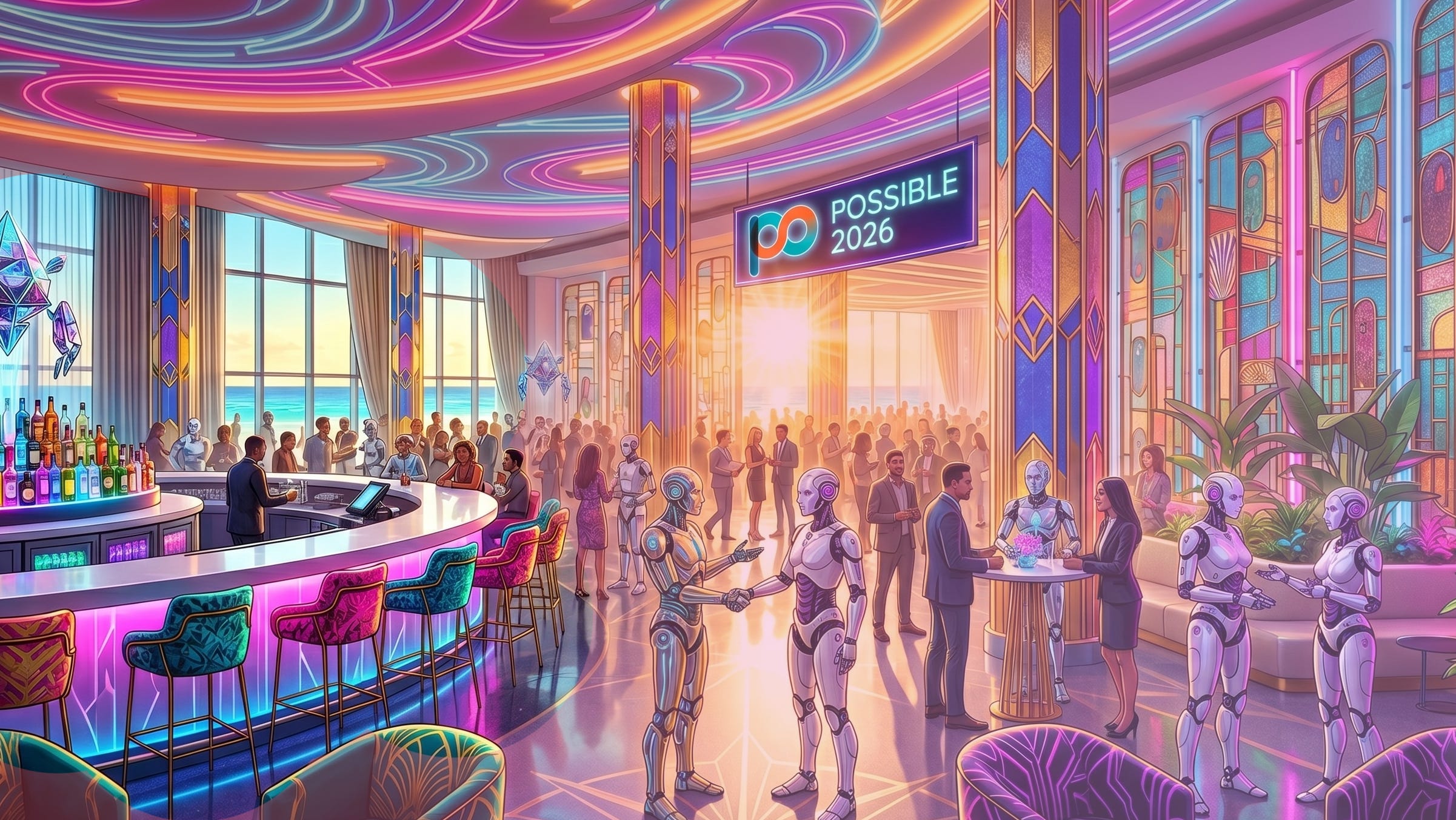
Ironically, just about everyone at POSSIBLE was ALSO complaining about AI output at some point this week.
Too generic. Too bland. Too corporate. Sounds like a chatbot, not a brand.
If I had a glass of wine for every time someone said the word “slop,” I wouldn’t be coherent enough to write this post.
But what I kept reminding people, when I had the chance: The tool is not the problem. Your brief is.
Brand voice guides used to be written for humans who could read between the lines. “Friendly and conversational” meant something to a writer who had onboarded, sat in enough meetings, and absorbed the culture.
To Claude, to ChatGPT, to whatever agent you’re pointing at your homepage, it means nothing. It reads the line. Not between it.
The fix isn’t a better model. It’s a better map.
Kaleigh Moore has been writing about this for a while, and the framework she lays out is the cheapest high-leverage move any marketing team can make in 2026: an AI-native brand voice guide. More explicit than your human one. More example-heavy. Paired comparison paragraphs labeled on-brand, too formal, too generic. Hard “never do this” rules. Never use “leverage.” Never open with “So.” Never drop a generic inspirational quote. A machine doesn’t know these things unless you tell it.
Then upload it. Then actually tell the tool to use it. Attaching without instructing underperforms, which is a sentence I wish I didn’t have to write.
The same logic applies one layer up. Another common theme here at POSSIBLE was also talking about AEO and GEO. Every agency had it on their agenda. Almost none had a case study older than a quarter.
The tactics are real. HubSpot’s six strategies for SaaS are a fine starting point. Optimize for evaluation-stage questions, not just problem awareness. Get serious about third-party validation. Structure content so an AI can actually extract it. Implement schema.
But “best practices” is not a phrase that applies to something eighteen months old. “First practices” is the honest version. If your AEO partner has a “system,” ask what they tested last month that failed. If they can’t tell you, they don’t have one. They have a pitch.
Same skepticism with the agent vendors. There were more agent demos at POSSIBLE than there were people to watch them. Half of those companies will be acquired, pivoted, or gone by next year’s conference. “Open and interoperable” is what vendors say when they can’t lock you in. That’s actually good news for buyers, if you can hear it.
3 things you can do this week that will outperform anything you’ll buy:
Rewrite your brand voice guide for AI. Make it explicit. Add the “never do this” list. Upload it everywhere your team is prompting.
Audit your AEO pitch. Ask your agency what they’ve tested that didn’t work. The answer tells you whether you’re hiring a partner or funding their R&D.
Don’t marry the first agent vendor who promises transformation. Rent before you buy. Integrate before you commit. Half the landscape is about to change.
The tools are fine. The tools have been fine for a while.
It’s the instructions that need work.
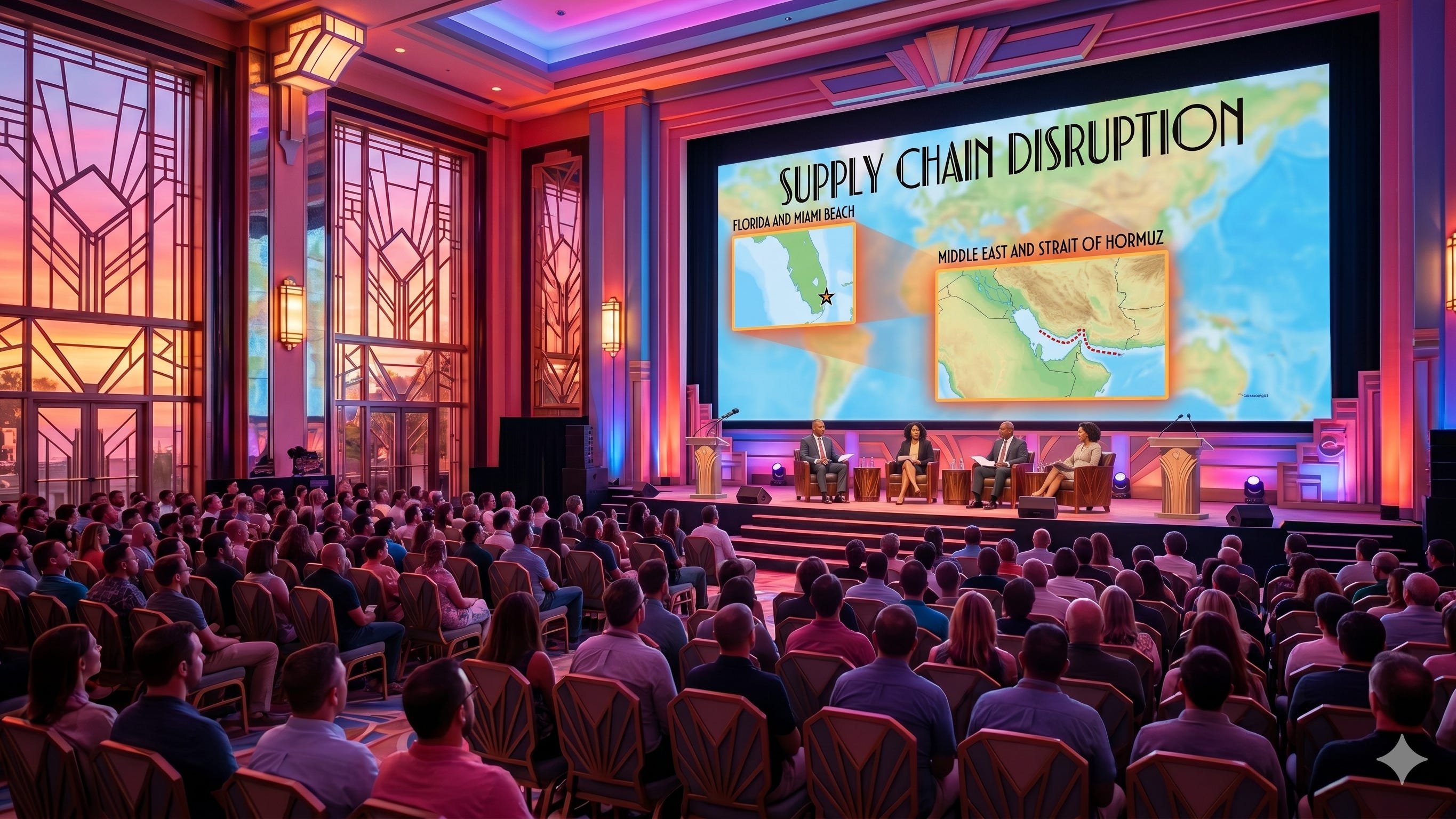
We just spent the past three days talking about Commerce Media. Meanwhile, the crisis in Iran, and more specifically the Strait of Hormuz, was the quieter refrain running through every hallway conversation.
At POSSIBLE, nobody really wanted it in the foreground.
But while a few thousand marketers were at the Fontainebleau and Eden Roc hotels on Miami Beach, talking about agent stacks, retail media consolidation, and whether creators are the new agencies, the Strait of Hormuz remains a shitshow.
Effectively closed down since late February, when the US and Israel launched an air war against Iran and assassinated its supreme leader.
20% of the world’s seaborne oil trade passes through there. 20% of global LNG. All held up at the world’s most critical energy chokepoint. Now a dual blockade, with the US Navy blockading Iranian ports since mid-April and Iran blockading the strait itself. No bueno.
Oil prices are a boring topic for marketers, but the reckoning is coming. Gas prices are up more than a third since the start of the war. Crude oil surged past $120 per barrel and forced QatarEnergy to declare force majeure on all exports. Goldman raised its December 2026 inflation forecast by a full percentage point. The IMF’s pessimistic scenario has global growth falling to 2%, something that has happened four times since 1980.
That’s the macro you are planning your 2026 media budget inside of, in case you’re wondering why tensions are high and long-term views are murky.
The editorial consensus is not subtle. The Center for American Progress called it “the most significant supply chain shock since COVID-19.” Helium, sulfur, tungsten, the ingredients that go into semiconductors and fertilizer and munitions, all caught in the blockade.
The Denver Gazette put it plainest: Trump misjudged how Iran would strike back economically, the same way he misjudged China in the trade war. He started a war of choice based on what he said were imminent security threats, and Iran demonstrated it could exact economic costs his team had underestimated. His approval on the economy dropped to 30%. His approval on Iran is 32%. Even his own supporters, the Tucker Carlson and Megyn Kelly end of the coalition, have been publicly breaking with him.
None of this made it onto a POSSIBLE stage. Fair enough. The conference is about marketing.
But every CFO conversation happening in every portfolio company right now is about the new inflation floor, the rerouted supply chains, and how long a 35% jump in energy costs takes to show up in consumer discretionary spending. Put that in your 2027 pitch deck.
The wars we start without thinking through the consequences don’t stay in the war. They show up in the media mix, the supply chain, the shelf price, the consumer confidence index, and the quarterly earnings call.
Marketing doesn’t operate in a vacuum. It just keeps getting planned like it does.
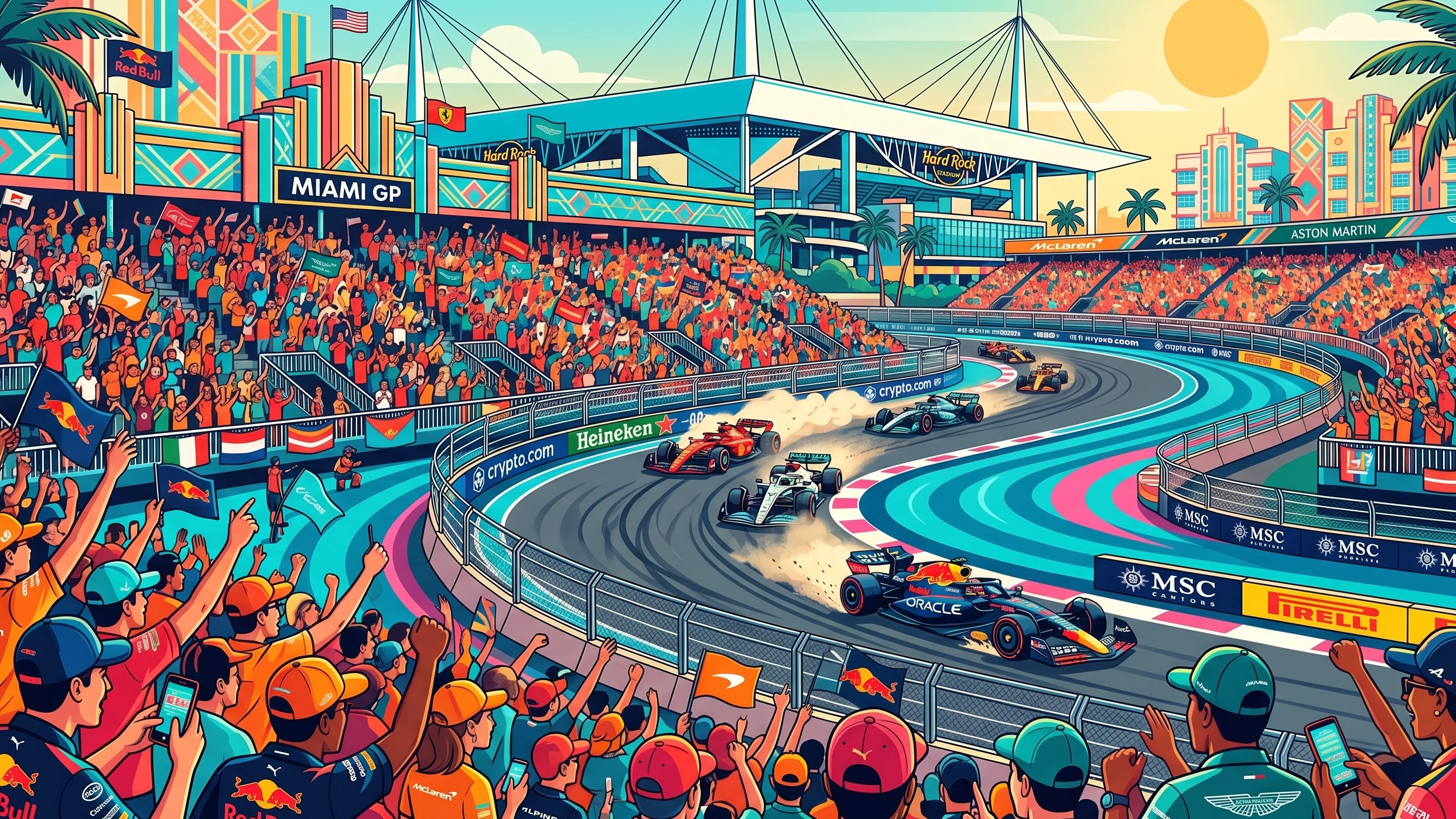
Let’s pivot. Or more accurately, take the inside racing line at Turn 18...
From “marketing doesn’t operate in a vacuum” to “neither do Formula 1 races...” and the reason I’m still in Miami after POSSIBLE ended last night.
This weekend is the Miami Grand Prix. My first live F1 race. And after a month-long hiatus caused by the war in the Middle East, which resulted in two cancelled races, the return to the track is exciting on a lot of levels.
I spent yesterday with some of the team leaders. Today too. Whatever you think of Formula 1 as a product, from a business perspective they are crushing it and doing just about everything right. The Netflix effect turned into a real flywheel. US fanbase tripled in five years. New tracks, new audiences, new merch lines, new sponsors.
The operating model they’ve built inside a sport that used to be a rich man’s hobby is, honestly, one of the most interesting case studies in sports media right now. Maybe I’ll write about it separately. Maybe I won’t. I’m on vacation-adjacent time.
Personally though, this weekend isn’t about the business story.
It’s a bonding moment with my son, who is flying down from New York to meet me here in Miami tomorrow. Fan Fest. Sprint race. Qualifying. The whole shebang. Maybe our team or FIA friends hook us up with a paddock tour. Maybe they don’t. Either way, he’s going to lose his mind, and I’m going to pretend I’m not losing mine.
The whole weekend isn’t going to be cheap. That’s not the point.
He’s finishing his freshman year of high school. Which means three more summers. Four more Memorial Day weekends before he’s technically an adult. Every parent of a teenager knows the math, and the math is brutal. The window isn’t closing. It’s already half closed.
So these are the experiences we prioritize. The memories we actually make. Not the ones we keep meaning to.
If POSSIBLE was about deciding fast, with 60% of the information, and Political was about the consequences of deciding poorly, Personal is the one where the decision is easy.
You buy the tickets. You get on the plane. You put your kid in the grandstand and watch him watch the cars. You figure the rest out later.
Note to self: sunscreen. Reapply. Repeat.
*AI Disclosure: 100% of this was written by me, a human with only light edits and typo corrections from Grammarly. The images are mostly AI-generated using Nano Banana.
Comments
Nothing yet. Say the first thing.
Sign in to join the conversation.