
A quick note before we get into the article.
First of all, sorry for disappearing a little over the past two weeks. I’ve had some personal matters pulling more of my attention than expected, and I didn’t want to shove this essay out just to hit a cadence. This piece sits underneath a lot of what I want the Insight Series to become, and it needed more time than I originally planned to give it.
For those of you paying to be here, I don’t take that lightly. To make up for the slower rhythm, the next piece will likely be a wider defence-sector walkthrough. A few names and themes I’m working through rather than the usual single-company deep dive, though markets have a habit of repricing faster than I can finish writing sometimes.
If I’m honest, that might just be the shape of things for a while. Partly because the personal situation is still ongoing, and because I think the game itself is changing too. With AI in the mix, ideas travel through markets much faster than they used to. By the time a fully polished deep dive is finished, half the informational advantage can already be gone.
What seems to matter more now is spotting which clusters actually matter, forming a coherent frame early enough, and getting the critical pieces out while they’re still alive.
One last bit of transparency. The defence contractor I use as an example in this essay is a stock I’ve just started building a small position in. I want to be clear that it’s still early and the work is still evolving.
As always, thank you for the patience and support that make writing this publication worthwhile.
In the winter of 1930, John Maynard Keynes sat in Cambridge watching two things happen at once.
The world economy was collapsing.
And an entire profession was failing to notice that its explanations had stopped working.
This is not an indictment of the classical economists. Their models were rigorous and had survived for generations. When unemployment rose, wages would fall. Lower wages would encourage hiring. Markets would clear and equilibrium would return. The logic was internally coherent.
The problem was that the mechanism had stopped firing.
Unemployment stayed stubbornly high. Recovery kept failing to appear.
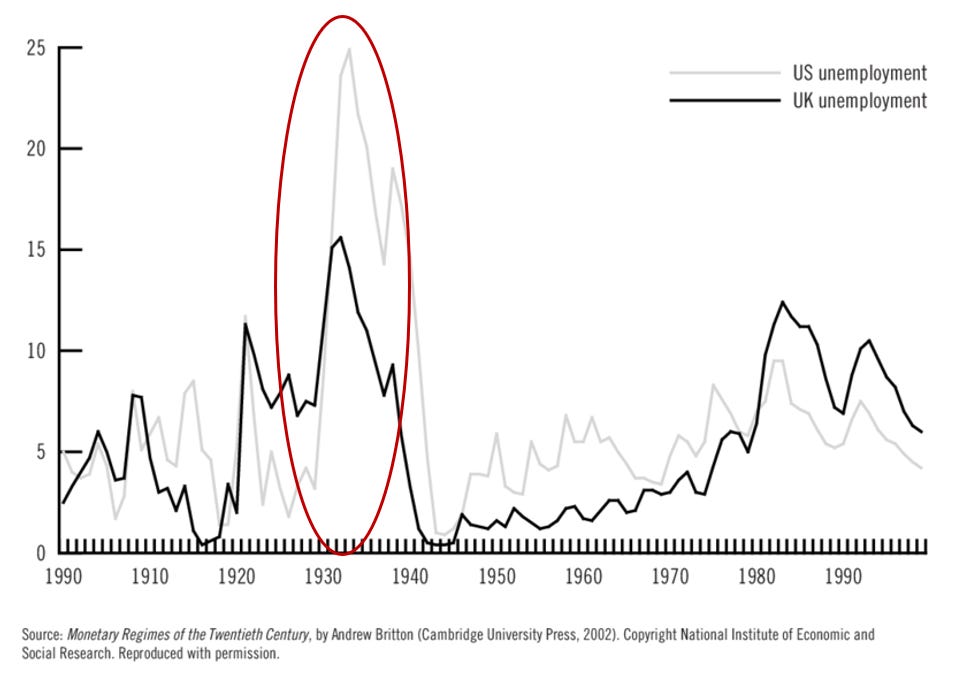
And the response, for the most part, was to run the same model with more conviction. To argue that wages hadn’t fallen far enough yet, that the adjustment was still in progress, and that the mechanism would assert itself if only markets were left alone to work.
Keynes watched this and eventually concluded something that took years to fully articulate.
The problem was not the inputs to the model. It was the thing the model was built around.
Classical economics treated the labour market and its price-clearing mechanism as the central organizing force of the economy. Keynes started to suspect that no single market made sense on its own. You had to look at total spending across the whole economy at once.
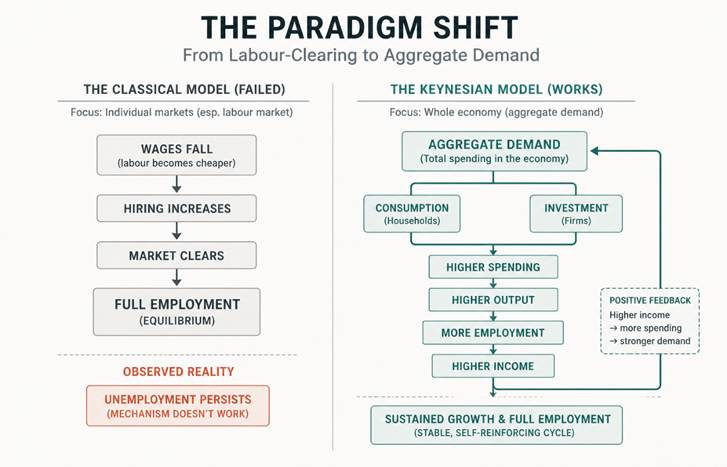
That if employers wouldn’t hire even when wages fell, it was not because labour was mispriced. It was because nobody was buying anything. And if nobody was buying anything, cutting wages would make things worse because workers are also consumers. Lower wages mean less spending, which means less demand for output, which means fewer jobs, which means less spending again.
What mattered was not wage clearing. It was aggregate demand.
That sounds obvious in hindsight. At the time, many economists found it rather incomprehensible and offensive.
Because a frame held long enough, starts to feel like reality.
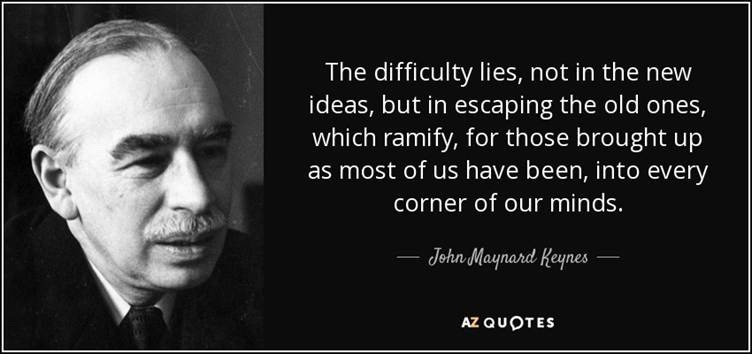
That line matters far beyond economics.
Most investment mistakes are not caused by insufficient effort. They come from thinking very hard inside the wrong structure. A coherent narrative can survive for years after the underlying representation has stopped matching reality.
Most of the time, you will find you are in narrative. That is not a failure. It is where the work begins.
That is what this post is about.
Not Keynes specifically. But the cognitive event he was living through. The shift from a refined model to a different map.
And more importantly:
what allows that shift to happen,
what prevents it,
how false insight impersonates the real thing,
and why some positions quietly demand a much higher standard of thinking than others.
One important clarification. This is not an argument that every position requires insight. Or that investing should be reduced to a single cognitive model. There are positions where process discipline, valuation mean reversion, and good risk management are totally sufficient. For them, the pursuit of representational novelty would be over-engineering.
The framework in this post is not for those positions. It is for the ones where the size of the bet implies a claim that you are seeing something the market is not, where conviction is doing the work of justification.
For those positions, it is not just an academic question of whether that conviction is grounded in a real shift or just a coherent story.
It is the question that determines whether the sizing is warranted. Most portfolios have positions where this question is live and unanswered.
By the end of this post you should be able to pick up any current position and work through five things pretty quickly:
Apply a four-layer taxonomy. Distinguish clearly between information, opinion, narrative, and genuine insight, and identify where your own thesis is actually sitting.
Run a two-step diagnostic. Test whether a thesis has genuinely changed its unit of analysis, using Rolls-Royce Holdings and a live defence contractor position I am building, as case studies in representational shift.
Use the Conditions Model, a five-stage framework introduced in this series, to identify where a thesis is stalled, and what kind of work is actually required next.
Recognize the five false signals that impersonate genuine insight from the inside, including the emotional “click” that can make narrative coherence feel like proof. I use my own Byrna Technologies Inc. thesis as a live post-mortem of that trap.
Understand why representation itself is a source of risk, and why even highly sophisticated analysis can quietly compound a framing error instead of correcting it.
The Black Wednesday trade that we will cover in the post is useful for exactly the above reasons. George Soros’s breakthrough was not the belief that sterling would fall. It was the shift from reading the ERM as a political commitment to reading it as a reserve arithmetic problem. Once that switch occurred, the entire trade compressed into a single conditional statement about finite reserves and speculative pressure.
That is the level this series is trying to study. Not cleverness or originality for its own sake.
But the conditions under which people genuinely begin seeing the same reality differently.
Comments
Nothing yet. Say the first thing.
Sign in to join the conversation.