
AI is here to stay, but no one has any idea if the price tag of new AI infrastructure will ever be worth it. The costs are starting to feel like sunk cost fallacy after a point. Every new project is pitched to promise the returns of the previous. It is hardly surprising that investors are getting skeptical when funding rounds are getting more frequent and looking more unrecoverable.
No doubt AI is becoming more pervasive. The demand for generative intelligence will continue to grow and more infrastructure will be needed. But that doesn’t guarantee profitability.
The industry can still build too much too soon and leave unwitting investors holding the bag.
The size of the investment is not the issue. The global economy can handle $1.8 trillion. The problem is how far capital spending has moved ahead of the revenue needed to support it.
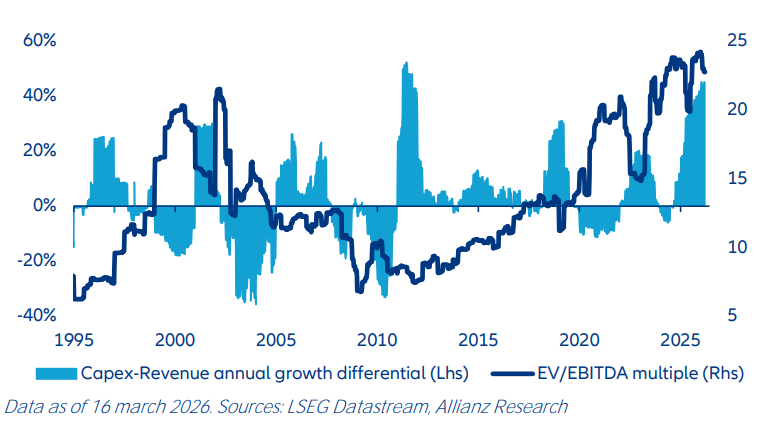
Based on recent data, the gap between sales and investment growth for US technology companies is ~ 46%. This was 32% in the 2001 telecom overbuild. Hyperscaler capital spending is expected to increase by about $534 billion between 2025 and 2027, while annual operating cash flow rises by roughly $340 billion. Even under optimistic forecasts, cash generation is not keeping pace with the increase in spending.
While estimates for closing the gap vary widely, some indicate that AI monetization would have to increase by 5x to 13x to justify current spending. Either end of that range requires far more than mere continued adoption. Revenue must multiply quickly and reach the same businesses financing the infrastructure before the assets age or another round of spending begins.
Without a view on capital recovery and valuation, conviction will continue to rise and fall with the news flow.
Investment decisions require something firmer. An expected return and the amount of capital we are willing to risk while the answer remains uncertain.
I have been pretty bullish on the AI infrastructure buildout for some time and that view has shaped some of my investments, including HASI and Hammond Manufacturing. It was predicated on the simple premise that advances in AI and wider adoption would keep driving demand for computing power. More computing power would require more electricity. Infrastructure providers should therefore benefit. The thesis seemed infallible.
But the scale and pace of AI infrastructure spending are giving me second thoughts. When we cannot say what would count against a thesis, it becomes hard to know how much confidence we can have in the thesis.
This is not saying it is time to abandon the AI theme, However, more caution and discernment about how AI demand translates into investment returns and being clear eyed about the associated risks.
A more prudent investment approach at this juncture, would be to look for parts of the value chain that can recover the capital committed and provide shareholders with a reasonable return, even if AI demand disappoints. This means looking for situations where capital recovery depends on fewer optimistic assumptions to pan out. Even at the cost of missing out on spectacular upside.
Through this lens, announced megawatts are little more than declarative plans until backed by serious capital commitments. A 20 year contract may sound reassuring, but duration alone does not say enough about the protection it actually provides. Neither does it inform the customer’s ability to walk away, nor who absorbs the resulting loss and whether a regulator can override the economics later. Even dependable business cash flows can produce a disappointing investment when too much of it is already recognized in the share price.
The eventual economics of the AI buildout may remain unknowable for years. I find it more useful to see the buildout as a series of obligations. Each layer commits capital against an obligation from the next. Tracing those obligations shows which investments require AI monetization to justify the spending and which have a route to recovery before that question is settled. This allows us to participate in the buildout without depending on it as a whole earning an adequate return.
The speed of technological improvement makes future capacity needs difficult to forecast.
Recent analysis using data from Epoch AI and Artificial Analysis estimated that the inference price required to reach a fixed level of frontier-model performance had been falling by roughly 5× to 10× per year across key benchmarks. While these historical rates cannot simply be extrapolated, the direction and pace of improvement are difficult to ignore.
That describes the cost of reaching a fixed level of performance. The economics look different at the frontier. The same study estimated that the price of running frontier models had risen by between 3× and 18× a year as models became larger and devoted more computing power to reasoning. Capabilities that already exist are becoming cheaper to deliver, while the best available performance is becoming more expensive to provide. Paid usage must grow and produce enough revenue to close that widening gap.
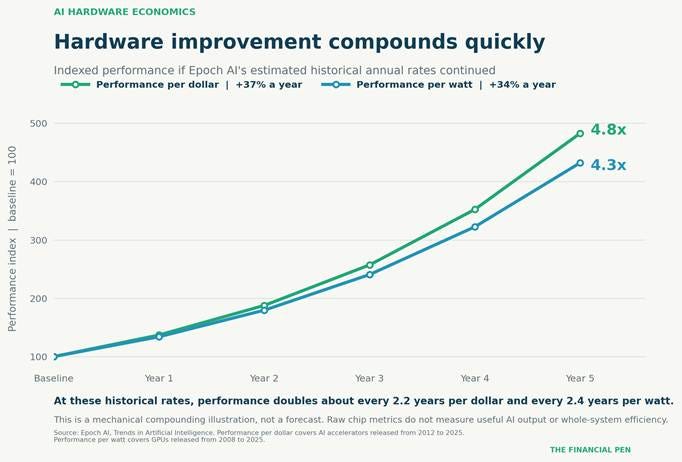
Hardware is improving too. Epoch AI estimates that AI-chip performance per dollar has risen by about 37% a year, while GPU computing performance per watt has improved by roughly 34%.
Neither measure translates directly into useful AI output. Power consumption varies with the model, context length and efficiency of the wider system, including memory, networking and cooling. There is no single measure of performance per watt that can be applied across the entire buildout. Even so, future systems should be able to accomplish substantially more with the same amount of power.
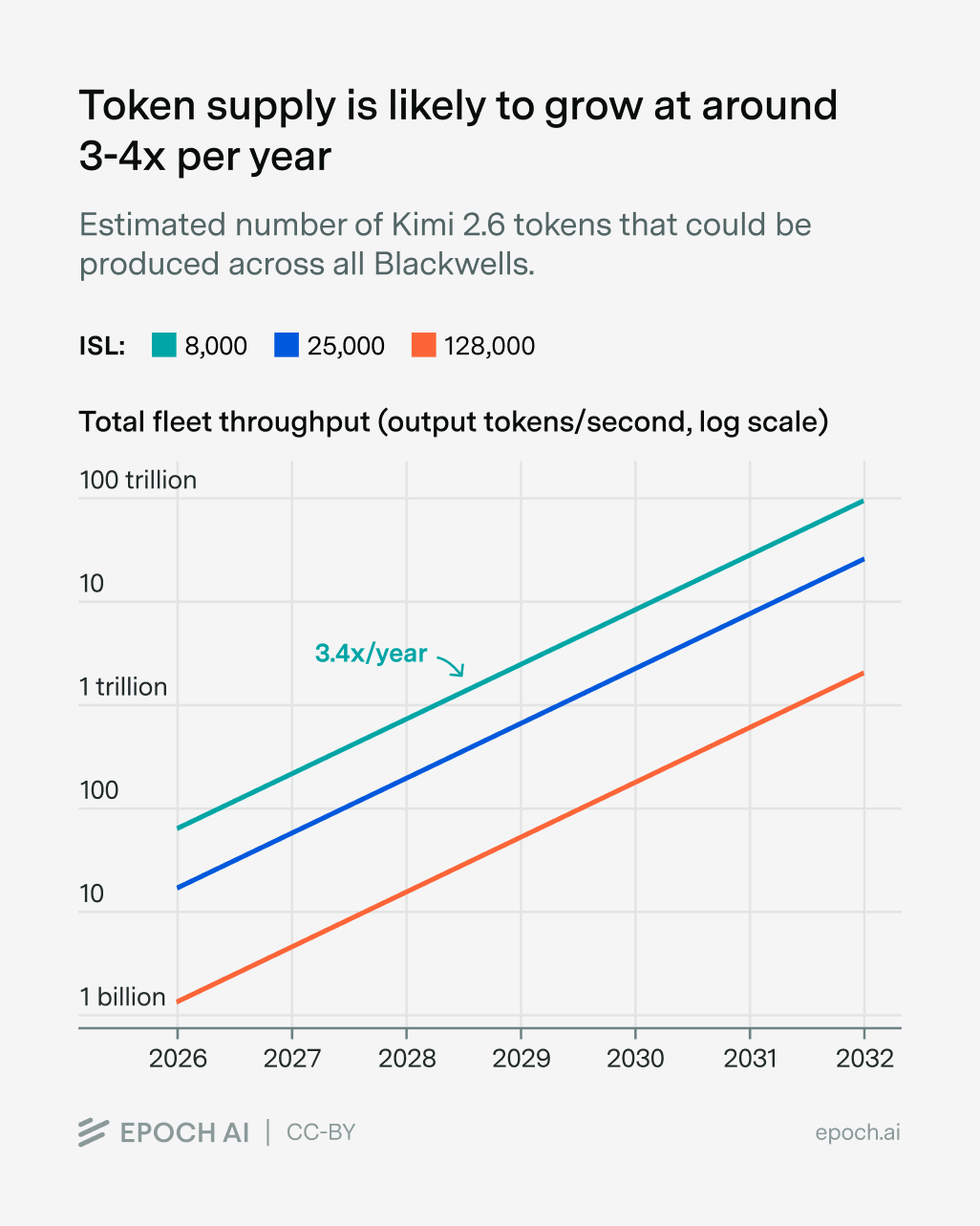
Demand may still grow faster as efficiency improves. An informal 2026 Epoch research estimated the inference capacity could grow by roughly 3.4× a year under fixed model and input length assumptions. Google reported that the number of tokens processed across its products had risen 7x in the year to May 2026, reaching more than 3.2 quadrillion a month. Combining Google’s figures with broader industry estimates, Epoch suggested that token demand could be growing by around 10× a year. Usage is clearly expanding rapidly. What is still uncertain is how much of it will become durable, commercial demand.

AI demand comes from training models, integrating them into applications and applying them to compute-intensive work such as scientific simulations and robotics. These workloads do not require the same kind or amount of computing power. Some can use smaller models or run at the edge, while others may require substantially more compute as context windows grow.
For those reasons, token consumption makes for an unreliable measure of economic demand. The same number of tokens can answer a trivial question or help complete work that would otherwise take a professional hours. Token volume can tell us how much AI is being used, not how much economic value it creates or how much customers will pay for it. Much will depend on whether usage grows faster than prices fall, what that usage accomplishes and how much of the resulting value AI providers can capture.
To compound the issue, new demand cannot be measured if the capability does not yet exist. And companies will find it hard to discern how much of their work is worth automating unless it can be done reliably. Better models will surface new possible uses and better infrastructure will make those uses cheaper and easier to deploy. These will beget demand that could not have been seen beforehand.
Naturally, no emerging industry can forecast how much capacity it will eventually need. AI is no different. Companies must build before the full size of the market becomes clear. What makes AI unusually difficult to forecast is that both sides of the equation keep moving. Better models create new uses and more demand. Better chips and greater efficiency change how much computing power is needed to serve that demand. By the time planned supporting infrastructure actually comes online, both may look very different.
If companies build too early, they run the risk of weak utilization. Costly tech obsolescence may also compound disappointing returns. Build too late and there may not be enough capacity when new models and enterprise workloads arrive.
Once customers become embedded in a competitor’s infrastructure and software, winning them back becomes difficult. Firms therefore have a strong incentive to build ahead of proven demand. Spare capacity is costly, but it preserves their ability to compete for the next wave of workloads.
The same competitive pressure begins before a model reaches its users. Epoch AI estimates that the cost of training frontier language models has risen by roughly 3.5× a year since 2020. Better chips and greater efficiency reduce the cost of a given amount of computing power, but developers are reinvesting those gains in larger training runs.
BIS’s model of the AI investment race corroborates this phenomenon. Competitive pressure can push industry capex high enough to undermine the aggregate economic surplus, despite every participant responding rationally to the danger of falling behind.
In some ways AI capex exerts a strategic toll. Capital needs to be spent to preserve the ability to compete irrespective of whether the capacity is immediately required. Such expenditure tends to produce disappointing collective returns, at least in the short term.
If capital must be committed before the scale or composition of demand is knowable, it is imperative to understand what assumptions the downstream buildout is being constructed around to determine where the downside lands if the forecast fails.
A hyperscaler will request power across multiple sites because they cannot predict which site will be the fastest to complete. Data center developers will also construct multiple campuses for that reason, and potential clients will work with more than one developer to avoid being dependent on a solitary project. This is all completely rational. However, it results in multiple requests to connect to the grid that serve the same eventual load.
Texas is a prime example of how rapidly anticipated demand for load can diverge from the actual demand on the system. By mid 2026, Electric Reliability Council of Texas (ERCOT) identified over 438 GW of proposed large load demand. Approximately 389 GW, or 89% of the demand, was attributed to data centres. This is over 5x ERCOT's highest recorded system peak of approximately 86 GW.
It feels implausible that every megawatt in the queue will be built, let alone arrive on the grid at the same moment. A meaningful share will very likely never materialize. Some applications will lapse, some will be displaced by better sites, and some represent multiple attempts to secure the same scarce resource.
That bears keeping in mind. An interconnection queue is more like an inventory of options on future system capacity. Each option is at a different stage of development, carries a different cost of abandonment, and has a very different chance of being exercised.
ERCOT’s operating data is illustrative. By June 2026, it had approved roughly 9 GW of large load for energization. The highest observed non-simultaneous monthly demand from those approved loads was closer to 4 GW. These data cover more than data centres and cannot be mapped cleanly onto the 438 GW headline queue. Even so, it should make us appreciate that a requested megawatt is only an expression of interest. It may never secure approval. An approved megawatt may await customer deployment. An energized megawatt may never reach sustained, economically meaningful utilization.
Texas policymakers are now trying to impose a cost on that optionality. Senate Bill 6 requires large power users to put financial commitments behind their applications, disclose overlapping requests elsewhere, and explain how they will support grid reliability. This helps them discriminate between genuine projects and unreliable placeholders.
ERCOT’s Batch Zero process was designed around the same principle. Rather than study every application in isolation, ERCOT would group large load projects that met defined maturity and commitment requirements. This was more than an administrative refinement. When proposed demand is large enough to alter transmission needs across the system, each new request can change the assumptions underlying the studies completed before it.
Batch Zero has since been delayed after Governor Greg Abbott ordered an audit of proposed data centre projects early August. The framework remains intact, but the pause shows that even qualified projects are subject to political and regulatory scrutiny before they can proceed.
Stricter screening and batch review should remove at least some duplicated and speculative capacity from the queue. However, a more orderly queue is not the same as realized demand.
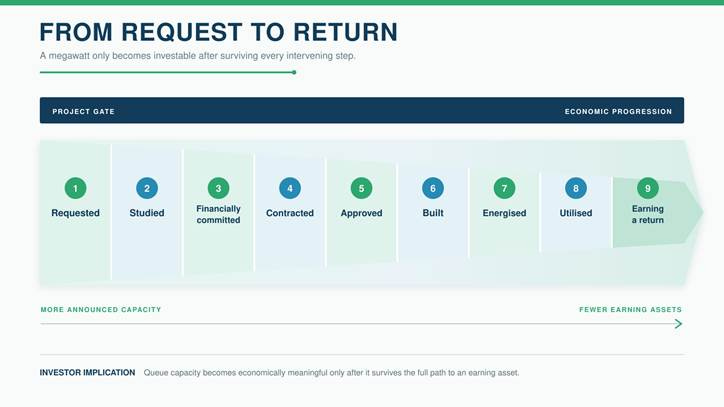
Available capacity does not equate to load, nor load to a target return on investment. In order for the investment to be justified, the project must bring in sufficient revenue over a long enough duration to offset the investment in the project’s related infrastructure.
A project may become more credible as it progresses through the funnel but that comes with the cost of having more capital placed at risk. An abandoned request may initially cost little beyond studies and deposits. Once land has been acquired, equipment ordered and transmission work begun, cancellation can leave behind financing costs, contractual obligations and assets without sufficient demand. The probability of failure may decline as the project advances, but the potential loss grows if it still fails.
Investors tend to fall into the underwriting trap of capitalizing megawatts near the top of the funnel as though they were already operating assets at the bottom. In reality, even a project that is cleared for construction may face years between initial capital deployment and meaningful cash recovery.
That takes us to the next issue of time itself as a risk factor.
Even real demand can generate disappointing investment results, since the AI stack runs on three different clocks.
The first clock is technology. Changes in models, training, methods, inference, and even customer preferences may happen in a matter of months.
The second clock is the hardware. Accelerators, servers, networking hardware and cooling systems are expected to earn returns over several years, even though a new generation of chips can change their relative economics well before the existing fleet is fully depreciated.
The third clock is infrastructure and finance. A data centre campus, substation, transmission upgrade or power plant can require years of development and may be financed against cash flows expected over decades.
Better algorithms may reduce the compute required to deliver a given service, but they do not shorten the repayment schedule on a substation that has already been built.
Big Tech’s different accounting methods for determining the useful life of servers and network equipment accentuates the uncertainty related to AI hardware obsolescence, and the opportunity to earn a reasonable return on the investment.
Alphabet extended the estimated useful life of its servers from 4 years to 6, and certain network equipment from 5 to 6, cutting its 2023 depreciation expense by $3.9 billion.
Amazon extended server lives from 5 years to 6 in 2024, before reversing course for a subset of servers and networking equipment. From 2025, it shortened their estimated life from 6 years to 5, citing the faster pace of AI and machine-learning development. That revision added $1.4 billion to 2025 depreciation expense and reduced net income by $1 billion.
Meta reached the opposite conclusion, extending the useful life of most servers and network assets to 5.5 years from 2025, reducing depreciation by $2.92 billion.
While not necessarily unreasonable., we need to be aware that these decisions are not trivial administrative choices. They estimate economic durability in a market where the underlying technology is moving quickly enough to make those estimates consequential.
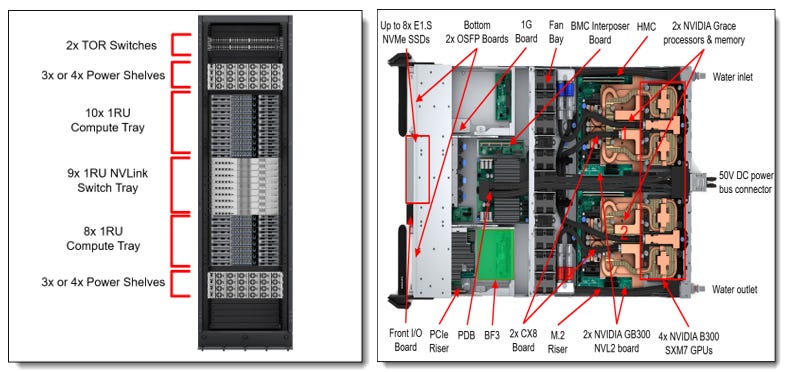
The physical infrastructure has its own version of the same problem. Nvidia’s GB300 NVL72 rack can draw as much as 142KW. By 2027, a server rack the size of a large refrigerator could have peak power demand equivalent to that of 65 households. The International Energy Agency (IEA) estimates that AI-server power density rose 11x between 2020 and 2025 and could increase another 4x by 2027. Efficiency at the component level is improving, but much of that benefit is being redeployed into denser configurations rather than lower absolute power demand.
That can render a facility commercially obsolete even if it remains structurally sound. The shell may still have decades of useful life, but its but its critical electrical and thermal infrastructure may not support newer, denser hardware. Retrofitting a site designed around an earlier generation of hardware becomes expensive and disruptive and, in some cases, probably less economic than building anew.
Hyperscalers try to manage the mismatch by committing different layers on different schedules. Land, power access and adaptable foundations are secured early because they take longest to develop. Chips, servers and networking can be ordered later as technology and customer demand become clearer. Amazon has said that a significant amount of its planned capacity is supported by customer commitments.
This is rational capacity planning as it prevents the premature purchase of technology that will soon be outdated. But it does not make the earlier decisions liquid. Site infrastructure cannot simply be redeployed at negligible cost if the anticipated workload fails to arrive or if the next equipment generation demands a different design.
These long duration assets earn their return only if each successive wave of hardware and customer demand arrives quickly enough to put them to work. This presents a unique challenge. A data center campus is a long-term commitment, but the assumptions about demand for this commitment are made in a fast moving market where the technology is likely to rapidly evolve, perhaps even in a few quarters.
Private capital accepts long intervals between construction spending and returns because an asset must be built, deployed, and used before it can generate cash flow.
In a normal cycle, the first wave of investment begins to demonstrate its economics before the next is funded at a larger scale. Frontier AI is compressing that sequence. The next round of spending is already under way while the return on the previous round remains only partially observable. Competition does not allow firms to wait for one generation to earn back its cost before committing to the next. Capital must be committed again before investors can tell whether the previous round generated an adequate return.
A new model introduces a capability. Developers build products around it. Competitors reproduce it, while smaller models take on parts of the same work. Open-source alternatives place an upper bound on pricing, and competition pushes a share of the resulting cost savings into lower prices, better products, and improved service for customers. The technology diffuses quickly, and so does the economic value it creates.
By the time the original developer begins to monetize the model at scale, much of that value may already have been distributed across users, customers, competitors, and complementary providers. Retaining a leading position then requires another funding round. A new training run, more specialized infrastructure, and a larger, more expensive computing cluster. The cycle of investment begins again.
In a conventional buildout, the economic logic typically works like this. Capital gets deployed, the asset is used, and the owner eventually harvests the resulting cash flow.
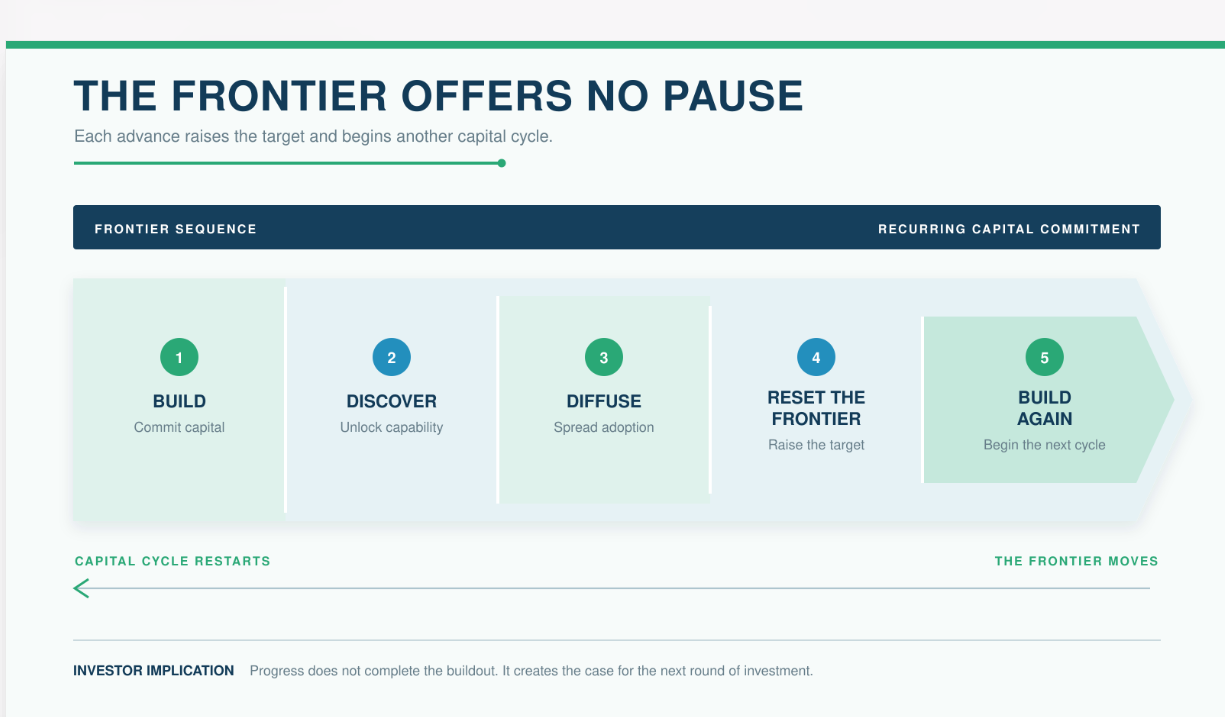
Frontier AI complicates that logic. Users may be added rapidly, grow revenue at an exceptional rate, and create genuine economic value, yet still fail to earn sufficient return on the capital required to remain competitive.
The cost of serving a query is only one part of the economic equation. Revenue must cover not only inference, but also operating expenses and the continuing investment in research, training, and product development needed to sustain the business. It must then generate enough after-tax cash flow to maintain and replace a rapidly evolving hardware base and earn a return on invested capital above its cost of capital.
It is too early to conclude that this describes the entire AI complex. New applications may have more attractive unit economics. Infrastructure may remain scarce in key locations. The largest platforms may also retain more of the value pool than skeptics expect.
But the funding requirement is no longer confined to a handful of hyperscaler balance sheets. It is fanning outward across the broader AI infrastructure ecosystem.
Once the capital stack extends across the ecosystem, weak monetization at the application layer can travel downstream as underutilized capacity, impaired equipment values, delayed cash recovery and thinner returns for everyone financing the buildout.
For much of the past decade, the largest technology companies could fund investment from internally generated cash flow. Their operating engines were large enough to absorb vast infrastructure spending without materially changing the financing question. That is now changing.
The current AI buildout is drawing on a broader pool of external debt and structured capital beyond hyperscalers’ own balance sheets. Attention is shifting from how much the platforms spend to who owns the assets, provides the capital and bears the loss if utilization disappoints.
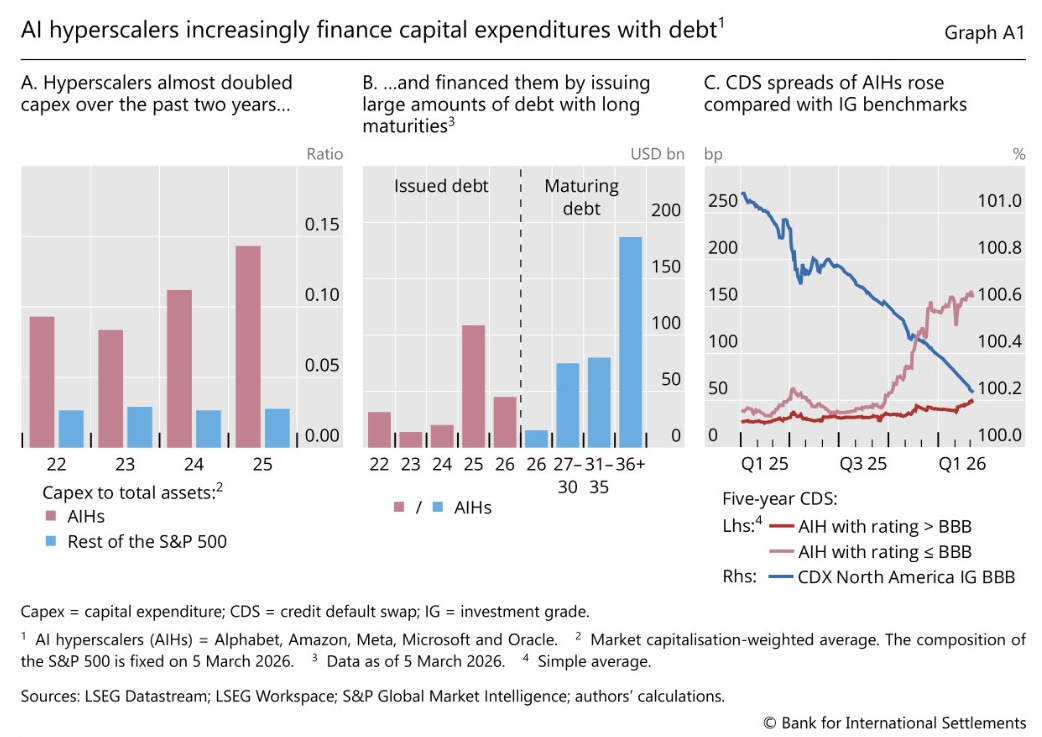
The BIS estimates that leading AI firms issued more than $100 billion of gross corporate bonds in 2025, much of it at maturities beyond five years.
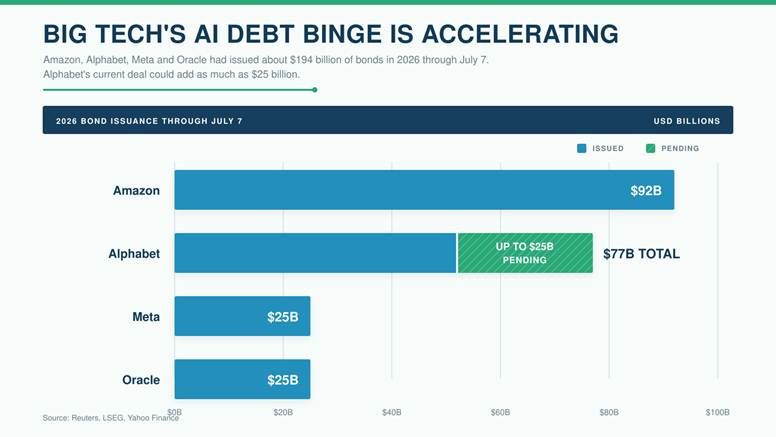
By 7 July 2026, Amazon, Alphabet, Meta and Oracle had reportedly issued about $194 billion, already well above the roughly $108 billion raised during all of 2025.
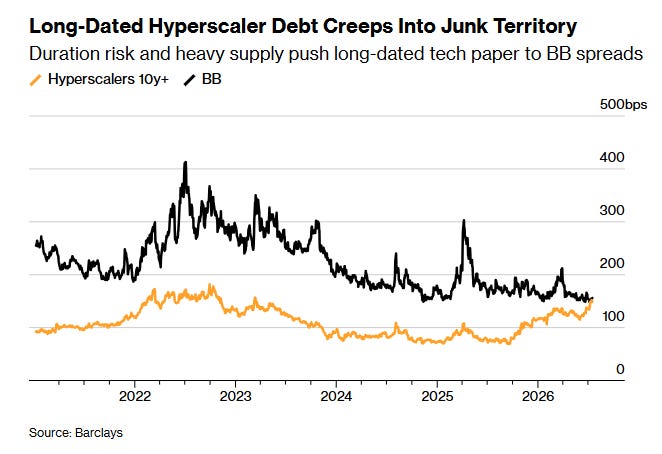
Bank of America estimates that 43% of hyperscaler debt issued over the preceding twelve months has maturities beyond 10 years, compared with 23% for other non-financial issuers.
Long dated funding is not inherently dangerous. It is sensible to finance long-lived infrastructure with long-duration liabilities. Doing so reduces near-term refinancing risk and gives demand more time to develop. But it also postpones the reckoning. If utilization proves weaker than expected, longer maturities do not resolve the economic problem. They simply extend the period before weak returns encounter a maturity wall.
The more important change is taking place one step removed from the hyperscalers themselves. More of the buildout is being financed through separate vehicles, borrowing outside their consolidated balance sheets.
The BIS describes this as shadow borrowing. Arrangements that resemble debt economically, even where the debt sits in a separate legal vehicle. A special purpose entity raises equity and debt to develop a data centre campus. The hyperscaler may take a minority stake, sign capacity or lease commitments, and provide guarantees or other credit support. Institutional investors then fund the vehicle against those contractual cash flows.
Meta’s Hyperion project in Louisiana is a good example of how this can work. Blue Owl managed funds own 80% of the venture and Meta the remaining 20%, with roughly $27 billion committed to the buildings, power, cooling and connectivity needed for the campus. Meta then leases the completed facilities in 4 year blocks. But Blue Owl is not simply left holding the asset if Meta walks away. For the first 16 years, a residual-value guarantee can require Meta to make a capped payment if it terminates or does not renew a lease and the campus is worth less than the agreed protection level.
The structure gives Meta flexibility. It can secure capacity without owning every dollar of concrete, power equipment, and servers outright. The financing can move off the balance sheet but the campus still has to generate enough value to justify the capital committed to it.
The risk is that so much of the campus’s value depends on the needs of a single customer. A project of this scale still has to earn a return commensurate with the capital committed. If Meta eventually needs less capacity or chooses not to renew, the venture would have to find another use or bring in another tenant willing to take that capacity. Neither offers the same protection as having Meta’s full corporate balance sheet standing behind the investment.
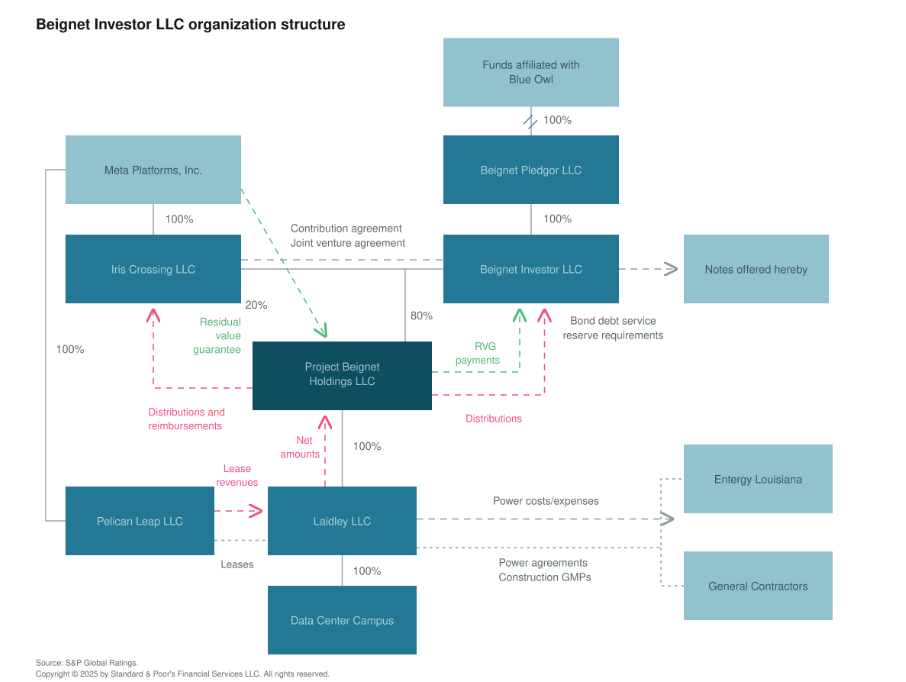
The Beignet vehicle has issued approximately $27.3 billion of secured, fully amortizing notes due in 2049. Their creditworthiness rests heavily on a single campus, Meta’s lease payments and the residual-value protections supporting the project.
The additional spread is one indication of what investors require to bear that concentration and project-specific risk. Despite an A+ S&P rating, the Beignet notes reportedly traded at roughly 225 bps over Treasuries. A month earlier, Ameren Illinois issued additional 2055 first-mortgage bonds at around 75 bps over Treasuries. While the comparison may be imperfect given Beignet’s amortizing structure and lower liquidity, the spread gap still highlights the greater concentration risk in investment grade debt supported by one project and one principal tenant than in utility debt backed by a diversified operating system and established ratepayer revenues.
The financing structure gives the investment more time to work while spreading the exposure among the hyperscaler, infrastructure equity and creditors.
That also implies that a weak underwriting premise can persist for longer before its consequences become apparent. Lease payments may continue and the bonds may amortize as scheduled. But should the campus fail to earn a commensurate return, the economic shortfall remains.
Power generation is often seen as the more sustainable AI play because electricity demand should outlast the AI narrative. The underlying assets retain practical value even if the competitive landscape changes. But physical necessity does not, by itself, determine who gets to monetize scarcity or how much of the resulting return they can retain.
Electricity is produced within a system where the state has power to determine how scarcity is priced and allocated. Asset ownership may confer economic exposure, but not full control over the value ultimately captured.
Regulators such as FERC (Federal Energy Regulatory Commission) and state utility commissions govern the terms on which generators and large loads participate in the grid: How they connect, who bears the cost of transmission upgrades, which utility investments can be recovered from customers and how reliability costs are allocated. FERC and the regional grid operators also establish the interconnection and transmission rules that apply to co-located data centres. They determine what grid access a project may retain and which system costs it remains responsible for.
The costs and revenues negotiated in a private contract are shaped by the regulatory framework that establishes the underlying obligations, tariffs and rights of access.
The Talen–Amazon arrangement at Susquehanna is what happens when a private power contract encounters that framework. Amazon initially sought to expand an existing 300 MW co-location arrangement, drawing as much as 480 MW directly from the adjacent nuclear plant. In November 2024, FERC rejected the interconnection amendments needed for that expansion. It did not prohibit co-location or cancel the commercial agreement. Instead, it concluded that PJM had not adequately justified the proposed non-standard treatment while the implications for grid reliance, reliability and cost allocation remained unresolved.
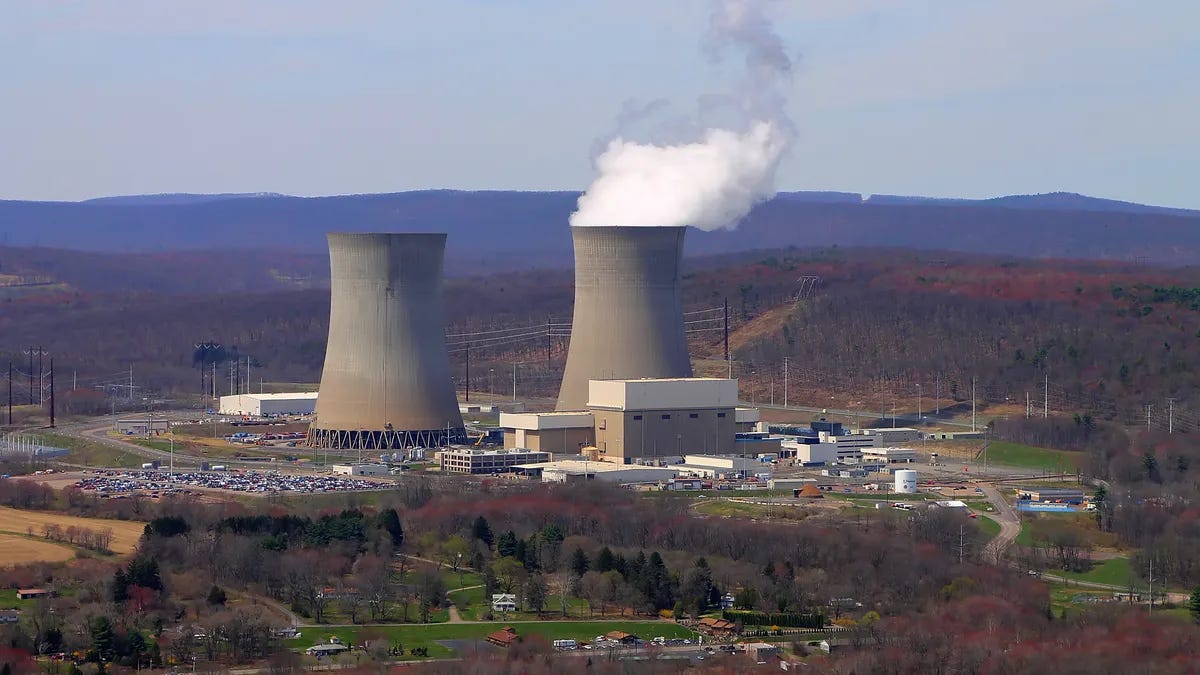
Talen and Amazon later replaced the proposed expansion with a front-of-the-meter agreement covering up to 1,920 MW through 2042. The power now moves through the grid, subject to PJM’s rules. Even under that structure, Talen expects to retain a premium to merchant power prices for scarce, continuous carbon-free generation.
The episode makes the point that neither physical proximity nor a signed commercial contract to an attractive power asset is enough. Susquehanna’s value can only be monetized through an arrangement that fits within the regulatory architecture governing the grid.
Utilities are within the same hierarchy, but with a different set of obligations and protections.
Large load tariffs can require data centre customers to bear more of the financial risk created by the infrastructure built to serve them.
AEP Ohio’s data-centre tariff requires extended contracts, minimum billing and reimbursement for certain buildout costs.
Virginia created a large-load class for Dominion customers at or above 25 MW, with minimum payments tied to contracted transmission, distribution and generation demand.
Georgia permits longer contracts and recovery of site-specific and upstream system costs for customers above 100 MW.
These provisions make utility led growth more defensible. They mitigate the risk that existing ratepayers fund infrastructure built for a large customer that later delays, downsizes or abandons its project.
The protection ultimately depends on the regulatory bargain. Regulators determine which investments can be recovered, how quickly that recovery occurs and how much of the economic burden falls on shareholders.
Scarcity value from special access to the grid rests not only on the asset and the contract, but also on continued regulatory support.
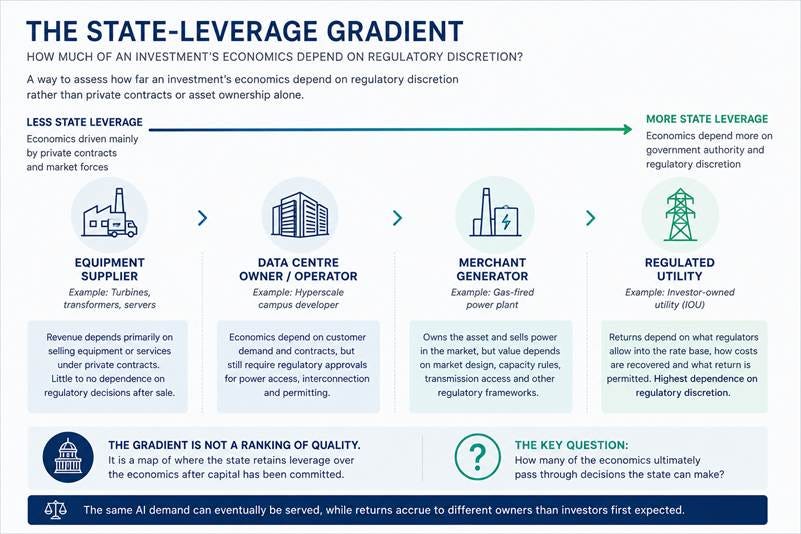
A useful mental model is to see it as state-leverage gradient, a way of assessing how far an investment’s economics depend on regulatory discretion rather than private contracts or asset ownership alone. An equipment supplier may be cyclical, expensive or vulnerable to a weaker order cycle. A utility may benefit from strong cost recovery and a constructive regulatory compact, and a merchant generator may own a plant supported by a long-dated contract.
The gradient isolates the degree to which an investment’s capital recovery depends on government authority rather than on a private agreement alone.
That becomes important if the AI buildout is delayed. Demand may still arrive, but the longer the wait, the more opportunity customers, regulators and capital providers have to revisit who bears the cost. The eventual AI demand can therefore be every bit as large as forecast while the returns end up distributed very differently from what today’s valuations assume.
Technological success does not assure uniform investment success. History offers plenty of examples. Railways and fibre optic networks remained economically important long after the investment booms surrounding them destroyed capital for many of their original investors. The returns often accrued to later owners who acquired the assets under better economics.
AI infrastructure may follow a similar path. The challenge is to identify investments capable of recovering the capital committed and continue compounding through the longer buildout, even when demand arrives later or proves less profitable than expected.
The rest of the post:
Identifies the layer of the buildout whose returns depend on the fewest uncertain assumptions about AI demand and regulatory treatment.
Tests five listed companies within that layer, comparing how much of the AI forecast shareholders must underwrite, what protection they receive and which company offers the best insulated return.
Builds a return case through 2029 showing how the preferred company’s plan and outlook could support an indicative annual total return of ~10%, without requiring a more optimistic AI outcome or valuation.
The aim is to identify the part of the AI buildout least dependent on its most optimistic outcome, then find the listed investment within it offering the best balance of protection and participation. The framework explains why one company stands out today.
The rest of this deep dive is for paid subscribers.
The market does not lack information. It lacks attention directed at the right places. This publication searches for underfollowed companies, neglected bottlenecks and catalysts whose significance may not yet be reflected in the price.
Paid subscribers receive 3 to 4 deep dives each month, covering:
specific equity opportunities;
variant-perception frameworks through The Insight Series;
the growing research archive.
$10/month or $100/year.
Comments
Nothing yet. Say the first thing.
Sign in to join the conversation.