
Welcome to Fiddler on the Proof, the spiritual successor to FiveThirtyEight’s The Riddler column.
Every Friday morning, I present mathematical puzzles intended to challenge and delight you. Most can be solved with careful thought, pencil and paper, and the aid of a calculator. The “Extra Credit” is where the analysis typically gets hairy, or where you might turn to a computer for assistance.
I’ll also give a shoutout to 🎻 one lucky winner 🎻 of the previous week’s puzzle, chosen randomly from among those who submit their solution before 11:59 p.m. the Monday after puzzles are released. I’ll do my best to read through all the submissions and give additional shoutouts to creative approaches or awesome visualizations, the latter of which could receive 🎬 Best Picture Awards 🎬.
The Fiddler Baseball League consists of exactly two teams of equal skill: the Algebraists and the Geometers. Over the course of a season, these two teams play each other 162 times. Each team has an equal chance of winning each game, and the results of games are independent of one another.
At the end of the season, on average, how many games would you expect the team with the better record to have won? (If the teams have the same record, then you should include one of them in your calculation.)
After some expansion, the Fiddler Baseball League now boasts 30 teams. Over the course of a season, each team plays each other team five times. (Thus, each team plays a total of 145 games.) As before, each team has an equal chance of winning each game, and the results of games are independent of one another.
At the end of the season, on average, how many games would you expect the team with the best record to have won? (If more than one team has the same best record, then you should include one of them in your calculation.)
There’s so much more puzzling goodness out there, I’d be remiss if I didn’t share some of it here. This week, I’m sharing another feature from Quanta Magazine (yes, Quanta is amazing). This time, it’s a snapshot of AI’s role at the frontier of mathematics, particularly why it’s been so readily applied to Erdős problems.
Then do it! Your puzzle could be the highlight of everyone’s weekend. If you have a puzzle idea, shoot me an email. I love it when ideas also come with solutions, but that’s not a requirement.
I’m tracking submissions from paid subscribers and compiling a leaderboard, which I’ll reset every quarter. All correct solutions to Fiddlers and Extra Credits are worth 1 point each. Solutions should be sent prior to 11:59 p.m. the Monday after puzzles are released. At the end of each quarter, I’ll 👑 crown 👑 the finest of Fiddlers. If you think you see a mistake in the standings, kindly let me know.
Congratulations to the (randomly selected) winner from last week: 🎻 Jade Nichols 🎻 from Kalamazoo Michigan. I received 54 timely submissions, of which 41 were correct—good for a 76 percent solve rate.
Last week, you analyzed a long vertical cylinder that had three narrow open rings, each of which wrapped around seven-eighths of the cylinder (leaving a one-eighth “gap”). The rings were evenly spaced vertically, but were otherwise randomly rotated about the cylinder’s central axis. For some orientations of the rings, there existed at least one vertical line down the cylinder’s surface that passed through each ring’s gap, as illustrated below.
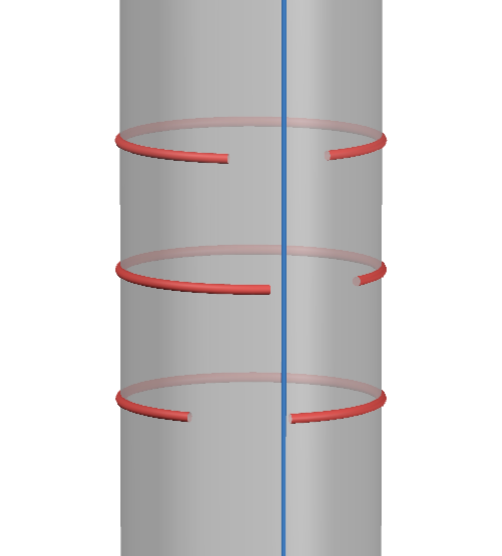
What was the probability that at least one such vertical line existed?
First off, the fact that the rings were evenly spaced didn’t matter here—this fact was only relevant for the Extra Credit.
Let’s start with the ring at the top. You could always draw a vertical line that passed through its gap. But with the addition of a second ring, it wasn’t guaranteed that a line could pass through both. For this to occur, at least part of the rings’ gaps had to be overlapping. In other words, the center of the second ring’s gap had to be within a 1/8-rotation of the center of the first ring’s gap, which occurred 1/4 of the time. Thus, the probability you could draw a vertical line through both the first and second rings was 1/4.
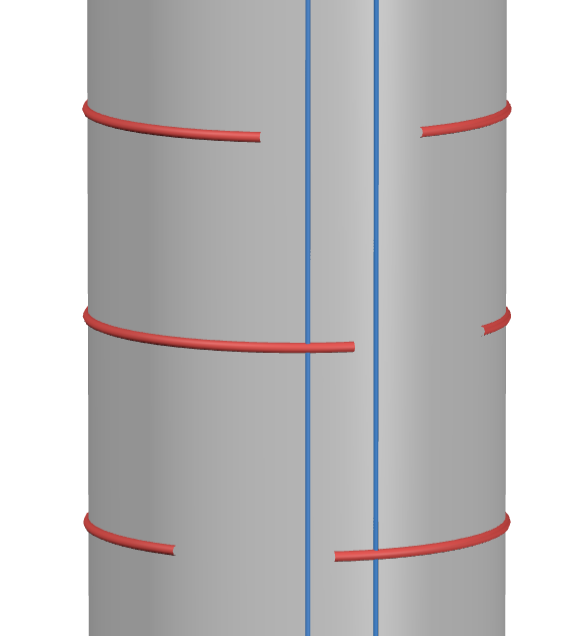
The same was true for the third ring with respect to the first ring; the probability you could draw a vertical line through both the first and third rings was 1/4. Thus, you might have thought that the probability a line could pass through all three rings was (1/4)·(1/4) = 1/16. However, that wasn’t right. Why not? Because it was possible to draw a vertical line through the first and second rings, draw a vertical line through the first and third rings, but not be able to draw a line through all three rings, as illustrated below. So the probability wound up being less than 1/16.
To get ourselves back on track, let’s consider the angular overlap between the gaps in the first two rings. If they overlapped completely (both covering the same 1/8 of the circle around the cylinder), then the probability the third ring shared some of this overlap was 1/4. If they didn’t overlap at all, then the probability the third ring shared some of this (nonexistent) overlap was 0. And if their overlap was somewhere in between, say k (with 0 < k ≤ 1/8), then the probability the third ring shared some of this overlap was k + 1/8.
The probability that k was 0 was 3/4. The remaining quarter of the time, the overlap was uniformly distributed between 0 and 1/8. Thus, the probability the third ring shared some of this overlap (again, that was k + 1/8) was a uniform distribution between 1/8 and 1/4, so that the average probability was halfway between, or 3/16.
At this point, you had the following two facts:
The probability that the second ring’s gap had any overlap with the first ring’s gap was 1/4.
When there was some nonzero overlap between the first two rings’ gaps, the average probability that the third ring’s gap shared some of that overlap was 3/16.
Putting this all together, the probability that a vertical line could be drawn through all three rings was (1/4)·(3/16) = 3/64. Sure enough, this was slightly less than our prior naive calculation of 1/16.
This was the answer when the gap size g was 1/8 of the way around the circle. As long as g was less than 1/2, the probability the second ring’s gap had any overlap with the first ring’s gap was 2g. And when there was some nonzero overlap between the first two rings’ gaps, the average probability that the third ring’s gap shared some of that overlap was 3g/2. Putting these together, the probability that a vertical line could be drawn through all three rings was 3g2. When g was at least 2/3, the probability a vertical line could pass through all three rings was 1. And when g was between 1/2 and 2/3 … well, that I shall leave as an exercise to the reader!
Congratulations to the (randomly selected) winner from last week: 🎻 Japheth Wood 🎻 from Kingston, New York. I received 41 timely submissions, of which 29 were correct—good for a 71 percent solve rate.
Instead of requiring a vertical line down the cylinder’s surface, now any helix down the surface was allowed. An example of such a helix passing through all three gaps is shown below.
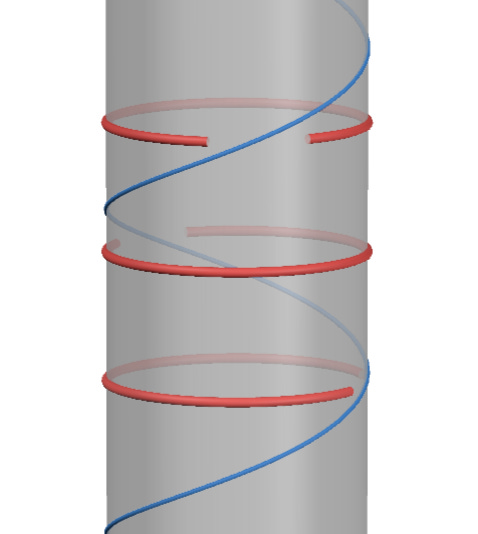
What was the probability that there existed at least one such helix that could pass through each ring’s gap?
Comments
Nothing yet. Say the first thing.
Sign in to join the conversation.