
Welcome to Fiddler on the Proof, the spiritual successor to FiveThirtyEight’s The Riddler column.
Every Friday morning, I present mathematical puzzles intended to challenge and delight you. Most can be solved with careful thought, pencil and paper, and the aid of a calculator. The “Extra Credit” is where the analysis typically gets hairy, or where you might turn to a computer for assistance.
I’ll also give a shoutout to 🎻 one lucky winner 🎻 of the previous week’s puzzle, chosen randomly from among those who submit their solution before 11:59 p.m. the Monday after puzzles are released. I’ll do my best to read through all the submissions and give additional shoutouts to creative approaches or awesome visualizations, the latter of which could receive 🎬 Best Picture Awards 🎬.
From Randi Goldman comes a riddle of rings:
A long vertical cylinder has three narrow open rings, each of which wraps around seven-eighths of the cylinder (leaving a one-eighth “gap”). The rings are evenly spaced vertically, but are otherwise randomly rotated about the cylinder’s central axis. For some orientations of the rings, there exists at least one vertical line down the cylinder’s surface that passes through each ring’s gap, as illustrated below.
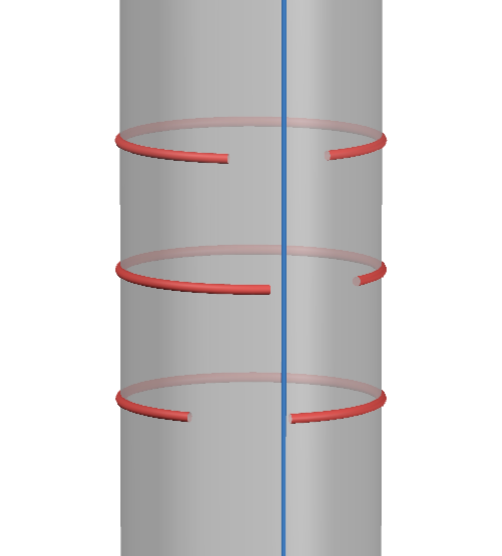
What is the probability that at least one such vertical line exists?
Instead of requiring a vertical line down the cylinder’s surface, now any helix down the surface is allowed. An example of such a helix passing through all three gaps is shown below.
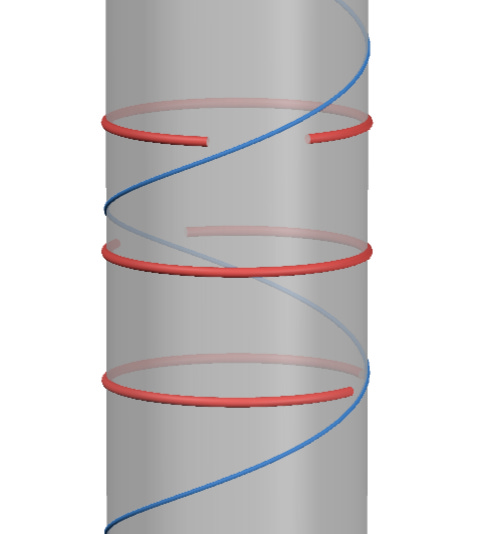
What is the probability that there exists at least one such helix that can pass through each ring’s gap?
There’s so much more puzzling goodness out there, I’d be remiss if I didn’t share some of it here. This week, I’m sharing Quanta Magazine’s features on the 2026 winners of the Fields and Abacus medals. In particular, I recommend the feature on Shayan Oveis Gharan and his work on the traveling salesperson problem.
Then do it! Your puzzle could be the highlight of everyone’s weekend. If you have a puzzle idea, shoot me an email. I love it when ideas also come with solutions, but that’s not a requirement.
I’m tracking submissions from paid subscribers and compiling a leaderboard, which I’ll reset every quarter. All correct solutions to Fiddlers and Extra Credits are worth 1 point each. Solutions should be sent prior to 11:59 p.m. the Monday after puzzles are released. At the end of each quarter, I’ll 👑 crown 👑 the finest of Fiddlers. If you think you see a mistake in the standings, kindly let me know.
Congratulations to the (randomly selected) winner from last week: 🎻 Calvin Josenhans 🎻 from Madison, Wisconsin. I received 56 timely submissions, of which 50 were correct—good for an 89 percent solve rate.
Last week, Fiddler Nation made it to the semifinals of the World Cup. All four teams that had made it this far were equally matched in that they each possessed the same total amount of “energy.” In advance of each semifinal game, teams had to independently decide how much of their energy to allocate to the match; all remaining energy went toward the finals. The team that spent more energy in any given game won. The semifinals and finals occurred so close in time that teams couldn’t recuperate any of their energy in between.
You had heard that the managers for the other three teams were abysmal and had no idea how to allocate their teams’ energy. Each of the other managers independently picked a random percentage between 0 and 100 and allocated that portion of their team’s energy to the semifinal game; the remaining energy went toward the final.
Since you were the cleverest manager of the bunch, you could choose an optimal strategy that maximized Fiddler Nation’s probability of winning the World Cup. What was this optimal probability?
If you (naively) went with the same randomized strategy as all your opponents, then by symmetry you each had a 25 percent chance of winning the World Cup. Surely it was possible to improve upon these chances.
Suppose the fraction of energy you dedicated to the semifinal round was A, which meant you had 1−A energy for the final—if you made it that far. Let’s calculate your probability of winning the World Cup p as a function of A. Maximizing p(A) would then result in the optimal strategy.
You won the semifinal round as long as your opponent allocated less than A energy to the match. Since the probability distribution for their energy was uniform between 0 and 1, the probability that your energy was greater than theirs was just A. Thus, your probability of advancing to the final was similarly A.
However, the probability distribution for your opponent’s energy in the final was not uniform. Why? Because you knew for a fact that your finals opponent had won their semifinal match, which meant they had allocated more energy to their semifinal match than their semifinal opponent had. Therefore, their probability distribution for energy spent in the semifinal was that of the maximum of two uniformly chosen random variables.
Determining this probability distribution is a classic problem in order statistics, and you can work it out for yourself by considering the function max(x, y) over the region 0 < x, y < 1. The probability your opponent in the finals spent energy B to win their semifinal turned out to be 2B.
Because you faced the winner of the other semifinal, i.e., the one who had spent more energy in that match, they had less energy saved up for the final. That was good news for you, as it meant you had a greater chance of beating them. In particular, you needed 1−B (their remaining energy) to be less than 1−A (your remaining energy), or, equivalently, you needed B to be greater than A.
The probability distribution for B is shown below. For a given value of A, the probability that B was greater was the area of the purple trapezoidal region, or, equivalently, 1 minus the area of the blue triangular region. This was 1−(A)(2A)/2, or 1−A2.
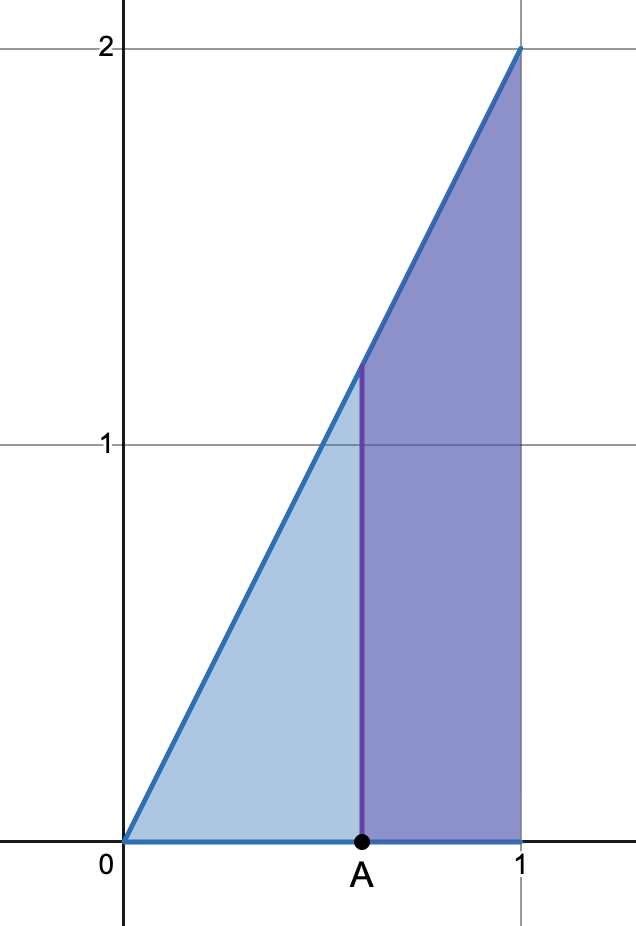
Putting this all together, your probability of winning your semifinal match was A, while your probability of winning the final (given that you won the semifinal) was 1−A2. Your probability of winning the World Cup was the product of these, or A·(1−A2). Solver Chris Payne plotted this as a function of A:
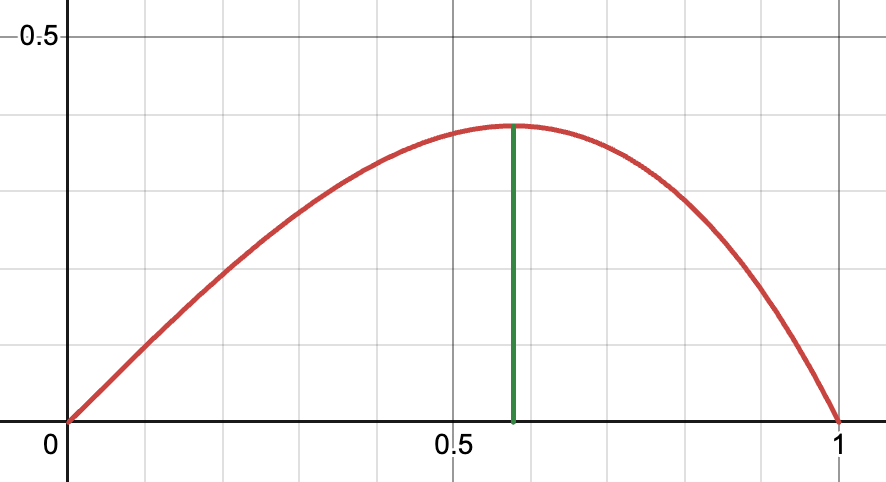
To maximize this function, you could set its derivative, 1−3A2, equal to zero, which occurred when A = 1/√3, or about 0.57753. Thus, it was optimal to dedicate about 58 percent of your energy to the semifinal match, saving the remaining 42 percent for the final. With this strategy, your probability of winning was 1/√3·(1−1/3), which simplified to 2/(3√3), or about 38.5 percent. That was a lot better than the 25 percent chance we naively started with!
Several readers submitted answers of 1/√3, the fraction of your energy you should have expended in the semifinal, which was not what the puzzle was asking for. However, given that these readers had essentially “solved” the puzzle, I awarded credit.
By the way, what were your three opponents’ respective chances of winning when you played optimally? To advance, your semifinal opponent had to allocate more than 1/√3 of their energy to the semifinal match, the probability of which was 1−1/√3. With some calculus, you could determine that their chances of winning in the finals was then (5−√3)/9. Putting this together, your semifinal opponent’s probability of winning the World Cup was (1−1/√3)·(5−√3)/9, or about 15.35 percent. That meant the remaining two teams each had a 23.08 percent chance of winning—not too far from 25 percent. Thus, by optimizing your strategy, you took greater advantage of your semifinal opponent than a potential finals opponent.
Congratulations to the (randomly selected) winner from last week: 🎻 Aaron Slepkov 🎻 from Peterborough, Ontario, Canada. I received 27 timely submissions, of which 19 were correct—good for a 70 percent solve rate.
As it turned out, I spoke too soon. Fiddler Nation had made it to the quarterfinals of the World Cup rather than the semifinals. As before, teams had to allocate the same total amount of energy across up to three matches.
The managers for the other seven teams remained abysmal. Each manager independently picked a random percentage between 0 and 100 and allocated that amount of their team’s energy to the quarterfinal. If they won, they allocated a random amount of their remaining energy to the semifinal. And if they won that, the rest of their team’s energy went toward the final.
Fiddler Nation’s strategy had to be drawn up in advance, with no specific knowledge of the other teams’ strategies beyond what I already shared.
That said, as the cleverest manager of the bunch you could once again choose an optimal strategy that maximized Fiddler Nation’s probability of winning the World Cup. What was this optimal probability?
Comments
Nothing yet. Say the first thing.
Sign in to join the conversation.