
A lot of fantasy books have this character:
Hello! I am Priesty Priesterson, devout worshipper of Temu Christ. I behave exactly like the author thinks a Christian does, which is to say nine times out of ten I turn out to be a venal asshole who opposes the protagonists. My religious order is pretty much the Catholic Church with, like, a noose instead of a cross because our Christ was hanged, isn’t that deep?
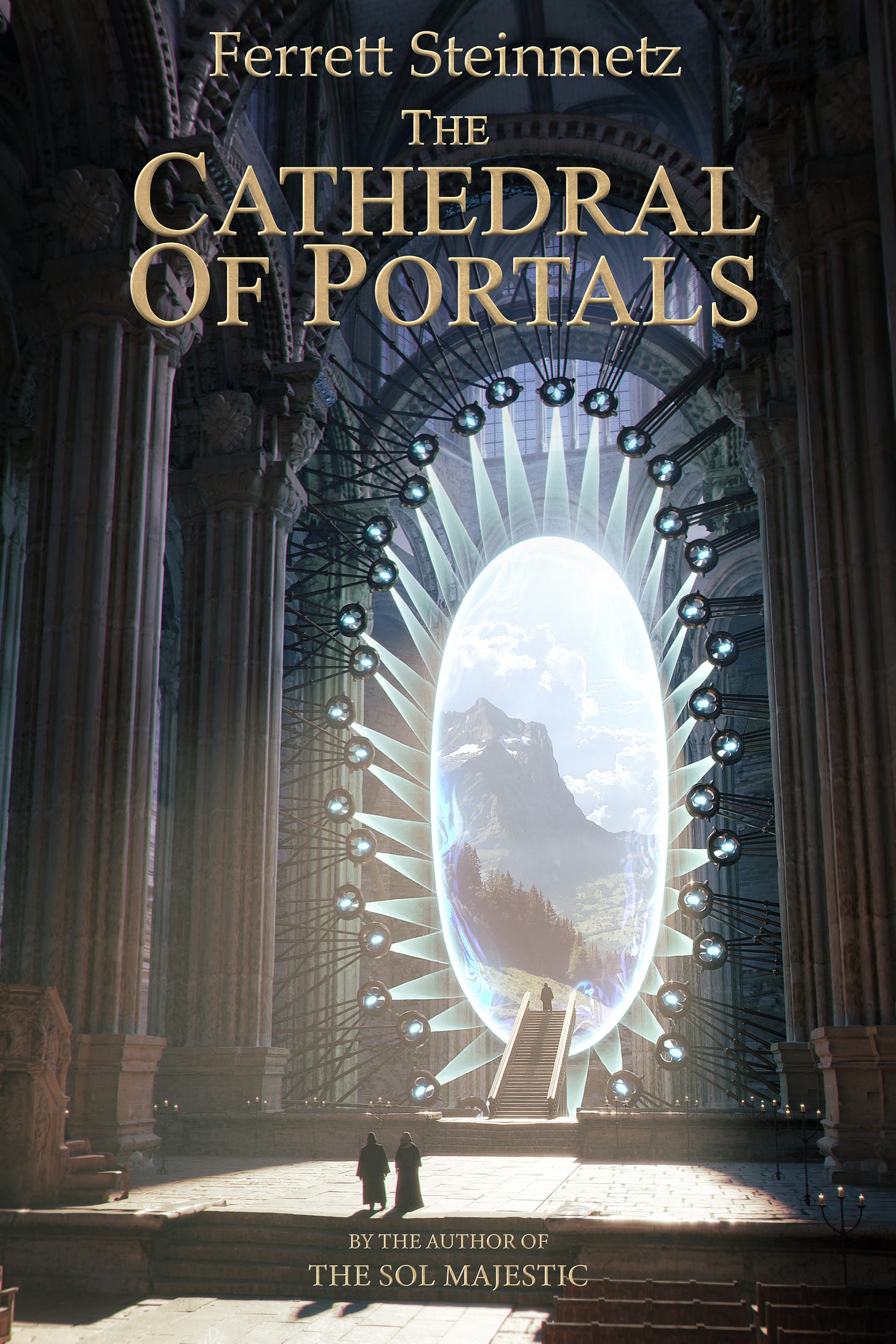
But my serialized novel The Cathedral of Portals just got to the chapter where I introduce Exemplar Philothea, devout worshipper of the Peddler - where the Peddler is very much a Christ analog. And I’m gonna be honest:
I think the religion’s the best thing about the book.
Because what I wanted in the Cathedral of Portals (now coming M/W/F to a browser near you!) was a reflection of the complexity of real-world religion as I saw it - with a lot of interpretations of the exact same scripture, with folks using their beliefs to justify both cruelty and kindness, and with a muddled version of events that’s very much been tainted by outside forces and yet people take it dead seriously.
I’ll be honest: When I pitched the idea of the Church of the Bodiless Ascension to her, Gini didn’t think I could pull it off. She thought the idea of a religion based around a genderless Christ figure was too abstract, too scholarly, and that I couldn’t make it interesting.
Thankfully, at least in Gini’s eyes, I made it extremely compelling.
So lemme tell you how I built a religion, using Christ as a template but using that as a way to open up the world to become something entirely different.
Step 1: Make the Religion Explicitly Capitalist (And Yet Also Socialist)
In the world of The Cathedral of Portals, The Peddler was an extremely successful merchant who forged a worldwide network of five trade routes. But instead of being a venal asshole, the Peddler instead channeled that immense wealth into bettering the world. “Improve the world fivefold,” said the Peddler, “And Heaven will be yours.”
So what we have here is not a poor carpenter, but basically an Elon Musk who took a world-changing amount of money and used it specifically to give poor people a leg up.
Which has a couple of interesting knock-on effects:
First, the Church of the Bodiless Ascension very much believes that trade is their sacred mission - like the Peddler, they believe that trading between neighbors improves communal ties, so they’re all about buying and selling for profit.
But they also believe that trade should be heavily regulated - to give the same price to everyone is as close to a sin as they get, because to them, the whole point of a marketplace is that you leverage the flow of commerce to give price breaks to the poor and to give jobs to folks that will help them not be poor. Why else would you take on this sacred duty?
The Peddler said it themselves: “When the Church does not rule the coin, coin will rule the Church.”
But of course, this isn’t a perfect world, and some folks are gonna be greedy - and a Church based on a merchant’s opinions, even a good-natured merchant, will have some built-in biases. So while some marketplaces are managed according to the Peddler’s will, others are quite happy to gouge people with slave-labor contracts. And while the idea of an unregulated black market is of course a sin, they often become a necessary reality when incompetent merchants seize control of the local trade routes and yet have no idea how to manage inventory.
Still, what’s important is that the public believes the Church should be working for the common good, so you have a populace that believes wholeheartedly in socialist beliefs. Which means even the greediest of church elders are forced to do acts of good socialism to keep up appearances.
Second, because the Peddler had Five Sacred Trade Routes (and also because you have a Church that believes that labor is not a joyless task but instead is something that should be done for personal improvement), folks travel. A lot. They’re given time off to do so, and often join pilgrimages that take them along one of the Sacred Trade Routes. And that in turn means that you have a populace that is heavily encouraged to rub elbows with their neighbors, meaning that religion has eroded (but not erased!) the concept of countries and states.
And that idea that folks should be neighborly is further reinforced by:
Step 2: Make a Genderless, Raceless Christ Figure
Early on, I decided I wanted a religion that had “discrimination is a sin” baked right into its very foundation. That alone would change the world; it wouldn’t stop people from discriminating against gender or race, of course - it’s human nature - but it’d make them work a lot harder to justify their biases.
So what I decided was that my Christ analog would be genderless.
Or, rather, they became genderless.
The Peddler was put to death by the Tyrant King (may his name be forever stricken from the records) for the sin of refusing to fund the King’s unjust war. (For all the Peddler’s coin, in a tie, the guys who control the swords are gonna win.) The Peddler could of course have funded a revolution to free them… but they were firm in stating that starting a war would not improve the world fivefold.
So like Christ, they let themselves be led to death.
But when the Peddler died, something much crazier happened than returning from the dead. Lemme quote from today’s chapter:
And at the moment the Peddler was torn from limb to limb, God gave them Their Bodiless Ascension—raising Them to Heaven as proof of how beautifully They had learned God’s lessons.
And during that glorious Ascension, God erased all memory of the Peddler’s gender, appearance, or race. None of Their Steadfast Students could remember who the Peddler had been, only what They had done.
On that day, God transformed the Peddler from a human into an ideal—the first True Student.
And that has two knock-on effects:
First, when someone becomes an Exemplar of the Peddler, they give up their gender. Which means that not only are nonbinary folks tolerated, they’re often venerated.
Second, between that and the fact that the Peddler’s Advisories heavily revolved around “Respect the competent, no matter where you find them,” you have a whole culture that’s taught not to discriminate against any physical features.
They do; of course they do. Again, that’s human nature. But given the whole point of the Peddler is that they became anonymous so they could be judged by their deeds alone, again, it makes it a lot harder to be sexist or racist… And so the society is less sexist and racist.
(In fact, the book is light on character descriptions simply because the folks in the book don’t often draw such distinctions.)
Basically, anyone can do any job, and often does.
Step 3: Make the History Realistic.
Every chapter in The Cathedral of Portals starts with a quote from Scyr Lil, Historian - someone writing from a distant future who’s trying to reconstruct the past. And that was nice because it gave me opportunities to shim in bits of worldbuilding I couldn’t quite get into the book…
But unlike the main characters, Scry Lil is approaching this world from a scholarly perspective - which means they’re very aware that the Peddler’s Advisories aren’t unadulterated. They’ve been translated and rewritten and edited, with layers of interpretations and folklore accreted around it - and who the Peddler was or what they actually said is still very much in question.
Did the Peddler actually exist? Was all memory of their features erased? What did the Peddler actually believe or do?
But hey - Scyr Lil’s first quote, which kicks off the book, tells you all you need to know:
Millennia have passed since the Sundered Age, and we still have no satisfying answers to the era’s two central questions:
Who was the Peddler?
And what caused the Sundering?
The characters in the book are operating off fundamental assumptions that are technically wrong. But that doesn’t matter. Much like the Bible has been endlessly mistranslated and edited, The Peddler’s Advisories have often been rewritten with a vengeance…
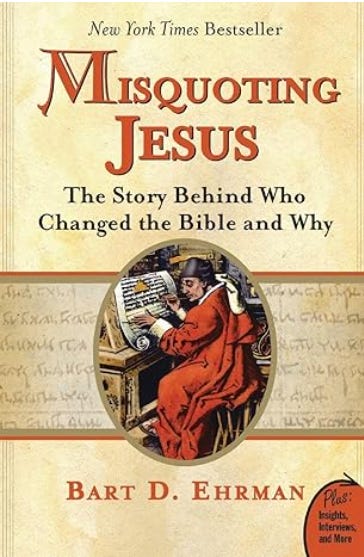
Which means that, much like the New Testament, the Peddler’s Advisories have a couple of core tenets that get repeated so firmly that it’s probably what the Peddler said… but a lot of other opinions have been shoehorned into the Advisories and now, to all appearances, those rogue philosophies are what the Peddler said.
Which means that in the world of The Cathedral of Portals, people have intensely different takes on the Peddler, depending on which bits of the Advisories they’ve found compelling. And those discussions propel the narrative quite heavily.
(This, incidentally, is why I find it short-sighed whenever someone complains that the Bible is self-contradictory - the reason the Bible lasted so long is because it’s self-contradictory! The more people can extract their personal meanings from a religious text, the more likely it is that text will catch on and spread. If the Bible had singular, clearly-stated instructions - as in “Thou shalt not kill, and that includes during war and in self-defense and also suicide, and there’s no exceptions ever,” then practically nobody would follow it. All you have to do is look at how many people follow the reasonably precise instructions in Leviticus to realize that specificity is the death of broad popularity when it comes to most religions.)
Anyway. I could go on - but if you want to see the underlying worldbuilding, pay attention to Scyr Lil. They’ve got some pointed understandings of the world the protagonist lives in… and yet, like many historians, they don’t really understand what’s happening in the protagonists’ time at all.
Anyway. I could go on, but if that’s not enough to intrigue you, I don’t know what will. But a large portion of the book is driven by the tension between the Church’s tenets and their actual applications, and I felt in the end it came off as pretty realistic.
As a reminder, there’s three ways to read it:
FOR FREE, a chapter at a time: At Royal Road, we’re on Chapter 2 - the introduction of Philothea.
PAID, a chapter at a time: A paid level at my Patreon. We’re on Chapter 4 - the second chapter in Philothea’s story.
PAID, all at once: Pre-order the book at Amazon for its final publication on October 30th.
PRICELESS YET FREE: Sharing a link promoting the book! Or leaving a review/commenting/following on Royal Road!
I hope your Christ analog will be as fun to create as mine was,
T.F.
No posts
Comments
Nothing yet. Say the first thing.
Sign in to join the conversation.