
The first bright red Fresno peppers appeared in the garden this week. I know, I should say ripened, but it did feel like they appeared. I didn’t think any of the peppers I’d planted were even close to red, and then there was this little cluster of 3 hidden in the tangle of pepper plants falling over on themselves.
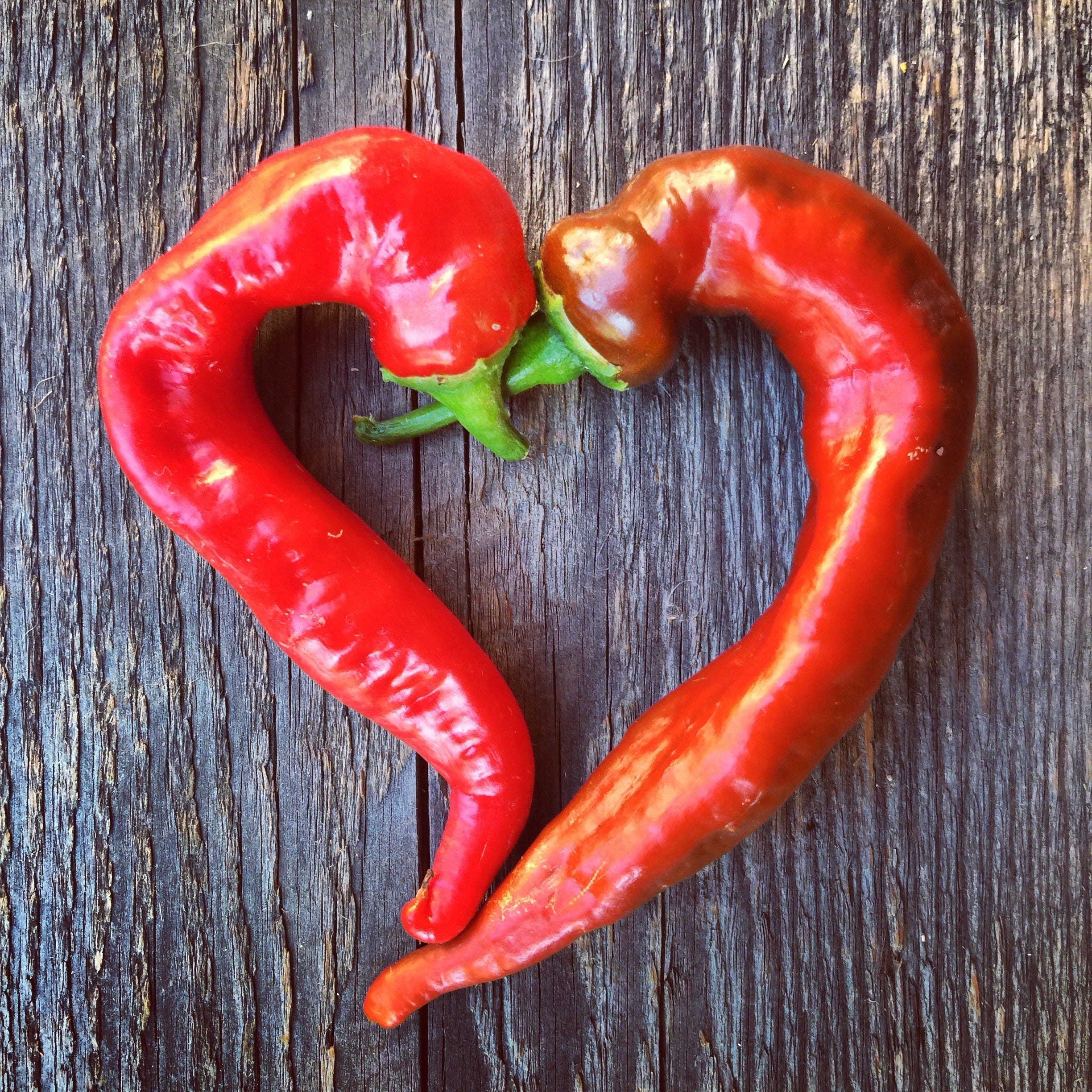
…but pickled peppers aren’t necessarily fermented peppers.
Let’s start with the definition of a pickle (I know you’re thinking of your favorite cucumber variety—garlicky dill pickles, bread and butter pickles—but let’s put that aside for the moment). The simplest definition is “to preserve or flavor (food) in a solution of brine or vinegar.”
Pickle can also be a verb—to pickle. Chances are if you are reading this, it is because you enjoy the act of making pickles.
Any food can be “pickled,” remember, it is just acidifying the food for preservation, but for the sake of this post, we are going to stick to peppers. The word pickles leads us to a misconception is that all pickles are cucumbers, which is not true—cucumbers just happen to be ubiquitous enough to have received the label. Or, that all pickles are chunky vegetable bits, remember, anything acidified for preservation is pickled.
Hot sauce is pickled peppers that you can pour.
The second part of this idea of pickling: the food, or peppers in our case, are brought to a pH of 4.6 or lower, which is necessary to kill most bacteria. In other words, for something to be a pickle, it must be acidic. This acidic and anaerobic setting is the environment that preserves our hot peppers to be enjoyed well beyond the harvest season—in a beautiful little bottle of hot sauce. If what we are doing is preserving by submerging the peppers in some kind of acid, then it becomes clear that fermentation is a technique or a tool of the art of pickling. So, in short, all vegetable fermentation is pickling, but all pickling is not necessarily fermentation.
There are many ways to make hot sauce. Let’s start by looking at fermented hot sauces. Many commercial hot sauces are fermented in the first step of the process. The fermentation is to acidify and add flavor. It is done by putting a pepper mash, basically raw puréed peppers and salt, into an anaerobic situation to be fermented by lactic acid. After a while, you have hot sauce, and it is acidic enough to be considered pickled and safe. It is now either finished and ready to use or a base upon which to build flavors with other ingredients, like fruit syrups or other herbs and spices. Most commercial makers add vinegar at this point. Why? To stabilize it further by ending the lives of the probiotic microbes (primarily lactic acid bacteria) so that they no longer cause issues by continuing to ferment the peppers. Nobody likes selling bubbling bottles of hot sauce—something about making the customers nervous.
Other makers skip this whole step and just add vinegar to a pepper mash to acidify it; often, these pureed peppers are cooked with salt and vinegar and whatever spices and flavors the maker might want. They are then packed in a jar and water-bath canned to remove the oxygen and seal the jar. So, you are thinking, well, that seems faster; why bother with fermenting the peppers at all?
It could be the best reason is that it is fun and easy, and a great way to preserve fresh peppers.
Master Hot Sauce Fermentation Course
First, the mashed peppers are salted, which creates the brine in which the whole operation takes place. The microbes then get busy doing what microbes do: transforming the carbohydrates (sugar and starch) into acid. The cool thing about fermentation as pickling is that the microbes do the work for you, and they acidify everything equally, well below our magic 4.6 on the pH scale, and you don’t even have to buy vinegar or make your own vinegar. All you need to do is set up the right environment, which folks figured out thousands of years ago; adding vinegar to make the process go faster came later. As a result, fermented pickled vegetables require no heat, no long hours canning, can be set up in a few minutes, and last for months (and in some cases years) in the fridge. And hot sauce, when fully fermented properly, does not need refrigeration.
That is not all. Fermentation increases the flavor of the peppers; this is why many commercial companies still use fermentation as the first step in the process. Tabasco, for example, ferments and ages their peppers in oak barrels for two years. The sauce would not be the same without that time spent.
As you can see I get excited about making hot sauce this time of year. If you like to learn through reading, Fiery Ferments, is a hot sauce and condiment book that will blow your mind, with the potential. AND don’t be scared by the title every recipe in the book can be made with any heat scale you like, or just a plain old red bell pepper.
Here is a post with a mash recipe from the archives
Time to Make a Pepper Mash - hot or not
·
October 17, 2025
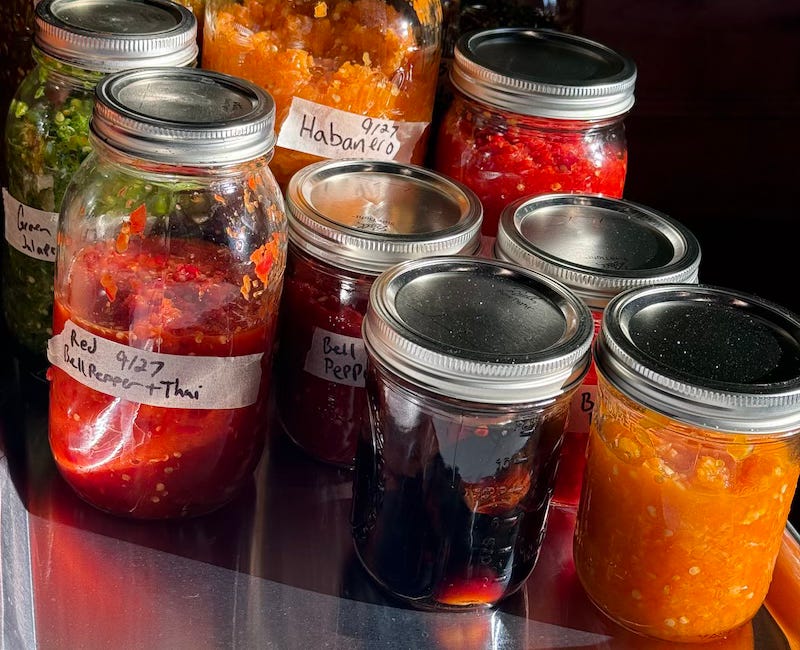
Here in North America, the leaves are golden and red, and the peppers are in full swing. Head to any farmer’s market or produce section and you should find a bounty of peppers from sweet yellows, reds, and oranges to super spicy, tiny hot chilies. I admit, while I am not a certified hot head, I do love all peppers. Whether you like super spicy or not ho…
Stay tuned, we are finalizing the details for our September webinar, and looks like in October we will be talking with Ann from NYrture Natto.
In the meantime, head over to Fermenting Change to make sure you get alerted to a live about the simplicity and beauty of the vegetable-forward cuisine of Northern Europe highlighted in the new book Scandinavian Everyday. Be sure to check out the Mustard Curry Pickle Recipe while you are there.
As we are in the best time of year—harvest season—please check out our complete catalog of fermentation courses at The Fermentation School. Where you can trust what you learn to build confidence, feel safe, and create amazing flavor.
No posts
Comments
Nothing yet. Say the first thing.
Sign in to join the conversation.