
“What do you do when you no longer believe in a system?
You stop depending on it.”
I can’t recall exactly what the quote was, or even the exact details of the story, but I remember the scene vividly.
The quote came from the mouth of Leyla Kazim, writer, presenter on BBC’s The Food Programme, and recurring food critic on MasterChef. She was recounting a radical life-change story. The kind she is deeply familiar with. The kind becoming increasingly cliché in a world tiring of meaningless jobs and systems that no longer serve us, if they ever did.
This story was of a man who left his cushy corporate job to run a farm because he stopped believing in our broken food system.
Or something like that.
Again, the details are fuzzy. But what the quote implied lingers with me still.
Moments before, Sandor Katz was scribbling wobbly lines on a stray napkin, trying to explain the concept of gerrymandering to Leyla while I poorly attempted to outline the U.S.’s supposed three-tier system of government to her, a lifelong Londoner.
It was our last night at Aterra, a rustic “eco boutique” set in the Alentejo region of southwestern Portugal. It was late. The lights had gone dim. We were sitting around one of the many Japanese-style low tables in our dining hall-turned teaching area, surrounded by small clusters of people similarly delaying sleep and the end of an incredible time together with intriguing conversation. Legs strewn on floor cushions, Sandor squatting on the table next to us in one of his standard sets of colorful tie-died shirts, hoodies, and patterned pants.
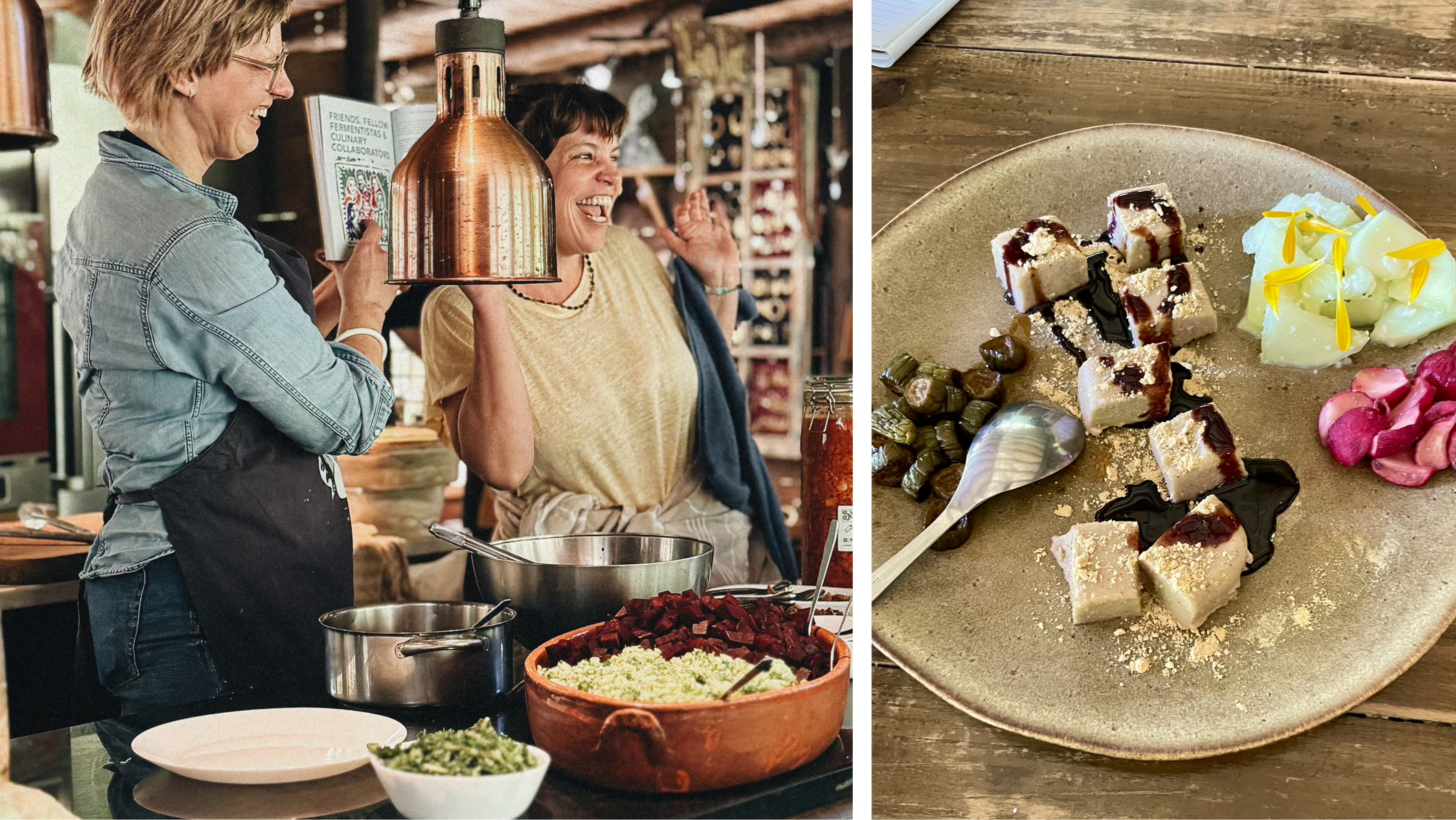
We were there for Ferment Academia, the inaugural weeklong fermentation “residency” put on by our animated Brazilian leader, award-winning cook and teacher, and plant-based fermentation expert, Paula Neubauer, and her event assistant, Stephanie Sacco. And I was there, specifically, because I’d won a spot in the residency thanks to Paula and The Fermentation School. I donated money to their collective fundraising campaign supporting the nhandesy, and I was the lucky name pulled from all donors, granting me the final participant spot in the experience.
By that point, we were tired, but more intimate. The week was coming to a close for the more than 40 participants; there was little cell service or internet on the property, and we were full yet still sipping local wine and nibbling on ash-dusted goat cheese from a visiting maker we’d met earlier in the day.
So connection was flowing as effortlessly as you’d expect around a late-night campfire with close friends.
Which is why a group of fermentation nerds found themselves talking about politics.
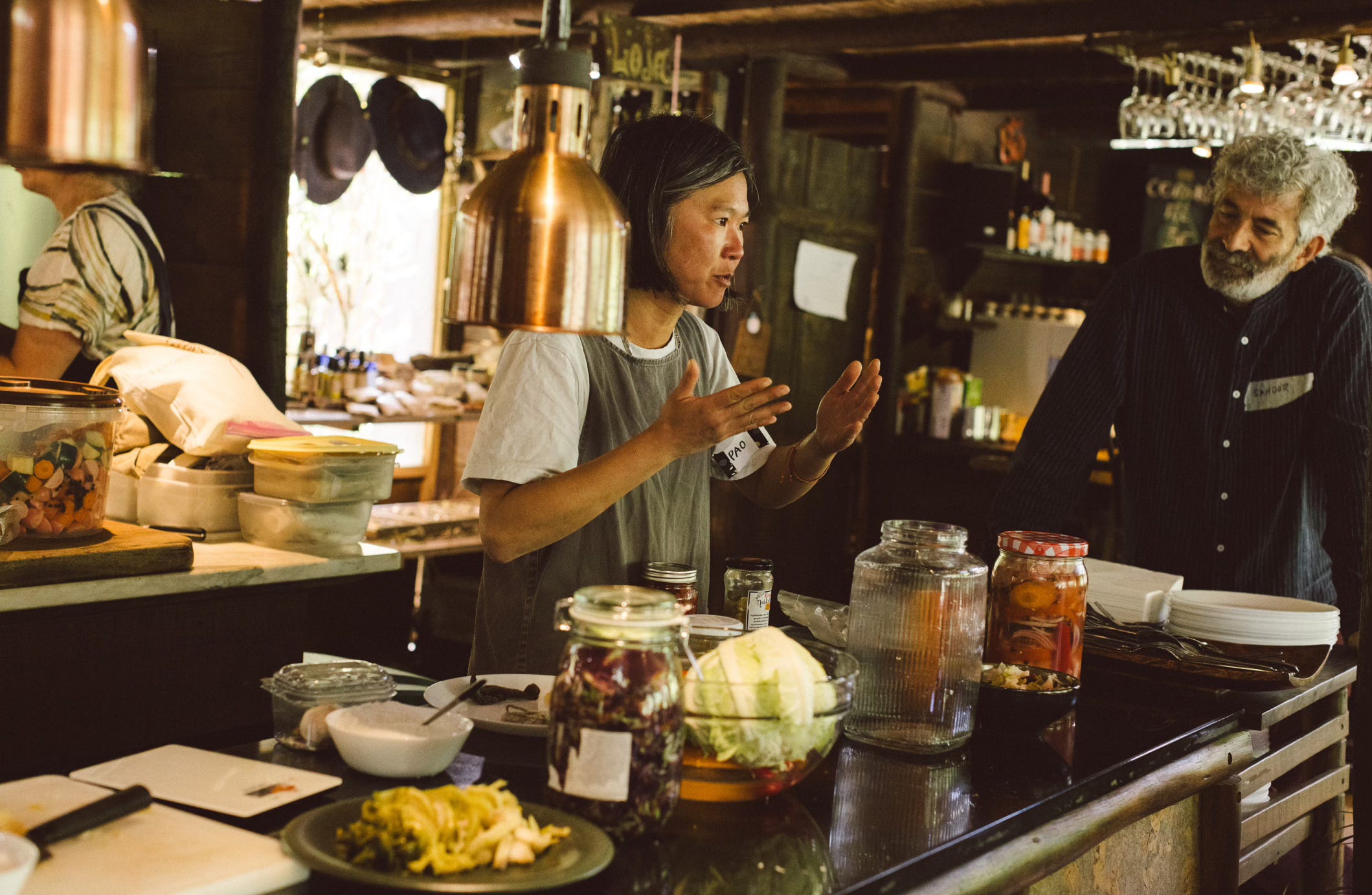
It’s also why, in this post-event write-up, I’m not giving you a run-down of the residency’s unbelievable lesson lineup or detailing the absolutely ridiculous succession of food we ate all week. (I’ll let some of the photos do that for me.)
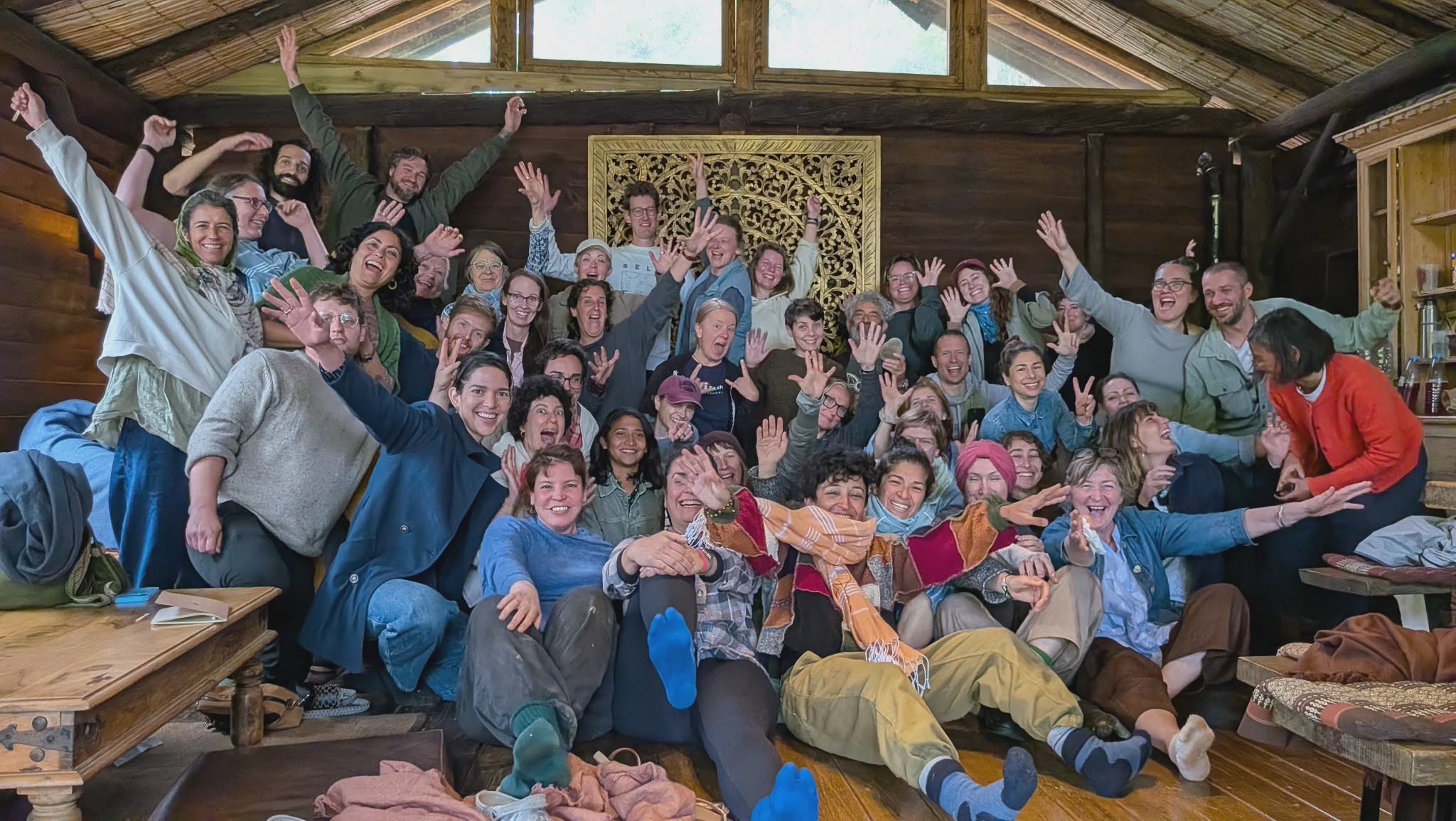
See, our attendees and presenters—as Sandor himself recalled—“were an eclectic international group that included microbiologists, chefs, fermentation professionals, food journalists, food scientists and technologists, farmers, and home practitioners from Portugal, Germany, Spain, UK, Netherlands, Ukraine, Latvia, Romania, Serbia, India, Taiwan, Brazil, Chile, Bolivia, Argentina, Puerto Rico, [the] U.S., Australia, and more.”
And yet, despite our varied homes of origin, occasional language barriers, and likely complex mix of political interests and opinions, what emerged was a temporary but tangible experience of community in practice.
Food and fermentation were why we were there, but what many of us traveled home with—and what remains now that it has ended (shoutout to our still-active WhatsApp chat)—was a reminder of what community can feel like, even if only briefly. In fact, the next morning, during the group’s closing circle, what most attendees voiced wasn’t specific fermentation knowledge they were glad to have gained or a specific meal they’d enjoyed, though both were common.
What we were grateful for was connection.
The people and the conversations we had together—on bus rides, on walks between the compost toilets and our tents, and shouting over the incessant peacocks at Aterra—were special. Not for any other reason than how utterly uncommon this level of sustained interaction and genuine connection has become in “modern” society.
As much as we were a dedicated group of food professionals and enthusiasts, we are also people living within deeply broken systems, trying to understand how to rely on them less while feeling profoundly alone in that inquiry.
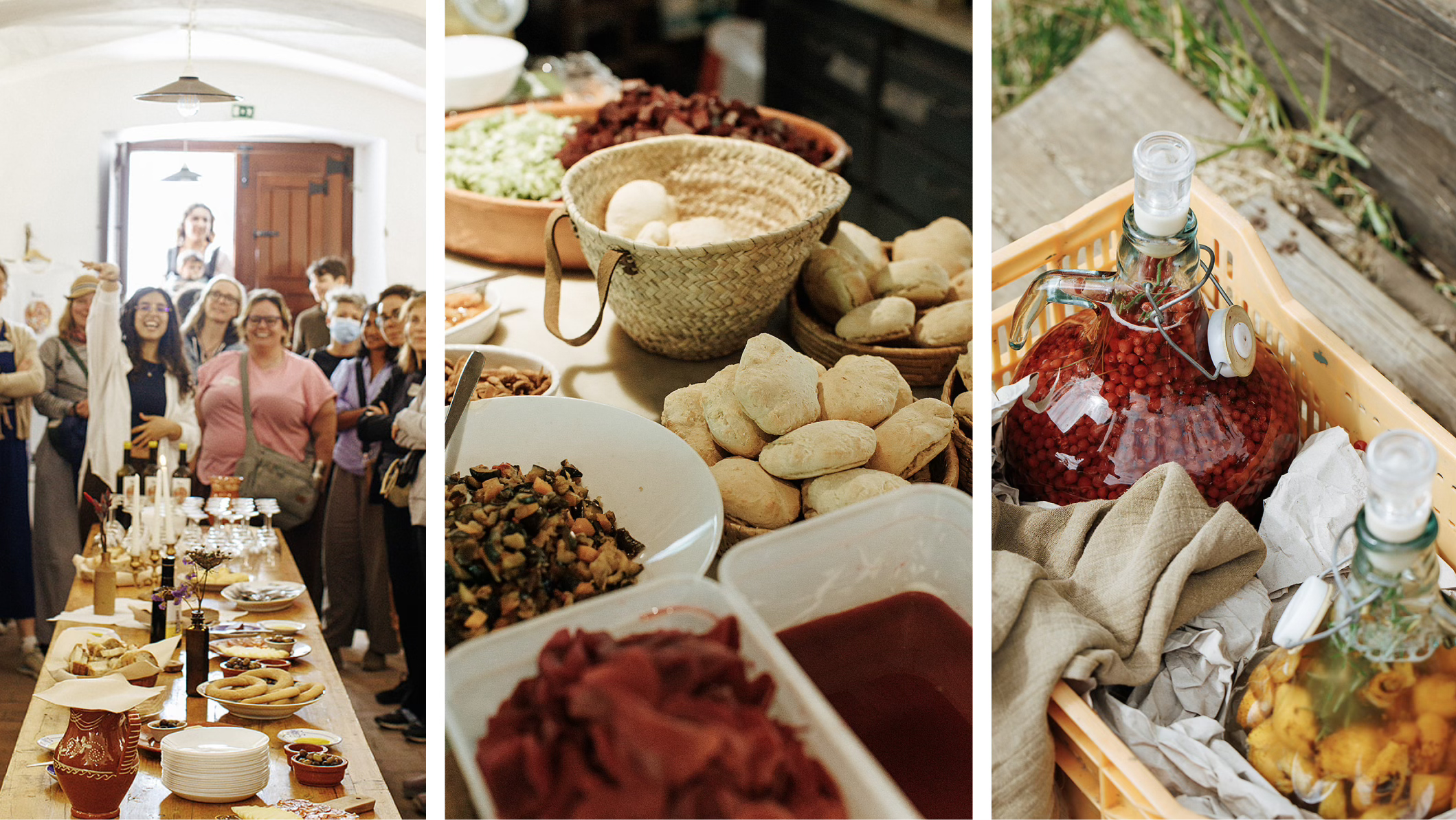
And while fermentation is, of course, an ancient and deeply ordinary practice, it is also—right now, in this moment, and within modern dominant culture—quietly revolutionary.
Revolutionary because it operates on abundance rather than scarcity. Even in a crowd of well-known fermentation experts, famous in their own right, people are overly generous with their knowledge, advice, and time. We give, even while the world hoards and protects its recipes, “novel” ideas, and hard-won food insights.
Revolutionary because (bio)diversity is the cornerstone of any healthy ecosystem. Like ecotones in nature—where forests meet beaches, or deserts meet grasslands—life becomes richer where the two meet. Ferments contain more life, become more alive, when seemingly unrelated things are brought together. Humans are no different, and Ferment Academia offered a visceral reminder of that.
Revolutionary because it teaches intimacy with place. It primarily encourages the use of local and seasonal ingredients. This cuts costs, reduces impact on the planet, and brings you into a closer relationship with what is near to you rather than outsourcing your needs to far-off places and unknown faces.
Revolutionary because, in fermentation, there is no such thing as waste. Cherry pits? Make them into vinegar. Carrot tops? They make a killer fermented pesto. Spoiling fruit? Try a wild-fermented soda. Most modern humans throw these things away, unable to see the value they still offer. This often extends to how we treat each other. Relationships become difficult, and we move on. Communities become inconvenient, and we withdraw. People struggle, fail, or behave imperfectly, and we discard them rather than asking what transformation might still be possible. Fermentation does the opposite—transforming what appears to be wasting or “rotting” into something alive and complex. It sees possibility in every scrap.
Revolutionary because what is invisible is perhaps most important. We are more nourished when we partner with microbes and other unseen forces, and when we trust that we are not necessarily the most critical—or even most intelligent—actor in our myriad relationships. As my friend Kate says, humans may just be evolutionary “school buses” for bacteria and other tiny organisms: convenient transportation for the micro-world around us.
Revolutionary because it connects us to our ancestors. You inherit the microbiome and mitochondria of your mother, which means you are partnering with microbes, yeasts, bacteria, and other ancient species and “technologies” from generations ago, while your microbiome will pass to future generations after you. Meanwhile, humans have used fermentation for thousands of years across nearly every region and culture on Earth. It is employed in our fanciest restaurants, but is also the practice of kitchen witches, home cooks and gardeners, Indigenous grandmothers, and wisdom-keepers across time—many of whom don’t even know it’s called “fermentation.”
And, in my mind, perhaps most importantly:
Fermentation is revolutionary because it often operates on the gift economy.
A gift economy relies on trust, reciprocity, and relationships rather than direct transactions. Instead of asking, “What can I get for this?” it asks, “What can I contribute to the whole,” or “What can I give, considering all I have been given?” In many traditional cultures, gifts were not simply objects exchanged between individuals, but a way of weaving social bonds, reinforcing mutual care, and keeping resources circulating through the community. At its healthiest, a gift economy creates a sense of belonging and interdependence, where generosity becomes less about obligation and more about participating in a living flow of support.
In fermentation, strangers who have never met know to bring something fermented to each other when they first come together. There is an unspoken obligation between us, even if we’ve never met, and we happily accept it, because something delightful is sure to be in our future. You have excess miso, but I have too many kefir grains. I know how to butcher, but you know how to grow koji. Our lives and our meals are better when we share. In fact, when we don’t, our excess goes unused, spoils, rots. The food goes bad, the system fails, and so do we.
An example of the “gift economy” on full display during “Ferment Karaoke,” when residency attendees shared ferments from home, turning a group tasting into an exchange of stories, skills, and abundance. (Video credit: Michael Dobson of Cafe Effe.)
So, what do you do when you no longer believe in a system?
Fermentation shows the way:
Operate from abundance rather than scarcity.
Embrace diversity, even when it terrifies you—everything from mold to your new neighbor.
Shorten the distance between yourself and your daily needs. Learn the rhythms of your local seasons, and preserve what is nearby.
See possibility where others see waste. In food, and in each other.
Build relationships with and begin to trust in what is most “unseen.”
Remember that intelligence exists beyond your own understanding, and that other species have things to teach you.
Live in consideration of your ancestors—those who came before, and those who are still to come.
Give generously, because reciprocity is how we begin to depend on each other instead of the systems we no longer believe in.
And, gather together so you might remember the power of community, microbial or otherwise.
I hear Ferment Academia is already building a waitlist for 2027.
I couldn’t recommend it more.
No posts
Comments
Nothing yet. Say the first thing.
Sign in to join the conversation.