
Welcome to Runway Notes, a series dedicated to sharing notes, observations, and context from runway shows.
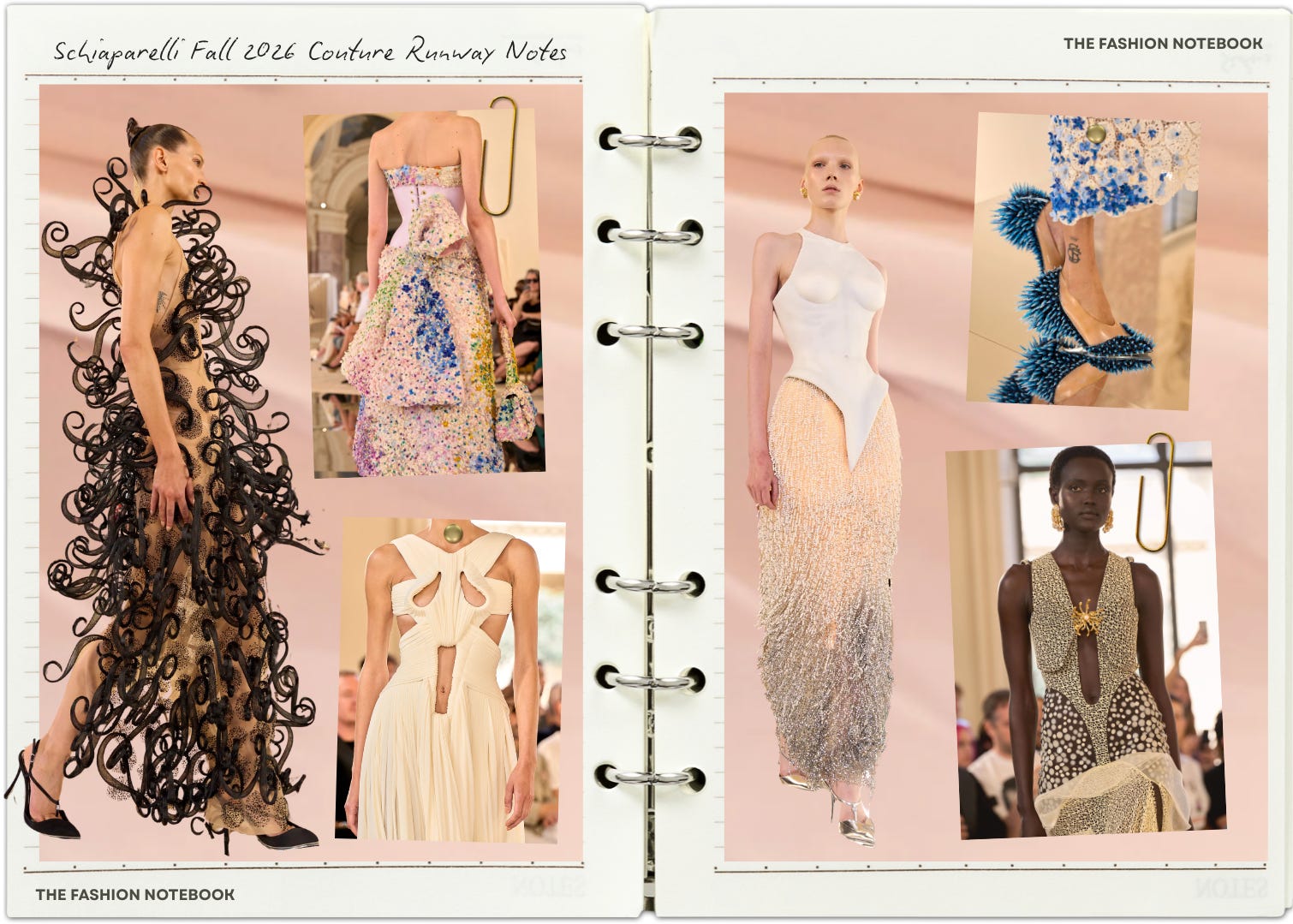
When you think of the word couture, you probably picture the world’s most luxurious fabrics, intricate embroidery, and one-of-a-kind materials. But at Schiaparelli, couture means baked fish scales, sculpted silicone, and molded latex.
Maison Schiaparelli is fashion’s biggest Surrealist house. Founded by Elsa Schiaparelli in 1927, the brand became known for its intricate collaborations with Surrealist artists like Salvador Dalí. After all, who could forget the iconic lobster dress that provoked traditional dress codes?
In 2019, American designer Daniel Roseberry became the brand’s Creative Director, and has kept the surrealist, avant-garde vision of Schiaparelli alive ever since.
Last year, Roseberry’s Spring 2025 Couture collection marked a breakthrough in his career as a designer. He questioned the meaning of modernity, challenging his atelier to reconsider what it could look like. In the show notes, he wrote “I’m so tired of everyone constantly equating modernity with simplicity: Can’t the new also be worked, be baroque, be extravagant? Has our fixation on what looks or feels modern become a limitation? Has it cost us our imagination?”
Because the collection was so widely celebrated, you can imagine how intimidating it must have been to follow it with another couture collection, even for him.
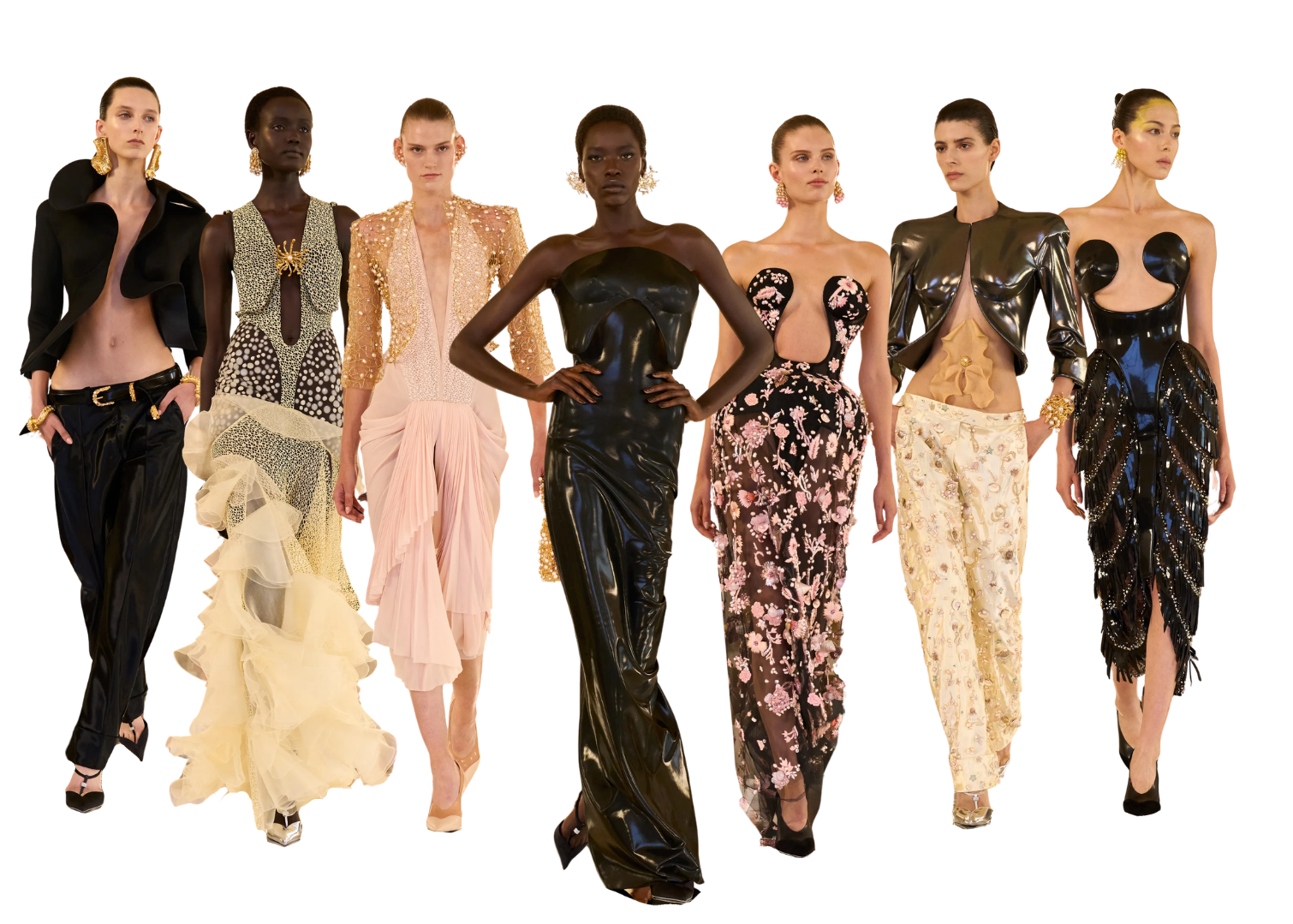
So for Fall 2026 Couture, Roseberry embraced that exact feeling of uncertainty, introducing “The Call of the Void.” Leaning into surrealist tension, the world’s growing relationship with AI, and the fear of the unknown, he worked with an atelier specialized in silicone to design a non-traditional luxury collection—one built with baked fish scales and latex, yet executed with the level of craftsmanship that’s demanded in haute couture.
Roseberry explained,
“Only when I surrendered to the void did I truly start to enjoy making this collection… While we talk about how couture is something to master, we don’t really think about what true mastery actually means. Perhaps that is the deepest lesson Elsa left this House: not a vocabulary of symbols, but a permission to believe that impossibility itself can become a creative method. The moments when certainty disappears are often the moments when something genuinely new becomes possible.”
That philosophy is evident in this collection, where experimentation takes the lead instead of conventional ideas of couture. Roseberry and his atelier embraced uncertainty as part of their creative process, proving that even synthetics and unexpected materials can become elegant.
The craftsmanship behind its unconventional materials is the spotlight of this collection. Schiaparelli’s atelier is constantly developing new techniques because it works with materials rarely seen in couture. These choices demand experimentation and innovation because they’re not conventionally easy to work with.
Throughout the collection, Roseberry presents the body through connecting themes, referencing sea creatures and their textures—like jelly fish bodices, fishtail fringes, and octopus-like tentacles.
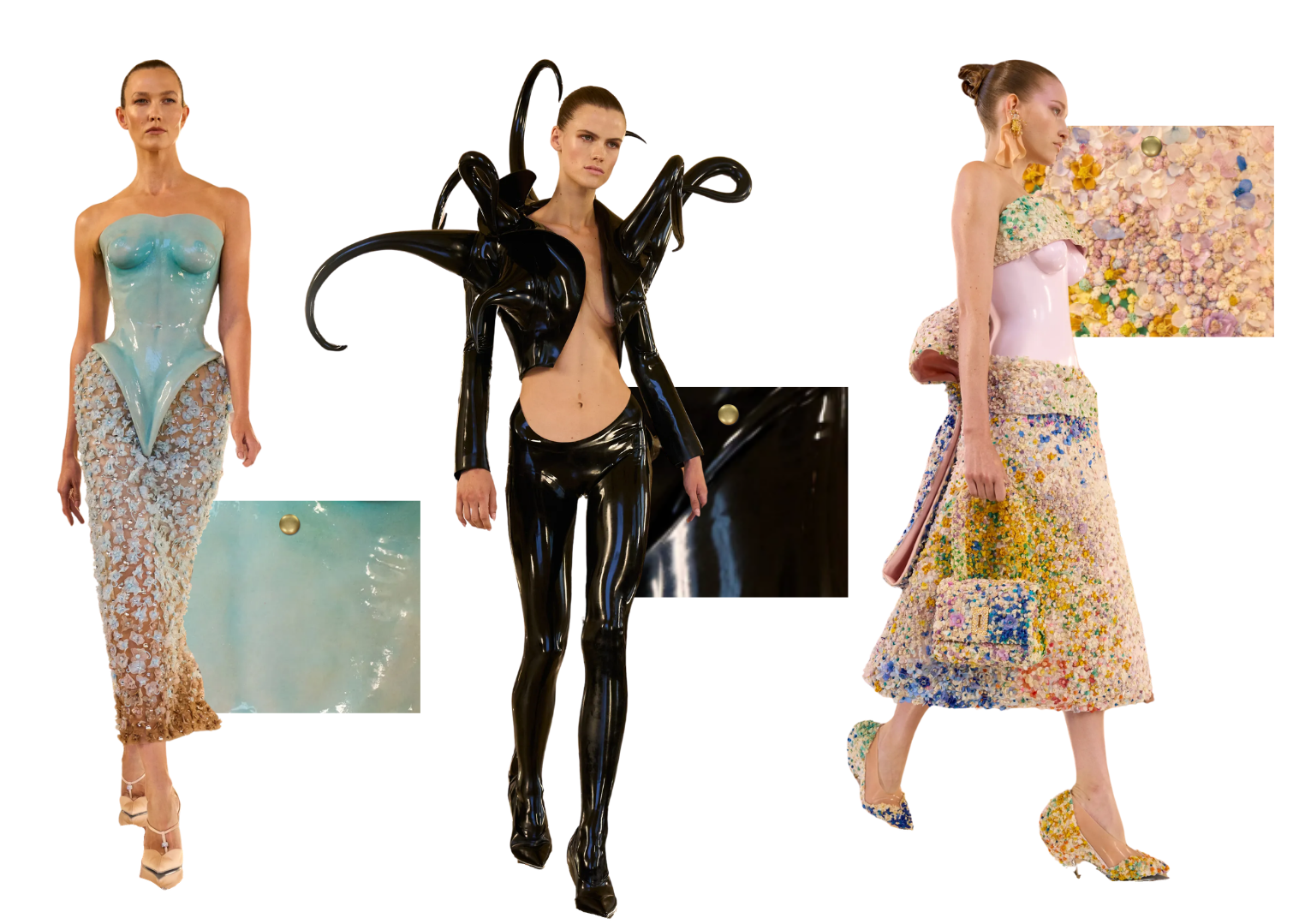
Despite the recurring themes, materials, and textures, the collection never feels like a literal interpretation of the depths of the ocean. You notice the repetition of latex, the luxurious embroidery, and the marine-like textures, yet you know it’s couture. Each piece displays character and the collection as a whole connects to the beauty of the unknown. Like Roseberry mentioned in his last couture collection, modernity can also be extravagant.
Many pieces in the collection are also open to interpretation, part of what makes it so intriguing. The back of look #7, for example, can resemble a ghost, a skeleton, or even the human pelvis—which is fitting for Schiaparelli as the body is often treated as an abstract concept.
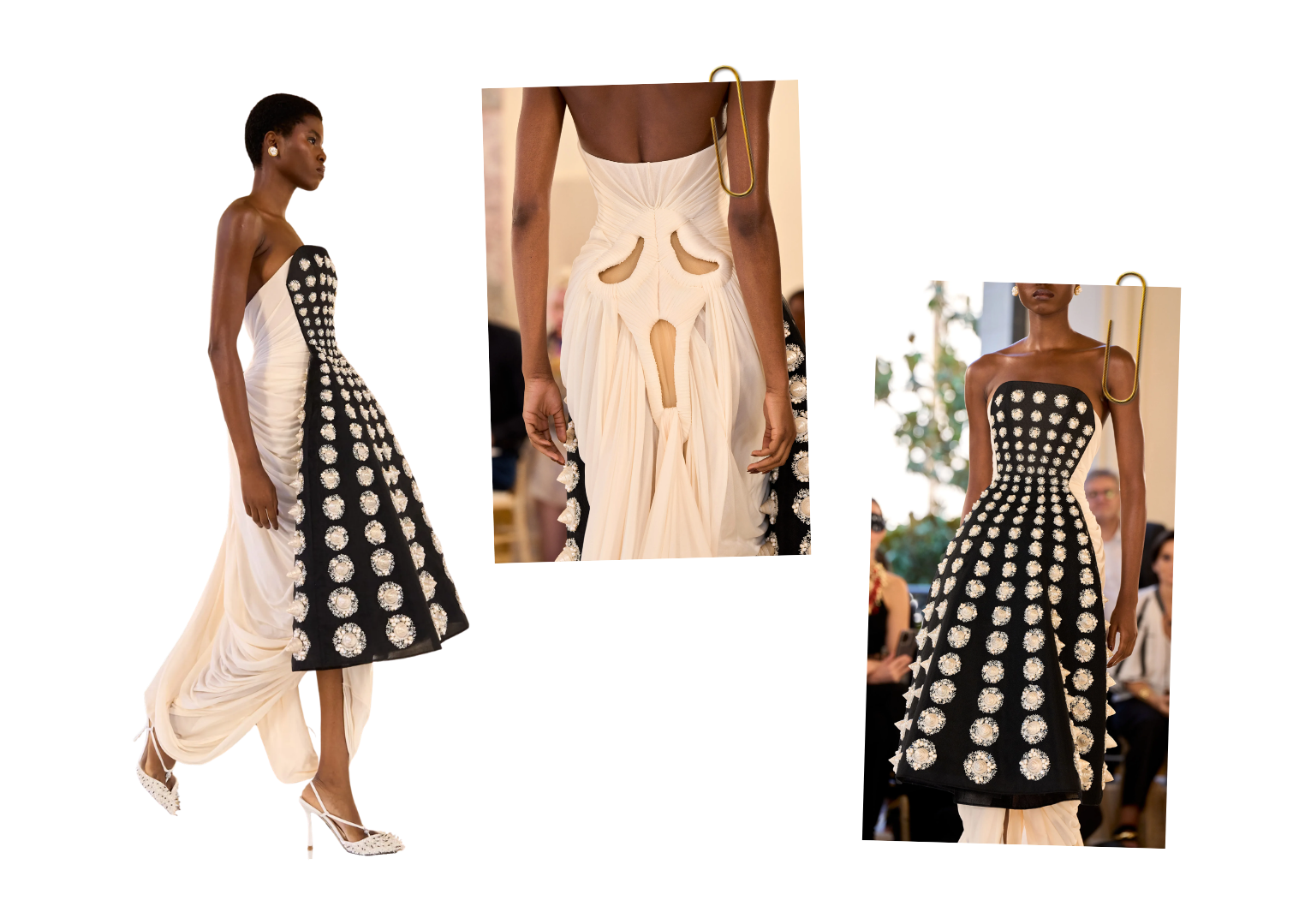
Throughout the 1930s, Elsa Schiaparelli reimagined the body as surreal motifs. She was also one of the first couturiers to introduce plastic and metal zippers to luxury gowns. So Roseberry’s continued willingness to experiment with unconventional materials feels very Schiaparelli.
What makes this collection so fascinating to look at isn’t just what the garments look like, but how they were made. Many people were surprised to learn that the Bubble Pump was entirely handcrafted instead of 3D printed, which explains the extraordinary level of craftsmanship that went into its illusion.
The atelier also sculpted silicone into sheets to create organic textures, used latex to form inflatable tentacles, embroidered real flowers that had been preserved with sugar water, and incorporated unconventional elements like seashells and baked fish scales. Even the models’ ears were extended and reshaped with prosthetics.
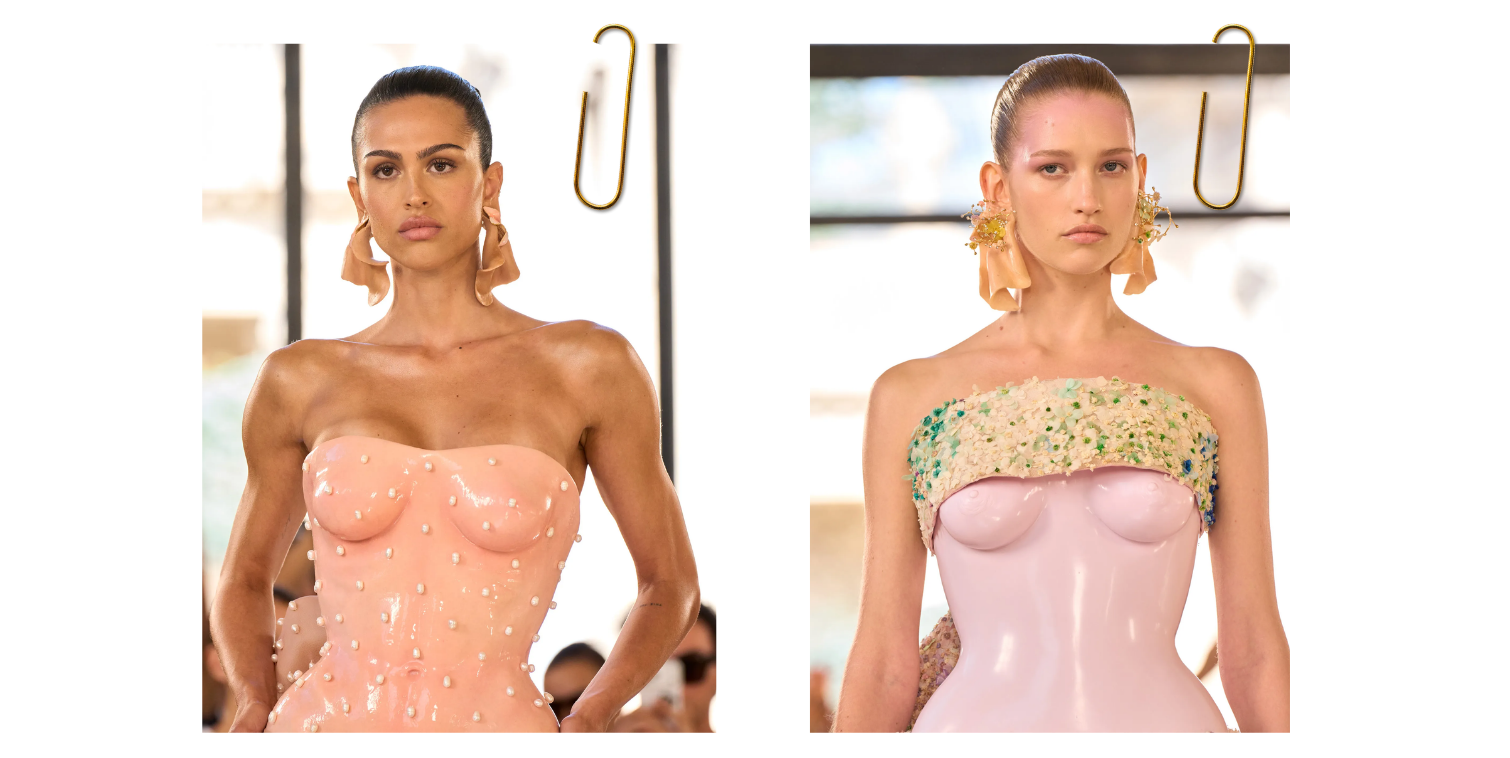
These aren’t the regular silk, satins, and wools traditionally used in couture. Roseberry embraced synthetics to show that couture shouldn’t fit into a single definition, while also making the atelier figure out how to use the materials in the process. At Schiaparelli, innovation happens because of the materials, not the other way around.
The mirrored runway at Petit Palais enhanced the show’s surreal atmosphere, its reflective surface creating the illusion of water beneath the models and reinforcing Schiaparelli’s fascination with the unknown.
In Schiaparelli’s world, nothing is discreet, and every piece carries meaning. Roseberry’s Fall 2026 Couture collection is proof that innovation rarely comes from certainty. Sometimes, it begins with the willingness to explore the unknown.
What intrigued you the most about this collection?
Thanks for reading!

No posts
Comments
Nothing yet. Say the first thing.
Sign in to join the conversation.