
One of the reasons I love the framework of intersectionality is that it reminds us that not all identities are immediately visible.
Some of the experiences that shape us most deeply are the ones other people never see.
A learning difference.
A disability.
A family circumstance.
A challenge we quietly navigate while trying to keep up with expectations that were never designed with us in mind.
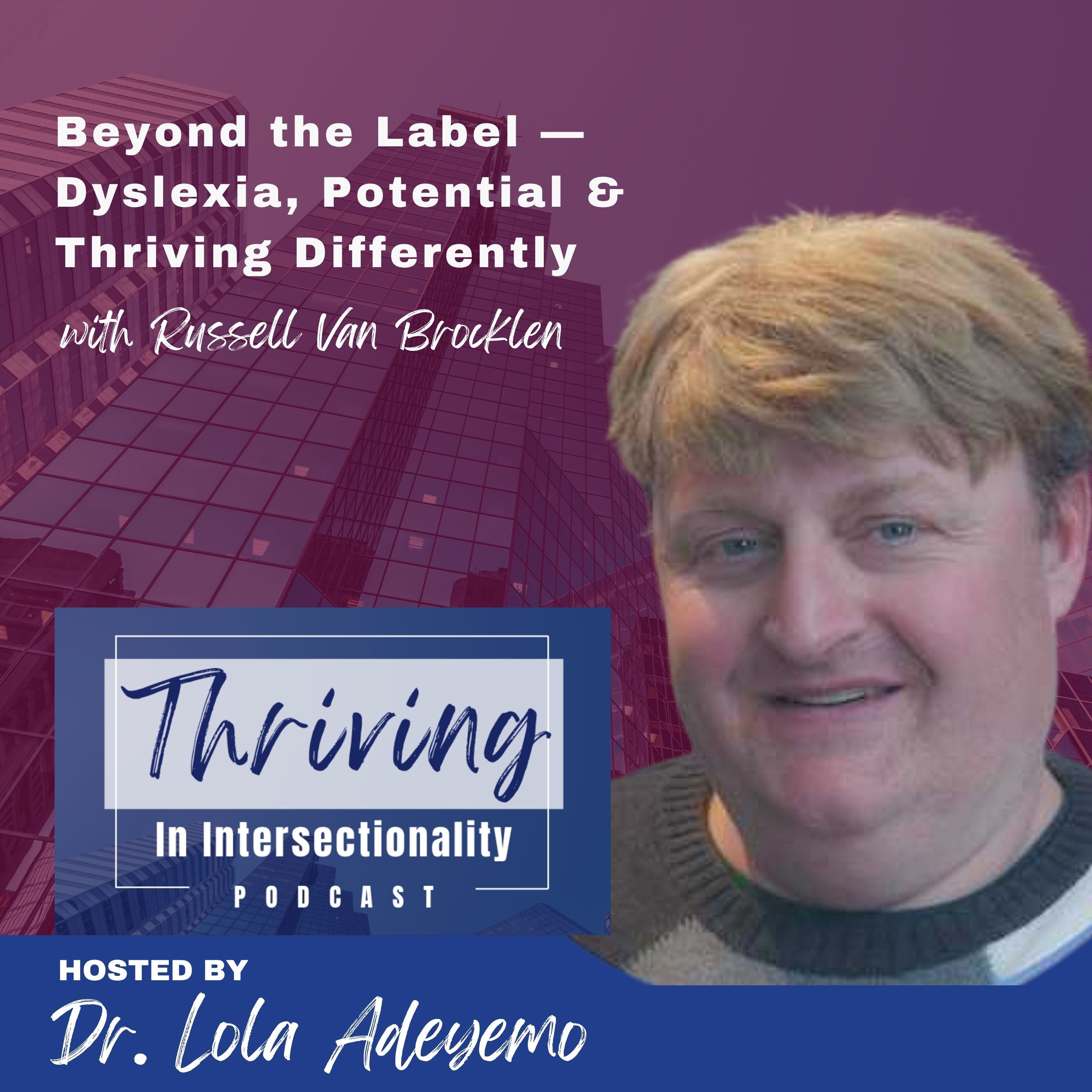
That was one of the themes that stayed with me after my conversation with Russell Van Brocklen.
On the surface, we talked about dyslexia.
But underneath that conversation was something much bigger.
The relationship between difference and potential.
And what happens when systems confuse one for the other.
Labels can be useful.
They can help people access support, accommodations, resources, and community.
But labels can also become limitations.
Especially when they are attached to assumptions.
Not capable.
Not academic.
Not leadership material.
Not smart enough.
Not ready.
Not likely to succeed.
Many people spend years carrying labels that tell them what they cannot do.
And eventually those messages become internalized.
Not because they are true. Because they are repeated often enough.
One thing that stood out to me in Russell’s story was the distinction between intelligence and performance.
We often treat them as if they are the same thing.
They are not.
Performance measures how well someone navigates a particular system.
Intelligence is far broader.
Yet schools, workplaces, and institutions often reward one specific way of learning, communicating, processing information, or demonstrating competence.
And when someone learns differently, the system often assumes the problem lies with the person.
Instead of asking whether the system itself might be too narrow.
As I listened to Russell share his experiences, I found myself thinking beyond dyslexia.
How many people are currently being underestimated because their strengths don’t fit traditional expectations?
The employee whose accent is mistaken for a lack of expertise.
The immigrant professional whose international experience is overlooked.
The student who struggles with reading but excels in creativity and problem-solving.
The leader who thinks differently from everyone else in the room.
The person who communicates differently.
The person who learns differently.
The person whose potential is still hidden beneath someone else’s assumptions.
Intersectionality teaches us that identity is layered.
So are people’s strengths.
One reason this conversation resonated with me is that belonging is ultimately about recognition.
Not agreement.
Recognition.
Being seen for who you are rather than who others assume you are.
Being evaluated based on your capabilities rather than your stereotypes.
Being given opportunities to demonstrate strengths rather than being defined by limitations.
For many people, the difference between thriving and struggling is not talent.
It is whether someone was willing to see beyond the label.
The conversation also made me reflect on how much influence leaders, educators, and parents have.
We may not realize it in the moment.
But the language we use shapes possibility.
The expectations we communicate shape confidence.
The assumptions we make shape opportunities.
Every day, we have the opportunity to reinforce a limitation or reveal a strength.
And often, people remember those moments for years.
One of the most powerful questions I left this conversation asking myself is:
How often do we mistake difference for deficiency?
Because sometimes the thing we see as a weakness is simply a different way of learning.
A different way of communicating.
A different way of solving problems.
A different way of experiencing the world.
And when we create environments that make room for those differences, something remarkable happens.
People stop spending their energy proving they belong.
And start using their energy to contribute.
🎧 Listen to the full conversation with Russell Van Brocklen below.
What assumptions might we be making about someone’s potential based solely on the way they learn, communicate, or process information?
Thanks for reading Lola Adeyemo (PhD) - On belonging, leadership, and identity! This post is public so feel free to share it.
Comments
Nothing yet. Say the first thing.
Sign in to join the conversation.