
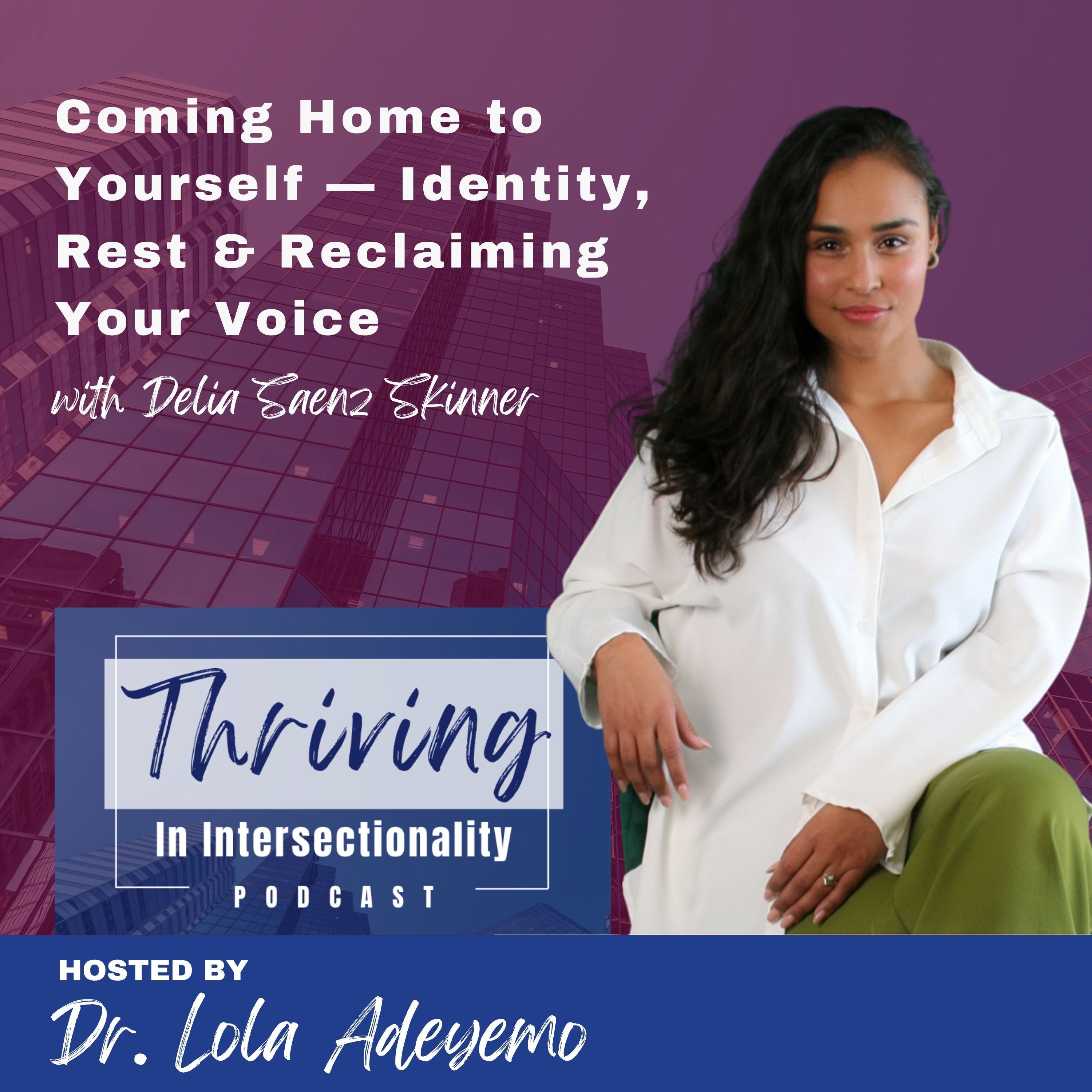
There was one sentence from my conversation with Delia that stayed with me long after we stopped recording.
She talked about learning, as a child, to slowly put parts of herself away.
Not because they were wrong. Because they made belonging harder.
I don’t think she’s alone.
In different ways, many of us have learned to do exactly the same thing.
Sometimes it’s our accent.
Sometimes it’s our emotions.
Sometimes it’s our culture.
Sometimes it’s our ambition.
Sometimes it’s our softness.
Sometimes it’s simply telling ourselves, “Don’t be too much.”
We don’t always abandon ourselves all at once.
Sometimes it happens one small compromise at a time.
As Delia described her childhood, I found myself thinking about how often survival teaches us to become smaller.
Be quieter.
Be easier.
Be more agreeable.
Work harder.
Prove yourself.
Don’t ask for too much.
For many immigrant professionals, these lessons become second nature.
For women, they often begin even earlier.
For people navigating multiple identities, the calculation can become constant.
How much of myself is safe to bring into this room?
It’s a question many people answer without even realizing they’re answering it.
There is a part of Delia’s story she shared on her educational journey. She
shared that it took her nine years to complete community college.
Nine years.
Not because she lacked intelligence.
Not because she lacked determination.
Because life happened.
She was navigating being undocumented.
Working.
Becoming a mother.
Trying to create opportunities while carrying responsibilities many people never saw.
Today, people see the master’s degree.
The educator.
The consultant.
The founder.
The speaker.
What they don’t immediately see is the journey it took to arrive there.
And that’s true for so many people.
Success often hides the story.
Delia’s work today centers on something our culture doesn’t always celebrate.
Rest.
Not as escape.
Not as laziness.
Not as something we earn after proving our worth.
But as something that helps us remember who we are.
That idea challenged me.
Because many of us were taught that our value comes from productivity.
Keep going.
Do more.
Work harder.
Achieve the next thing.
Yet somewhere along the way, we begin measuring our worth by our output instead of our humanity.
Delia reminded me that sustainable leadership doesn’t begin with doing more. Sometimes it begins with stopping long enough to hear yourself again.
One phrase continued coming back to me throughout our conversation.
Coming home to yourself.
Not creating someone new.
Not becoming someone different.
Coming back to the parts of yourself that existed before survival became your primary strategy.
Before the world told you who you had to become.
Before belonging became conditional.
There is something incredibly hopeful about that idea.
Because it means we aren’t searching for someone we’ve never met.
We’re remembering someone we’ve always been.
As leaders, managers, educators, and colleagues, we often celebrate resilience.
We admire perseverance.
We reward productivity.
But perhaps we should also ask different questions.
What parts of people have been hidden just to make it here?
What gifts have been buried beneath years of adaptation?
What happens when people finally feel safe enough to stop performing and simply be?
Those are the workplaces I hope we continue building.
Places where belonging doesn’t require people to edit themselves.
Places where leadership makes room for humanity.
Places where rest is recognized not as weakness, but as wisdom.
Delia reminded me that reclaiming yourself is rarely one dramatic moment.
It’s a series of small decisions.
To trust yourself.
To listen to your body.
To tell your story.
To stop apologizing for your humanity.
To believe that who you already are is enough.
Maybe that’s what thriving in intersectionality really means.
Not finding one perfect identity.
But giving every part of yourself permission to come home.
🎙️ Listen to my full conversation with Delia Saenz Skinner on
Thriving in Intersectionality.
I’d love to hear from you:
Have you ever felt like you had to hide parts of yourself in order to belong? And what has helped you begin the journey back to yourself?
Thanks for reading Lola Adeyemo (PhD) - On belonging, leadership, and identity! This post is public so feel free to share it.
Comments
Nothing yet. Say the first thing.
Sign in to join the conversation.