
Similar to the Data Driven Decisions for Managers post I wrote a couple of months back, this will be a relatively lengthy and detailed analysis and simulation of how innovation works in the team and how to get innovative teams.
I will also hold a free webinar on this topic on the 5th of March (register here), where I will go through more real life example and, of course, questions, but, for now, here’s the fundamental thinking.
I consider this an essential topic for any manager who wants to have a systemic understanding of innovation, so they can then shape their teams and organization to increase their innovative power.
If you’re not interested in the process and only want to see the results and the recommendations, jump to the final section, “Practical Recommendations For Managers”.
A funnel is a good model for innovation. A funnel is nothing more than a series of steps, of actions, hurdles, obstacles etc, that the innovation idea needs to go through in order to take shape and become a successful innovation.
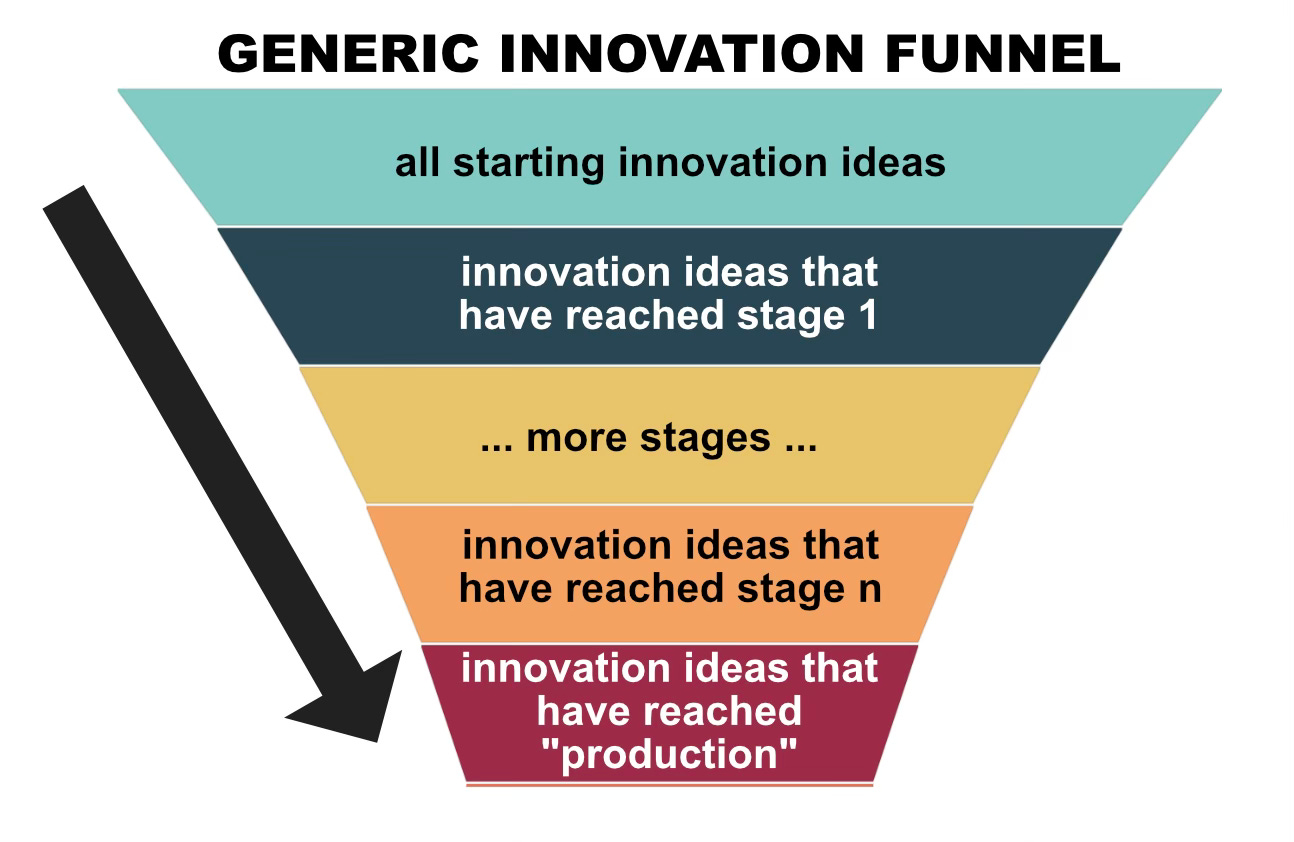
All innovations start as ideas and have to go through various stages in order to become “production” innovations, things that actually exist and have an impact.
The number of stages varies, sometimes they are more formal, sometimes informal, sometimes they are approvals, sometimes they are effort, but the general model describes the innovation process well enough.
At each stage, some ideas die, and only a subset the original innovation ideas manage to travel through the whole funnel and end up in production. Those of you with sales experiences will immediately think of the classical Sales Funnel; it’s the same idea.
Therefore, the game of innovation becomes about:
Originating as many ideas as possible in the first place and
Moving through the stages as fast and as successfully as possible
I have then create a simulation for this funnel process that takes into account the following variables:
Number of Team Members
For each team member, a motivation to innovate, represented as a percentage between 0% and 100%
For each team member, their Effective Motivation, calculated as 10% increase or decrease in their motivation, if the averaged motivation of their team mates is over or under 50%
For each team member, an ability to innovate, represented as a percentage between 0% and 100%
For each team member, their Effective Ability, calculated as 10% increase or decrease in their ability, if the averaged ability of their team mates is over or under 50%
Numbers of layers of approval (stages) the innovation has to pass through in its road from idea to successful innovation
Each layer of approval has a likelihood for any innovation that reaches it to pass. If it doesn’t pass, it’s rejected and the innovation fails. In real life, these percentages could represent actual approvals, effort, bureaucratic complexity, access to resources etc, but we summarize everything unde a one percentage value here
A feedback mechanism where every team member’s motivation is 1) increased by a percentage if their innovation passes a layer 2) decreased by a percentage if their innovation fails or, 3) stays the same, despite rejection, if they receive “Good Feedback”. Good Feedback, in real life, is of course not just some nice words, but useful feedback and guidance that actually motivates them to try again
The Simulation Consists running 1000 runs of “innovation rounds” for various combinations of the variables above, and then looking at the averaged and overall results for 1000 runs. This is meant to simulate innovation in time, across hundreds of days. During each run:
Each team member is polled to see if they will originate an innovation idea. The likelihood of them originating an innovation idea is the combined probability of their Effective Motivation and Effective Ability. For example, a team member with a 20% Effective Motivation and 50% Effective Ability, will have an overall 10% (20% * 50%) chance of originating an innovation idea in any given round
Whatever ideas are originated are then walked through the approval funnel as described above.
I will first give the results for 6 distinct simulation scenarios, and we will then analyze the differences, and then end by extracting insights and recommendations for managers.
5 team members, their initial motivation is 50% for all, their initial ability is 50% for all, 3 approval layers, 50% likelihood each, they all have the “Good Feedback” atribute set to false, and a 5% motivation feedback factor.
For 1000 runs, we get these results:
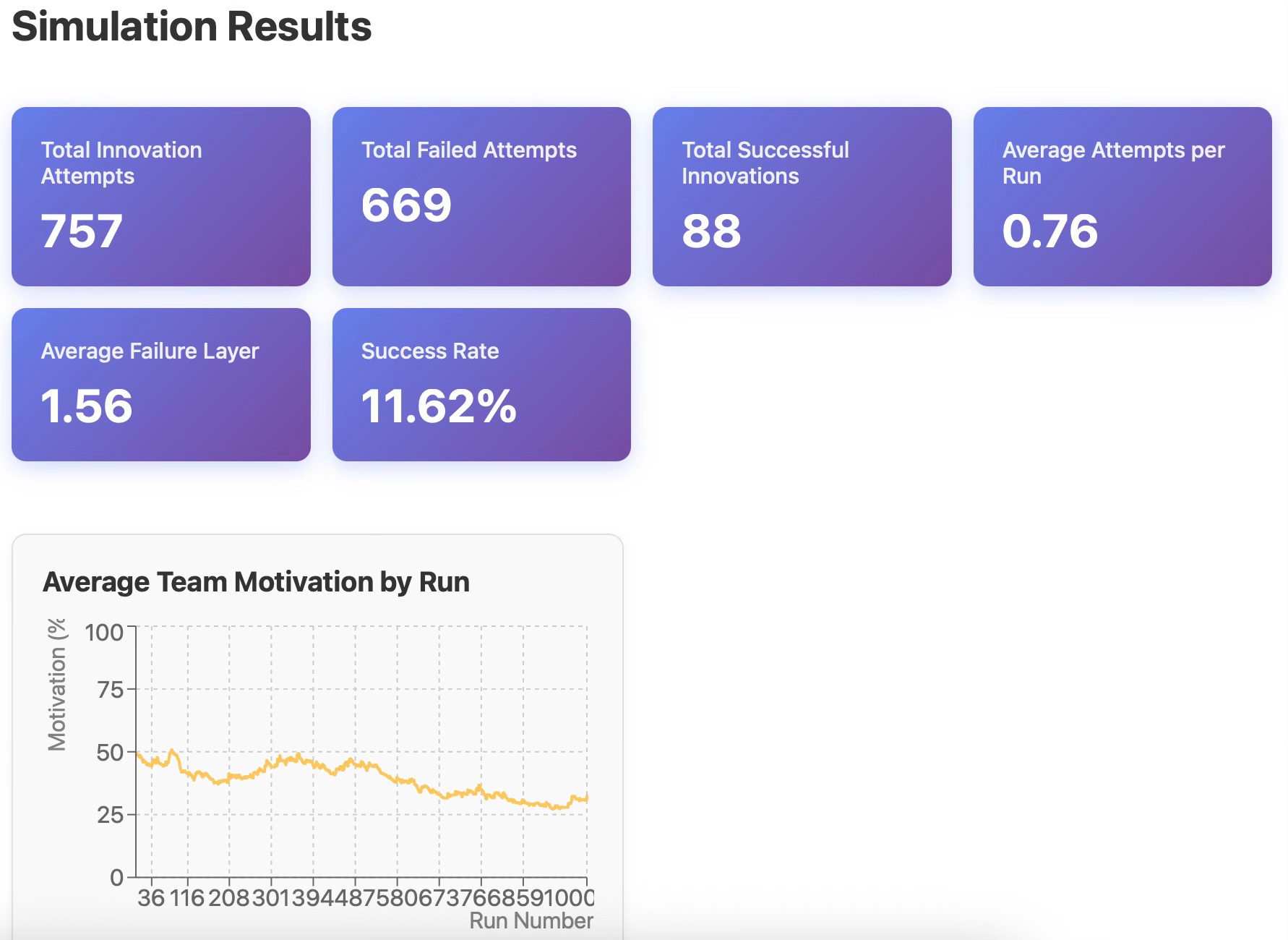
Same as scenario 3, except the bold part: 5 team members, their initial motivation is 50% for all, their initial ability is 50% for all, 5 approval layers, 50% likelihood each, they all have the “Good Feedback” atribute set to false, and a 5% motivation feedback factor.
For 1000 runs, we get these results:
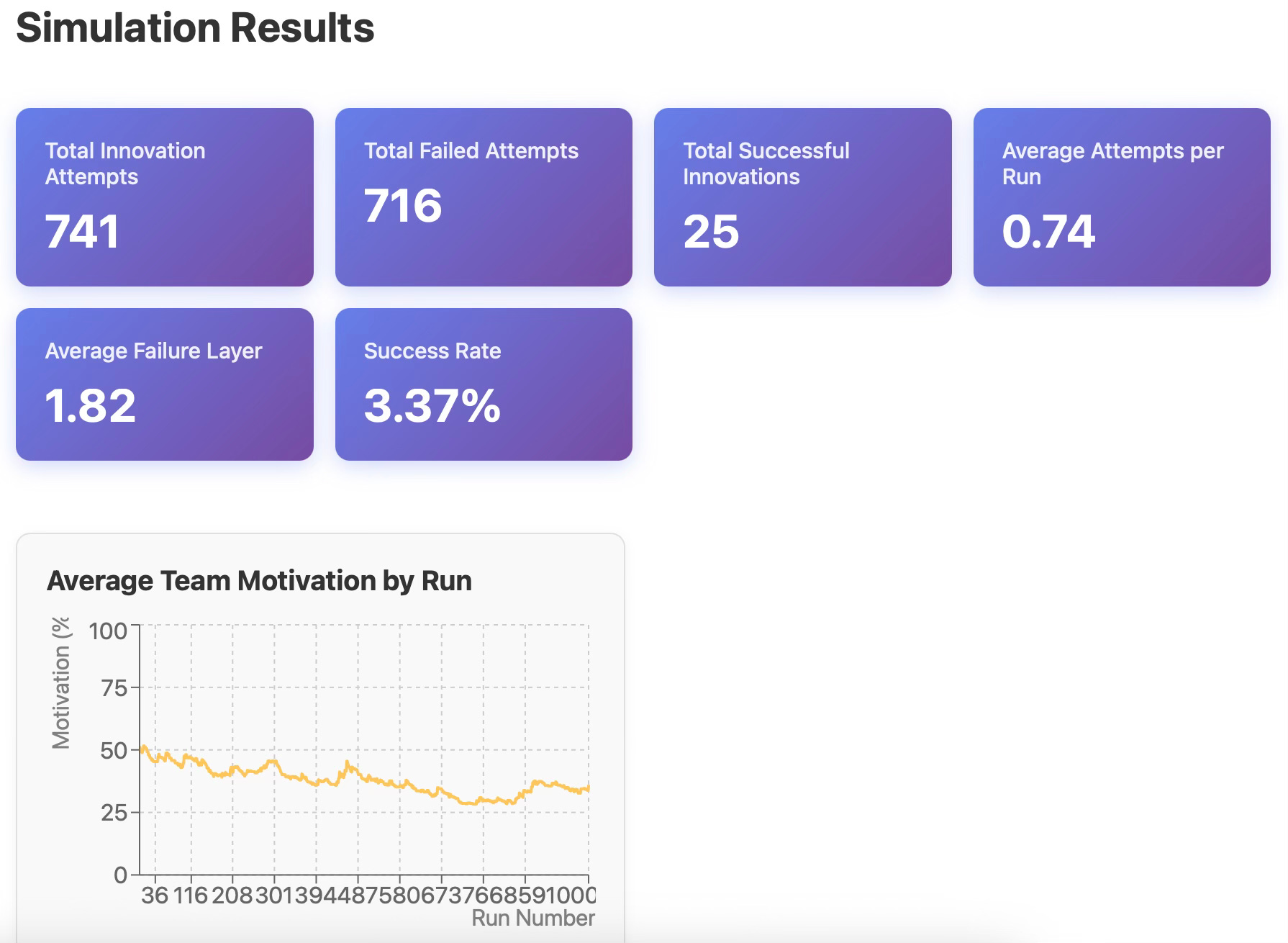
Same as scenario 1, except the bold part: 5 team members, their initial motivation is 50% for all, their initial ability is 50% for all, 3 approval layers, 50% likelihood each except layer 2 which is 20%, they all have the “Good Feedback” atribute set to false, and a 5% motivation feedback factor.
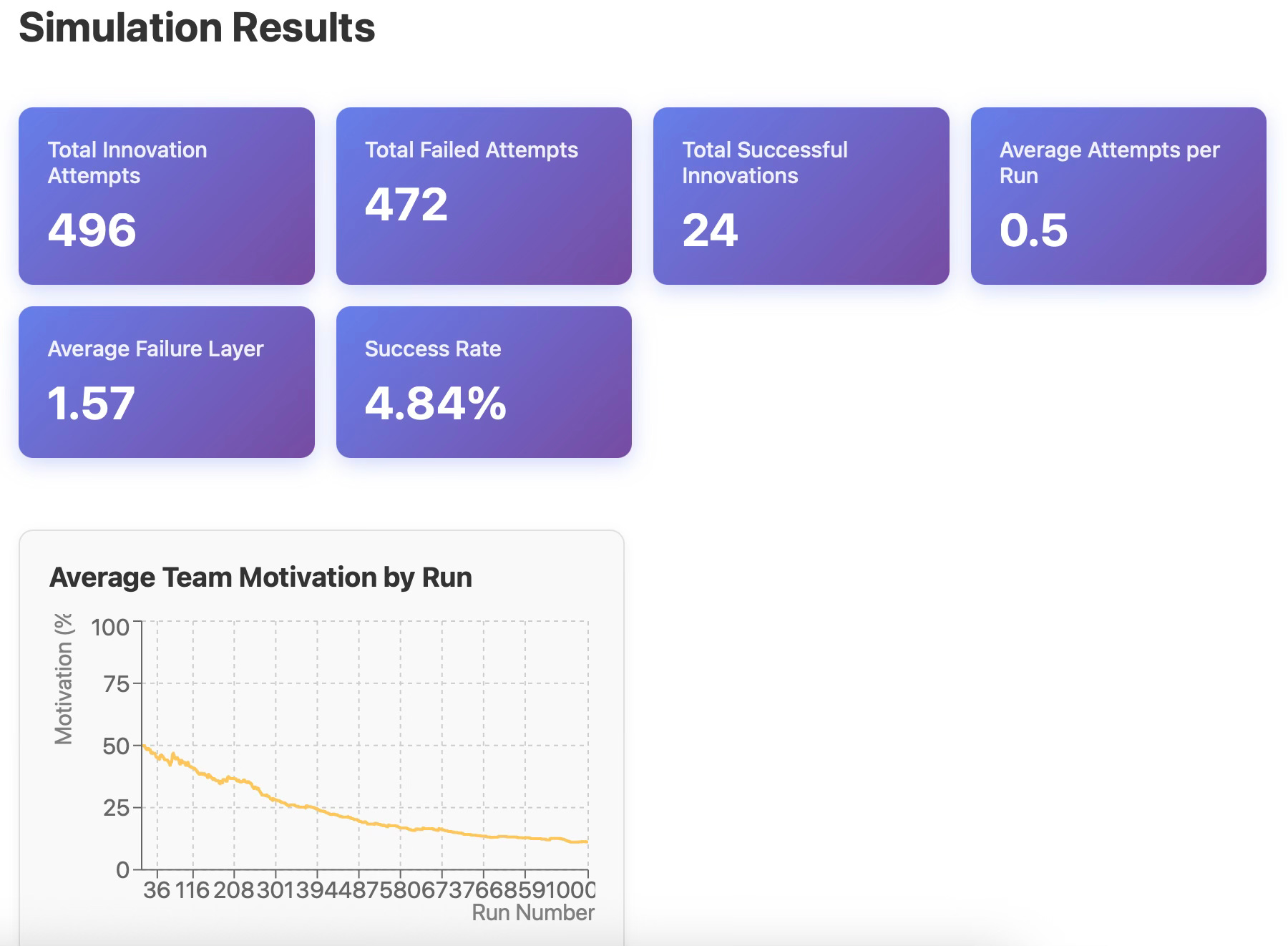
Same as scenario 3, except the bold part: 5 team members, their initial motivation is 50% for all, their initial ability is 50% for all, 3 approval layers, 50% likelihood each except layer 2 which is 20%, they all have the “Good Feedback” atribute set to true, and a 5% motivation feedback factor.
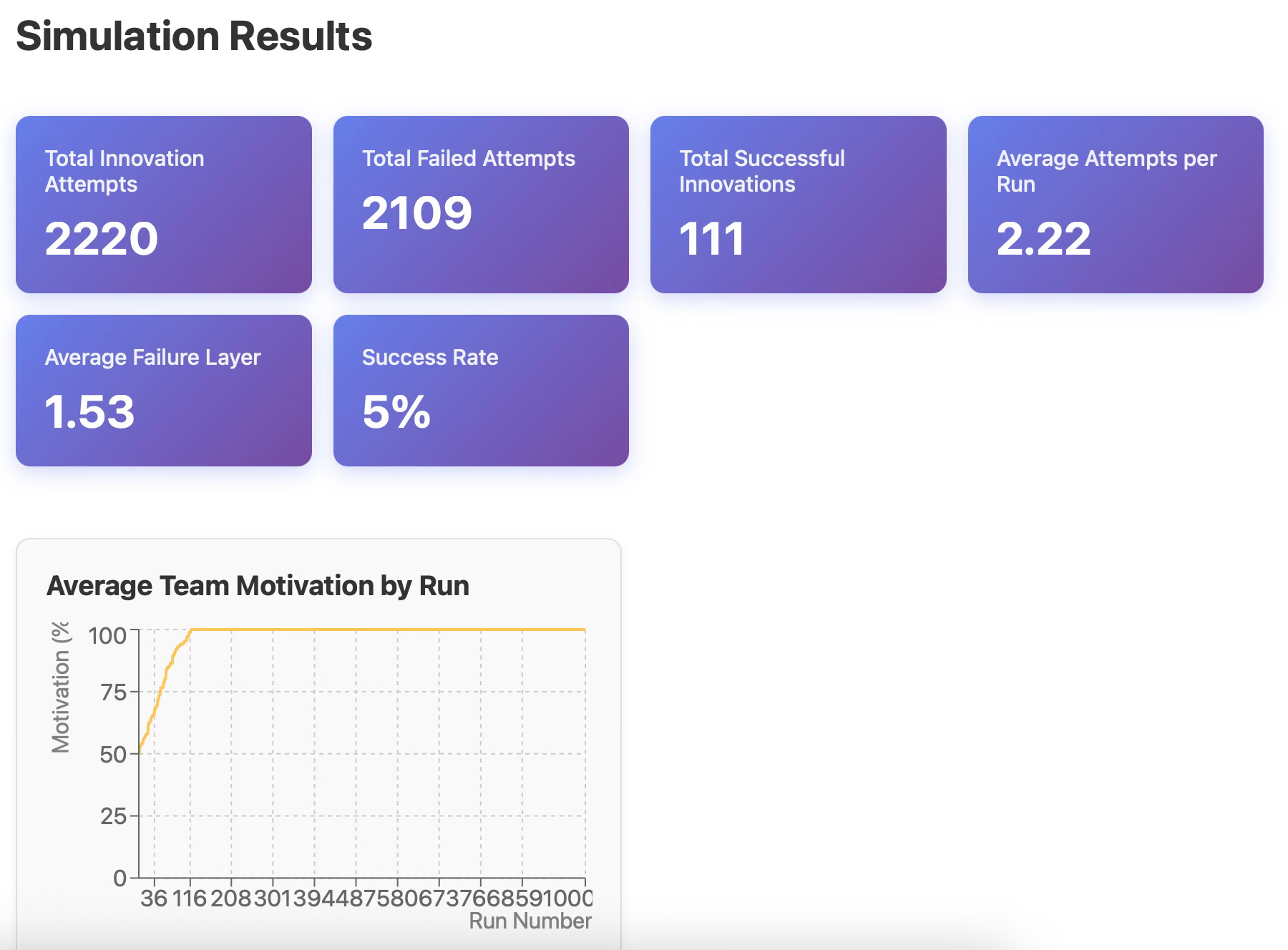
3 team members, their initial motivation is 50% for all, their initial ability is 50% for all, 2 approval layers, 75% likelihood each , they all have the “Good Feedback” atribute set to true, and a 5% motivation feedback factor.
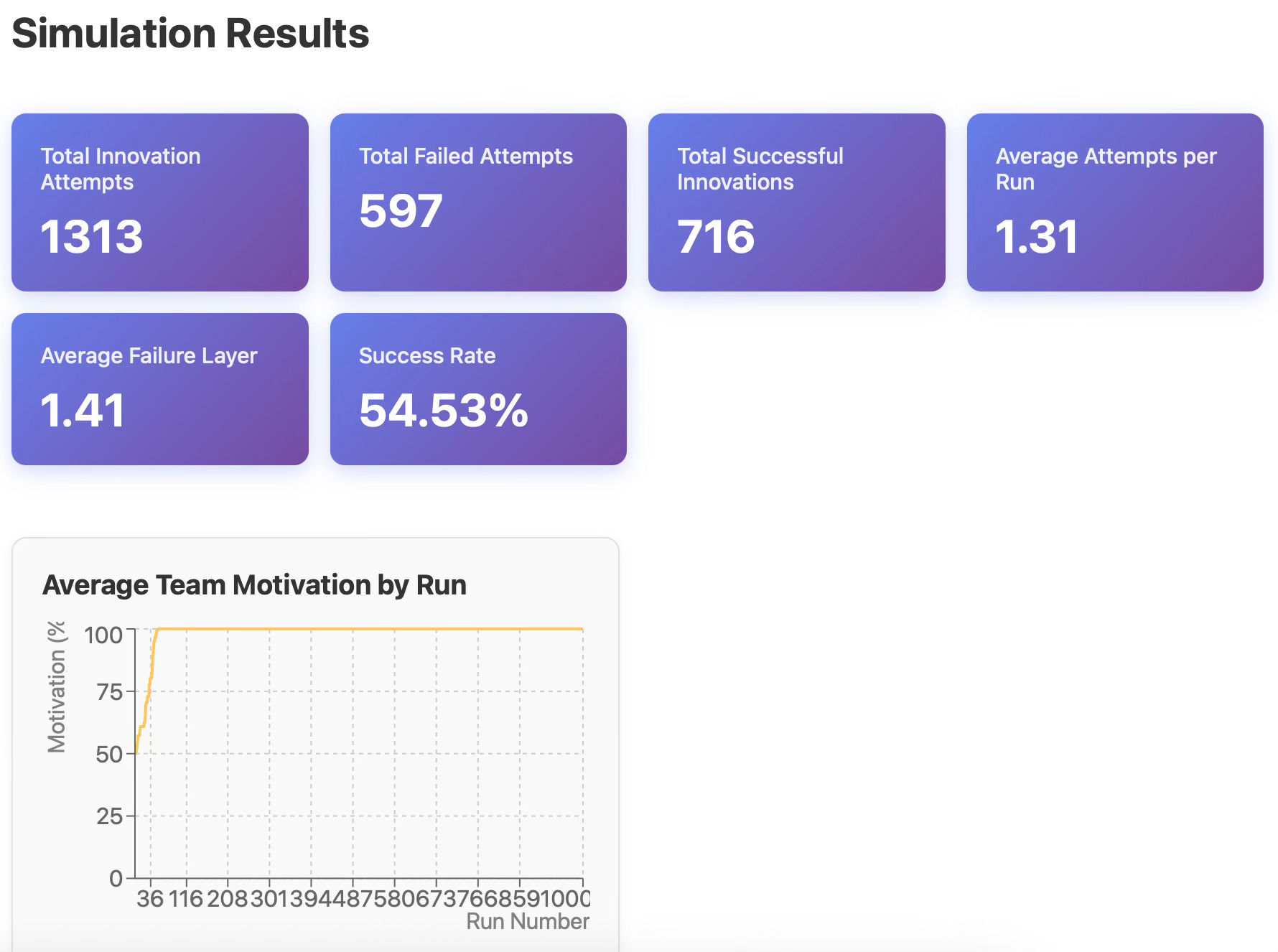
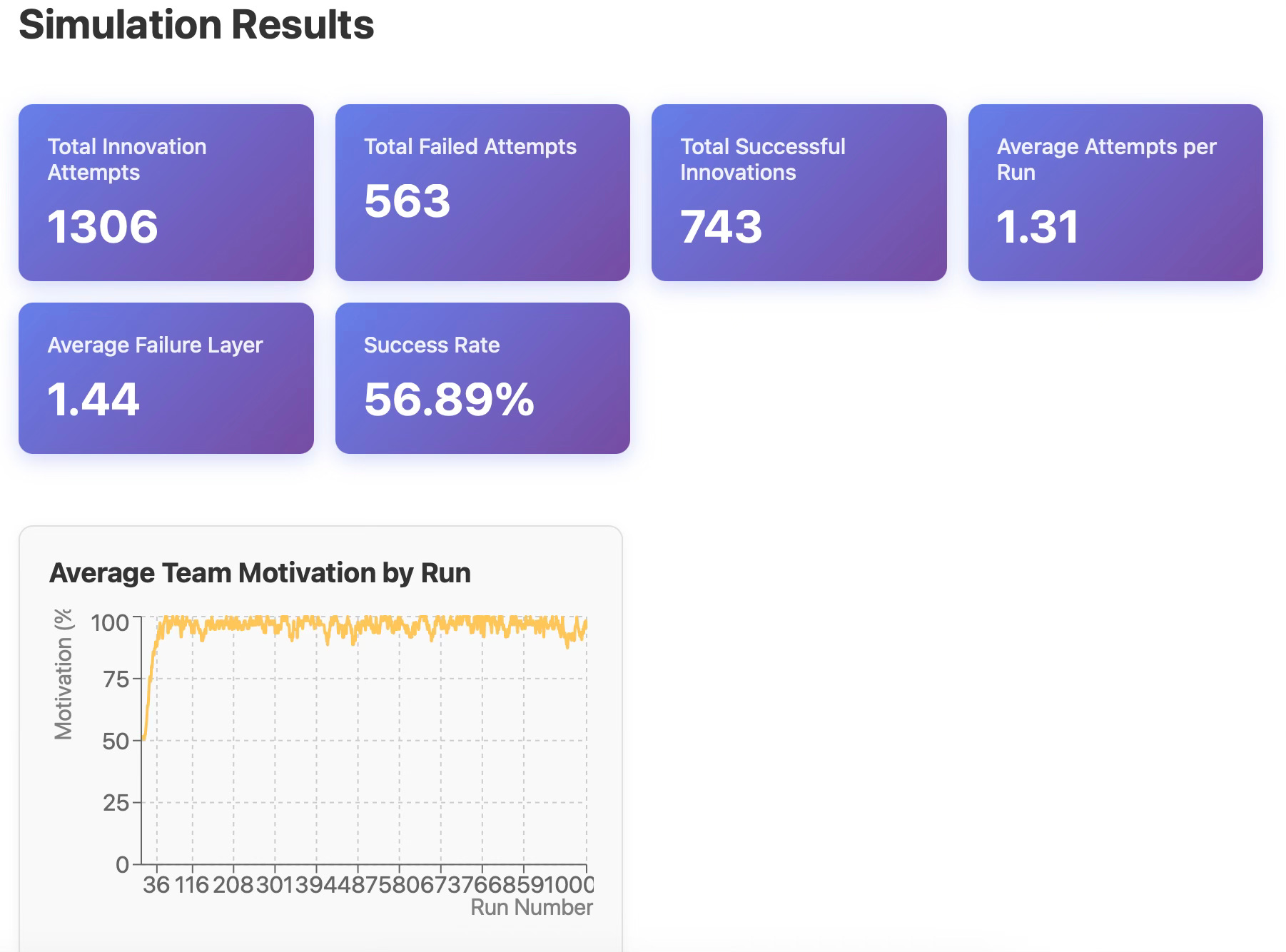
Same as scenario 5, except parts in bold: 3 team members, their initial motivation is 50% for all, their initial ability is 50% for all, 2 approval layers, 75% likelihood each , they all have the “Good Feedback” atribute set to false, and a 5% motivation feedback factor.
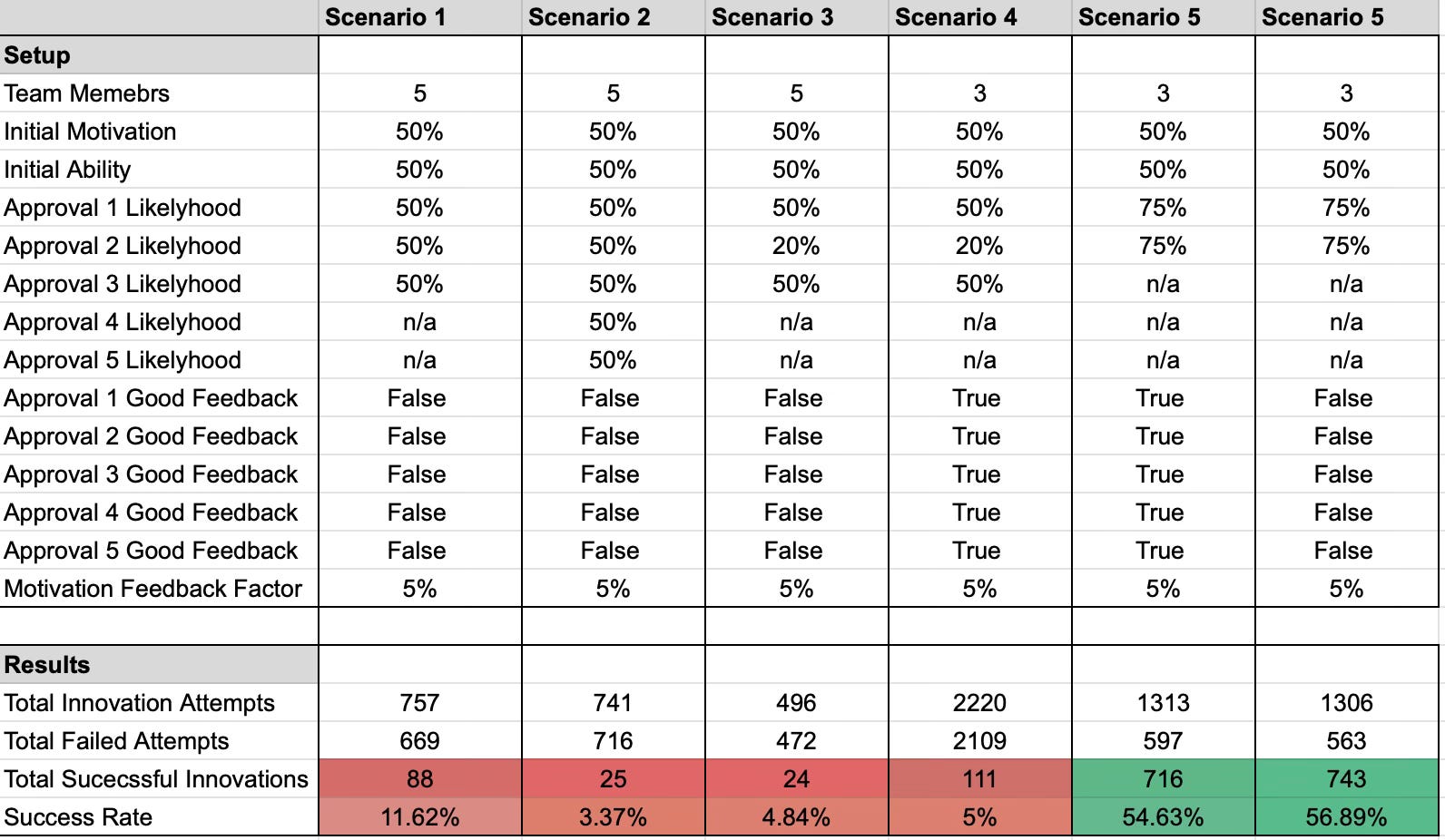
Let’s put the results of the 6 scenarios in a table format, with a particular focus on the Total Successful Innovations, with the end result, and Success Rate, which represents the efficiency of the innovation process, how much do you have to work, how many times do you have to try in order to get one successful innovation.
Analysis:
The more approval layers, the less innovation.
The “stricter” the approval layers are, the less innovation.
Even with an apparently reasonable configuration of 3 layers of approval, 50% chances of approval per layer, and a reasonable motivated and capable team (50%), over 88% of innovation ideas fail before becoming reality.
By adding 2 more approval layers, we now have over 96% of innovation ideas failing before becoming reality.
Reducing back to 3 layers, but reducing the likelihood of layer 2 to 20%, we get results almost as bad as 5 layers at 50% (95% failure rate).
By comparing Scenario 4 to Scenario 3, we see the impact of the “Good Feedback” flag. The overall success percentage is similar (4.84% vs 5%), but the Good Feedback flag allows the team members to keep their motivation fore much longer so they keep trying for much longer (2220 total attempts vs 496), resulting in almost 5 times more successful innovations in the end (111 vs 24).
As we see in Scenario 5, when we fave fewer layers and higher likelihoods, both successful innovation and innovation efficiency dramatically increase. We are in 10x scenarios now.
What Scenario 6 shows, in comparison to Scenario 5, is that Good Feedback matters less when there is a lot of success, because success motivates by itself the team sufficiently to keep trying.
Analyze and understand the flow of innovation in your organization. Sometimes, these “approval layers” are formal, documented and explicit, but other times they are informal, like needing help from another team and not knowing how to get it for example, or a thousand other things. Any “obstacle”, any impediment, any action, formal or informal, needs to be modeled as a step in the funnel.
Once you understand your innovation funnel, work hard to make it smaller.
Once you understand your innovation funnel, work hard to increase the likelihood percentages for each of its steps. For example, maybe there’s an approval step called “Scalability Testing”, but for this to happen, access to a certain testing environment is needed, and this access is hard to get. This means that this approval step has a low likelihood percentage, and innovation ideas die here simply because they can not get access to do scalability testing. So, either remove this step fi possible, re-engineer it, or make it much more easily accessible.
All in all, a short funnel, with few steps, and a high likelihood of approval, is probably the single most important thing you can do.
Especially when you expect most ideas to fail, “Good Feedback” is essential. Good Feedback is not just nice words, but all the measures required to make sure that your people understand failure is part of the process, they are not afraid of it, are not punished for it, and when they fail they get good feedback, guidance, encouragement and help to try again.
If the team gets demotivated, it will enter a death spiral of innovation: they are demotivated → they try to innovate less → they succeed less → they get even more demotivated etc.
However, high motivation and high ability combined with a big approval funnel leads to many attempts, but few successes. There will be a lot of work, but comparatively few results. Your innovation process is active, but ineffective.
In summary, motivate your team to generate innovation ideas, teach them to overcome failure and, above all else, shorten and simplify your funnel.
Comparing the results of the simulation with my experience, I consider them to match. While the results are intuitively what I expected, I am however surprised by the huge numerical differences between Scenarios 5 and 6 and the rest, and that has served to make me want to be even more aggressive in simplifying “approval funnels”.
No posts
Comments
Nothing yet. Say the first thing.
Sign in to join the conversation.