
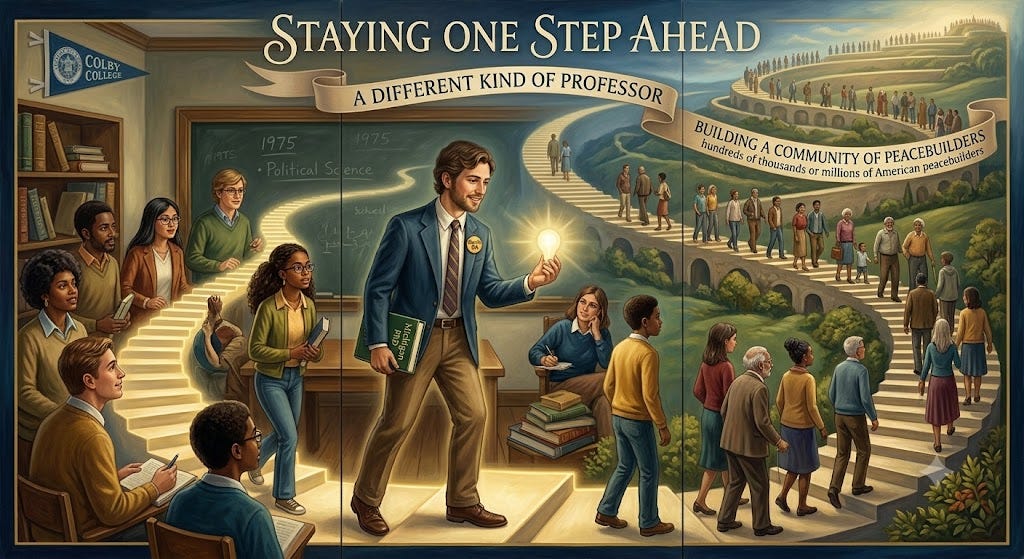
Staying One Step Ahead—And Behind
From time to time, I revisit a decision that I made decades ago and use the mental journey to figure out what I should be doing today.
Over the last few weeks, as I began developing a strategy for Peacebuilding Starts at Home (PBSH), I kept going back to an approach to dealing with my students that I started developing after something utterly unexpected happened at the very end of the very first hour of the very first class I ever taught.
It changed my life then and continues to do so today in what first struck me as a wholly different context.
Now, I see that what I learned half a century ago will be the key to the work that I do for the rest of my life.
I know that that’s quite a statement, so let me explain.
The story actually began a decade before I started teaching.
In many ways, I fit the stereotype of a 1960s activist—even though I missed most of the sex, drugs, and rock and roll.
I describe myself as having majored in ending the war in Vietnam at Oberlin. I went on to be conscientious objector and spent two years performing alternative service. I did my PhD dissertation at Michigan which led to my first book on the new left in France
Yet, there were three overlapping ways in which I did not fit those stereotypes and led to this post.
First, I could always see both sides of every issue. I was convinced that I was right. But, perhaps because family members and others I knew and respected didn’t agree with me, I took other points of view seriously.
Second, I was always comfortable talking to people on “the other side.” Indeed, more often than not, my role at both Oberlin and Michigan was to work with students and faculty members who, for example, did not agree that military recruiters should be kept off of campus.
Finally, I rarely tried to win arguments. Although I could not have put it this way at the time, I somehow sensed that few people change their minds as a direct result of a political debate. Rather, people change their own minds and usually do so gradually as a result of in depth dialogues with people they knew and liked.
I knew from the beginning that I would not be a conventional academic. My very decision to become an academic reflected a desire to have more of an impact than I could have had as a lawyer or high school teacher or religious leader, all of which I considered while at Oberlin.
I knew that I could “profess” and use my classroom as a venue for spreading my own interpretations of political life.
At the same time, I did not want to become an ideologue in how I taught or in what I wrote who was seen as cramming his ideas down his students’ and readers’ throats. I had spent too many hours in classes in which professors had seemingly tried to do just that.
Then, in 1975, I got my first teaching job at Colby College.
To be honest, I didn’t spend enough time thinking about how my desire to be an activist professor would play itself out in the classroom.
While I knew that I didn’t want to be a left-wing version of my conservative mentors, I hadn’t worked out how I was going to pull any of that off before I walked into my first class.
Too much time putting together courses of my own for the first time. Too many nerves as I dealt with my twenty-seven-year-old version of imposter’s syndrome.
But as I was walking out of my first class, everything changed.
Mark came up to me and asked if I had been his camp counselor when he was ten at YMCA Camp Hazen.
Yup. He had.
Mark was a delightful ten-year old. Now here he was at age twenty.
Taking an upper division course in comparative politics.
With me as an advisor.
Looking like he came straight out of the preppy handbook.

My imagination (and panic level) ran wild.
What if Mark had turned into a conservative Republican?
And was going to hate me?
And my failure to get with him and his friends got me fired?
Even though Mark assured me a couple of days later that he was, in fact, almost as liberal as I was, I quickly learned that some of those assumptions held true for plenty of Colby students.
Most Colby students were a lot more conventional than I was used to—which wasn’t saying a lot. Nest to none of them aspired to become progressive college professors; at least half of them saw their future on Wall Street.
All of a sudden, the question I had avoided in the months before I moved to Maine took center stage—to go along with the daily panic about preparing the next day’s classes.
I had to figure out what it meant to be a politically engaged academic given my own classroom experience and political style.
Sooner rather than later, I realized that my own unusual activist past opened the door to ways of working with Mark and his friends/
They were part of a different generation and came from a different socio-political world, I wouldn’t, couldn’t, and shouldn’t “profess” and use my classroom as a political platform.
At the same time, there was no way I could hide my own point of view. Then as now, I wore my political viewpoints on my clichéd sleeve.
Luckily, as I got to know Mark, his friends, and a few other students with whom I had pre-Colby ties, I came to realize that it wasn’t my job to convince them that I was right. It was to help them reach their own conclusions that could stand them in good stead as they made their life choices, including if they ended up on Wall Street.
Especially if they ended up on Wall Street. Or the military. Or took up any other career that gave me pause.
By the time Mark graduated two years later, vague ideas had morphed into a set of principles that I refer to as my “one step ahead” approach to teaching.
I started by treating my students with the same dignity, respect, and empathy that I had tried to show to my own professors and fellow students.
Then, I would try to position myself one step ahead of them, invite them to consider tools and analyses that challenged but didn’t overwhelm them, offer them the opportunities to accept or reject them and explain why they did so, and grow along the way, whether they accepted my ideas or not.
Once they had taken that step, I would move myself a bit and issue them another, more complicated challenge that would allow them to grow some more.
My one-step-ahead model also required me to change in these key ways. I had to make it clear that:
· I didn’t have all the answers.
· I was genuinely curious about them and cared for them.
· I liked being questioned, revealing a bit of personal vulnerability, although I would not have used that term at the time.
I would start with relatively noncontroversial subjects like the differences between our presidential and the European parliamentary forms of government. It also worked when I started teaching more contentious subjects involving the cold war and the nuclear arms race in the 1980s.
I wanted them to take what I had to say seriously, but I was more interested in helping them develop their own ability to make sense of the world would so that they could be able to better defend whatever conclusion they reached.
Even more importantly for the rest of this article, I changed, too.
I became a better teacher because I was working with the whole person not just the young political science student.
Just as I had done with my campers.
And had a great time doing so.
I would never claim that my one-step-ahead model worked with every one. In particular, it didn’t help much with students I didn’t get to know well which was occasionally the case at Colby and far more common after I moved to George Mason University and the University of Reading and did not teach the same students several times over the course of their undergraduate careers.
Still, I can point to hundreds of students who benefited from it. Just as importantly, I can say that I’m still learning from them every time my mind goes back to one or more of those interactions.
Now, I find myself returning to what I started learning when Mark tapped me on my shoulder.
I’m part of a team that will build a grass roots network of peacebuilders and a whole lot more as part an effort to turn our troubled country around. There are many reasons why we decided to start the initiative, many of which came together in the book I published at the end of last year, Peacebuilding Starts at Home and the movement of the same name. You can learn more about the book by scanning this QR code which will take you to my publisher’s web site.

This time, I will be working with all Americans, not just students.
This time, too, I will be more of an activist. I will want them to accept my invitation, see how peacebuilding tools can be applied to many of the vexing problems we face today, and find ways of doing their part
This time, too, I will be starting with people who are more predisposed to agree with us than most of my Colby students were.
This time, too, I will have to start with where my interlocutors are and go from there, knowing that each discussions we have will be different.
Even though I haven’t been in the classroom for a few years, everything I learned from teaching Mark and about five thousand other students can help me do this job, too, by turning me into a different kind of organizer.
Being non-judgmental, patient, and empathetic
Giving the people we meet an attractive model that they can gradually buy into and incorporate into their everyday.
Asking questions that spark curiosity and build relationships.
Showing my own openness by simultaneously conveying the image that I both know my stuff but will take what they have to say seriously, too.
Tailoring solutions to the needs of the very different people we will meet.
Knowing that I won’t be able to do this on my own but will have to develop teaching and training tools that people whom I never meet can use for discussions with people whom I will never meet and somehow get us all to become part of what is at least a loosely organized national team.
We will start with people like Mark (who is now a retired lawyer) who are already receptive to some of what I’m interested in even if they don’t see themselves as a peacebuilder or see how what we do could make them even more effective in dealing with the issues that they cares about.
And the new neighbors in the condo we moved into a year ago.
And others in the Falls Church community who are more interested in climate or immigration or affordability.
And with the people we meet who will be interested in leading such discussions themselves.
And, in time, developing ways of reaching out to opinion leaders in the media and beyond.
And, as we get better at using these tools, do what I’ve always been personally good at—building strong working relationships with people we disagree with.
We will not be able to reach all Americans using this updatd version of my one step ahead model, but we can come close and take these efforts to scale until we have hundreds of thousands or even millions of American clamoring to live in a society in which most people are able to solve most of their problems most of the time without the use of force or coercion.
A Different Kind of Learner
In conclusion, let me turn to the final two words in this post’s title which has gotten short shrift until now.
One of the joys of teaching came from the fact that my students were also one step ahead of me and helped pull me along to new insights.
My students helped me evolve intellectually and politically. They were the first to get me interested in what would now be called conscious capitalism. I just came back from a retreat at which activists in their early thirties helped Gretchen and me see new ways of community organizing.
In other words, when I try to put myself one metaphoric step ahead of my students and colleagues, I’m also putting them in a position in which they are one step ahead of me.
And then pull me along.
That has already happened in the dozens of dialogues I’ve had with potential peacebuilders while writing my book and as we have laid the groundwork for Peacebuilding Starta at Home—The Movement.
Whether it was in the classroom or at a retreat center or even on a Zoom call, I’ve seen everyone grow and everyone change.
And have a great time doing so.
The views and opinions expressed in this article are those of the author and do not necessarily reflect the official policy or position of the Alliance for Peacebuilding or its members.
No posts
Comments
Nothing yet. Say the first thing.
Sign in to join the conversation.