
Starting with this article, I will be shifting the focus of this newsletter and will start asking you to do things.
I’ll still be reporting on things I’ve learned, but each post will now also have a clear call to action as we begin creating the Peacebuilding Starts at Home network that has to include people like you.
And I literally mean you.
That’s not something I’m comfortable doing, especially when it means asking you to do things for me.
I’m starting the hardest post that I will ever have to write for this series

Because I’m about to ask you to buy my book which you can do either by scanning this QR Code or clicking this link.
But I’m getting ahead of myself.
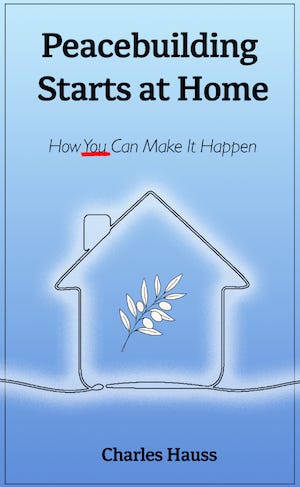
At the end of last year, I published Peacebuilding Starts at Home.
I hadn’t planned on writing it—or any other book. I had already written nineteen of them. I was over 75. I wasn’t ready to retire, but another book?
In 2023, however, my friend (and alleged boss) Liz Hume said that the time had come. The Alliance for Peacebuilding (AfP) had to ramp up its game and take on more of a leadership role in the United States.
Not that we wanted to. We had plenty to do in the rest of the world.
But we had to, given the problems facing our own country.
We knew we had ideas and skills that peacebuilders in the United States needed if we were going to turn our county around.
Liz also pointed out that a book could provide the intellectual scaffolding that we could draw on in building a movement that could forge a paradigm shift in the ways Americans deal with their deeply rooted problems.
In the two years it took to research and write the book, I learned a lot. At the same time, I was able to integrate almost everything I had learned over the course of my career as a student of social movements with the insights that I gleaned from the people I met while doing the research, which meant that I ended up writing a book whose scope surprised me.
For the purposes of this article, let me focus on three key points.
The first lies in its opening sentence. Peacebuilding Starts at Home is an invitation masquerading as a book.
Because I wanted my readers to take my invitation serious and send in their RSVP either at the end of the first or final chapter, I also realized that I had to forget most of what I had learned about writing as an academic. Sure, I needed to make some “conceptual” points about building a movement or the causes of the problems facing the United States/
But, if I really wanted folks to take me up on my offer, I had to focus on stories that shows them how people like them could make a difference—despite what many of them think when they see the public opinion polling data that suggest most Americans feel powerless.
To my delight, I discovered that thousands of American peacebuilders and other social change activists were already having an impact in their communities or on a single issue or even in the media.
So, the book is based on their stories, including the fun I had meeting new people and learning about what they did.
That leads to my second point. As impressive as they might be, the work of the individuals and organizations that I met flies below most people’s radar screens. As one of the people I met, David Sloan Wilson, put it, they are often hidden in plain sight.
Their work is also too scattered. In Wilson’s words again, they were like tiny islands in an archipelago of social change initiatives scattered across a vast ocean.
And that turned a theme I had talked about for years into a central organizing point for the book and the movement we are now building. I had to show how we can take our work to scale in which turned out to be three overlapping ways.
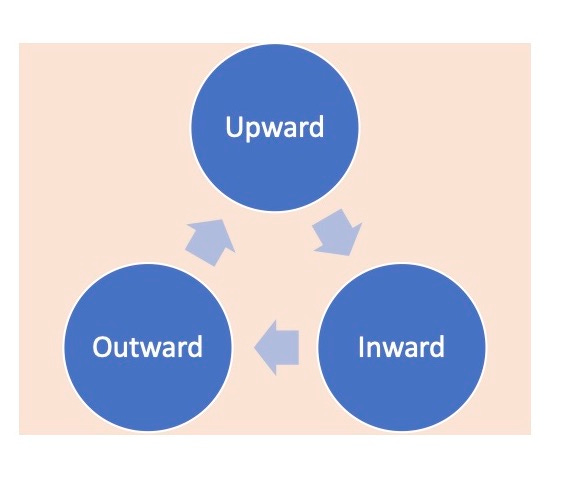
To begin with, people have to deepen their personal understanding of what peacebuilding involves along with their mastery of key skills. I also discovered that while there are plenty of promising initiatives out there in places like Portland Oregon, none of them have found their way to Portland ME or Portland CT (near where I grew up) or any of the twenty other Portlands. In other words, we need to take our work to scale outwardly. And, of course, we need to have an impact on policy makers which involves more than just building a big enough movement but one that also has the capacity to help our leaders see that we need a paradigm shift in the way we deal with our problems.
Finally, gettng readers to seek the importance of scaling was not going to be enough. If I wanted people to accept my invitation, I had to offer them a strategy that gave them something that I called a rational basis for hope the first article I ever wrote about peace forty yearsago.
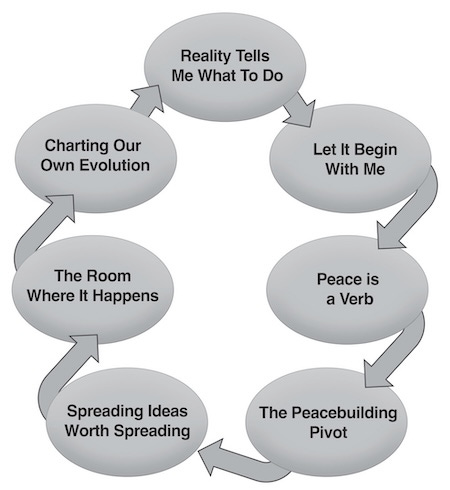
Eventually, I settled on this loop which also provided me with the organizational structure for the book and the movement which we are now in the process of creating. You can explore it in detail in the book (yes, another hint to buy a copy), but let me limit myself to the first two components you would get to if you started “at a few minutes after the hour” going clockwise, because these are the two areas anyone reading this post can pursue.
Let it begin with me. The first combines going to scale inward and a bit of the outward side of things, too. It actually is quite simple. All I can really change is myself. Sure, the impact of what I think and do can ripple out. And if I am right, it can (and will) ripple out far enough to pull our country out of the rut(s) it is in. But it all does start with me, my values, and my actions. Hence, going to scale inward. As we put it on the AfP web site, you don’t need a graduate degree to be a peacebuilder, but there are some core values—some of which fly in the face of conventional wisdom—that you really do need to know about. Yes, another reason to buy my book---or any of the dozens of other ones I’ve read over the years.
Peace is a verb. Start with a tautology. The ipact of your actions can only ripple out if you act. You have to do something. In fact, Peace is a Verb was the book’s original title until Liz pointed out that it might work for a book, but not for a movement. Still, it is a great chapter title that let me list the kinds of things that people like you are doing as peacebuilders in their local communities through mediation centers, civic associations, explicit peacebuilding groups, the so-called bridging movement, and a whole lot more. And then, to my surprise, I found that people who focus on other issues like climate change, inequality, immigration, and even the culture wars are beginning to realize that they had to think and act like peacebuilders, too. Reading about them will undoubtedly spark your imagination until you come up with things that you can do in the course ofy our daily life. If not, my colleagues and I can help you find what I call your on-ramps into doing your part in building peace here at home.
The book goes farther and shows how we can build on the seemingly simple, low-impact things you can do and create a movement that can pull off the paradigm shift that I have been ranting about when I first heard that term in my first political science research methods course in 1966. But to see all that, you will have to read the book (yes, another not so subtle hint).
More importantly, even before I sent the book off to my publisher, I knew that two hundred pages of prose would not be enough. We would have to act on those words. So, my colleagues and I spent the last few months developing a strategy that turns a loop-on-paper into a loop-in-real-life.
While the Peacebuilding Starts at Home campaign does address all the steps along the loop and all three areas of scaling, let me return to my invitation and ask you to join us in the part that will be the easiest to join.
We plan to build a network of at least one million peacebuilders by the end of this decade.
That is a huge challenge.
Especially since we will have to do so one conversation at a time.
So, I have decided to host as man of those discussions as I can in the days, weeks, and months to come.
I will be helping the people I talk with better understand everything on the loop, ranging from the new problems we face to what they as individuals can do about it and why I still come back to my title of forty years ago—a rational basis for hope.
I will also be recruiting others to host those conversations, because we will never reach our million peacebuilder target if I’m the only one doing so.
And, my colleagues and I will build on everything we have learned about building networks and communities to build bridges connecting those “islands” that David Sloan Wilson refers to.
I could give you plenty of other reasons to buy the book. After all, I just barely scratched the loop’s surface
However, here’s one final one that, if you are new to it, could be your first step as a peacebulder. All of the royalties I earn from Peacebuilding Starts at Home are going to support the work I just described.
Even before you crack the cover and read its second sentence and beyond, you will have begun doing your part.

So, let this link or the QR code do its magic.
The views and opinions expressed in this article are those of the author and do not necessarily reflect the official policy or position of the Alliance for Peacebuilding or its members.
No posts
Comments
Nothing yet. Say the first thing.
Sign in to join the conversation.