
Hello. And hello to new subscribers. It’s been a hot minute. I’ve been launching rebrands, managing a puppy, training a future Matilda, and, well… life, eh?
Two pieces of housekeeping before the newsletter.
You’ll see this week’s column is about AI. I’ll also be co-hosting a series with Christina Vetta from Social Hills focusing on practical applications of AI in marketing from professionals who’re using the technology in their day-to-day work. Our aim is to cut through the noise and give grounded, practical help to working marketers who have busy day jobs.
I’m currently available for freelance and contract work for strategy, brand, general marketing and content. Get in touch if you think I’d add value to your business.
Onwards.
Is AI good at creating adverts? Based on current outputs, yes—but also no. The same is true for human advertisers.
This may seem threatening, and that’s understandable. Any disruption that threatens jobs will be met with hostility.
But earlier this year, Tom Roach, one of the most level-headed voices in the industry, had the following to say about AI:
“What are we going to learn? There’ll be some surprises about how well some of these ads will do. People probably won’t notice or care how we make our ads – that’s our business. They just care how they make them feel.”
Now Roach’s agency, Jellyfish, along with effectiveness testing platform System 1, have released research confirming exactly that. Consumers aren’t just responding to AI adverts – the 18 ads tested scored higher than non-AI adverts.
Among them was Coca-Cola’s latest iteration of the Holidays Are Coming creative, featuring cute animals excited as the Coke trucks roll into town.
There are telltale signs of AI. The animals have that all-too-polished sheen. But CGI has been generating animals for years with little backlash. If LinkedIn is to be believed—and take this with a large grain of salt—it took around 70,000 prompts to generate. Is that better than CGI? More or less skilled? More cost-effective? Quicker? And does it matter?
In System 1’s ratings, this year’s Holidays Are Coming scored 5.9 stars, generating a more emotional response than the category average. This doesn’t necessarily mean it’s a triumph for AI, but it does show a creative team who know what they’re doing and are leaning on years of brand heritage and advert familiarity.
There’s another ad that’s had far less attention than the Coca-Cola Christmas advert. Budget telco Amaysim released an entirely AI-generated advert created in less than two weeks.
It’s nowhere near as polished. It’s got some big visual mistakes. The woman is missing a finger, and her hands merge into one another in the wide shot. The dad on the toilet is wearing underpants. The kid’s posters have nonsense words on them. The body movements are jerky. Ad creatives, understandably, were less than impressed.
And yet, the advert does a lot right. The over-proliferation of orange everywhere is a strong use of a distinctive brand asset that clearly marks this out as an Amaysim advert. The proposition and messaging – escape your pricey telco – is simple and clear.
The script, which may not be AI-generated, riffs off the human behaviour of telling your friends and family when you find a good deal. There’s the obligatory jingle at the end. And what the press release doesn’t mention is this is part of a wider campaign. I’ve heard the advert on the radio multiple times, and there are no mistakes. The reach, frequency, consistency and multi-channel strategy are all best practice.
Most agencies or marketers wouldn’t let AI mistakes through, and neither should they. But Amaysim has greater leeway than other brands. It’s a budget, challenger brand with a level of humour that’s rarely present in its bigger competitors. Releasing a not-exactly-perfect AI-generated advert is very on-brand for Amaysim.
Ironically, the biggest challenge for marketers isn’t getting AI to create adverts – it’s the perception of AI as a category. Research suggests that when consumers know AI has been used to generate advertising, they can have a more negative view. But this is relative.
Luxury brands using AI, for example, seem to be particularly affected (but not always). This makes sense. The human craft and exclusivity that sell luxury can be undermined when this isn’t reflected in communication.
Similarly, medical and government adverts appeared to have worse perception when AI was known to be present. AI coffee ads, though, generated a more positive effect, as do performance-focused adverts. And research from Kantar suggests that AI ads often generate negative emotions.
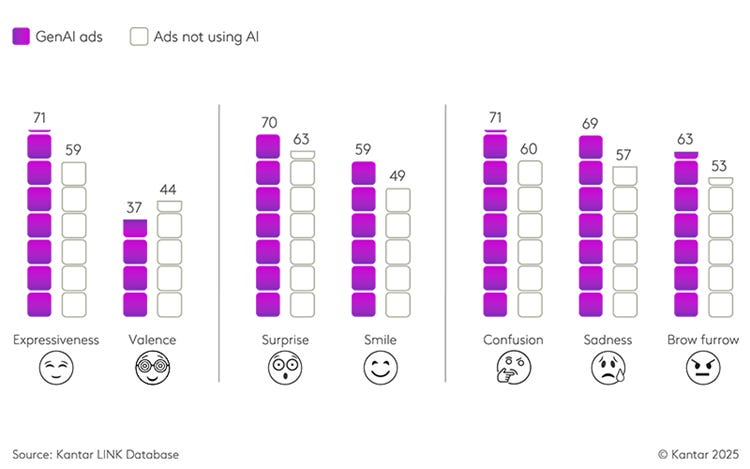
It’s not conclusive, but as in other forms of marketing, context matters. Consumers are more likely to trust a brand that spends on big above-the-line out-of-home or TV than one that just uses low-quality online advertising.
Sectors or brands that require trust or are perceived as artisan have more to lose. And for smaller brands who previously couldn’t afford or didn’t have the equipment to create adverts, the bar has suddenly lowered, similar to how Meta’s ad platforms made it possible for smaller companies to reach customers at scale.
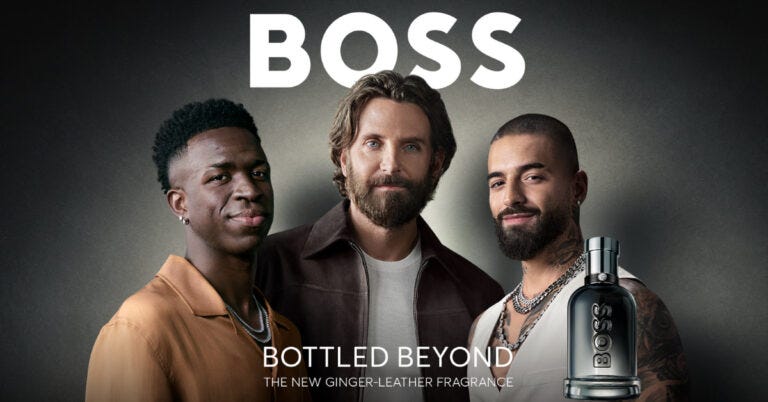
Finally, even in a world of AI slop and poorly made AI adverts, humans are still capable of making terrible creative. Mark Ritson has called Hugo Boss’s celebrity-heavy campaign “the worst advert of the year“. Only 3% of consumers could recall a selection of adverts in a recent Indian study. Nielsen suggests two in three consumers can’t recall adverts. Those in glass houses…
Contrast this with an AI-generated concept, retouched by humans, for tomato brand Mutti. It’s bold, striking and, like Amaysim, speaks to a brand truth. In big out-of-home digital large-format placements, it doesn’t stand out as AI-generated. And even if it did, would people care?
AI slop is a problem, but that’s more a platform and human question than a creative one. There are still many creative tasks that AI can’t do as well as humans, although that’s likely to change. But, as with all advertising, if the strategy’s off, the brief’s wrong, and the idea is bad, neither human nor machine can rescue the campaign.
Kantar’s Mary Kyriakidi recently summed it up best: “With GenAI, it’s not the tech that wins hearts, it’s the humans steering it.”
Like this? Hate it? Got you thinking? Share it.
Saint Etienne’s collaboration with Confidence Man, Brand New Me. Their debut, Foxbase Alpha, is one of the best albums of the 90s, and the band have been consistently at the top of their game for over 30 years.
This is apparently their last album, and a world with no new Saint Etienne music makes me sad. But equally, what a way to go out.
This is a breezy collab that goes right back to their Foxbase Alpha roots. Plus the Hanna Barbera inspired video is brilliant.
No posts
Comments
Nothing yet. Say the first thing.
Sign in to join the conversation.