
Virginia stands at a pivotal moment in its approach to firearms legislation. The stakes go far beyond politics or partisanship; these decisions will shape public safety, enforceability and the practical ability of law-abiding citizens to respond proportionately to real threats. In an era of economic and geopolitical volatility, prudence — not symbolism — should guide the commonwealth’s firearm policy.
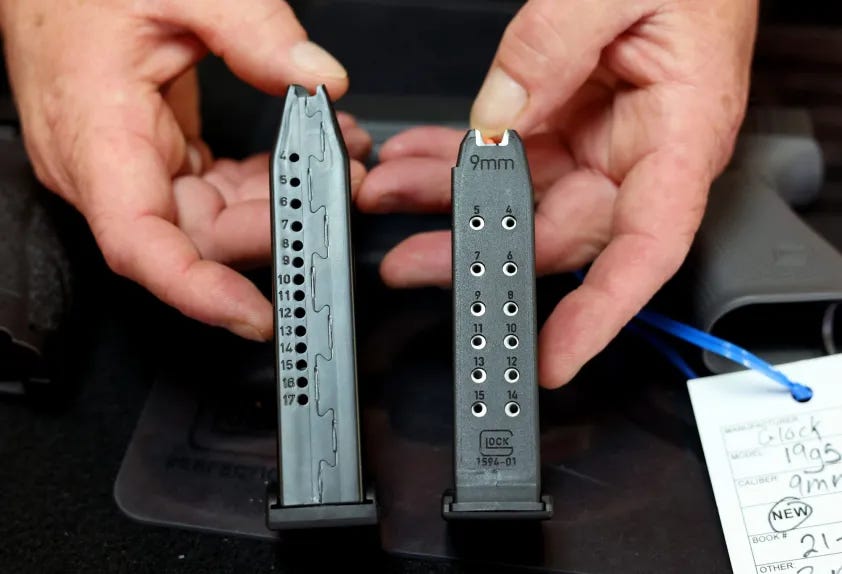
As a former federal agent and current private-sector armed professional in the Richmond region, I believe the core question is simple: Does restricting magazine capacity make Virginians safer, or does it create new hurdles without delivering measurable gains? Imposing a 10-round cap on standard-capacity magazines — commonly configured for 15 rounds in many handguns and 30 in many rifles — runs counter to modern manufacturing standards and hinders everyday citizens and trained responders alike. Law enforcement and security personnel rely on predictability to counter imminent threats and protect others, instinctively conducting tactical reloads in rapidly evolving encounters to restore full capacity and ensure reliability — something such limits would compromise.
This concern is amplified by the sheer volume of magazines already in circulation. According to a 2024 report by the National Shooting Sports Foundation, more than 700 million magazines exceeding 10 rounds are currently in private hands nationwide. Unlike the 1994 federal assault weapons ban, which was implemented in a significantly smaller marketplace and in a distinct policy era, any present-day provision would face a vastly different environment.
Prior to its 2004 expiration, the federal ban was calibrated to far lower production volumes, fewer firearms and a less demanding legal framework. Today, production norms, civilian access and digital marketplaces have reshaped the industry. Any modern ban would contend with a substantially transformed firearms ecosystem and a populace accustomed to standard magazine capacities — conditions that blur legal boundaries and impede practical application.
Imposing new limits would introduce legal and practical ambiguities — inviting litigation and inconsistent enforcement that undermine public trust and strain uniform implementation. The implications are not theoretical. In recent weeks, several sheriffs across the commonwealth have publicly questioned the practicality of proposed magazine limits and related firearm restrictions, arguing the changes would primarily affect lawful Virginians. While their concerns do not determine what becomes law, they underscore the tension policymakers should seek to avoid — statutes that introduce unnecessary complexity while yielding unproven safety benefits.
The historical perspective illustrates how dramatically the balance of capability has shifted since the Founding era, when militias possessed arms comparable to government forces. Industrialization widened that gap, and today the U.S. military employs technologies far beyond civilian reach. At the same time, Virginia does not legislate in isolation. The commonwealth shares borders with multiple states that impose no comparable restrictions, creating a patchwork legal landscape that complicates enforcement and invites circumvention. Similar laws elsewhere face ongoing constitutional challenges, raising the prospect of prolonged, taxpayer-funded litigation. In an environment of finite law enforcement resources, policymakers must weigh whether this approach meaningfully enhances public safety or simply compounds existing resource constraints.
Policymaking requires enforceable standards that withstand legal scrutiny and real-world application. Magazine limits may signal intent, but intent alone does not determine effectiveness. When millions of standard-capacity magazines remain in circulation, neighboring states impose no such limits, and online sales reduce barriers to acquisition, the measurable impact becomes harder to substantiate against present-day realities.
The goal of reducing gun violence transcends political lines. The question before the governor is whether this mechanism will demonstrably reduce harm without imposing avoidable trade-offs or narrowing longstanding constitutional protections. Sound public policy rests on evidence indicating that the benefits outweigh the costs. Virginia’s tradition has long balanced individual rights with public safety. That balance should not be altered unless it is clear this change will materially reduce violence in today’s fundamentally different era.
No posts
Comments
Nothing yet. Say the first thing.
Sign in to join the conversation.