
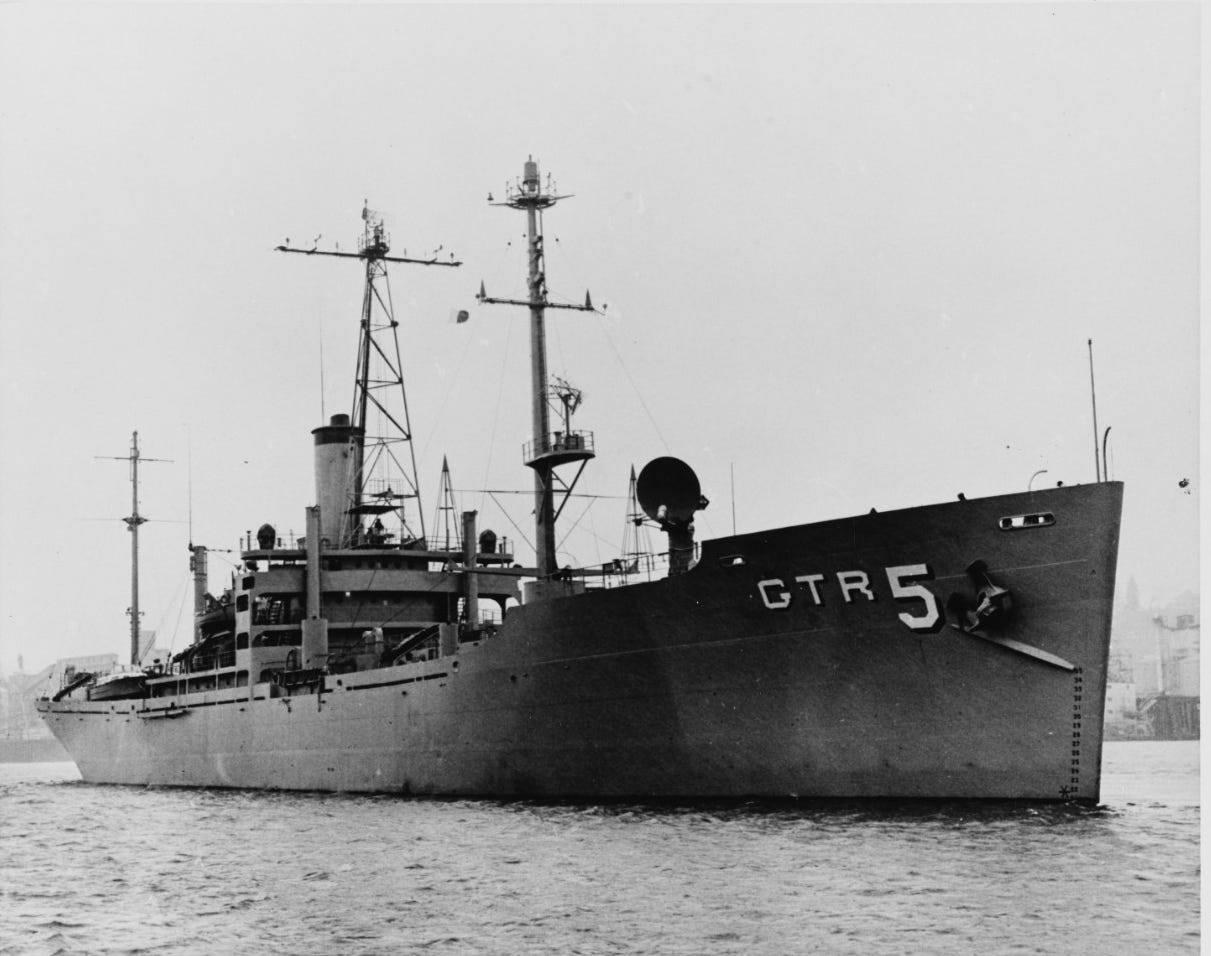
Thirty-four Americans were killed when Israeli forces attacked the USS Liberty on June 8, 1967. Nearly six decades later, the central questions of what happened—and why—remain unresolved.
On June 8, 1967, during the height of the Six-Day War, Israeli air and naval forces attacked the USS Liberty, a U.S. Navy technical research ship operating in international waters off the Sinai Peninsula. Thirty-four Americans were killed—thirty-one sailors, two Marines, and one civilian National Security Agency employee—and 171 were wounded.
According to survivor accounts, the attack lasted approximately ninety minutes and unfolded in multiple phases. Israeli jets launched the initial air assault, followed by three fast attack boats that fired five torpedoes. One struck the ship, tearing a 39-foot hole in the starboard side. Israeli helicopters later circled overhead as the Liberty’s crew worked frantically to control flooding, fight fires, and tend to the wounded. The engagement eventually ceased—the battered ship was left adrift with dozens dead and many more wounded—as sailors struggled to stabilize the vessel. Escorted by the guided-missile cruiser USS Little Rock and the destroyers USS Davis and USS Massey, the damaged Liberty limped to Malta, arriving on June 14 for emergency repairs. Workers there counted more than 800 cannon holes across the ship’s upper decks.
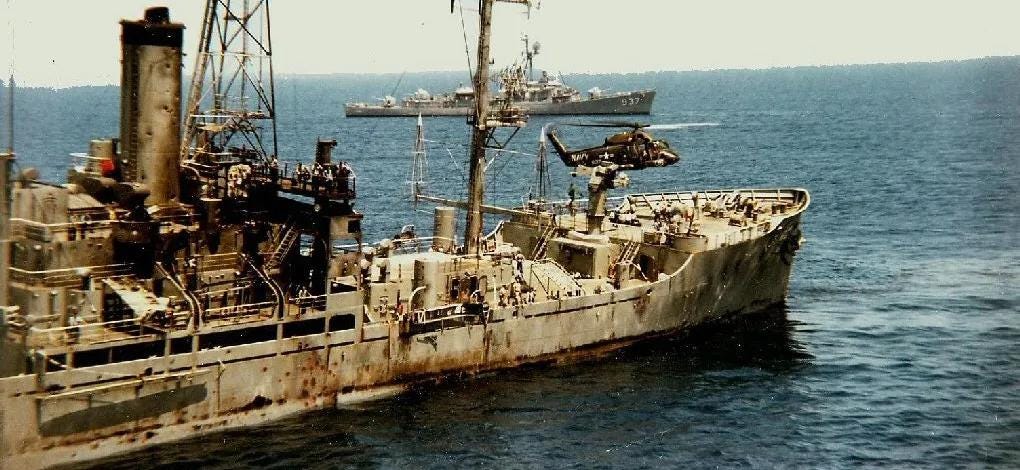
The Liberty had been deployed to the eastern Mediterranean to monitor military communications during the Six-Day War. Operating with the National Security Agency, the ship intercepted electronic transmissions across the region using specialized signals equipment and a contingent of NSA linguists and intelligence specialists—providing Washington with real-time situational awareness of the conflict.
Subsequent investigations by both the United States and Israel concluded that the attack was a case of mistaken identity. Israeli officials stated that the ship had been misidentified as an Egyptian vessel amid the confusion of active combat operations. The U.S. Navy Court of Inquiry found no conclusive evidence that the attack had been deliberate, and the CIA later assessed that the available information did not definitively establish intent.
For nearly six decades, that conclusion has stood has defined the official record. Yet documented facts and testimony complicate government narratives.
The USS Liberty remains one of the most disputed naval incidents of the modern era. The controversy persists not because of prejudice or political hostility, but because the totality of the circumstances lies uneasily alongside Israel’s official explanation. The question is not whether wartime errors occur—they do, often tragically. The question is narrower and more difficult: at what point does a mistake become implausible—and when does the accumulation of variables exceed the bounds of coincidence?
A significant point of tension concerns what Israeli naval headquarters knew before the attack began. Later government inquiries in Israel acknowledged that the vessel off the Sinai coast had already been identified earlier that day as American—described as “an electromagnetic surveillance ship of the U.S. Navy.”
The Israeli government has maintained that this information was not transmitted to the air controllers or naval crews who later engaged the Liberty. According to the official explanation, the earlier assessment was either overridden by later reports misidentifying the vessel as Egyptian, or it never reached the pilots and torpedo boat operators who carried out the attack. The distinction is crucial: awareness at headquarters does not automatically establish tactical intent. Yet it raises an unavoidable question. How did confirmed recognition at the command level fail to prevent a sustained, multi-phase engagement lasting approximately ninety minutes?
Visual identification presents another layer of tension in the mistaken-identity narrative. The USS Liberty was not a conventional naval vessel. As a technical research ship (AGTR-5), it carried more than forty antennas designed to collect electronic signals, giving it a silhouette distinct from that of standard warships.
Survivors have repeatedly stated that a large American flag was flying during the attack. Several crew members have said the initial strafing runs damaged that flag, after which sailors raised an even larger replacement in an effort to ensure unmistakable identification. Many survivors have testified that this second, more prominent flag remained visible during the torpedo strikes that followed.
Israeli officials have maintained that early reports misidentified the Liberty as the Egyptian transport El Quseir, a substantially smaller cargo ship measuring approximately 275 feet and displacing about 2,640 tons—not a signals-intelligence platform equipped with extensive antenna arrays. By contrast, the Liberty displaced more than 10,000 tons and measured roughly 455 feet. The physical differences between the two ships—size, profile, and configuration—continue to fuel skepticism among survivors about how such a misidentification could have gone uncorrected throughout communications.
The fog of war—including smoke from the initial airstrikes—has long been cited by Israeli authorities as contributing to confusion. Yet the attack did not consist of a single pass or fleeting exchange. It unfolded in successive stages over roughly ninety minutes. Miscalculations are inherent to war. But in the case of the Liberty, time, visibility, and prior recognition strain the limits of plausibility.
In the decades since, U.S. intelligence personnel have publicly stated that they intercepted or later reviewed Israeli communications that, in their accounts, reflected awareness that the vessel was American. Among them was Ronald G. Gotcher, an Air Force Hebrew linguist stationed at a listening post in Crete in 1967. Gotcher has consistently maintained that he intercepted and translated exchanges between Israeli pilots and ground control during the attack. In his account, pilots acknowledged the ship’s American identity while receiving orders to proceed with the attack.
Marvin Nowicki, a retired Navy Chief Petty Officer and Hebrew linguist for the National Security Agency, was aboard a reconnaissance aircraft over the Mediterranean intercepting Israeli military transmissions in real time during the encounter. Nowicki has said he heard pilots recognize the vessel as American, though he later indicated the recognition appeared to occur only after the air attack had begun and described the incident as an error rather than a deliberate strike. He later stated that he last saw the original recordings at NSA headquarters in Fort Meade in the late 1970s. While some related transcripts have been released, the recordings he described have never been publicly produced and remain classified or otherwise unavailable despite multiple Freedom of Information Act requests.
If Israeli pilots or controllers recognized the vessel as American during the engagement, the issue shifts from misidentification to prolonged military action after that recognition. The air attack preceded the arrival of torpedo boats—if the ship’s identity was established during the earlier air phase, the continued aggression raises a further question: why the escalation was permitted rather than halted immediately.
Even within President Lyndon B. Johnson’s administration, the mistaken-identity conclusion did not stand without dissent. Secretary of State Dean Rusk later stated he was never fully satisfied with the explanation that the attack had been accidental. Captain William McGonagle, the Liberty’s commanding officer during the assault, questioned the misidentification given the ship’s markings and visibility. Ward Boston, senior counsel to the U.S. Navy Court of Inquiry, later said he believed the attack had been deliberate and that the inquiry’s scope had been constrained by broader political considerations. While the administration formally accepted Israel’s apology, statements from senior U.S. officials reflect skepticism about intent across multiple levels—from enlisted survivors to senior naval officers to members of the President’s Cabinet.
Several additional aspects of the incident remain subjects of ongoing contention. Among the most contentious are allegations that Israeli torpedo boats fired upon life rafts lowered from the Liberty after the attack. Many survivors—including the USS Liberty Veterans Association, which represents surviving crew members—have stated that life rafts were destroyed by gunfire. In a formal report submitted to the Department of Defense in 2005, the association asserted that Israeli torpedo boats deliberately strafed the rafts.
Claims have also been raised that U.S. distress frequencies were jammed during the attack. Several Liberty radio operators later reported interference that appeared to block multiple emergency channels. Some survivors argue the disruption targeted specific U.S. Navy frequencies, suggesting intentional electronic interference. Others attribute the communications failures to antenna damage sustained during the initial air assault or to the dense electronic environment of the Six-Day War.
Questions have likewise surrounded the reported recall of U.S. aircraft launched in response to the Liberty’s distress signal. Fighters from Sixth Fleet carriers were dispatched after the attack began but were recalled before reaching the scene. Some survivors and former naval officers later questioned the decision and its timing, arguing that it delayed assistance to the damaged ship. Official explanations have cited operational considerations and the risk of escalation amid Israel’s rapidly expanding conflict with its Arab neighbors.
Survivor accounts have also raised questions about restrictions placed on the crew after the attack. Numerous sailors later stated that they were warned not to discuss the incident publicly and were told that violations could result in disciplinary action or court-martial. Some described the warning as a formal “gag order,” while others suggested it reflected routine security restrictions associated with classified intelligence missions.
Nearly six decades later, the official conclusion remains contested. Duration, visual identification, prior headquarters awareness, vessel characteristics, intercepted communications, and consistent survivor accounts do not independently establish intent. Taken together, however, they call into question the credibility of the mistaken-identity conclusion and warrant continued scrutiny. Each element narrows the space in which error alone can plausibly explain the sequence of events.
For the surviving crew members and the families of the thirty-four Americans killed, the issue has never been speculative. It has never been about diplomatic convenience or historical footnotes. It has been about clarity—whether the full circumstances of that afternoon have been adequately examined, transparently addressed, and met with accountability and justice.
The USS Liberty endures not because of prejudice or political hostility, but because unresolved contradictions linger within the official narrative. At minimum, the incident remains a test of institutional candor. Until common sense outweighs coincidence, doubt will prevail—because the central question remains unanswered: at what point does a mistake become implausible?
No posts
Comments
Nothing yet. Say the first thing.
Sign in to join the conversation.