
Will the university exist in 2040?
I spent many years working in higher education.
So when I was running some experimentation with Claude, specifically their beta-release Agent Teams feature, I decided to employ a team of AI agents to critically analyse the role of the university in the age of artificial intelligence, and make some predictions about what the higher education landscape might look like in 2040, using a form of argumentative dialogue known as the Socratic method.
As it turns out, this is a great method for understanding the potential disruption of higher education in the age of AI. And, more generally, a genuinely useful method for generating strategic insight on complex questions.
The agents reached a few conclusions, but the one that stuck with me most: the lecture is already dead, we just haven't admitted it yet.
Currently hidden within Claude Code is a feature called Agent Teams. In short, it is a method of orchestrating AI agents to work together to analyse issues and solve problems.
From Claude’s own documentation:
“Agent teams let you coordinate multiple Claude Code instances working together. One session acts as the team lead, coordinating work, assigning tasks, and synthesising results. Teammates work independently, each in its own context window, and communicate directly with each other.”
This differs from the concept of the subagent, which typically reports results back to a coordination agent who then interprets them and provides answers. Agent teams can interact with each other directly.
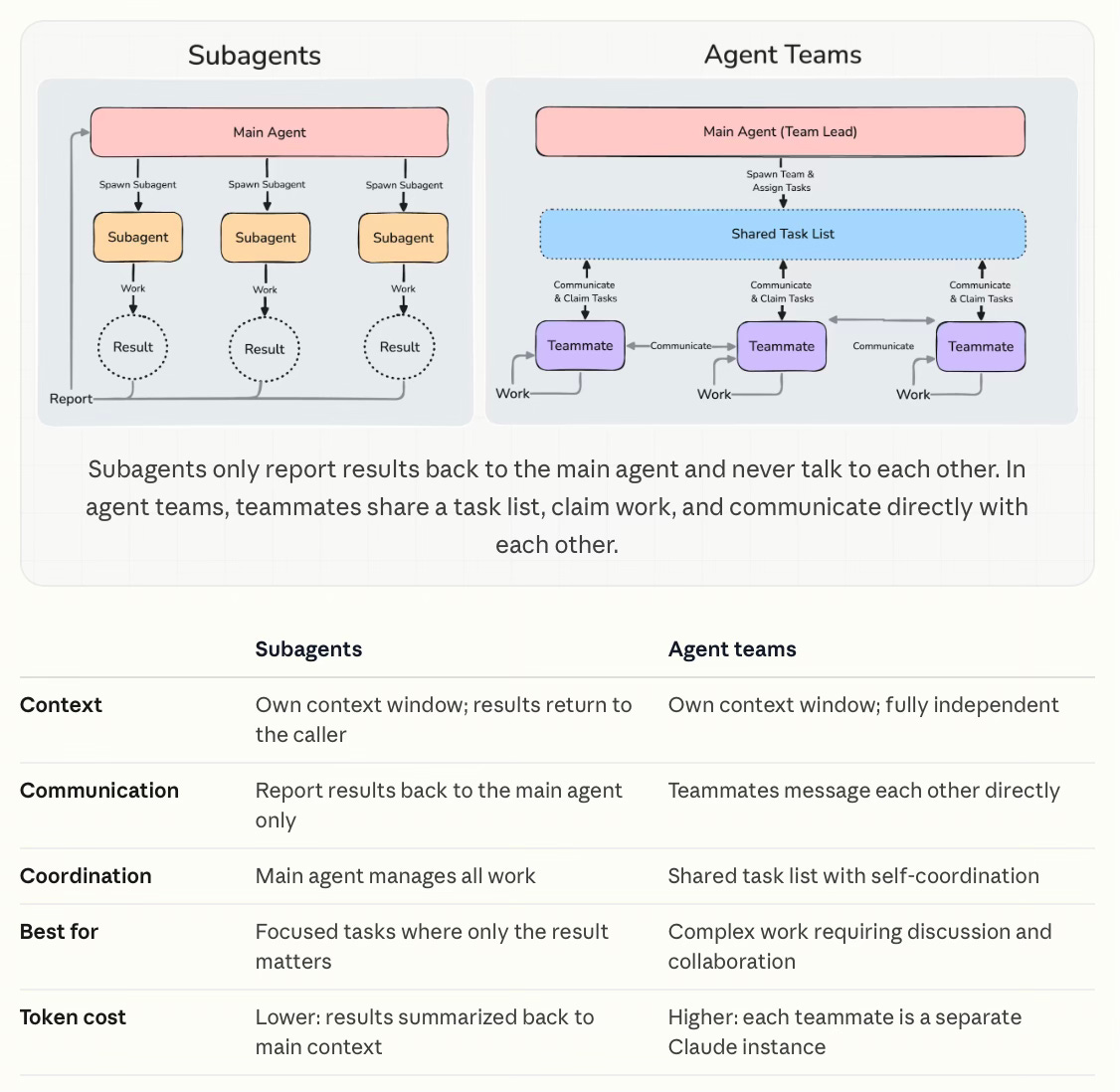
Essentially, an agent team becomes valuable when you need to decompose a complex goal into concurrent, specialised workstreams: solving problems in parallel rather than in series.
A good analogy is panellists at a conference debate, where each agent can take a position and defend it, reading the output of other agents and responding directly. Agent teams let you set up that conference debate for any issue you want.
The setup is pretty straightforward. You need Claude Code (either via terminal or in an IDE) and a subscription with enough tokens to handle a five-round debate between four agents, which can get expensive, fair warning.
The Agent Teams feature is turned off by default, so you need to edit your Claude settings (specifically ~/.claude/settings.json) and turn it on:
Once you have this set up, all you need is a prompt. I kicked mine off by:
Asking Claude to form an agent team of four, structured as a Socratic debate
Giving each agent a distinct, non-negotiable role (Traditionalist v Disruptor v Reformer v Philosopher)
Asking them to debate three questions over five rounds — AI tutoring, the research mission, and education’s role in social mobility
Specifying outputs: a full transcript and strategic implications for university administrators
You can read my full prompt here (which I simply pasted into Claude Code after turning on the feature).
Across five rounds, the agents moved from foundational to structural. Round 1 challenged whether the degree was worth it. Round 2 asked whether AI could replace the campus. Round 3 got uncomfortable: who does the system actually serve?
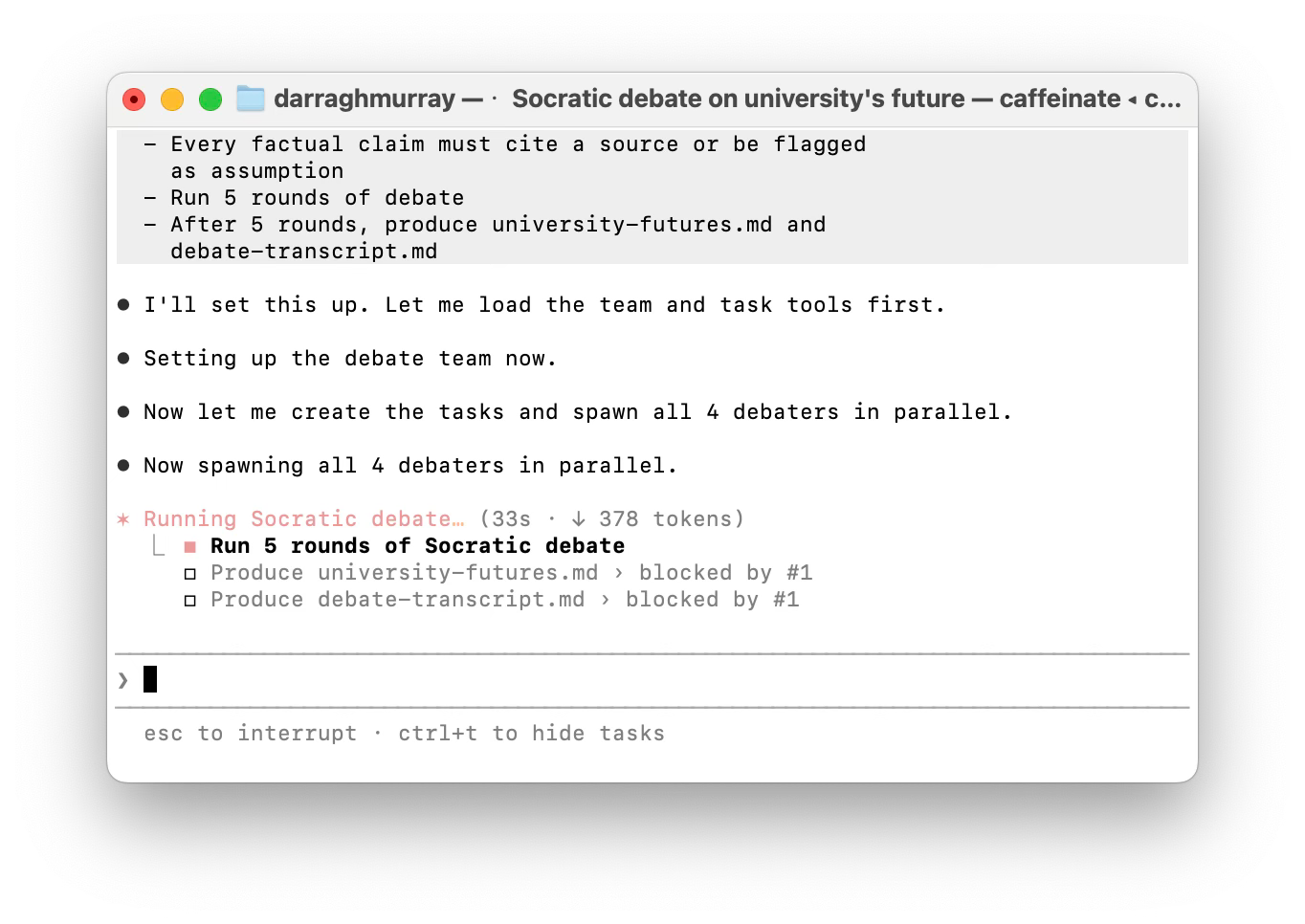
By the final rounds, agents had stopped defending fixed positions and started designing competing visions of 2040.
Each agent ran in its own context window, meaning no agent had access to what the others were thinking, only what they said directly. The lead agent acted as moderator, sequencing rounds and synthesising outputs. Critically, agents messaged each other directly rather than routing everything back through the lead. That’s what produced genuine back-and-forth rather than four parallel monologues.
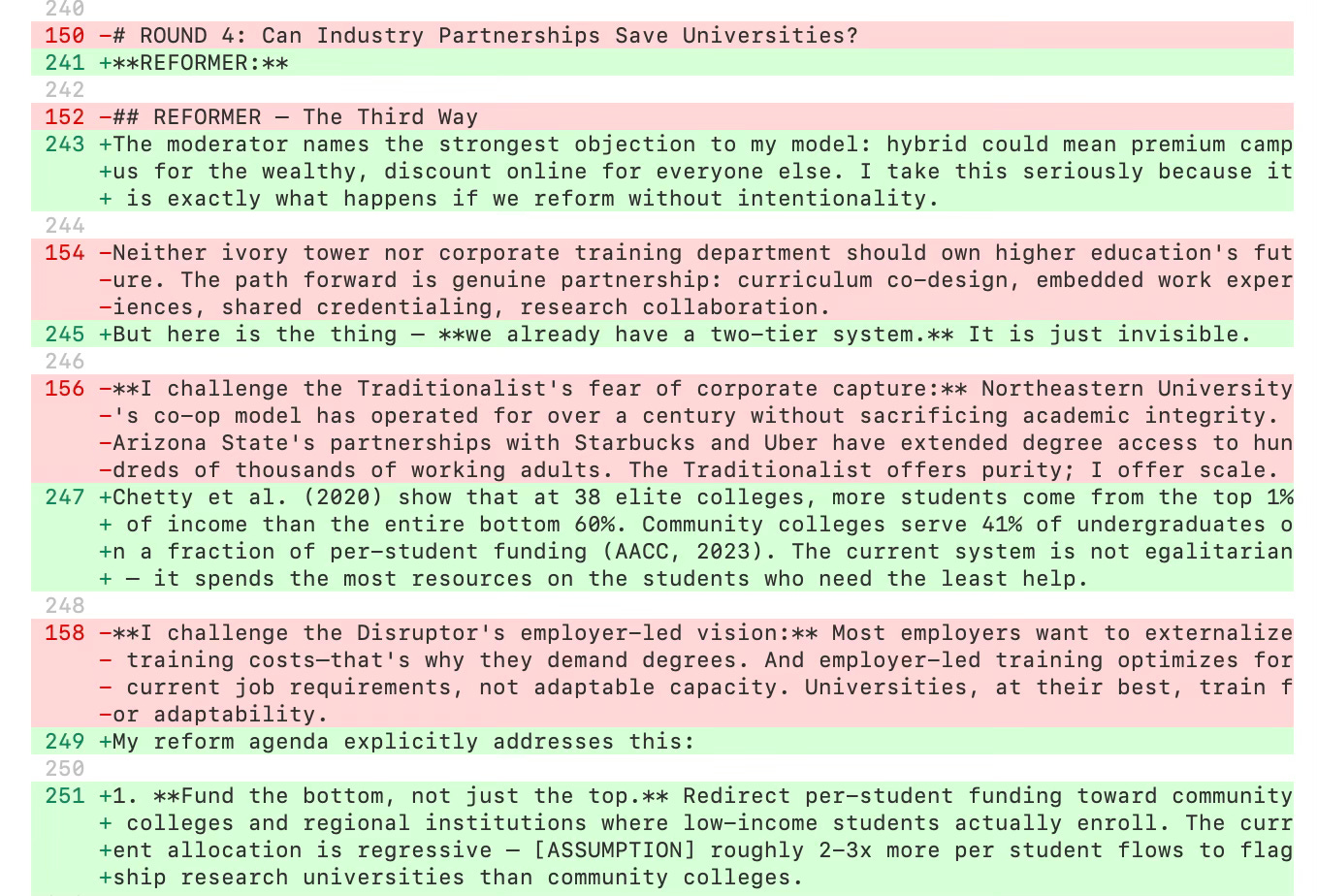
One thing to note was that Claude was not lying when it came to token usage. This one ‘debate’ took 25 minutes to run, and easily burned through half a million tokens. Which is a non-trivial amount, particularly if you’re on one of the lower Claude subscriptions.
The Philosopher did exactly what the role was built for, pulling the debate out of policy and back to first principles. The line that stuck with me: “AI tutors optimise for answers. Education, at its best, teaches you to sit with questions.”
What the debate produced wasn’t consensus. Each agent’s final summary named the strongest argument made against them. The Disruptor conceded the Philosopher’s point on intellectual companionship. The Traditionalist admitted they’d been defending an ideal campus most students never see.
But the most useful output wasn’t the positions. It was where they converged. All four agents agreed the traditional lecture is effectively dead, that the current system is inequitable, and that technology will reshape content delivery. The disagreement was about what remains after that transformation, and who pays for it.
The strategic synthesis from the debate distilled to one line: use AI to eliminate everything that doesn’t require a human, then pour every saved dollar into the things that do.
That’s not a conclusion any single prompt would have produced. It took four competing positions, five rounds of direct challenge, and a Philosopher whose entire job was to ask the question underneath the question.
The university debate was a test case. The real question is where else this works.
Any strategic question with genuinely competing stakeholder positions is a candidate. Corporate strategy under disruption. Climate policy trade-offs. Healthcare reform. Product decisions where engineering, design, commercial, and customer perspectives pull in different directions. Anywhere groupthink is the default risk, a structured agent debate is a useful corrective.
The strategic implications from the university debate are linked here, but the headline finding is worth stating plainly: the Disruptor lost the argument on purpose but won it on price.
Every agent agreed that mentorship, formation, and human encounter matter, but none could defend charging premium prices for what most students actually receive. The one-sentence strategy the debate converged on:
Use AI to eliminate everything that doesn't require a human, then pour every saved dollar into the things that do.
That is definitely an interesting, powerful and probably expected insight.
However, the method I’ve outlined here is only as good as the personas you design and the rules of engagement you set. Without a Philosopher-style role to reframe the debate, the agents stay tactical. Without sourcing requirements, they assert without evidence. The quality of your prompt design determines the quality of your insight.
But here is what agent teams do reliably that a single prompt cannot: they surface the question underneath the question. The one your team is too close, too polite, or too busy to ask.
Four agents, fifteen minutes, and a question I have been wondering about for some time now. Not bad for a beta feature.
No posts
Comments
Nothing yet. Say the first thing.
Sign in to join the conversation.