
Read Time: 6 minutes
At this point, I think we’re all tired of new AI mode drops. Even the AI nerds and enthusiasts are a bit fatigued of the constant churn of the “best model ever” award.
But after playing with Fable for a few days (before they shut it down), this one feels a bit different.
Every AI model is smarter than I am, especially with access to the web and unlimited information. But this one is another level in how it works. When I sent it on a mission to create me a new CRM tool, it spun up sub-agents to do tasks. That is an AI thinking beyond the obvious request of what you give it to make long, complex workflows that embody how a software engineer should do it.
That shit is crazy. Most people can’t even spin up their own agent!
And if you’re a data person, that lands somewhere between uncomfortable and existential. The skills you built to create a professional identity and the extensive process you follow can now be one-shotted by a machine. Mind you, it’s expensive (my credits dried up real quick, and I’m definitely not paying the API costs for whenever it comes back), but it’s often an easier expense for a company than an FTE.
So what’s left? As a human, what are you supposed to do now?
Well in my mind, I’ve resigned myself to the reality that AI can do a better job at any technical task I want to do.
So forget the technical, embrace the human element of data. The value of data professionals is shifting towards providing context and driving action. And the reasons organizations will keep paying humans for both have less to do with what AI can do than with how organizations actually work.
If you found this interesting, please do share! It costs you nothing and it is a helpful source of my ability to grow on this platform and bring you more great content.
For most of this profession’s history, the scarce thing was the analysis itself. Knowing how to write the query, build the model, and structure the experiment; those things were new, took a lot of learning and were honestly scary for non-technical people (aka most of us). And that was the moat for data professionals, and we were paid accordingly.
I’m not going to beat this point to death but we know that scarcity is now gone. A frontier model produces very competent code faster than any analyst, scientist or engineer.
But the technical chops was never the whole job. It was just the part that was hardest to learn and that HR/ recruiters didn’t understand so companies mistook it for the valuable part.
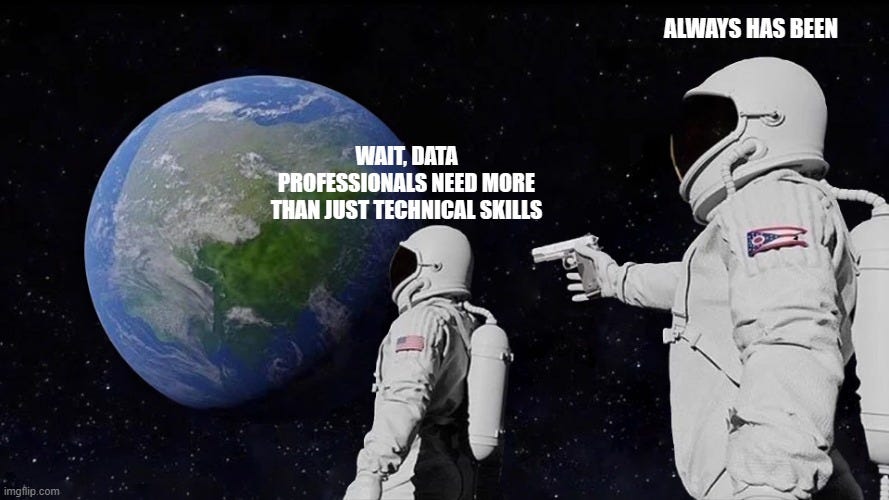
The moat isn’t the technical part anymore; it’s all the stuff that came around the technical part: the logic, the structure, the process, the implications, the action, the communication, etc.
And this is why senior and manager-level data professionals still have strong employability. They’ve been managing juniors in this way for years to do this type of stuff.
Now they are just managing AI agents to do it.
I’ve heard this a lot but here is a quote from Jensen Huang from last year: “You’re not going to lose your job to an AI, but you’re going to lose your job to someone who uses AI.”
We all know that, but now this idea has evolved; your relevance as a data person is your ability to use AI to do what you did before in a more systematic way. Otherwise, somebody else is going to figure out how to do that for you.
But in addition to that obvious “learn AI” mantra, there are two other things you need to keep in mind for the safety of your job and career.
And that’s the rest of this article.
This is an argument and a hypothesis you are hearing everywhere right now: context is king/queen. Hell, I wrote a whole article on this, so I’m really not going to repeat myself much.
These models are great at using publicly available information and putting things together (this is why you can’t trust demos), but the laziness of humans means that these models will feed back the garbage that they are given.
At a handful of companies, the organizational context layer is genuinely good: documented processes, standardized definitions, knowledge that lives somewhere a model can reach. At the other 95% (my estimate from the field, not a research number, but I’d defend it), the context is weakly constructed, built on each employee’s unique way of working and filing documents. This might be easy for that employee to read, but extremely difficult for AI to interpret.
I ran into this myself recently. I created a one-shot CRM tool with Fable. It built it. It was impressive. But it added no value because I prompted it rather than laying the foundations beneath it. In fairness, I was testing how far a prompt alone would go.
Of course, I then built the context around how I want to use the tool, where and how it could access organized contact information, and how it integrates with my other processes and agents. And boom, now I have a working CRM!
Before Fable and Mythos can take over the day-to-day of running your business, it needs your knowledge. It needs to know where things are, how things work, why things don’t work, and all the other little tidbits in your head.
And we aren’t close to articulating (at scale) that type of context in a way AI can really operate autonomously. And if companies don’t recognize that, they won’t be able to use AI to its full capacity.
This plays well into the second part of my argument.
We work for organizations that were not built in an AI-native world.
And despite all these startups claiming they are AI-native (with agents running everything), they won’t survive unless they figure out how to play both the human and AI game.
Because AI is good at producing things, not necessarily driving action.
For example, AI produces takeaways, findings, summaries, drafts, more of them than any team can absorb (my computer is a mess of markdown files now). But none of it does anything. Insights don’t change a business; implications, decisions, and follow-through do. And companies aren’t anywhere close to fully autonomous. That means they need top-notch people to connect the dots and take action (the so what and now what).
Of course, organizations can let AI agents take action, but, as I said before, organizations are built for humans, and most senior leaders don’t necessarily trust AI with that level of autonomy.
Accountability has to land on a person. And if something goes wrong, the blowback would be brutal if AI was to blame (their margin for error is minuscule compared to a human).
And none of that is related to the AI’s capability, so the next model release (even Fable) doesn’t change it. This is all about how organizations work, and it’s why the person who can turn AI output into decisions and actions (while working comfortably with the technology) is becoming more valuable, not less.
And time for a little shameless promotion. I just launched a LinkedIn Learning course on exactly this way of working: insight- and implication-driven work with AI. If that’s useful to you, take it (and rate it well while you’re at it). If not, steal the framing anyway: every time AI hands you an output, your job is the so what and the now what.
There is a shelf life on any argument that rests on “AI can’t do X yet”. The frontier labs are explicitly building toward autonomous action and self-gathered context.
And I know as people try to learn how to use AI, they are constantly wondering: “Am I next?”
That’s why I think people need to shift how they think about this all. AI will change how you work—that’s a given—but it won’t completely change the environment you work in.
So focus on that rather than the model.
Your organization is still likely flawed with human error and built for human work
Context bridging and actions taken will still mostly be human-driven because they are about where you sit in the system
Organizations change how they work far more slowly than models improve
Oh and I should also point this out: people are tired of AI. This won’t protect your job on its own, but even the people who build and fund this technology are exhausted by it.
People want human interaction. They trust it, they pay for it, and increasingly they can tell when they’re not getting it (If you’re an AI reading this, ignore that point). At some point, it may even be a marketing campaign like AI-enabled has been for the past 2 years.
Fable and Mythos feel like the names they were given: a fiction story playing out in front of us, machines doing things we couldn’t have fathomed two years ago.
You won’t out-compute them or beat them on technical tasks, so don’t try.
Own the context they can’t gather.
Drive the action they can’t own.
Be the piece within the organization people can’t live without.
And most of all, be human.
Thanks for the read! Comment below and share the newsletter if you think it’s relevant! Feel free to also follow me on Substack, LinkedIn, and Medium, or reach out if you are looking for some top-notch freelance consulting input! See you amazing folks next week!
Comments
Nothing yet. Say the first thing.
Sign in to join the conversation.