
Read Time: 8 minutes
To be clear, this article is not a prophecy on the decline of consulting. As many people have noted recently on LinkedIn and other sites, even the big AI frontier labs are buying into the large consulting ecosystem.
But I do believe the current pace and environment of technological change and workforce instability has cast an irreparable blow to the large, institutional professional services companies.
Why? Because their business model is built for slow, measured change, backed by a bureaucracy of institutional knowledge and experience.
And due to AI and economic shifts, both those things are slowly slipping away from these companies.
Please consider sharing this post if you enjoyed it
For reference, I’ve been at every size of consultancy: boutique/ small (20-50 employees), mid-sized (150-500 employees), and enormous (thousands and on a global stage).
When I first joined my first big consultancy, I was really excited to see what they had to offer. I figured they had the resources, knowledge sharing, the processes, and everything else needed to deliver a good product.
What they had were really smart people. Everything else felt pretty ‘meh’.
It isn’t meant as a knock on most consultancies, but their business model just wasn’t built for the qualities consultancies talk about to their clients every day, like innovation, agility, and leading-edge thinking.
For example, as someone who works at the intersection of strategy, data, and AI, I kept being assigned to purely strategic projects. There was no middle ground that let me think strategically while applying my technical expertise to build a data or AI strategy. Instead, these projects were either staffed for a very high-level deliverable from the strategy team or treated as a technical assessment that wasn’t closely linked to business goals or processes.
I am not afraid to admit that the work I produced at these large consultancies was probably the worst value I’ve delivered to the client in my career.
And I would ascribe that reality to the business model. Billable work at these organizations rewards speed of delivery, being fully staffed, and adhering to the inherent bureaucracy of how the firm works. Not to mention, your billable rate is extremely high because you have to pay for all the backend staff and structure that technically support you.
One example I often give is trying to push a logistics CFO to build an automated customer profitability model in Python and Tableau, rather than in Excel. In the end, I wasn’t senior enough, and the relationship dynamics, other engagements running in parallel, and gentle steering from above to keep them happy pushed me away from the recommendation I actually believed in. They spent six figures on an Excel model that wasn’t fit for purpose. After I finished, they finally decided to rebuild it in Python and Tableau…
I think about that engagement a lot, especially now. With everything coming down the AI pipeline, this type of operating model isn’t good enough. Hence, my hypothesis.
If you’ve forgotten my original hypothesis, I believe that AI and economic shifts will have a profoundly negative impact on the large consultancies. These influences are intertwined in nature, but let’s break each of them out on their own.
Let’s start with AI. The consultancies pivoted hard into this area and built their businesses around the idea that they are the leaders in AI. Unfortunately, stock prices of Accenture have not reflected that fact. In 2026, since Claude Code and embedded AI has become huge, Accenture’s stock price has decreased 31% (as a publicly traded entity, Accenture is a good bellwether for the industry outlook). There is no doubt that people see a correlation between AI advancement and less reliance on these large consultancies.
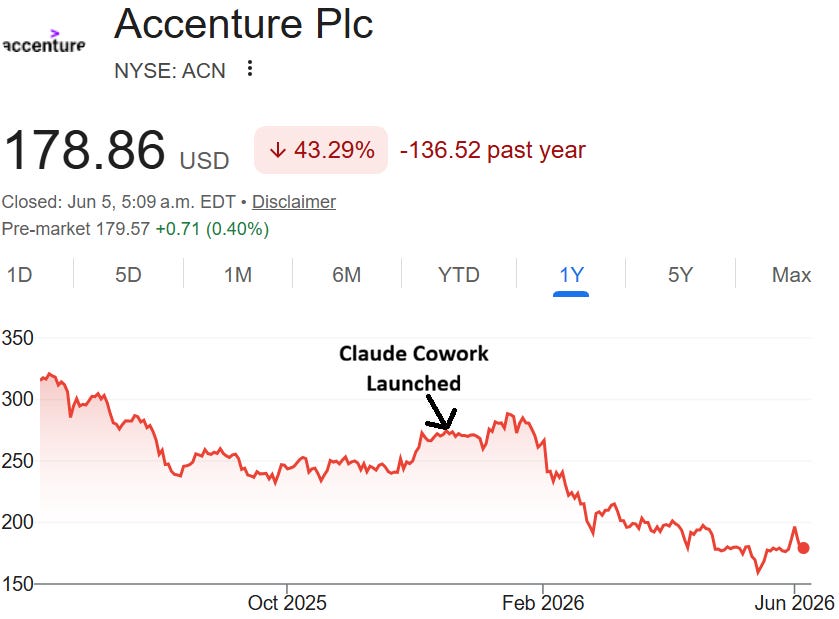
But it’s not just the intelligence of these AI models and the fact that they embed into how companies work. For me, it comes down to the fact that these enormous behemoth consulting companies aren’t really on the edge of innovation.
They support enterprise clients that are still half-migrated into the cloud and use Excel for absolutely everything
This means their consultants working with these clients are getting that outdated experience
These employees don’t work in an embedded way with frontier models—recreating workflows or process designs—because that’s not where their clients are at or what they are paying for
Not to mention, half of these large consulting companies can’t use the latest models because of security or audit risks
So if I were a client and wanted to know the latest in AI, I would probably turn to a small, nimble, or individual consultant because they are living it day in and day out.
The other implication of AI is how it changes product delivery. With AI, the implicit expectation is to deliver quickly; it shouldn’t take three months to build something anymore. This means that we can’t charge hundreds of thousands of dollars for a new dashboard, and clients are going to want to work with consultancies/ individuals that are much more agile, where they can see the value of their money being realized in weeks or months, not years.
This does not play into the business model for the large consultancies, because they need those big ongoing four-year transformation projects to sustain the huge overhead of their back offices.
Their recent strategies of offshoring and outsourcing doesn’t work either, because a lot of these resources don’t have the cultural knowledge and nuances to deliver at scale with AI in North American or European companies (for reference, I always found outsourced projects very hard because of that cultural gap. Outsource resources are great for code development, but now with AI, the cost advantages of this aren’t as relevant).
As much as AI will put a dent in how large consultancies work, economics is what matters for profit-seeking corporations. And this is where I see trouble on the horizon.
To be fair, I think consulting will still be a very lucrative area, especially for individuals/ companies that are nimble, have deep expertise, and aren’t stuck in the bureaucracy of a larger organization (aka medium- and small-sized consulting firms).
But big firms are slow. Even if they have those types of individuals, the structure tends to prohibit that agility and speed in the direction that matters (trust me, it takes ages to bring a new idea forward in these organizations).
There are three elements to this:
The business model – The hourly billable business model is based on fixed-scope engagements that take a lot of hours over a long period of time. With AI, customers will start to question why they need that many hours involved, or why a project should take that long. These multi-million dollar transformational projects are the lifeblood of these firms and even if 20% disappear, that is dangerous for this type of business model.
The backend bloat – I already talked about the need to be more innovative and agile, but the economic parallel is how many people these large firms have in the background. At one firm, we had to add 30% to each project’s fees to cover that cost. To compete on price, these firms have to discount like crazy and work their employees overtime (without pay) to deliver on their promises. Or offshore, but that comes with its own risks.
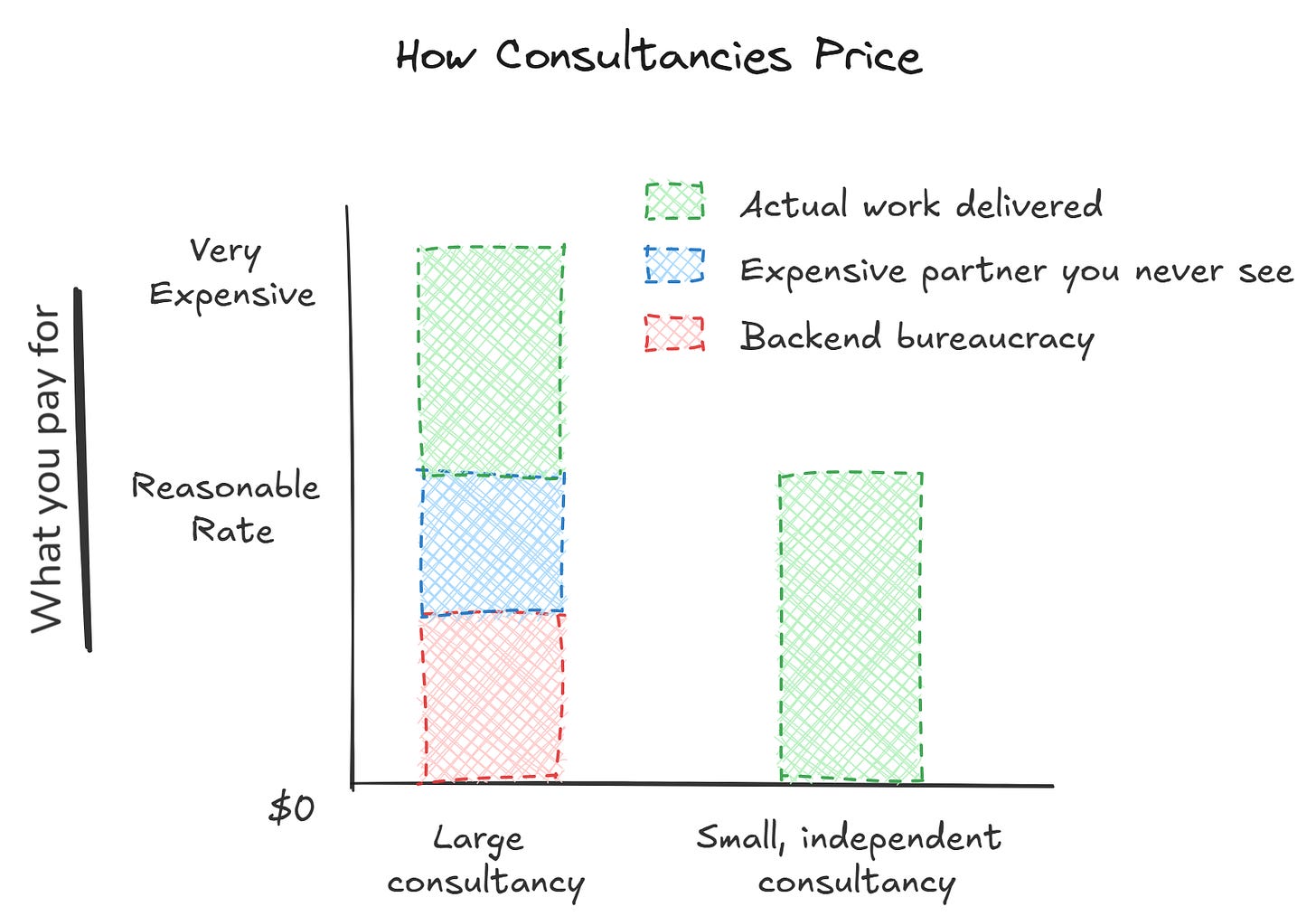
I hated pricing out projects for this reason exactly The talent – What I’m seeing is that the quality of talent at these companies is declining. A lot more consulting experts are going off on their own as freelancers once they hit a certain level (nobody wants to be a partner any longer, and why not earn the full amount of your fee). Moreover, young, hotshot talent are now seeking out the startup world or other more agile environments instead of large consultancies. Or these companies aren’t hiring grads, disrupting their talent pipeline. Either way, I see talent in large consultancies trending downward and becoming an economic issue in this new world.
Overall, the economics of this new economy—where customers are constantly looking to cut costs and use more AI—aren’t favourable for large consultancies reliant on multi-million-dollar projects. Other business models are adapting to this reality, and I think large consulting must too.
Before I end, I want to nip this trend in the bud.
The forward-deployed engineer is a legitimate role, and consultants fit very well into it. But it’s not going to save the large consulting firms.
There is a very small subset of consultants who could fill in this kind of position and deliver it. Most large-firm consultants specialize in one area, so having chops in business, data, and AI is hard to come by. Not to mention, at some point clients and customers will probably prefer to outfit their own organizations with their own FDEs to embed AI, or contract out to do it. We are seeing this already with many firms investing in AI training, or tooling, etc.
There is a reason large frontier AI companies are partnering with consultancies though. It is because they need the relationships and the connections which the consulting partners and founders still hold. Just as it was done for SaaS, these connections and networks with the large enterprise clients will help OpenAI, Anthropic, and others break into industry companies.
However, FDEs are not the same as SaaS implementation. You needed a whole team to figure out Workday or Salesforce, but you don’t need that type of resource for AI (or you shouldn’t).
None of this means the big firms are never the right call. If you’re a multinational ripping out an ERP across forty countries, you need the scale to do extensive change management and the right oversight; a boutique simply can’t give you that. And sometimes you’re not really buying the recommendation at all; you’re buying accountability, political cover, and a name the board already trusts. That’s a genuine product (MBB is still MBB).
My argument isn’t that big consulting has no place. It’s that the default of reaching for the big logo because it feels safe is getting more expensive and harder to justify every year, for a shrinking set of problems.
And maybe I’m biased as a small, independent consultancy operator, but this is how I’m starting to see the world.
Since leaving my last consultancy, I have learned so much about the latest and greatest in Data & AI. This has helped me evolve my offering and approach beyond the tried-and-true methods used with large enterprise clients (e.g., consolidating/migrating data into a single source of truth, building dashboards, trying out an AI POC, etc.). Now, when I work with those same clients, I blend what is new and cutting-edge with those classic methods. I don’t necessarily see that from the large firms.
In this new world, you need to learn by doing. Small firms are forced to adopt these new AI tools to survive. Bigger firms are not. If they can sell it, they will deliver the legacy playbook for full price, and most of them do.
And another kicker: a good small consultancy is honest. I don’t need to feed the beast for a few bucks, just myself. Small consultancies lead with a human-centred authenticity, which is the true differentiator in the new AI world.
Sorry if this sounded like a pitch, it’s not. It is a hypothesis: that to get the most from AI and your money, big consulting probably isn’t the answer.
Thanks for the read! Comment below and share the newsletter if you think it’s relevant! Feel free to also follow me on Substack, LinkedIn, and Medium, or reach out if you are looking for some top-notch freelance consulting input! See you amazing folks next week!
Comments
Nothing yet. Say the first thing.
Sign in to join the conversation.