
👋 Hey, Jon here!
This week’s article offers a first look at ChatGPT Ads performance!
This sample data for July 2026 comes from 442 home services businesses: 1,093 AI-attributed unique leads, 1,176 customers, 479 booked, 227 paying, $761,302 in closed revenue.
Inside of that sample, 20 accounts ran paid ChatGPT placements, generating 68 unique leads in July.
Twenty advertisers is a small sample, so keep that in mind as you read this analysis.
But it is 20 real contractors with real attribution, tracked through the full funnel from lead to booked to paying customer on a brand new ad platform.
The high-level conclusion is that ChatGPT Ads work, but they are meaningfully weaker than the organic ChatGPT referrals in this early data.
Note: ChatGPT Ads has no spend connector into any attribution platform yet, so I am unable to provide ROAS, CPL, or other ‘cost per’ metrics at this time.
And one thing to hold in your head for the whole piece: every lead here is a direct referral that started a new sales cycle. No view-throughs, no assists, no multi-touch credit.
These are leads that directly attributed to net-new revenue.
With that, let’s dive into some of the early ChatGPT ad platform takeaways!
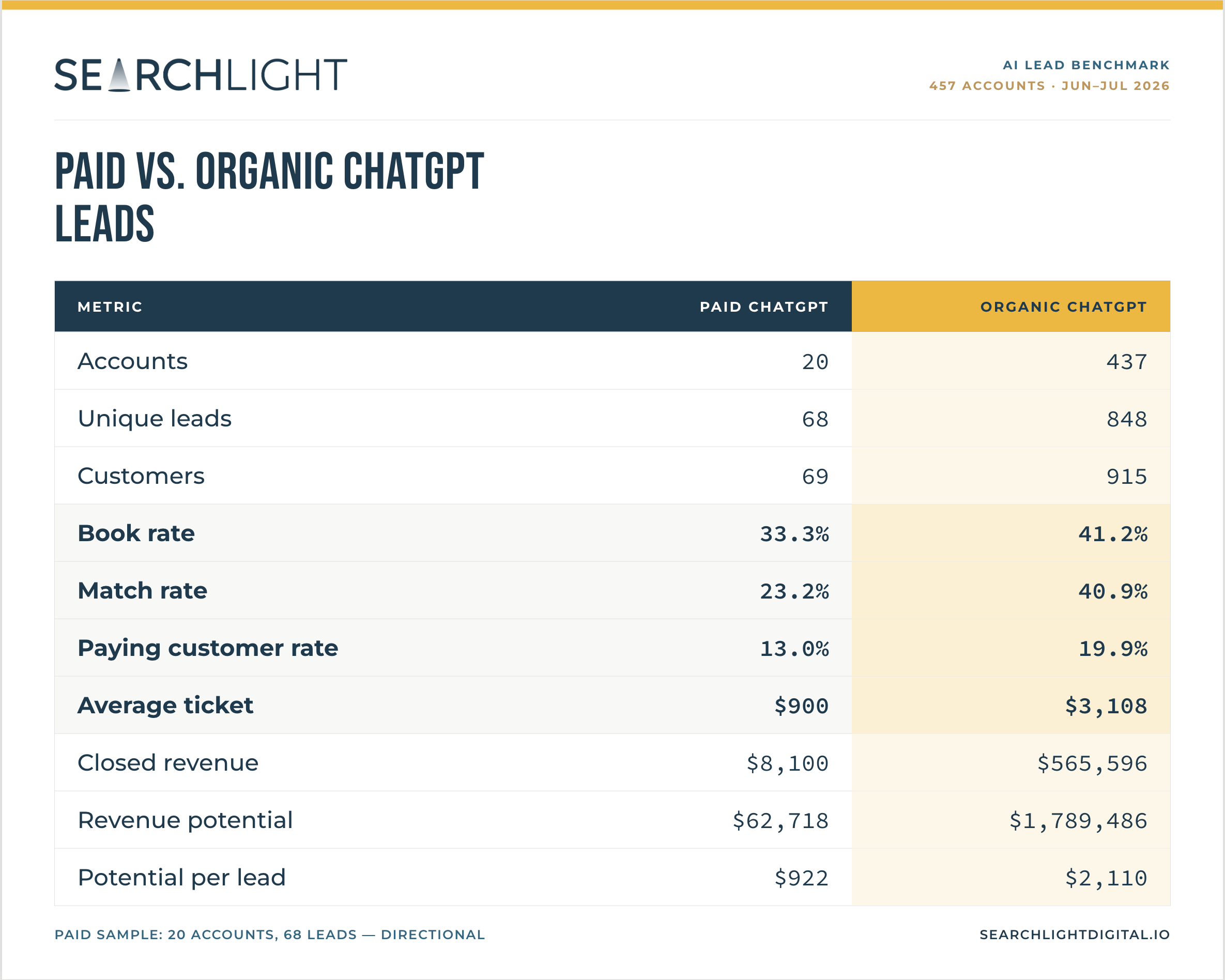
Accounts running paid ChatGPT: 20 of 442 with any ChatGPT presence (4.5%).
Among those 20 advertisers, paid was 70.1% of their ChatGPT lead flow.
It’s still very early for ChatGPT ads with minimal adoption - the platform can (and probably will) get better, but it’s still useful to look a the early patterns and trends, especially for efficiency metrics (book rate, match rate, paying customer rate)
Take 100 customers from each source, and there’s a notable gap in how they convert across different stages of the funnel:
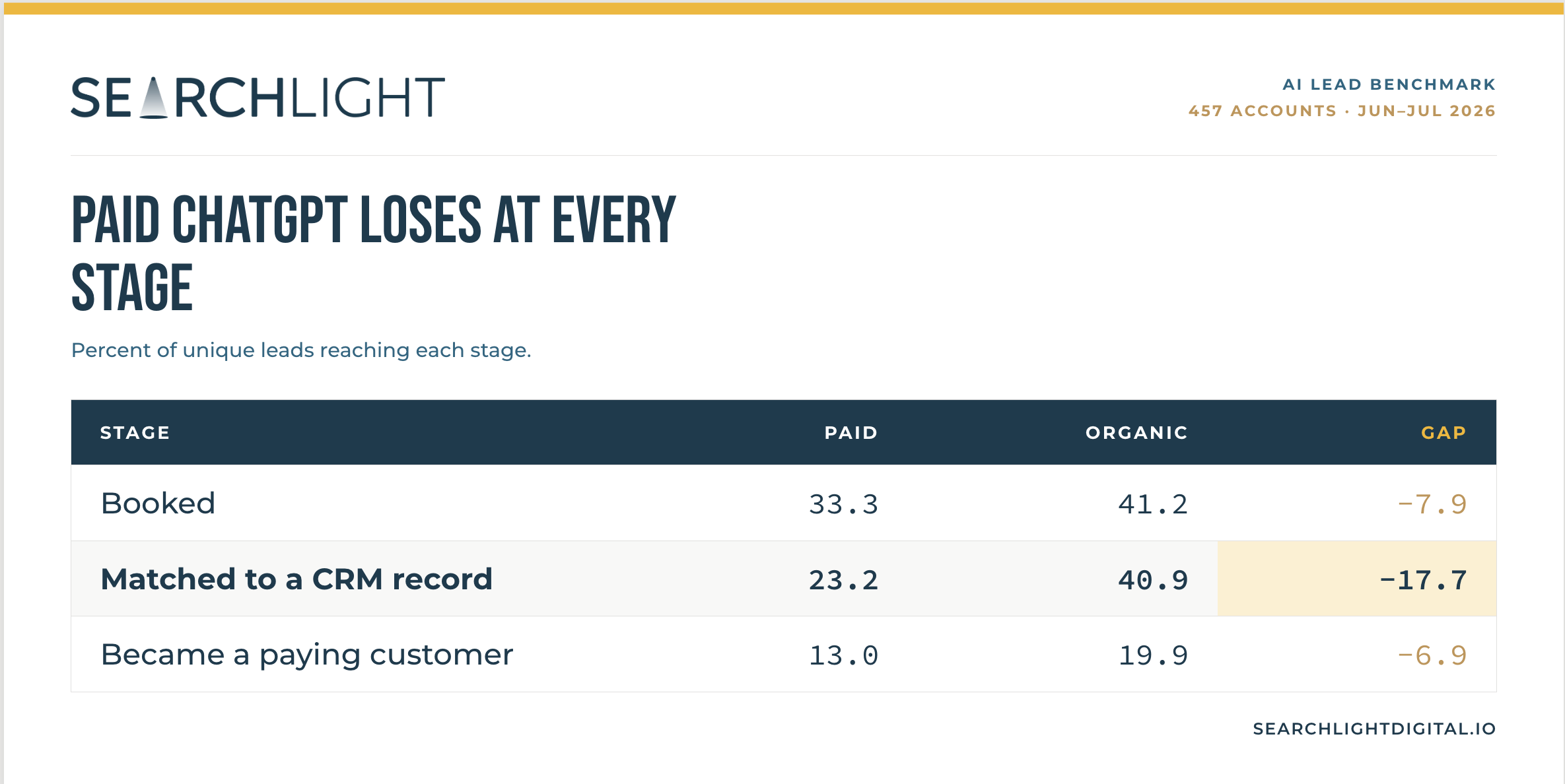
The match rate gap is the one that jumps out to me the most. Only 23.2% of paid ChatGPT customers matched cleanly back to a net-new CRM record, versus 40.9% for organic. Part of that is tagging chaos on brand new campaigns, which I will come back to.
However, I don’t want to speculate too much this early in the game - I’ve written about Google Organic / GBP vs. Google Ads previously, and we also tend to see better efficiency metrics from organic channels, although those tend to run a higher percentage of existing customers.
This analysis is still meant to serve as an early exploratory view of a brand new ad channel to give you some grounded perspective around whether or not it's considering pursuing an investment in the channel.
Book rates differ by 8 points. Average ticket differs by a factor of three and a half.
Paid ChatGPT average ticket: $900. Organic ChatGPT: $3,108.
I was even a little surprised by such a large gap between paid and organic, but again keep in mind the sample size is small, and ChatGPT is likely doing its own experimentation, tweaking, etc., as they try to improve ad performance.
Two things are probably driving the ticket differences between ChatGPT paid and ChatGPT organic:
First, service mix, which I will show you in a second: paid volume skewed hard toward repair-type cooling work in peak season, while organic AI referrals include a meaningful share of high-ticket replacement and install jobs.
For example, one organic ChatGPT lead in this dataset closed at $25,295.
Second, maturity. These are July leads measured in early August. Install and replacement work closes on a 30- to 90-day cycle, and big tickets take the longest. The paid cohort has had weeks, so I expect to see more of those pipeline opportunities convert.
However, looking at the revenue pipeline, which is what SearchLight measures to track the full customer journey and account for longer sales cycles, shows an even bigger gap between paid and organic ChatGPT:
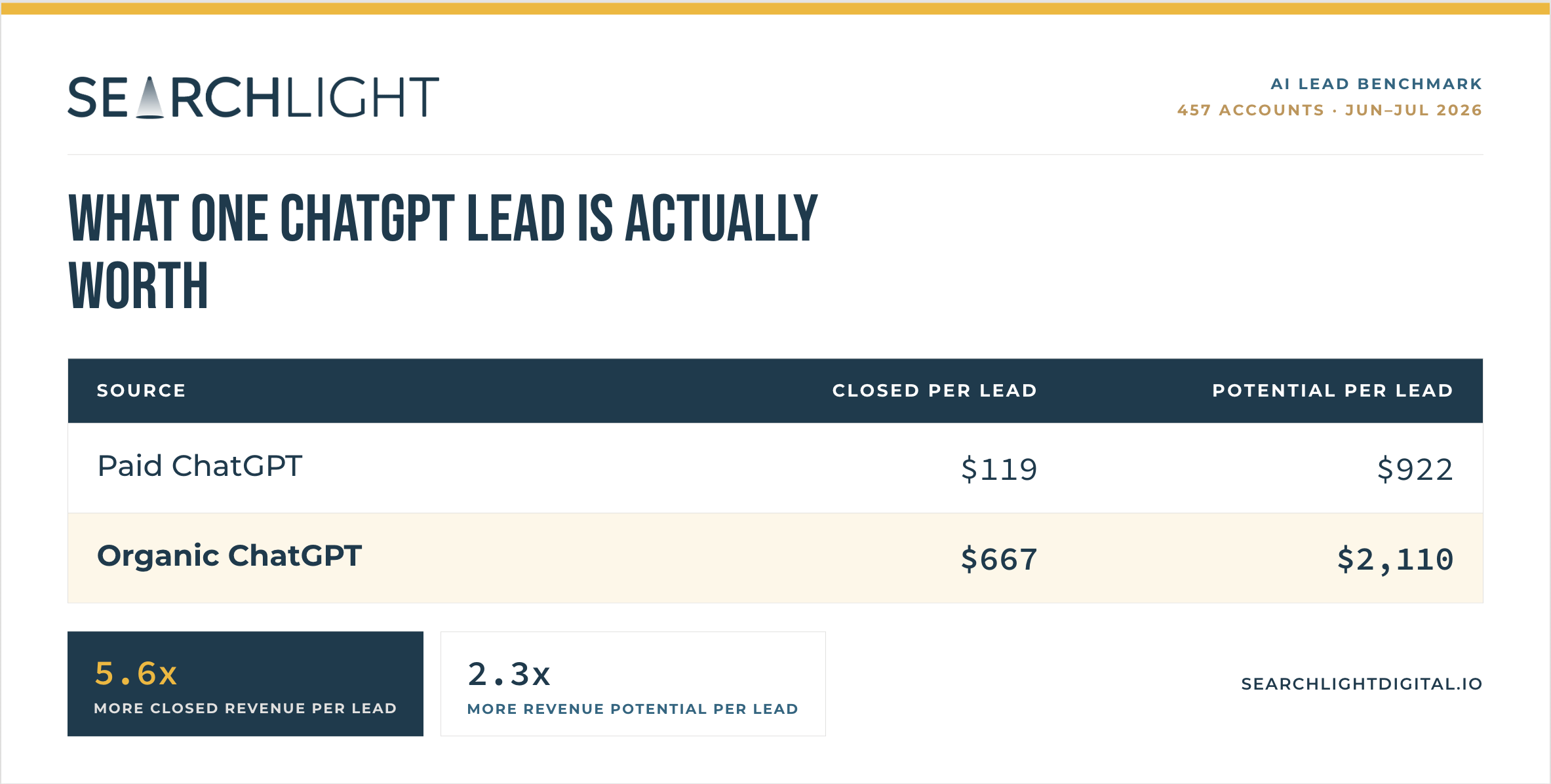
The ratio narrows from roughly 5.6x to roughly 2.3x once you count open pipeline. So a good chunk of the gap is timing for newer opportunities to make it through the sales cycle.
But not all of it.
Even on potential, organic ChatGPT is worth more than double per lead.
Across the whole portfolio in this sample, paid placements were only 7.4% of ChatGPT leads (68 of 916).
That number is close to useless, though, because 422 of the 442 accounts with ChatGPT leads are not advertising at all.
So adoption plays a meaningful role in this early data we’re seeing.
Here is the comparison that actually holds. Among the 20 accounts that did run paid ChatGPT in July:
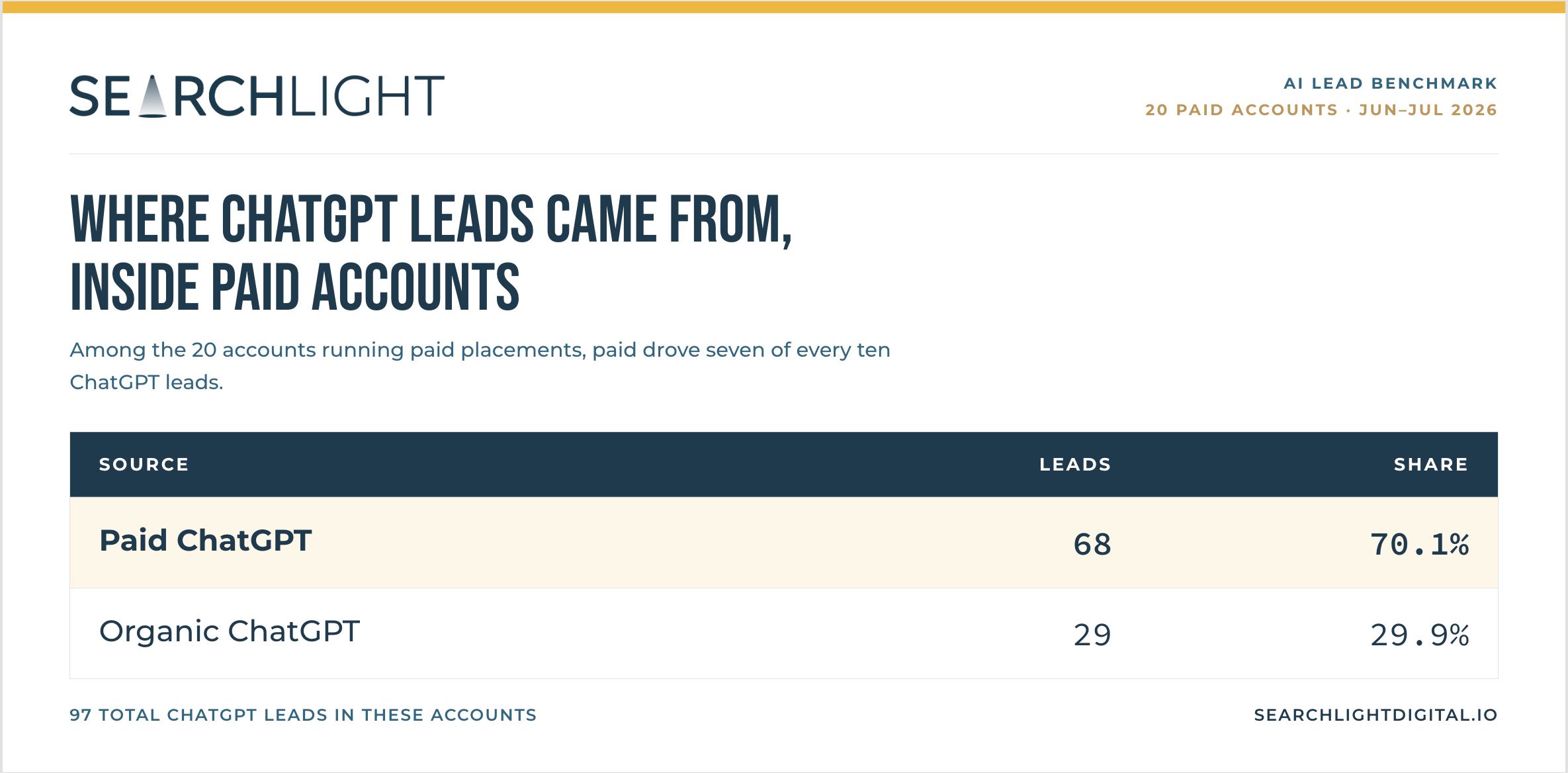
Seven of the 20 advertisers got 100% of their ChatGPT leads from paid. The median advertiser got 66.7%.
So for a contractor who switches this on, ChatGPT Ads become roughly two-thirds of their ChatGPT lead flow inside the first month.
That is fast.
For context, only 4.5% of accounts with any ChatGPT presence are running ads at all, so this is a channel where a small number of operators are currently capturing a large share of the paid inventory in their markets.
But the question is, did those ads add volume, or just replace it? If a contractor was getting 10 organic ChatGPT referrals a month and now gets 7 paid plus 3 organic, that is cannibalization, not growth. Given the ticket gap above, this is the question that matters most. Paying for leads you were already getting free, at a third of the ticket value, would be a bad trade.
I pulled June to find out. The answer is that there is no sign of cannibalization, and possibly the reverse.
Here is what happened to organic ChatGPT leads from June to July, split by what each account did with paid:
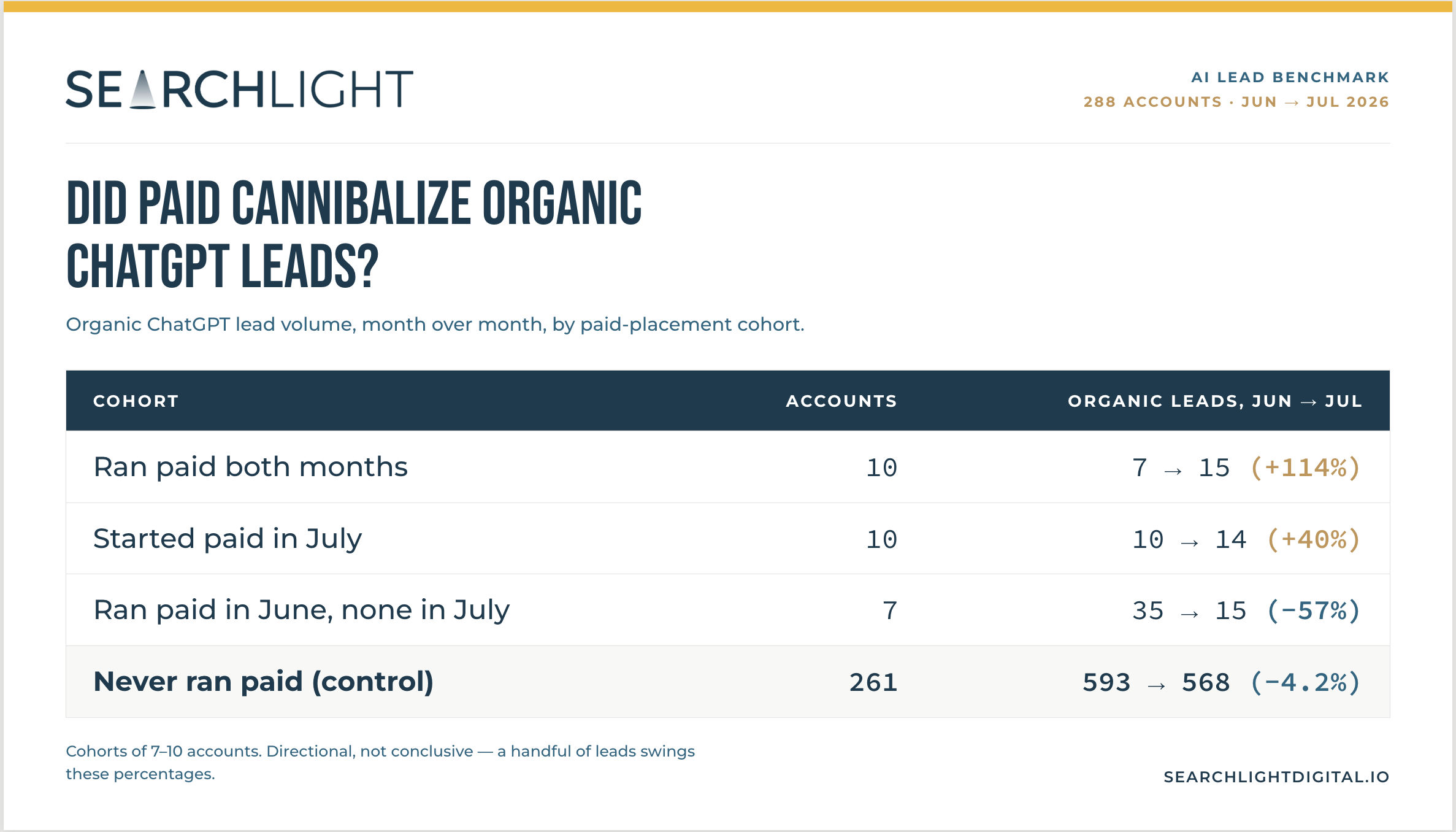
The control group is the anchor. Across 261 accounts that never touched ChatGPT Ads, organic ChatGPT leads were basically flat, drifting down 4.2%. That is the baseline for what ChatGPT referral volume did on its own in July.
Advertisers did not follow that baseline. The accounts running ads in both months more than doubled their organic ChatGPT leads while also adding 47 paid ones. Their paid volume was additive on top of organic that was itself growing.
How much of this should you believe? Less than the percentages suggest. That +114% is 7 leads becoming 15. Eight additional leads.
At that scale, a single busy contractor moves the whole number, and I would not bet a budget on it.
What I am comfortable saying: there is no evidence in this data that ChatGPT Ads eat your organic ChatGPT referrals, at least as shown in this small sample and early data.
The cannibalization worry, which was my own first instinct, is not showing up. Every advertiser cohort moved up against a flat control.
What I am not saying: that running ads causes organic lift.
Contractors who choose to test a brand new ad channel in July are probably also the ones expanding their marketing generally, and that selection effect alone could produce this pattern.
I need more months and more advertisers before I would put my name on a causal claim.
One more thing the June data surfaced, and I do not entirely know what to make of it.
Seven of June’s 17 ChatGPT advertisers produced no paid leads at all in July.
Roughly 40% churn in a single month. Without spend data, I cannot tell whether they switched campaigns off, kept spending and got nothing, or simply broke their tagging so the leads stopped being identifiable.
Those are three very different stories, and I won’t guess between them (remember, this is exploratory analysis!).
But a 40% one-month drop-off rate is worth watching, and it is the kind of thing that usually means the early experience is rougher than the topline numbers suggest.
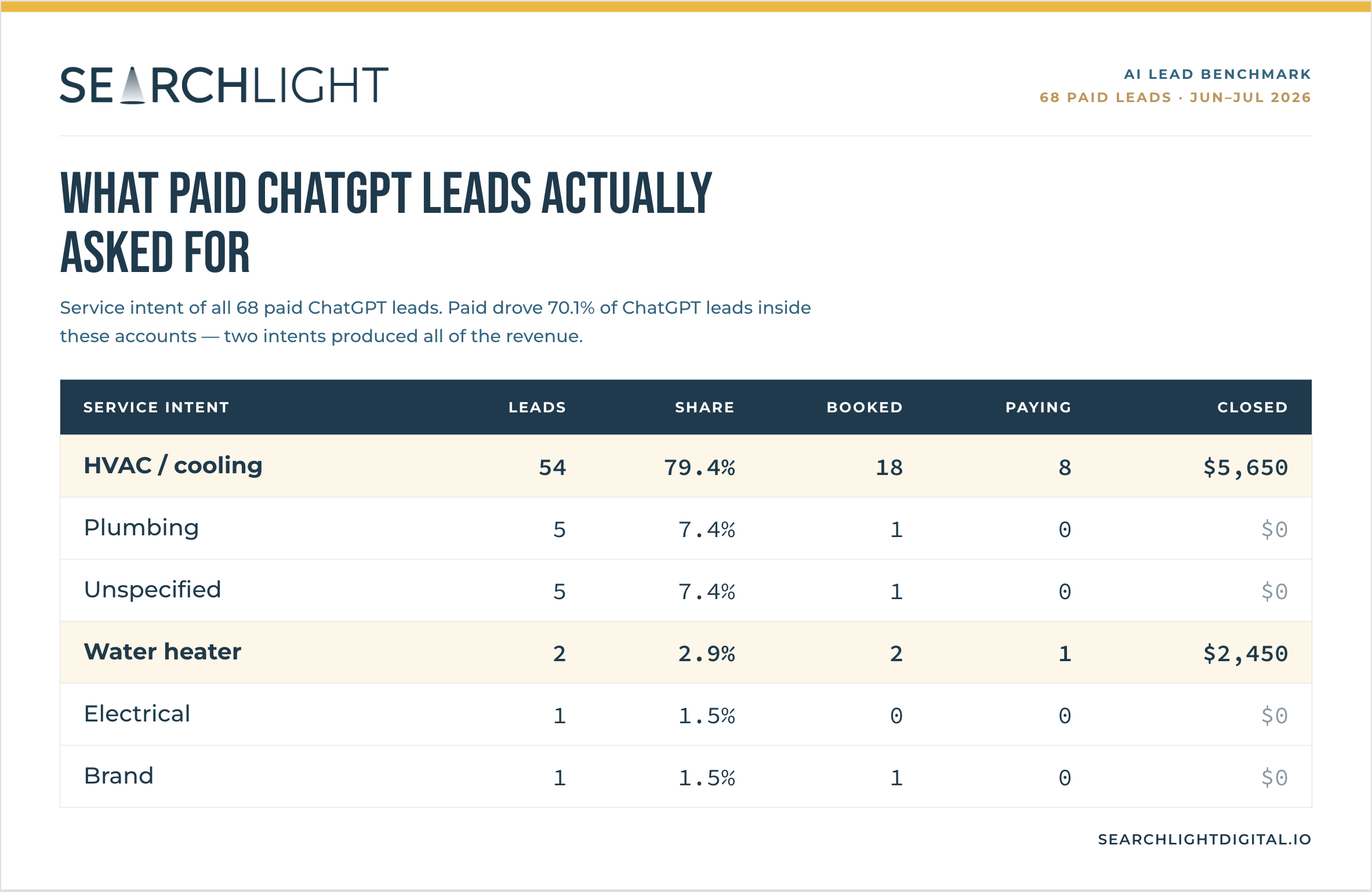
Nearly four in five paid ChatGPT leads were cooling-related in July, during peak season, which makes sense.
Pointing ad spend on a brand new channel to the highest-urgency, highest-volume, shortest-decision-cycle work they have is a good safe bet (and may influence the type of work and tickets that came back).
This dataset is a peak-season emergency-repair cohort, and the $900 average ticket should be read in that light. It is not evidence that ChatGPT Ads cannot carry a big job. It is evidence that almost nobody has tried.
The two water heater leads are the exception worth watching. Two leads, two booked, one paying, $2,450 closed.
I was excited to get this analysis out to you - new ad channels can unlock market efficiencies that can prove to be a competitive advantage, but it comes with risks.
I remember when Facebook started getting legs as an advertising channel and was very inexpensive, but at times could be really inefficient without proper measurement.
ChatGPT Ads is brand new, and we can likely all expect to see a lot of evolution come from the platform, so for now, the goal is to deliver some baseline data for you to wrap your head around the opportunities it is driving.
Until next time . . .
Jon
No posts
Comments
Nothing yet. Say the first thing.
Sign in to join the conversation.