

Greetings friends!
It’s wonderful to be back in NYC to share more wonderful things with you.
Seeing lots in the news and around the world this week to be hopeful for. Some bad stuff too, but I’m feeling the good vibes and leaning into it.
I have much going on with work which has kept me from writing, so I’ve added bonus material once again to the Mokkiri-zake. Also, I’ll be on a couple of podcasts coming up, and will be delighted to share them with you once they are locked in.
Loving your work. Thanks for being here.
Cheers,
Benj
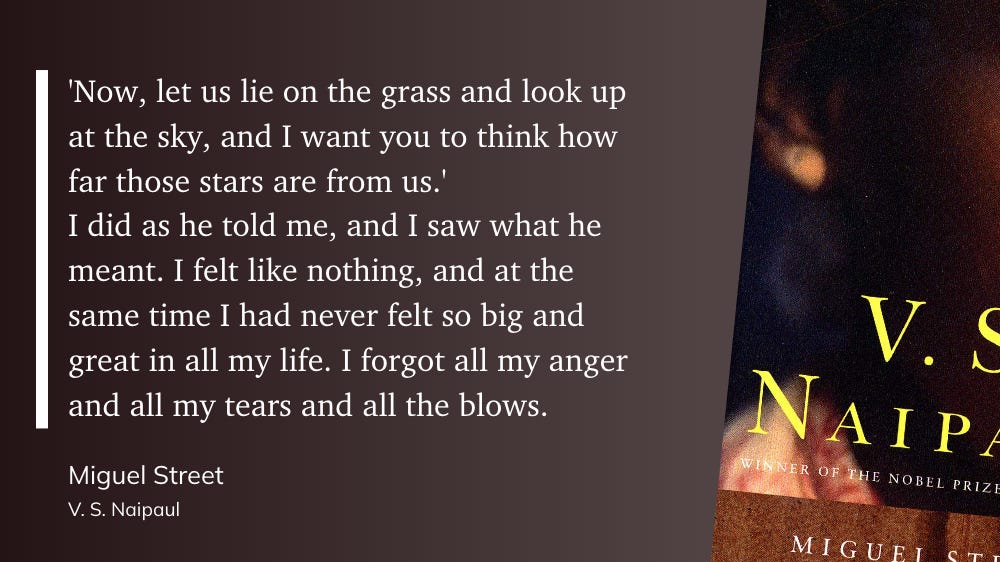
James Marriott recommended Miguel Street, my first book by V.S. Naipaul, so I picked up a lovely 1980s paperback volume from eBay and practically inhaled it in a couple of sittings. It’s a marvelous book—a portrait of the street on which he came of age. The real Miguel Street was called Luis Street, where Naipaul resided at #17; and what a place it must have been to live. I was struck by how simple the language is that he uses in this collection of vignettes, which tell the story of his upbringing by recalling to life the people he was surrounded by on a daily basis. He is tender and brutal with them, as they are variously tender and brutal with one another. At times, the portraits are deeply moving, and I was struck again and again by how different that wartime world must have been from the one we now find ourselves in. A world with so much daily violence between loved ones, and yet, a sense of community and comradeship, during a time of global-scale macro violence. I loved this heartbreaking book so much, and each character is still vivid as I write this.
And for the first time I heard Laura crying. It wasn’t ordinary crying. She seemed to be crying all the cry she had saved up since she was born; all the cry she had tried to cover up with her laughter. I have heard people cry at funerals, but there is a lot of showing-off in their crying. Laura’s crying that night was the most terrible thing I had heard. It made me feel that the world was a stupid, sad place, and I almost began crying with Laura.
All the street heard Laura crying.

I was a dynamite bartender (just ask this newsletter's editor) thanks to the many hours spent behind the stick at Micky’s Blue Room where I learned the craft. There was so much terrible music in the jukebox behind that fabled blue awning, but a lot of great stuff too. It was there, if memory serves, that Sean, our fearless leader, lovingly curated the late Joe Strummer epic, “Get Down Moses.” This one traveled across discs and playlists, and harks back to that classic Clash-era drive, but with some incredible Hammond organ and even some electronica blended in with the band. There is such powerful urgency to the vocals when Strummer pushes it, yet he also knows when to pull back, as though backing off the mic to let the reverb carry the words for him. I know it’s not like that, but it feels like that when you listen to it. In case it has been a while, turn this one up loud! It’s a brilliant song and an amazing recording.

The quest for the perfect EDC (Every Day Carry) is likely and perhaps thankfully going to be endless. As such, my ADHD, or as my kid calls it, my neuro-spicy brain is always on the hunt for the right tool to be at hand at the right time. So, if I’m walking around with no bag, I still need to have something to write with. For the majority of humanity, this is likely not something that much thought goes into. For me, it's an eternal quest. This is where my two Kawecos come in. The first is my reassuringly chonky retractable 0.7mm LED pencil, in brass. It has a wonderful weight to it and is wearing in nicely as it ages. This fits in the jeans pocket with a retractable (via rotation of the end) point so it won’t make any holes where they aren’t wanted. Love this thing, and it’s built to last. The second, its faithful companion, is also in the Sport lineup and is a black aluminum fountain pen, so it’s incredibly light and pleasant to write with. This thing has been shaken, bumped, and dropped, and has yet to stop writing perfectly since the day I bought it. I wish they had dedicated attached clips, as the accessory options they make aren’t offered in the same materials [frowns and panics as OCD becomes ascendent, clouding out all else, then recovers] and because they don’t stay put, weakening as you use them, I have already lost a few. In any case, not a deal breaker, and I am using these two more and more as I comb through the world of books that I am blessed to continuously inhabit, and that I get to share with you all here.
What happens when the limits are off? Bad things, I’m sorry to say. Frightful things. The reflected self is rarely reassuring for long. - All This Staring at Our Faces Is Messing With Our Heads - New York Times - Catherine Shannon
Writing is hard because the writer is learning. If AI eliminates the challenge, it also eliminates the learning. - The End of Reading Is Here - The Atlantic - Rose Horowitch
Forgive yourself, forgive others. - No Mercy / No Malice Turns 10 - profgmedia.com - Scott Galloway
In another video, Chang explains how he has made tens of thousands of dollars using AI influencers. “I’ve even had my clients buy me Rolexes for selling so much of their products,” he says. The video’s title is “How I print $51,000/month profit with AI influencers (feels illegal).” - Inside an AI TikTok Shop Slop Factory That Shills Supplements Recalled By the FDA - 404 Media - Jason Koebler
Executives are under pressure to show they can deliver – half of all CEOs BCG surveyed worldwide say their jobs depend on getting their AI strategy right. Public disclosures of net AI returns are patchy. JPMorgan’s estimate of $1-1.5 billion in value from its AI use is a rare case of a company naming a number.
Adopters are spending a lot, so where are the returns? That is the question most are asking right now. And yet, in a successful technology rollout, the first visible economic signal may not be the returns. Winners and losers might look the same. - 🔮 For AI adopters, success and failure look identical — at first - exponentialview.co - Nathan Warren
Researchers believe ambition is shaped by both personality and circumstances. A landmark 2012 study led by Timothy Judge, a psychologist who studies attitudes toward jobs and success, analyzed the trajectories of more than 700 people over 70 years and found that the most driven people grew up middle-class: not too rich to be complacent, not too poor to dream big. As the middle class shrinks, it seems as if ambition may be shrinking, too. Mary Volmer, a chaplain and lecturer at St. Mary’s, told me that students no longer ask themselves, “What can I achieve?” but “What do I need to survive?” - Gen Z Fell Out of Love With Work. I Don’t Blame Them. - New York Times - Emi Nietfeld
For a long time, it was possible to be both a highbrow and a lowbrow when appreciating literature. It was normal for the groundlings to stop cracking their nuts so they could hear Falstaff’s lewd jokes. The middlebrow pleasure Lewes got from Austen’s characters didn’t prevent him writing the sort of criticism Johnson would have approved of, in which “opinion is improved into knowledge.” - Does it matter if you don’t like the characters? - commonreader.co.uk - Henry Oliver
There is nothing more human than good taste, since there’s no way to define it. It’s mysterious. But you know it when you see it.You probably won’t find it at the clothing company Edikted, a hit among teenagers. Edikted relies on algorithms to design its products: It monitors customers’ social media activity and internet searches, factors in Hailey Bieber’s latest outfits and spits out 300 styles a month made cheaply in China. After it reached $460 million in sales in 2025, one of its founders boasted to The Wall Street Journal, “We’re more like a data company than a fashion company.”This model has proved so potent for the fast-fashion giant Shein, which aims to go public this fall at a valuation of over $40 billion, that it recently gobbled up the popular millennial brand Everlane. Fast fashion and mall brands used to look to the runways for inspiration. Now, much of their output has been slopified by back-end data and internet searches.The rise of the algorithm-designer and the fall of independent brands represent the latest stage of the financialization of fashion, the triumph of money over art and craft. We may wear skinny jeans one decade and wide ones the next, but the elevation of corporations over designers has been the industry’s overarching trend over the past 40 years, and it has gradually killed creative design at all price points. Fashion slop is the logical next step in the evolution of ready-to-wear clothing. - The Rise of Fashion Slop - New York Times - Amy Odell
Ulysses S. Grant, in 1875:
Where the citizen is sovereign and the official the servant, where no power is exercised except by the will of the people, it is important that the sovereign—the people—should possess intelligence. The free school is the promoter of that intelligence which is to preserve us as a free nation. If we are to have another contest in the near future of our national existence, I predict that the dividing line will not be Mason and Dixon’s, but between patriotism and intelligence on the one side, and superstition, ambition, and ignorance on the other. - Ulysses S. Grant on the Future Dividing Line - Daring Fireball - John Gruber
SpaceX perhaps marks a culmination of the kingly ideal, a moment in which, as Tim puts it, someone like Musk can “raise enormous amounts of capital while freeing himself from any restraints from those who provide it, so that he can spend the proceeds on Mars, humanoid robots, artificial intelligence or whatever next satisfies his ambition.” But it is also the moment in which someone who is visibly profoundly disturbed has briefly become the world’s first trillionaire. And it is one in which others want to copy him. - The political economy of billionaire derangement - programmablemutter.com - Henry Farrell
I am suffering a profound spiritual crisis due to these developments. I have been screaming internally for days. It feels as though I am living inside of a nightmare…For me, the affective quality of learning mathematics is empathetically tethered to an act of discovery and creation…If The Library of Babel existed, would authors continue to write books?…Perhaps I shouldn’t tell you this, but my aim is to be open: These developments have triggered some deranged thoughts in me. I have wondered if it is the express goal of these companies to make me kill myself…The story of human discovery and the triumph of the human spirit will soon be excised from this discipline…[T]he process of prompting novel proofs will be as auraless as ordering doordash. Watch as magic and mystery evaporate. Watch as the sun sets on our heroic age…There is nothing I can do. There may be nothing you can do. I have no prescriptions, policy recommendations, or coherent call to action. I just want to be honest and open about my emotional and spiritual response. I want to feel seen….I need the architects of our new mathematical paradigm to look me in the eye and acknowledge our shared humanity and soul before they deliver the coup de grâce. - The end of the age of heroes - noahpinion.blog - Noah Smith
As the SAT becomes more similar to the tutoring environment, the transfer distance between the two shrinks - and if near transfer is driving much of the reported success of digital tutors, we would expect students trained on those systems to perform relatively better on the digital SAT than they would have on its paper predecessor. Importantly, such improvements need not reflect deeper or more durable learning: they may simply reflect the fact that the assessment itself has become more similar to the environment in which students practiced.
Think about that for a moment:
If students who use digital tutors begin achieving higher scores on future standardized tests, those gains may not reflect deeper learning or more effective tutoring. They may simply reflect the fact that the assessments themselves have become increasingly similar to the tutoring environment.
Sometimes the easiest way to improve measured learning isn’t to change the teaching - it’s to change the test. - Are AI Tutors Really Teaching Students - or Just Teaching the Test? - The Digital Delusion - Jared Cooney Horvath
No posts
Comments
Nothing yet. Say the first thing.
Sign in to join the conversation.