
Watch the video version of this post on YouTube.
Listen to the podcast version of this post on Spotify or on Apple Podcasts.
This might be one of the most addictive kids’ games in history. It has no characters, no levels, no ending, and no clear objective, yet both adults and children are struggling to stop playing it. Hours disappear into a game that, on the surface, looks harmless, repetitive, or even boring.
But when you look a little closer, this game becomes a perfect example of how something simple can quietly hijack the brain’s reward system, especially in children.
The game is Cookie Clicker, along with its many modern equivalents like Money Clicker and other “idle” or “incremental” games now found everywhere, including Roblox.
When I was growing up, gaming was intentional. My first experience was on the Commodore 64, then the Sega Master System with Alex Kid, followed by Sonic the Hedgehog on the Mega Drive and eventually the PlayStation. Gaming felt special. You carved out a window of time, played, finished, and moved on to something else.
Today, games are radically different, not just in design, but in accessibility. Children now have constant access to tablets, iPads, Chromebooks, and phones. If a child has unsupervised access to a device, they will find these games, or their friends will introduce them. That’s why this conversation still matters, even though Cookie Clicker was created over a decade ago.
Cookie Clicker was created in 2013 by developer Julien Thiennot. It was originally intended as a joke, a parody of productivity culture, capitalism, and endless growth. The game was designed to be pointless on purpose, but ironically, that design is exactly what made it so addictive.
There’s only one action: click a cookie.
Every click increases a number.
There is no ceiling. No finish line. No “winning”
As the game progresses, you can buy upgrades that click for you, even while you’re away. That means a child can be at school, in bed, or doing something else, while the game continues working in the background. Therefore, they’re thinking about how many cookies they’ll have when they return. The only instruction the game gives is simple: keep going.
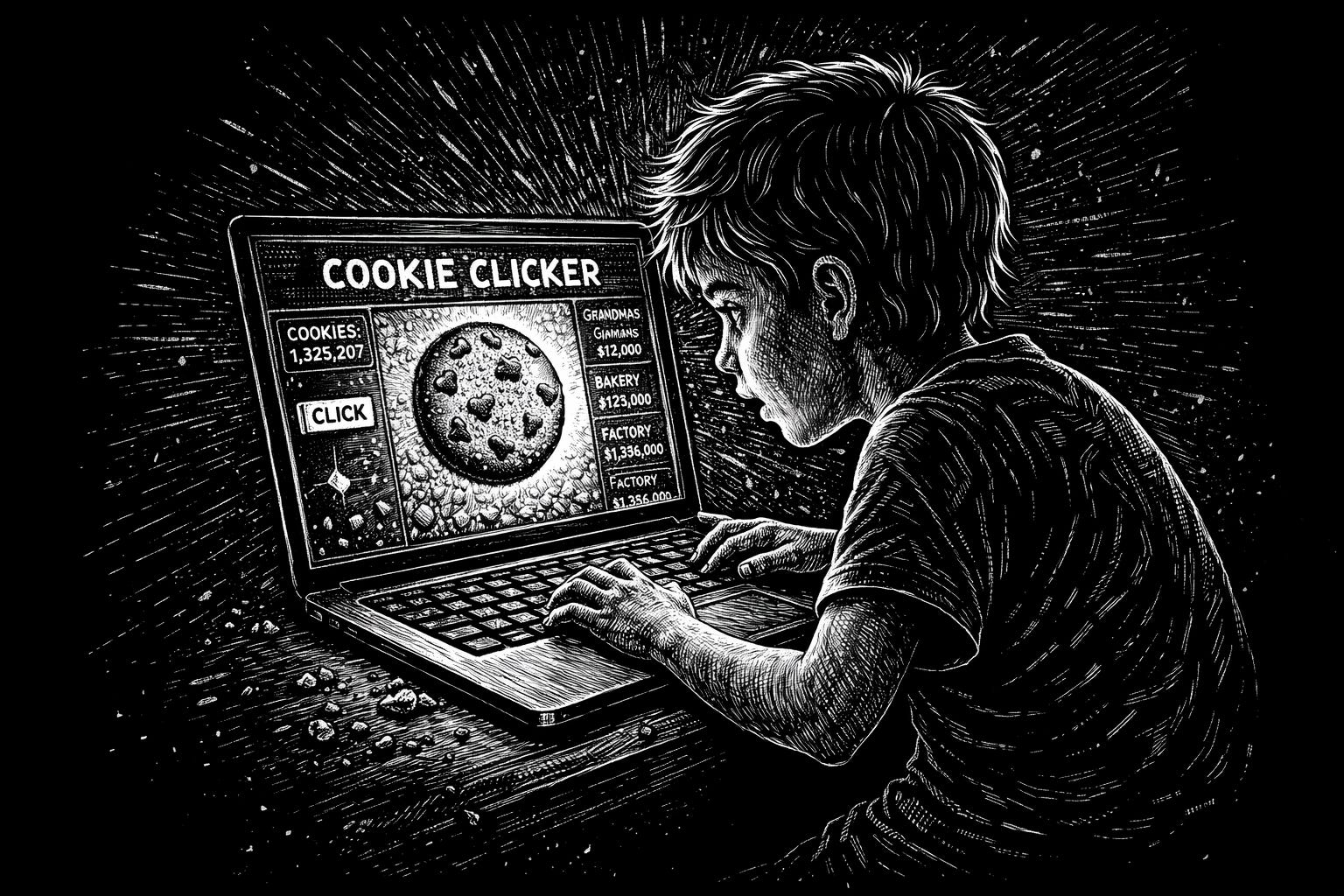
Idle games like Cookie Clicker have exploded in popularity because they’re no longer confined to niche websites. They’re everywhere, especially on platforms like Roblox.
Games such as Money Clicker openly advertise that they are endless. The goal isn’t challenge or creativity, it’s accumulation. Some of these games have tens of millions of visits, and children as young as two are now regularly using screens.
According to Common Sense Media’s 2025 report:
40% of two-year-olds own a tablet
58% of four-year-olds have their own tablet
Nearly one in four children have a mobile phone by age eight
Children aged five to eight now average over three and a half hours of screen time per day
To understand why games like Cookie Clicker are so compelling, we need to talk about dopamine. Dopamine isn’t the “pleasure chemical” we often think it is. It’s about motivation, anticipation, and wanting more. You don’t get the biggest dopamine hit when you win , you get it when you expect something to happen.
Cookie Clicker is built entirely around this loop.
Click → number goes up → dopamine spike
Click again → maybe a bigger boost → dopamine spike
Upgrade → exponential growth → dopamine spike
The game uses variable rewards, unpredictable growth, and constant anticipation. Combined with offline progress, it mirrors the same neurological mechanisms used in gambling and slot machines. For a developing brain, this constant stimulation of the reward system can be incredibly difficult to step away from.
While playing Cookie Clicker during my research, I told myself I’d stop at 400 cookies. Then 500. Then I noticed I was still clicking, even though nothing meaningful was happening. That’s the point. There’s no story. No skill. No creativity. Just repetition and reward.
And when a seven-year-old encounters this at school or through friends, it’s not surprising they’re drawn to it. This isn’t an attack on gaming, our own child enjoys games, however we try to focus on games with clear endings, skill-based progression, and meaningful goals. But games like Cookie Clicker are built purely for compulsion.
This conversation isn’t about banning Cookie Clicker or shaming parents, it’s about understanding what’s happening under the hood.
When parents understand how a game works, how it impacts the brain, how it holds attention, then boundaries become easier to explain. Children feel less blamed and more supported, and conversations become calmer and more educational.
That’s exactly how we navigate this in our own home. Our child knows about Cookie Clicker, Roblox, and Italian Brain Rot, not because we allow unrestricted access, but because we talk about them openly, and we take him on the journey with us. Which makes setting boundaries much easier, so it’s less about “you’re missing out” and more about “this content isn’t right for you, and here’s why”.
If screen time feels like a constant battle in your home, you’re not failing. You’re navigating tools that were never designed with children’s wellbeing in mind, only their attention.
If your child is playing games like Cookie Clicker, it’s worth asking why. Not from a place of fear, but from a place of curiosity. Because when we understand what our children are consuming, we’re far better placed to guide them, calmly, confidently, and without shame.
If you want to learn more, and see Cookie Clicker in action, then definitely check out my YouTube video below.
If you’re finding navigating screens, overstimulating content and the world of AI challenging with your little one, I’m currently building something powerful behind the scenes. Screen-Time Without Tantrums is a Hub that will help you understand why meltdowns happen, what YouTube and algorithms are doing to your child’s brain, and exactly how to create happier & healthier screen time.
Join the waitlist and be first to access it (plus you’ll gain access to early-bird pricing).
Watch the video version of this post on YouTube.
Listen to the podcast version of this post on Spotify or on Apple Podcasts.
Thank you for being part of my community. Too Much, Too Soon is a reader-supported publication. If you can and value my work, or if you take value in my daily content over on Instagram, please consider becoming a paid subscriber ($5/month), so I can continue to show up and make a positive impact.
Tom Piccirilli, Founder of The Dad Vibes
No posts
Comments
Nothing yet. Say the first thing.
Sign in to join the conversation.