
Introduction.
This will be the final newsletter published on Substack. I am streamlining my efforts to better translate science for a broad audience, and LinkedIn has been the best home for that work. If you want to keep reading, please join me there: LinkedIn.
Thank you to everyone who took the time to provide feedback. Special thanks to the agriculture teachers and FFA advisors who read this article—especially the teacher who offered thoughtful feedback and kind words. In my view, teachers are among the best of us: they help us learn, grow, and mature, all while being underpaid, underappreciated, and too often ridiculed for trivia reasons. To all the teachers out there—thank you
As a result of your feedback, you’ll notice two new sections: Consultants’ Corner and Building People. These sections offer practical tips for managing dairy cows and brief thoughts on personal and professional growth.
Enjoy the new format and content!
Dairy Science Update.
Methane mitigation research continues to advance. As more rigorous data accumulates, scientists can perform meta-analyses—an aggregated analysis of multiple studies. This week, Dr. Kebreab’s team from UC-Davis published a new meta-analysis on feeding tannin additives to cattle to reduce methane emissions.
Tannins are plant-derived phenolic compounds, encompassing a wide variety of substances. In the rumen, tannins alter microbial populations, inhibit methanogens, and reduce fiber digestibility. The average tannin dose provided to dairy cattle in this dataset was 7 g/kg of dry matter. Overall, tannin supplementation tended to reduce methane production by 10%. However, the forest plot shows that tannins were not effective in all cases. The authors suggest that doses of 8–10 g/kg of dry matter are most effective. Feed intake and milk yield were generally unaffected, but the limited data set for dairy cows highlights the need for further research.
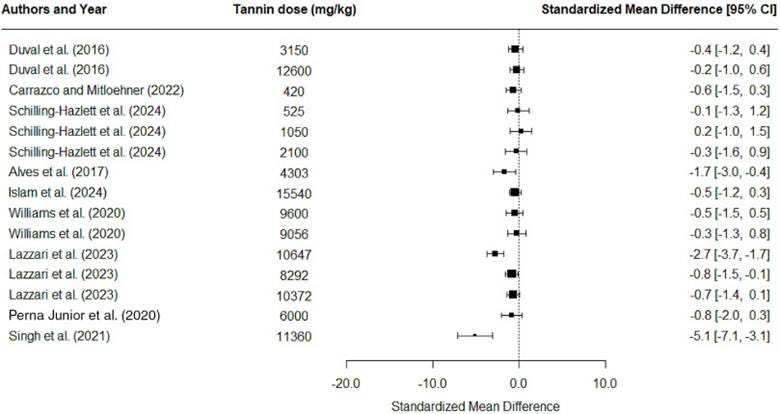
Read the entire article here: https://doi.org/10.3168/jds.2025-27254
Consultants’ Corner.
Make the most of your feeding software! Use it to monitor feeding times: Is feed delivered when you want, and is it consistent each day? Look for patterns—perhaps feed is late on weekends or varies by day. If inconsistencies arise, revisit your feeding protocols to identify and address gaps. Retraining and regular check-ins with staff could be useful.
Building People.
In academia, it’s annual report season! While annual reports are mundane, they offer a valuable opportunity to review your year’s progress. I enjoy this because it reveals whether I was able to stay focused on my big goals.
Set aside an hour or two to review your year’s activities. Use this time to recognize your successes and identify opportunities for continued improvement. Did you stick to your mission, or did you drift? If you drifted, when and why did it happen?
Signing Off.
Continuing the theme of reflection—what teacher or mentor made an impact on you? Please share in the comments, and consider tagging that teacher!
My shoutout goes to Mr. Baures, my high school English teacher. At the time, I couldn’t stand his class, but now I realize he taught me to be competent and resilient in the face of challenges. He pushed students to actually learn and didn’t tolerate excuses. While some, including myself, resented him for that, I now appreciate his approach. Thanks, Mr. Baures
No posts
Comments
Nothing yet. Say the first thing.
Sign in to join the conversation.