
Introduction.
Welcome to our Thanksgiving week edition of Some Udder Thoughts! I am certainly thankful for each of you who read this newsletter. I really enjoy planning it, writing it, and hearing from each of you about it.
Thank you to the folks who have provided feedback to me for the article. For those who haven’t yet, please send me your thoughts using this survey! https://forms.office.com/r/9yPysTwskr
What’s new in dairy science?
This week’s research is not very timely because it is not harvest season but it is vitally important to review! At what height do we chop our corn silage? What does changing chop length do to corn silage? Well, thankfully, a dedicated group at the University of Wisconsin Madison took an analytical approach to this question. Dr. Ferraretto’s team took a swing at a meta-analysis investigating the effects of chop length on corn silage.
They summarized 35 studies and 151 observations to investigate how cutting height affected corn silage. Based on their graphs, the cutting heights ranged from about 10 cm to over 100 cm. So what happens as we increase cutting height? Increasing the cutting height increased DM, CP, NDFD, and starch. They didn’t report it, but we can infer that fatty acids would also increase as most of the fatty acids are in the ear of the corn, not the stalk. Increasing cutting height also reduced NDF, ADF, lignin, uNDF, and ash concentration. The yield decreased as well – for each cm increase in cutting height, yield was reduced by 0.06 Mg/ha, or 0.026 US tons/acre. So obviously, there is an important trade off to consider and the decision is highly context dependent.
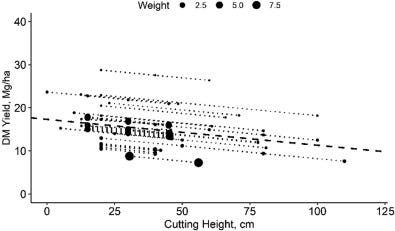
The changes observed are not necessarily surprising but putting numbers to them really helps when deciding what you need or want to harvest for silage. If you have excess silage, perhaps consider raising cut height to improve quality. If you need every bit of silage you can get your hands on, then go as low as the equipment can handle and as low as you’re willing to accept poorer quality fiber in the silage.
Read the entire article here: https://doi.org/10.3168/jds.2025-27233
Leadership, growth, and development.
This one is a reminder for my fellow professors—take this advice if you wish.
When you’re leading your team, mentoring students, and perhaps even coaching other colleagues, remember what you’re asking of them. Remember how hard it can be. Remember how daunting it initially feels to fail or to be scared of failure. With students especially, remember what it felt like to be doing the work every day, to be constantly corrected and critiqued, and to be hoping for a bit of encouragement.
I am grateful for the mentorship that I had as a student, and I speak of it often. My mentors were supportive and encouraging, but they had high expectations, which can be stressful sometimes. When I started my team, I, in my own unique style, tried to emulate that. I set high expectations for excellence while trying to build a team that supports and encourages each other through the challenges.
In my haste and shortsightedness, I prioritized the former and forgot about the latter. What happens then? You end up with good-natured people constantly worrying and stressed that they’re falling short. After a handful of experiences over the past couple of months, I too remembered that feeling. We should set high expectations, but we should also walk beside people to achieve those expectation—walking along with them, not in front of them.
Our job as universities is to help develop people and ideas. Both do better and are of greater quality when challenged and supported in equal measure. So, my reminder to myself and my faculty colleagues is this: spend equal time and energy on admiring and recognizing great work and good values as you do in challenging and critiquing your mentees and colleagues. How much better academia would be if we could do that as a community.
Final Thoughts.
Have a happy and safe holiday week! Take some time to really consider what you’re thankful for in every facet of your life. For me, I am thankful for my wife and family always, for my health and optimistic outlook, and for my students who teach me more than they probably know.
I often get caught up in my ambitions and goals – those concerns melt away when I remember what I really care about.
Happy Thanksgiving!
No posts
Comments
Nothing yet. Say the first thing.
Sign in to join the conversation.