
Introduction
Welcome to our new subscribers! This community continues to grow and now stands at 2,500+ strong with readers from all over the world.
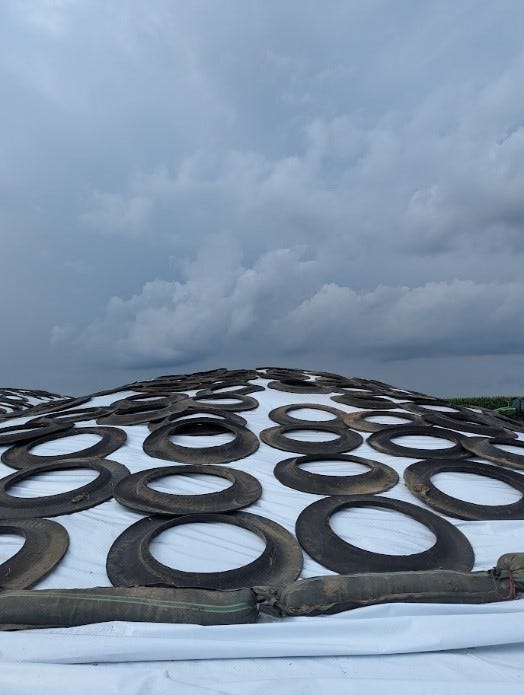
I also took a trip down memory lane this week at work. The OSU farm crew harvested our 3rd cutting of alfalfa silage and I figured I needed to get out from behind my desk, so my team and I helped cover the silage pile. Growing up, I never liked throwing tires and covering piles but now that I spend most of my time on a computer screen, it was a really pleasant change of pace. Covering the pile was probably good practice with corn silage right round the corner. Keep those silage piles sealed and covered tire-to-tire.
What’s new in dairy science?
We’ll stick with the forage trend of this newsletter to discuss some research with triticale silage from Gonzalo Ferreira at Virginia Tech.
Both farms I grew up on fed a traditional mix of corn silage and alfalfa silage so I never got much experience with other forages, especially small grain forages. As a result, I am trying to play catch up by reading research investigating different forages and a recent project investigated feeding triticale silage at different harvest maturities in low (19% fNDF) and high forage diets (26% fNDF).
Harvest stage, as with many other forages, affects the nutrient composition of triticale silage. Harvesting triticale at “boot” stage resulted in 1.3 units more CP, 2 units less NDF, and 17 units greater potentially degradable NDF than harvesting at the “soft dough” stage. Based on the nutrient composition and NDF digestibility, harvesting at the boot stage should result in greater DMI and milk yield.
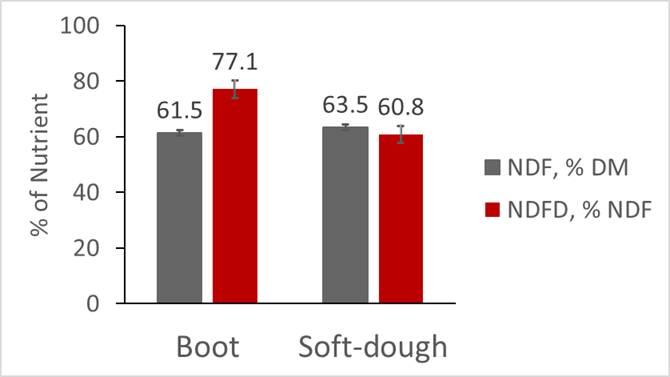
Figure 2. Harvesting triticale silage at boot stage reduced NDF and increased digestibility of NDF.
With any applied nutrition study, you should look closely at the type of cows they fed and the ration formulation. The cows were approximately 100 days in milk with 1/3 being primiparous and 2/3 being multiparous. The triticale silage was included in rations at 24 and 18% of diet DM in the high and low forage diets, respectively. Furthermore, soyhulls and corn gluten meal were added in in place of forage in the reduced forage rations.
As expected, cows consuming the boot stage triticale produced 1 kg/d more milk and 65 g/d more milk protein. The effects were consistent within both the low and high forage rations. Interestingly, the triticale silage did not affect DMI but increasing forage reduced both DMI and milk yield in these peak lactation cows. This research demonstrates the importance of fundamentals – get the harvest maturity right and it will pay off!
Read the entire article here: https://doi.org/10.3168/jds.2025-26629
Leadership, growth, and development.
Today’s thought is related to covering that silage pile last week. Covering a silage pile well is no small job and doing it in July means it is a sweaty and uncomfortable job. It would be easy to say how to cover the pile well from my desk and air-conditioned office but its another to do the job. In my opinion, one of the consistent failings of leaders is forgetting what its like to actually do the work you’re asking of the teams in your charge.
To help me remember how hard the work can be, I try to dedicate an hour or two each week to doing work alongside my team so that I remember what I am asking of them. This week, it was spending time helping to cover the silage pile and collecting milk samples with one of my students. Sometimes its helping with lab work or writing an abstract. I’ve had colleagues argue that I should spend my time in other pursuits like writing grants and papers, but I counter that sacrificing some time for the actual work like collecting samples, analyzing data, or covering silage piles keeps you plugged in with your team.
If you find yourself leading a team, I suggest you set aside time to work alongside them each week in their routine tasks. It will remind you of how difficult the work may be, keep you in touch with the challenges your team experiences, and engender a better environment among your team.
Final Thoughts.
Keep it simple this week – do the work, do it well, and enjoy the work simply for the sake of it. I hope July wraps up well and August starts with a bang!
No posts
Comments
Nothing yet. Say the first thing.
Sign in to join the conversation.