
There are a few items that I will always order when out to eat, which are mostly things that take more effort to cook at home. Lasagne is one, octopus another. When it comes to brunch, if there’s a Benedict on the menu, I’m ordering it. So I’m lightening it up a bit this month with an ode to one of my most favorite dishes: Eggs Benedict. When I was in Greece recently, we stayed at a resort with a large buffet for most meals. Like many buffets, there was an omelette station, but also a secondary action station as well. To my delight, this second area served a different variation of Eggs Benedict each morning: the classic, a Florentine, a Royale, a mushroom, all drizzled with a healthy glug of Greek olive oil. All that to say, it inspired me to look a bit deeper into the origins of this beloved American dish. I’m calling this post Culinary Curiosity #1, since I’ll be diving into more dishes and their histories, and this is the first!
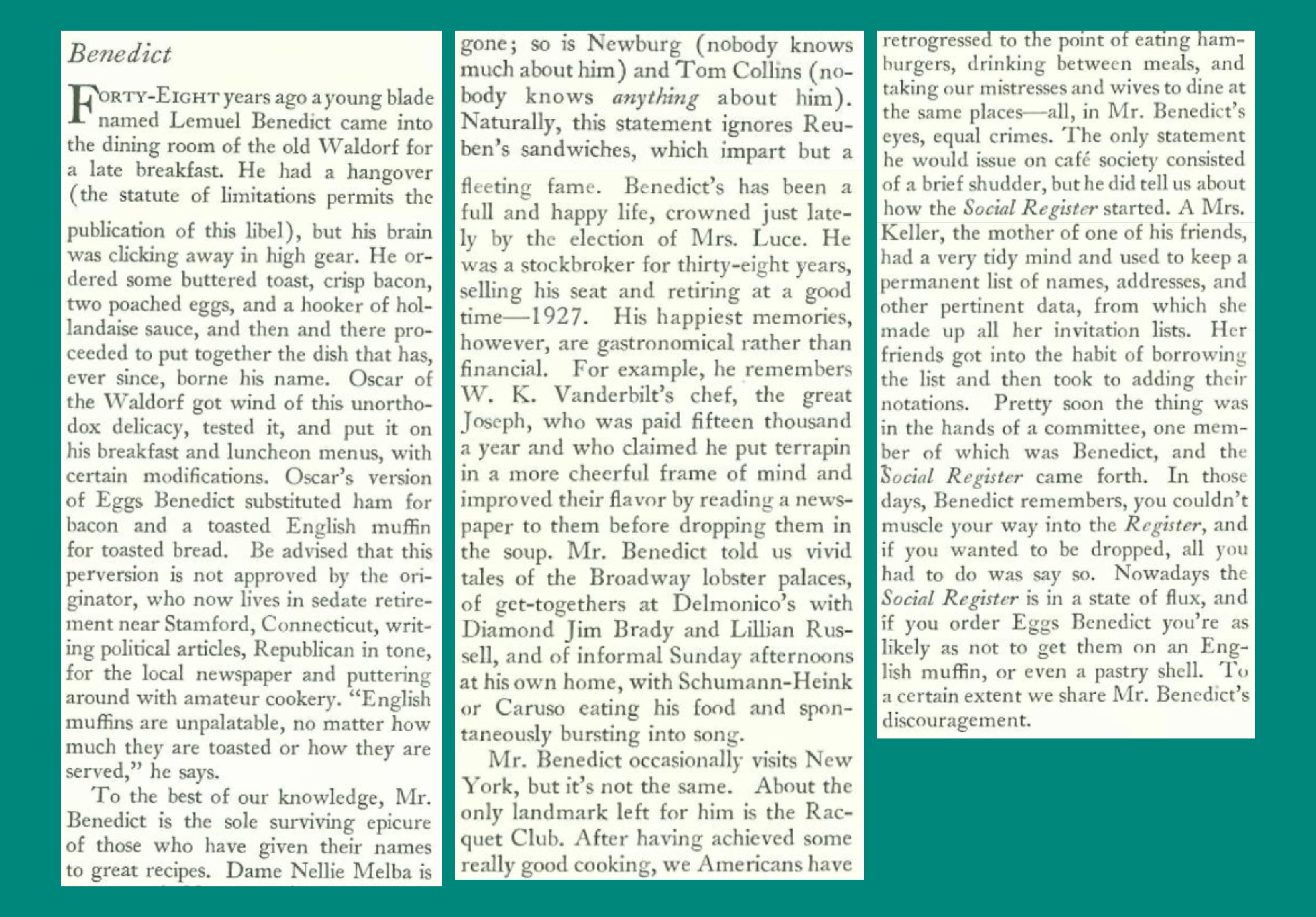
Like many named dishes, attributing Eggs Benedict to one definitive creator is difficult, but there are two notable possibilities, that actually have some overlap. In one, in 1894, a young man named Lemuel Benedict went to the Waldorf hungover and ordered “some buttered toast, crisp bacon, two poached eggs, and a hooker of hollandaise sauce.” The chef was so enamored with this combination he modified it to an English muffin and ham, and named it after Lemuel (The New Yorker profile on him notes “that this perversion is not approved by the originator.”)
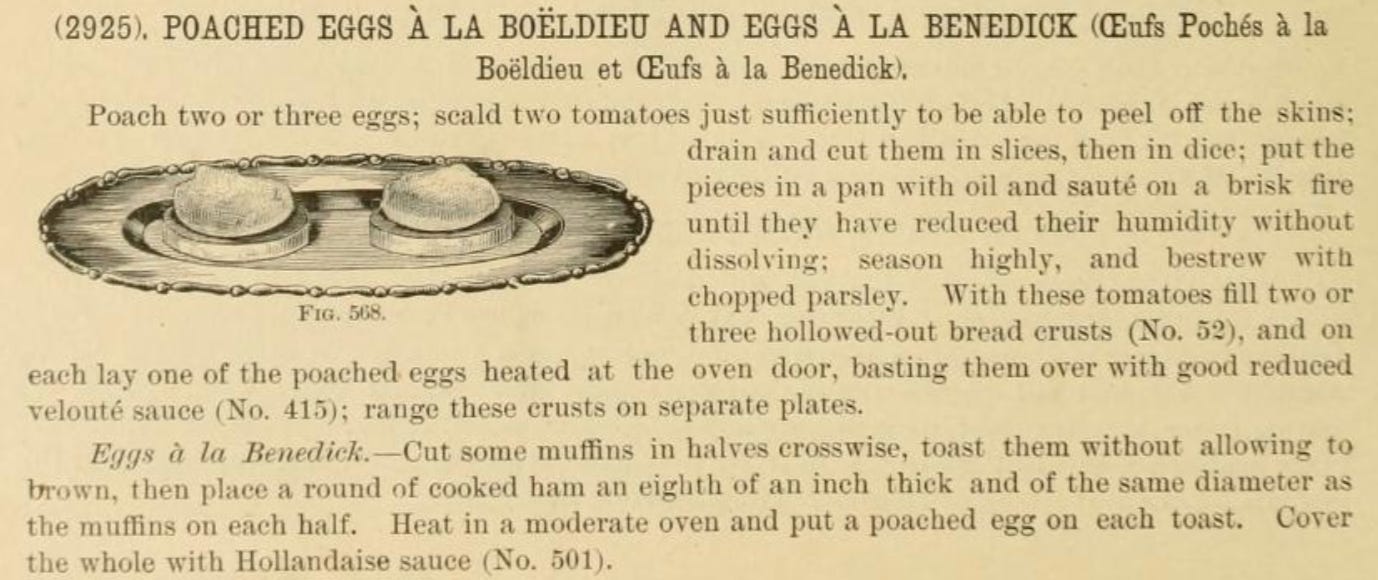
The other tale credits the dish to Delmonico’s and its chef Charles Ranhofer. In fact, the original Delmonico’s menu (which also claims to be the “first printed menu” whatever that means) had a note underneath the item: “Credit is given to Delmonico's Restaurant, the very first restaurant or public dining room ever opened in the United States. In the 1860's, a regular patron of the restaurant, Mrs. LeGrand Benedict, finding nothing to her liking and wanting something new to eat for lunch, discussed this with Delmonico's Chef Charles Ranhofer (1836 - 1899), Ranhofer came up with Eggs Benedict.” Another aspect that lends credence to this version of events is that the earliest written recipe for the dish appears in Chef Ranhofer’s 1894 cookbook, The Epicurean. A complete treatise of analytical and practical studies on the culinary art, including table and wine service, how to prepare and cook dishes... etc., and a selection of interesting bills of fare of Delmonico's from 1862 to 1894. Making a Franco-American culinary encyclopedia. The cookbook’s second claim to fame is having the longest title ever (just kidding).
My personal take is that Lemuel, a stockbroker who, from The New Yorker profile comes across as the quintessential curmudgeonly old guy who starts every sentence with “in my day…”, and has the article note that “His happiest memories, however, are gastronomical rather than financial,” laid claim to a coincidence of name and time. In fact, the article even notes that he waxed poetic about the heydays at Delmonico’s, so if Chef Ranhofer invented it in the 1860’s it would have certainly been on the menu during his “get-togethers…with Diamond Jim Brady and Lillian Russell.” Seriously, take a read through the whole piece, you’ll get a kick out of it and totally get where I’m coming from with my theory.
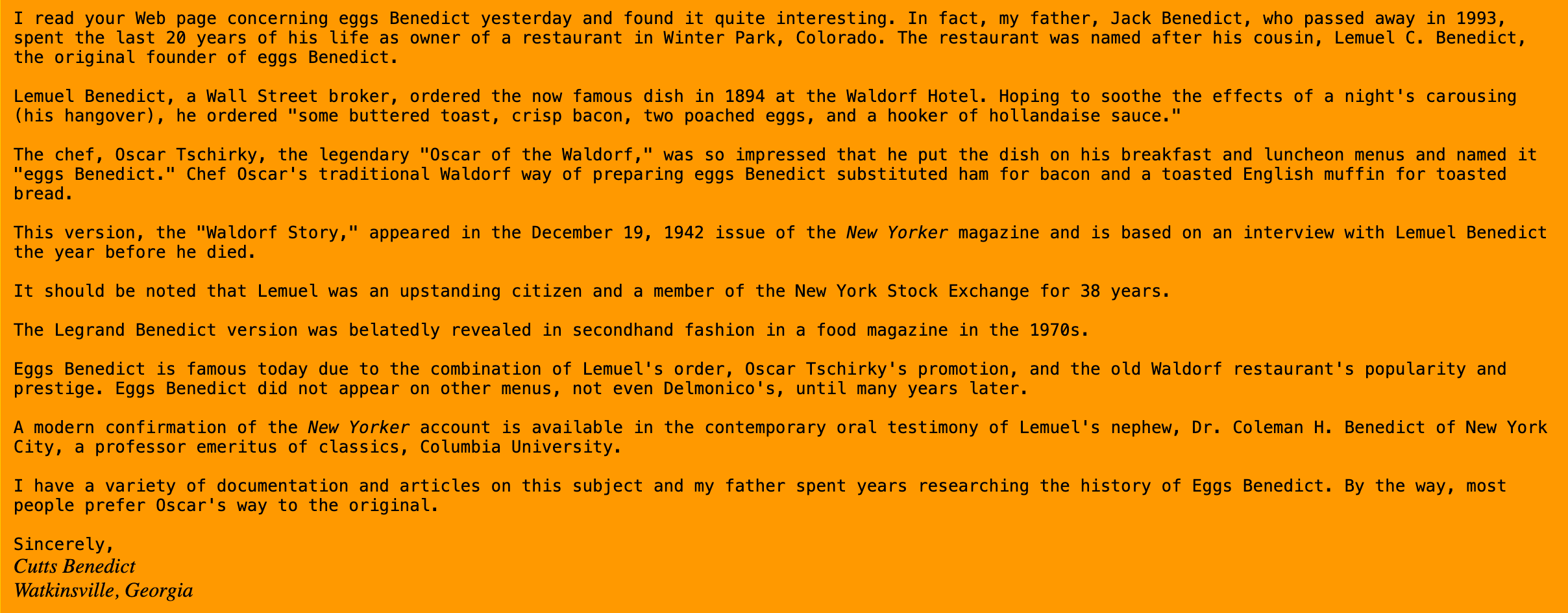
My search into the origin of Eggs Benedict led me to an archived forum that included an email from a man named Cutts Benedict, who claims that his father was a cousin of Lemuel, and a restaurateur in his own right, with an establishment named after his famed cousin. Clearly, this branch of the Benedict family has made it a fundamental part of their own origin story, so as much as I hate to say I don’t believe it, I think it’s one of those family stories that takes on a life of its own and becomes a core part of family lore.
So what is it about Eggs Benedict? Since its invention, many versions of the dish have been conceived. Wikipedia alone lists 23 varieties. Two of the most popular and widely available are Eggs Florentine, which replaces the Canadian bacon with spinach, and Eggs Royale, which subs the bacon for smoked salmon. There are a couple of versions that swap out the hollandaise for a different sauce option, like béchamel (Eggs Blanchard) or even clam chowder (Eggs Halifax), but for me, the hollandaise is the selling point.
Hollandaise sauce is one of the five mother sauces in classic French cuisine. A hot sauce made of clarified butter and lemon juice thickened with egg yolks, hollandaise is infamous for being difficult to make, and even more difficult to keep once it’s made. Because of this, hollandaise adds a sense of luxury to Eggs Benedict: it’s not generally something you would just whip up at home, but rather something you order at brunch with a mimosa (bottomless or not).
The mainstay of any of the iterations of Eggs Benedict, however is the poached eggs, another element that is perceived as being more challenging to make at home. Even at a restaurant, a perfect poached egg is a delight to receive. One of my most favorite food moments is piercing a poached egg and seeing the deep orange yolk spill out over the smothering of pale hollandaise.
These components, together with the English muffin base, which you rarely find on breakfast or brunch menus outside of this dish, and the Canadian bacon which is similarly unusual, make for a meal that feels special when you order it. Another thing I’ve noticed over the years is that when a Benedict and its variations appear on a menu, they’re often set apart in their own little decorative box or section, illustrating their status as a specialty brunch item. As to how this American special ended up as the action station of the very British resort I was staying at in Greece? That Eggs Benedict is composed of elements that appear to be more challenging to make causes it to feel special, and makes it a perfect dish for vacation, a time when you are treating yourself.
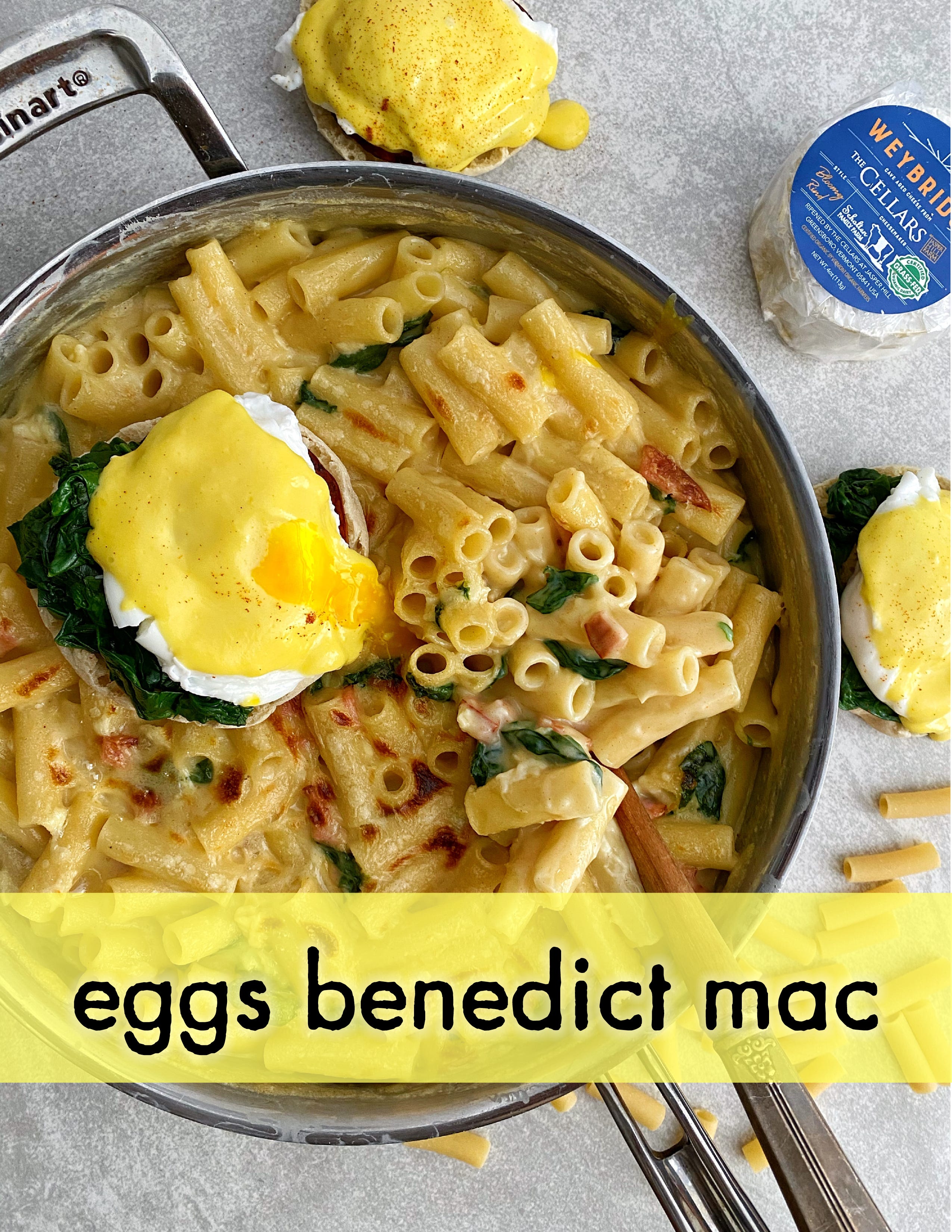
This month, I’m bringing you a recipe that mashes up Eggs Benedict with another one of my favorite things: mac and cheese. This Eggs Benedict Mac was actually in the quarterfinals of my March Macness competition in 2021. Sadly, it lost to BBQ Mac, but it had a better run than I expected. I guess my love of Eggs Benedict is more universal than I thought!
Comments
Nothing yet. Say the first thing.
Sign in to join the conversation.