
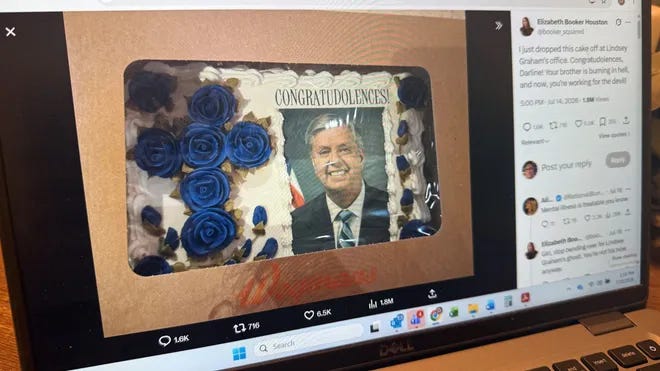
The Lindsey Graham cake drama I thought was about some random professor at Indiana University. Come to find out, y’all, it’s about Elizabeth Booker Houston. I’ve been seeing these old headlines on my Facebook page off and on, and I did not read or pay attention after the headlines. Congratulations, lawmakers want all you professors fired over a Lindsey Graham cake. I thought, like, damn, that’s crazy. My homegirl posted this on social media, and some professor copied off of her, and now she’s about to get fired. Damn.
No. They calling her to be fired for this cake.
Let me tell you why that opening paragraph matters more than the joke inside of it. I am a person who reads for a living, who teaches for a living, who has spent years in adult higher education telling grown folks that the headline is a marketing instrument and not a finding of fact, and even I scrolled past this thing four or five times without ever clicking. That is not a personal failure. That is the design working exactly the way it was engineered to work. The headline says professor. The headline says Indiana. The headline says fired. The headline does not say lawyer, does not say public health professional, does not say adjunct making about five thousand dollars a year for one course in food and drug law, does not say Memphis, does not say the woman in question buried a brother who was killed in a shooting in the Edge District in December of 2017 and has been begging that particular chamber of Congress to do something about gun violence ever since. The headline gives you a category and lets your assumptions fill in the rest, and the category it gave you was professor, which in the current climate is a synonym for suspect.
Watch it run. Elizabeth Booker Houston holds a JD and an MPH from the University of Memphis. She teaches food and drug law at the IU McKinney School of Law. She is a lawyer, a public health professional, and a comedian, and she was hired by institutions that were entirely aware of her public presence, because she has been publicly loud for years and none of it was hidden. Now go read how she got described. A failed comedian. A stunt. Grotesque political theater. Tasteless. Somebody who should get mental health counseling as part of her severance, which came from a sitting member of Congress.
Here is the record. Senator Lindsey Graham of South Carolina died on July 11, 2026, at the age of 71, of an aortic dissection. His sister, Darline Graham Nordone, was sworn in to finish out the term. On July 14, Elizabeth Booker Houston posted an Instagram video of herself and another creator setting a bakery sheet cake down among the flowers outside Graham’s former Senate office. The cake carried his Senate headshot, a cross made of blue frosted roses, and the word congratudolences, which is a mashup of congratulations and condolences. She then posted the photo to X with a message addressed to the sister now holding the seat. She said in the video that she would not be praying for his salvation.
Then came the calls. Congressman William Timmons of South Carolina tagged George Washington University, where she guest lectures, and asked about disciplinary action. Senator Jim Banks of Indiana said IU should fire her immediately. Representatives Marlin Stutzman and Erin Houchin joined him. Lieutenant Governor Micah Beckwith of Indiana went the furthest and said that if Indiana University did not fire her, the Indiana General Assembly should withhold state funding from the school, and he wrapped that threat in a complaint about why public education is failing and no longer respected.
A sitting statewide executive officer publicly instructed a public university to fire a lecturer for constitutionally protected political speech, and attached a funding threat to the instruction, while explaining that his motivation was concern for the health of public education. That is the whole ballgame in one sentence. That is a man pissing on us and telling us it’s raining.
Now here is where I need you to sit up, because this is not new, this is not novel, this is not some unprecedented moment in the culture war. This is a rerun. This exact script was performed sixty six years ago and the state of Alabama held the pen.
In February and March of 1960, students at Alabama State College in Montgomery staged sit ins at the segregated snack bar in the county courthouse. Governor John Malcolm Patterson did not go after the students first. He went after the money. He leaned on the college president, H. Councill Trenholm, a Black man running a Black state institution that lived and died on an appropriation controlled by white legislators, and he made the terms plain. Purge the faculty or lose your job. On March 26, 1960, Trenholm announced he would clean out the disloyal faculty members. The Montgomery Advertiser ran it the next morning.
Who got caught in that net. Lawrence Dunbar Reddick, chairman of the history department, a University of Chicago PhD, former curator of the Schomburg Collection, historian of the Montgomery Improvement Association, biographer of Martin Luther King Jr. He was fired in June of 1960. Olean Underwood was fired. And then there were the women. Mary Fair Burks, chair of the English department, founding president of the Women’s Political Council. Jo Ann Gibson Robinson, the WPC president who mimeographed the leaflets that launched the Montgomery Bus Boycott off a college machine in the middle of the night. Eleven faculty members resigned rather than wait for the axe. Burks and Robinson resigned at the close of the spring semester. Robinson had already had a rock thrown through her window by a police officer and acid poured on her car. State evaluators had been sitting in on classes to watch instructors, which is a beautiful euphemism for surveillance.
King wrote Trenholm’s actions off as cowardly, and said he had hoped the man would stand up to the governor and the board of education and refuse to fire eleven faculty members who had committed no crime and no act of sedition, and that if he had done so he would have gained support across the nation that he never dreamed of. The American Association of University Professors censured Alabama State for firing Reddick without due process. That censure sat on the institution for twenty years.
Twenty years. A Black college carried a professional stain for two decades because a white governor wanted a Black historian gone and used the appropriation as the crowbar.
Then, and this is the part that should make the hair on your arm stand up, that same Governor Patterson is a thread in the origin story of modern American free speech law. When the Committee to Defend Martin Luther King ran a fundraising advertisement in the New York Times in March of 1960 about the treatment of those Alabama students, Patterson and other Alabama officials filed libel suits. One of those suits, brought by Montgomery Commissioner L. B. Sullivan, became New York Times Co. v. Sullivan, decided in 1964, the case that gave this country the actual malice standard and made robust criticism of public officials survivable in court.
So here’s your through line. The free speech architecture that conservatives invoke every single day, the doctrine they wave around at every campus, was built in a courthouse out of white Southern officials trying to punish Black people for describing what Alabama was doing to Black students. Black speech under white state pressure is not a side plot in First Amendment history. Black speech under white state pressure is the load bearing wall. Apply Derrick Bell here. Interest convergence tells us that Black people get a legal victory when that victory happens to serve a broader white interest, and the press freedom the whole country enjoys today converged with a Black freedom struggle that needed a national newspaper to be able to print the truth about Montgomery without being sued into silence.
And now, in 2026, the descendants of the people who filed those suits are demanding that a public university fire a Black woman for a cake, and threatening the appropriation to make sure it happens.
Crazy how that works.
Go back further if you want. Ida B. Wells was running the Memphis Free Speech and Headlight in 1892 when she wrote about the lynching of Thomas Moss, Calvin McDowell, and Will Stewart at the People’s Grocery, and named the lie at the center of lynching. A mob destroyed her press and she could not go home to Memphis. Elizabeth Booker Houston is from Memphis. Ida B. Wells could not return to Memphis for describing how Memphis killed her friend. A hundred and thirty four years later a woman from that same city is being told her employment is contingent on how gently she speaks about a dead senator. The technology changed. The press was a printing press, now the press is an Instagram post. The instrument of punishment was a mob, now the instrument of punishment is a line item in a state budget. The logic never moved an inch.
Let’s do the law, because I am not going to argue vibes with people who claim to be the party of law and order.
Number one. Indiana University is a public institution. That means it is a state actor. That means the First Amendment binds it. This is not a debate. When IU acts as an employer against an employee for that employee’s speech, the Constitution is in the room.
Number two. The governing framework is Pickering v. Board of Education, decided in 1968, where the Supreme Court held that a public school teacher could not be fired for writing a letter to a newspaper criticizing the school board’s handling of money. The Court set up a balancing test. Was the employee speaking as a citizen on a matter of public concern, and if so, does the employer’s interest in efficient operation outweigh the employee’s interest in speaking. Connick v. Myers in 1983 sharpened the public concern requirement. Garcetti v. Ceballos in 2006 carved out speech made pursuant to official job duties.
Now run Booker Houston through that machine. She was not on campus. She was not teaching. She was not speaking pursuant to any duty owed to Indiana University. The video never mentions IU. She was a private citizen standing on public property in Washington, D.C., commenting on the political legacy of a United States senator, which is about as close to the molten core of protected political speech as a human being can physically stand. Steve Sanders, who teaches constitutional law at IU’s own Maurer School of Law, said out loud that he found the video juvenile and that he would not want to associate with a person who behaved that way, and then said in the same breath that she almost certainly could not be fired for it, and that a court would very likely find retaliation against her to be a First Amendment violation, and that none of it bears on her competence to teach food and drug law.
That is what an honest person sounds like. He does not like it. He says he does not like it. He also says the state cannot touch her for it. Two things can be true.
Number three, and this is the one that should terrify anybody who has ever set foot in a public classroom. The Beckwith threat is not a lesser offense than the firing. It is a greater one. Threatening to strip the appropriation from an entire university unless it terminates one specific person for one specific instance of political speech is the state using the budget to accomplish what the Constitution forbids it to accomplish directly. Courts have a name for that family of moves. Unconstitutional conditions. You cannot make a public benefit contingent on the surrender of a constitutional right. And Keyishian v. Board of Regents in 1967, which finally killed New York’s Feinberg Law loyalty oath regime, said in plain language that academic freedom is a special concern of the First Amendment and that our Constitution does not tolerate laws that cast a pall of orthodoxy over the classroom.
A pall of orthodoxy. In 1967 the Court was worried about a pall. In 2026 a lieutenant governor is standing on the quad with the light switch in his hand telling the whole faculty he’ll cut the power.
Number four. Her delivering that cake was, first, legally done on public taxpayer funded property. And number two, it’s protected speech. The Republicans are trying to say this is the worst thing they’ve ever said. I feel like it’s laughable considering everything they’ve done in their past and what they do.
The part that gets me is the volume of the free speech noise these same people have been making since 2015.
Let’s pull the September 2025 tape. After Charlie Kirk was killed at Utah Valley University, a wave of terminations moved through American higher education inside of two weeks. Darren Michael, a tenured theatre professor at Austin Peay State University in Clarksville, Tennessee, reshared a two year old Newsweek headline quoting Kirk’s own 2023 remarks about gun deaths. He added no commentary of his own. Senator Marsha Blackburn publicly tagged the university and asked what they were going to do. Two days later he was fired. The university’s president called the post insensitive and disrespectful.
Now watch the ending, because this is the receipt that closes the argument. Austin Peay’s own Faculty Senate reviewed the matter and concluded by September 22, 2025, that the administration had not followed its own Policy on Academic Tenure and Termination of Faculty Members for Adequate Cause. No notice. No hearing committee. No formal determination. And in January of 2026, the university agreed to reinstate Darren Michael, pay him five hundred thousand dollars, reimburse counseling costs, and issue a statement acknowledging it had failed to follow its own procedures.
Half a million dollars of Tennessee public money, spent to buy back the mistake of firing a man for a post, because a United States senator wanted a scalp on a Tuesday.
That was not the only one. Iowa State fired a financial aid advisor. The University of Mississippi fired an administrator. Middle Tennessee State fired a staff member. East Tennessee State put two faculty on administrative leave. Clemson suspended a professor and pulled two more from teaching. The Iowa Board of Regents ordered every state university to investigate employee social media inside of two weeks and authorized presidents to fire on the spot. And Congresswoman Claudia Tenney demanded that Syracuse University fire two professors, Jenn Jackson and Farhana Sultana, or face the loss of federal funding.
Same play. Same funding threat. Same two week window. Different corpse.
So when Booker Houston pointed out that the halls of GOP offices are plastered with Charlie Kirk personas and that nobody mentioned free speech, she was not being cute. She was reading the ledger out loud. Nobody mentioned free speech, and I’m not surprised.
I’m not going to point out that the disrespectful freedom of speech warriors that always say it’s about their rights are quick to say they don’t matter as soon as they feel like you’ve done something disrespectful to them. I’m not going to point that out.
And I would be doing you a disservice if I did not put the funeral on the table, because the timeline is unkind to these people. On July 28, 2026, at Washington National Cathedral, at Lindsey Graham’s own funeral, in front of his own family, the President of the United States stood at the lectern, said that virtually everyone liked Lindsey, stopped himself, said well, not everybody, but it sounds good, and got a laugh. He recounted the story of reading Graham’s personal cellphone number out loud to millions of people in 2015 and then recited the number again from the pulpit for anybody who wanted to give it a shot. He joked about Graham and war, which Sean Hannity then had to get up and clean up in the very next eulogy.
I’m not sure if this was before or after he fell asleep, but they talking about vile behind a cake.
Nobody drafted a letter to a university. Nobody called for a job. Nobody threatened an appropriation. Because the rule was never about decorum. The rule is about who gets to be irreverent and who gets to be employed, and those two categories have a color and they have a gender.
Every accusation is a confession.

I want to move off the personality and get to the part of this that is my actual field, because the individual outcome here is almost beside the point. Whether Indiana University fires Elizabeth Booker Houston or not, the damage to the institution is already done, and it was done the moment the lieutenant governor connected her name to the state appropriation in public.
Here is the mechanism, and it is not complicated.
American higher education has been quietly restructured over the past fifty years into a contingent labor system. The tenure line, which exists for exactly one reason, to make a scholar economically unkillable so that the scholarship stays honest, has been steadily replaced by adjunct and contingent appointments that carry no due process, no hearing committee, no notice requirement, and no security. Booker Houston teaches one course. She earns roughly five thousand dollars a year for it. She has said publicly that losing it would not be a financial hardship, and she is right, and that is precisely why she can talk. Now think about the tens of thousands of contingent faculty in this country for whom that five thousand dollars is the difference between the light bill getting paid and not.
Do you understand what I am telling you. The university does not need to fire anybody to win. The threat is the product. The firing is just the advertisement.
This is what the literature calls the chilling effect, and it does not show up in a lawsuit because the whole point of a chill is that the speech never gets made, so there is no plaintiff, no docket number, no ruling, no press release. There is only the syllabus that quietly loses a unit. The guest speaker who quietly does not get invited. The dissertation topic that quietly gets swapped for something safer. The junior scholar who quietly does not write the op ed. You cannot subpoena an absence.
Understand the funding lever ain’t not a new invention either. The Second Morrill Act of 1890 forced Southern states to either integrate their land grant institutions or establish separate ones for Black students, and every single Southern state chose separate, and then underfunded those institutions for the next hundred and thirty years, and we are still litigating that gap right now. Tennessee State University is owed somewhere in the neighborhood of two point one billion dollars in land grant matching funds that the state simply declined to send. The appropriation has always been the leash. Patterson knew it in 1960. Beckwith knows it in 2026. The only thing that changed is that the leash is now being yanked in front of cameras and called accountability.
Most of what gets called a free speech crisis on campus is actually a labor crisis wearing a free speech costume. You want faculty who will speak. Then you have to build institutions where speaking does not cost a person their livelihood. Everything else is theater.
Now let me get to the part of this that made me sit down and write instead of scroll.
Because the Republicans coming for her was predictable. The Republicans coming for her is a Tuesday. The part that is actually instructive is what happened on the other side.
Booker Houston has said that a caucus of both progressive, anti AIPAC Democrats and establishment Democrats cowered to MAGA and pulled her from an event because Republicans complained about a Lindsey Graham cake. Her framing is the one worth keeping. A conglomeration of progressives and establishment Democrats casting her to the side because y’all ain’t want no bad press.
I think it’s preposterous. And I think it’s clarifying.
This is why I roll my eyes at the DSA plus establishment plus progressive infighting. These people fight each other over what they feel safer on, but anytime they can come to a collective agreement about the fungibility of a Black woman, this is what happens. And I think it go both ways too. Either we talking about trying to use a Black woman to make sure you don’t get nothing, or throwing away a Black woman to make sure you don’t get nothing.
Fungibility is not my word. It is Frank Wilderson’s word, and Saidiya Hartman’s word before the term got its Afropessimist frame, and it means something very specific and very ugly. To be fungible is to be interchangeable. To be a unit of value that can be substituted, transferred, deployed, or discarded according to somebody else’s calculation, without your own interior life ever entering the math. Hartman writes about the enslaved body in Scenes of Subjection as available, as a vessel that can be filled with whatever meaning the observer needs at that moment, including empathy, including outrage, including entertainment. Hortense Spillers gave us the distinction between the body and the flesh, and the flesh is what remains when personhood has been stripped away and the thing that is left can be used.
Watch how cleanly the frame fits this week.
When the Democratic Party needs a Black woman, the Black woman is a credential. She is the proof of coalition. She is the face at the convention, the credentialed social justice influencer, the viral moment that demonstrates the party has range. That is fungibility as an asset.
When the Black woman becomes inconvenient, when Republicans complain, when the press might turn, the same body converts instantly into a liability and gets removed from the program. Same person. Same politics. Same commitments. The only variable that changed is somebody else’s risk assessment. That is fungibility as a write off.
Kimberlé Crenshaw named the structural version of this in 1989 with DeGraffenreid v. General Motors, where five Black women sued and the court told them they could bring a race claim or a sex claim but not a claim as Black women, because there was no category for the specific place they were standing. That is the same problem here in a different costume. The Republicans are not disciplining her as a woman. The Democrats are not discarding her as a Black person. Both are acting on her position at the intersection, where she is simultaneously loud enough to be useful and expendable enough to be dropped, and neither institution has a line item that acknowledges the position exists.
Moya Bailey gave us misogynoir precisely for this texture, the specific way anti Black racism and misogyny fuse into a single mechanism directed at Black women. And here is the receipt that ties the whole bow. Turning Point USA’s Professor Watchlist, the same organizational ecosystem generating these firing campaigns, lists Moya Bailey herself. The scholar who built the vocabulary for this exact harm is on the list of professors targeted by the movement inflicting it. You cannot write that. That writes itself.
The Combahee River Collective told us in 1977 that if Black women were free, everybody would have to be free, because our freedom would require the destruction of every system of oppression at once. Read it backwards and you get the diagnostic that matters here. The treatment of the Black woman is the tell. When a coalition wants to know what a coalition actually believes, it should look at what it does with its Black women when the room gets hot. Not what it says at the convention. What it does on the Thursday afternoon when a Republican congressman sends a tweet.
The material impact is not abstract. It is a lost booking, a lost fee, a lost audience, a lost professional relationship, a lost line on a bio. It is the two hundred and fifty thousand followers who now watch a person get quietly removed from a program and learn the lesson without anyone having to teach it. And most of all it is the Black woman scholar somewhere in this country reading this story right now, untenured, on a one year contract, in a red state, calculating whether the thing she knows is true is worth what it will cost to say.
That is the yield. That is what this operation is producing. Not one firing. A generation of qualified silence.
Let me be responsible with you, because I do not run a church of convenient conclusions.
Two things can be true. You can find the cake tasteless. You can believe there is something corrosive in the public celebration of any human being’s death, that grief should have a perimeter around it, that a sister burying a brother should not have to see a sheet cake in her feed. You can hold that, sincerely, as a moral position, and I will not fight you on it, and Steve Sanders held exactly that position out loud while defending her rights.
And at the same time, all of that is a question of taste, and taste is not jurisdiction. The state does not get a taste veto. The instant a lieutenant governor attaches a university’s appropriation to a citizen’s opinion about a dead politician, we are no longer discussing manners. We are discussing whether the state can purchase silence with public money.
The other honest thing. She was not silent about her reasoning, and it is not what the coverage suggested. She has said her brother was murdered, that people were cruel to her family in the aftermath, and that people like Graham treated families like hers like dirt while they begged that body to meaningfully address gun violence. You do not have to agree with the cake to understand that the woman was not performing a bit. She was answering a decade of being ignored with the only instrument she had left, which was three minutes of attention and a bakery.
And her own assessment of the response is the sharpest line anybody produced in the whole affair. She said they are hypocritical, that they have been crying about censorship and free speech for years, and they could not handle a piece of cake.
They couldn’t handle a piece of cake.
1. The funding threat is the constitutional violation, not the potential firing. Attaching a public university’s appropriation to the termination of one employee for protected political speech is the state doing indirectly what Pickering and Keyishian forbid it to do directly. The firing would be the symptom. The threat is the disease.
2. This is a 1960 rerun with a new cast. Governor John Patterson leaned on Alabama State College president H. Councill Trenholm with the same lever, the appropriation and the job, and got Lawrence Reddick fired and Jo Ann Robinson and Mary Fair Burks pushed out. The AAUP censure lasted twenty years. The technology of punishment updated. The logic did not.
3. The receipts from September 2025 already settled the legal question, expensively. Austin Peay fired a tenured professor over a Charlie Kirk post at a senator’s urging, its own Faculty Senate found the university violated its own procedures, and by January 2026 the school had reinstated him and paid five hundred thousand dollars of public money to close it out. That is what these campaigns actually cost taxpayers.
4. The real target is contingent faculty, not this one adjunct. She teaches one course for about five thousand dollars a year and has said losing it would not hurt her, which is exactly why she can speak. The chill lands on everybody who cannot say that, and a chill never generates a plaintiff, which is why it works.
5. Fungibility runs in both directions and both parties operate it. A Black woman used as a credential when useful and dropped as a liability when inconvenient is not two different failures. It is one mechanism with two settings, and the coalition that pulled her from an event ran the same calculation as the caucus that demanded her job.
Theory and Black Studies
Bailey, Moya. Misogynoir Transformed: Black Women’s Digital Resistance. New York University Press, 2021.
Bell, Derrick. Faces at the Bottom of the Well: The Permanence of Racism. Basic Books, 1992.
Combahee River Collective. “A Black Feminist Statement.” 1977.
Crenshaw, Kimberlé. “Demarginalizing the Intersection of Race and Sex.” University of Chicago Legal Forum, 1989.
Hartman, Saidiya. Scenes of Subjection: Terror, Slavery, and Self Making in Nineteenth Century America. Oxford University Press, 1997.
Jackson, Jenn M. Black Women Taught Us: An Intimate History of Black Feminism. Random House, 2024.
Mills, Charles W. The Racial Contract. Cornell University Press, 1997.
Robinson, Cedric J. Black Marxism: The Making of the Black Radical Tradition. University of North Carolina Press, 1983.
Spillers, Hortense. “Mama’s Baby, Papa’s Maybe: An American Grammar Book.” Diacritics, 1987.
Wilderson, Frank B. III. Red, White and Black: Cinema and the Structure of U.S. Antagonisms. Duke University Press, 2010.
Woodson, Carter G. The Mis Education of the Negro. Associated Publishers, 1933.
History and Primary Sources
Robinson, Jo Ann Gibson. The Montgomery Bus Boycott and the Women Who Started It. University of Tennessee Press, 1987.
Reddick, Lawrence D. Crusader Without Violence: A Biography of Martin Luther King, Jr. Harper, 1959.
Wells, Ida B. Southern Horrors: Lynch Law in All Its Phases. 1892.
Wells, Ida B. Crusade for Justice: The Autobiography of Ida B. Wells. Edited by Alfreda M. Duster. University of Chicago Press, 1970.
Martin Luther King, Jr. Research and Education Institute, Stanford University. Encyclopedia entries on Lawrence Dunbar Reddick, Jo Ann Gibson Robinson, Mary Fair Burks, H. Councill Trenholm, and John Malcolm Patterson.
American Association of University Professors. “The AAUP and the Black Freedom Struggle, 1955 to 1965.” Academe, Spring 2024.
Law
Pickering v. Board of Education, 391 U.S. 563 (1968).
Keyishian v. Board of Regents, 385 U.S. 589 (1967).
Sweezy v. New Hampshire, 354 U.S. 234 (1957).
New York Times Co. v. Sullivan, 376 U.S. 254 (1964).
Connick v. Myers, 461 U.S. 138 (1983).
Garcetti v. Ceballos, 547 U.S. 410 (2006).
DeGraffenreid v. General Motors, 413 F. Supp. 142 (E.D. Mo. 1976).
Contemporary Reporting
Odendahl, Marilyn. “Bitter Aftertaste.” The Indiana Citizen, July 24, 2026.
Indiana Public Media / WFIU WTIU News. Coverage of Steve Sanders’ First Amendment analysis, July 21, 2026.
Indianapolis Star and WBIW coverage of the lawmaker letters and the Beckwith funding threat, July 2026.
NBC News. “After Charlie Kirk’s Death, Teachers and Professors Nationwide Fired or Disciplined Over Social Media Posts,” September 12, 2025.
Duke Law Campus Speech Database. Incident records for Austin Peay State University, Iowa State University, and Clemson University, September 2025.
On Contingent Labor
Berry, Joe. Reclaiming the Ivory Tower: Organizing Adjuncts to Change Higher Education. Monthly Review Press, 2005.
Bousquet, Marc. How the University Works: Higher Education and the Low Wage Nation. New York University Press, 2008.
Comments
Nothing yet. Say the first thing.
Sign in to join the conversation.