
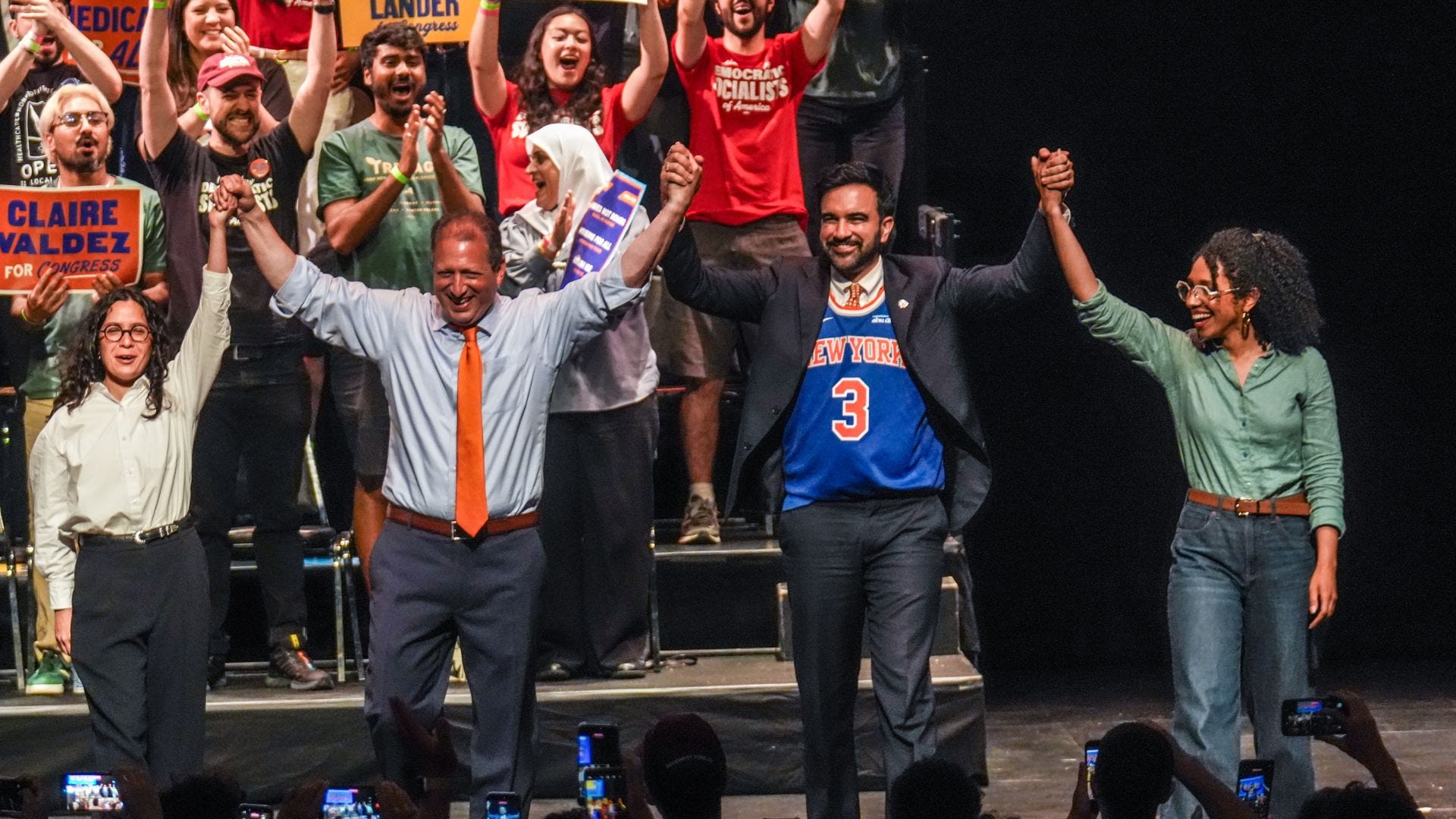
Last week, two incumbent Democratic House members in New York City were defeated in primaries by more left-wing challengers backed by the city’s highly popular mayor, Zohran Mamdani. In a third House primary for an open seat, the progressive candidate backed by Mamdani defeated a progressive candidate backed by Rep. Nydia Velasquez, who is retiring from office.
These results have generated responses nearing hysteria from all sides. Leftists and centrists are both describing the election as a “political earthquake” and proof that “socialism” is on the march inside the Democratic party. Many are also either celebrating or decrying the ways that harsh criticism of Israel and its American partner AIPAC have now become mainstream.
There are grains of truth in these responses. And if politicians perceive something as earth-shaking, that perception gains traction even if it’s based on shaky evidence. Incumbent Democratic politicians rarely back challengers to other incumbents, so what Mamdani and his allies in DSA-NYC just did is justifiably making waves.
But intra-party conflict isn’t unusual. Everyone should take a chill pill and also recognize that as Daniel Schlozman and Sam Rosenfeld argued in their book The Hollow Parties, America's political parties have become increasingly incapable of organizing broad constituencies. Last week's New York primaries offered another vivid illustration of what politics looks like under those conditions.
To be clear, I think it’s unstrategic and worrisome to excuse one of those winning candidates, Darializa Avila Chevalier, for her far-left views, just because she took on and defeated an incumbent, Rep. Adriano Espaillat, who was too cozy with real estate, Wall Street and AIPAC. As one of the founders of Columbia University Apartheid Divest, Avila Chevalier is as Hamas-adjacent as they come. Founded in early 2024, the CUAD coalition regularly put out statements that praised the “Al-Aqsa Flood” attack of October 7, argued that Hamas was a “progressive force” because it was advancing the destruction of imperialism, posted a “tribute” to Hamas mastermind Yahya Sinwar after his death, lauded Chairman Mao, and revoked its own apology for a member who had declared that Columbia was lucky he wasn’t killing Zionists, among other effusions.
When asked by a normally leftish local Democratic club, Broadway Democrats, if she would condemn Hamas and its October 7 massacre, Avila Chevalier “point-blank” refused to do so or say anything about “its execution of its own political dissidents, its theocratic view of government and what a society is, its misogyny, its homophobia, its racism,” Curtis Arluck and Paula Diamond Roman, wrote in the club’s newsletter. And for the record, the fact that people are drawing distinctions over a person’s bona fides based on when they decided to start using the word “genocide” to describe Israel’s war crimes in Gaza is yet another example of how today’s left is more interested in purity tests than growth.
But I think current freakout over last week’s primary results is highlighting the wrong explanation for what just happened, because everyone involved—leftwingers and centrists, pro-Palestinian activists and pro-Israel activists—has a shared interest in inflating the salience of what happened around their issue, either as a victory or a threat. Good for clicks, good for fundraising, but not necessarily good for the main task we collectively face, which is beating the fascists now in control in Washington. For people who pay a tremendous amount of attention to politics, yes, what each candidate had to say (or not say) about Israel/Palestine mattered a lot. But most people, including a lot of the tuned-in ones who show up in primaries, do not rate the Middle East as a top concern. A recent Siena College poll, conducted statewide among registered voters June 17-23, found that only 6% listed “Iran and the Middle East” as their top issue, well behind the cost of living, affordable housing, crime, and immigration.
You may not agree with what follows. But hear me out. Last Tuesday’s primary results across New York showed two things most of all: First, that the Democratic party establishment in the state is quite hollow and too beholden to status-quo politics to generate voter excitement for its preferred candidates. And second, that in low-turnout elections, relatively small groups of well-organized people with a good candidate and clear message can mobilize enough voters to win local election fights.
Here’s some context that’s been missing from nearly all the commentary on the New York primary: It took place less than a month after Democratic Governor Kathy Hochul and the state legislature delivered a budget that was 57 days late and a giant disappointment to many. The massive bill, which is always negotiated in secret , and then jammed through the legislature without amendment because state Democratic leaders are hypocrites about democracy, weakened the state’s ambitious climate protection law, gave immigration rights activists demanding strong anti-ICE measures half-a-loaf ($82 million rather than a requested $183 million for legal services and direct deportation defense), and most critically avoided taxing the ultra-rich.
As Invest in Our New York, the statewide coalition working for greater fiscal equity and more robust funding of social services, put it, “The final budget does nothing to fill the enormous federal cuts that will strip 1 million New Yorkers of their healthcare (including 460,000 who will lose their Essential Plan coverage on July 1) and endanger 200,000 people’s SNAP benefits. It also does not fund truly universal childcare statewide with living wages for workers or provide the revenue necessary to address the soaring cost of living, or tackle our state’s affordable housing crisis.” Hochul’s only sop to the “tax the rich” movement that confronted her so vocally last October when she rallied with Mamdani before the general election was a modest pied-à-terre tax on luxury second homes in New York City, which will raise a piddling $500 million (the state budget is $268.5 billion).
This is not the kind of “deliverism” that you go to elections with to excite voters, especially those who are increasingly resigned and cynical about the potential of electoral politics to do anything to improve their lives, resentful of the power of the billionaire class, and worried about the precariousness of their current lives and occupations. So, the first point I would make is that last Tuesday’s results showed the failure of imagination and lack of courage of status-quo Democrats in the party’s political establishment everywhere.
This wasn’t just apparent in the loss of incumbents like Espaillat to newcomers like Avila Chevalier, or incumbent-designees like Brooklyn borough president Antonio Reynoso to Mamdani ally Claire Valdez, or in lower-level fights for state assembly seats in several Brooklyn districts. Where I live in Westchester, we saw the weakness of the party establishment in reverse, in the Democratic primary election for supervisor of Greenburgh, a town of about 95,000. There, it was a longtime incumbent, Paul Feiner, an iconoclastic independent Democrat who has held that post for more than 30 years, who held off a challenge from Barry McGoey, an Ardsley village trustee and former head of the Yonkers firefighters union who was backed by everyone from Rep. George Latimer and the county Democratic party to the Greenburgh Democratic Committee and many local mayors, other electeds, and local labor unions.
McGoey and his allies outspent Feiner by somewhere between 2- and 3-to-1, money they used to bombard voters with negative fliers, texts and robocalls. But McGoey still lost to him by 12 points, 4,945 to 3,839. Why? Because Feiner is known by many ordinary voters for his accessibility. Despite trying to gin up concerns about the town’s fiscal management, the McGoey camp never explained sufficiently why it was time to replace one oldish white man with another one. McGoey’s past history as a registered Republican and the amount of money that flowed into his coffers from Yonkers Democrats – a city and claque known to many us locally for rampant cronyism—also didn’t help in his claims to be the “change” candidate. As Monica Joy Taylor wrote in Black Westchester, “Greenburgh wasn’t willing to trade a supervisor known for picking up the phone for every constituent for a candidate manufactured by party leadership.”
The second thing to keep in mind is that Tuesday’s election was nothing like the genuine earthquake that shook New York City a year ago, where turnout among voters under the age of 40 exploded and enabled Mamdani to blow past former governor Andrew Cuomo, the avatar of the state Democratic establishment for decades. The victories of Darializa Avila Chevalier, Claire Valdez and Brad Lander showed no such surge. Thirty percent of registered voters came out in June 2025, compared to about half as many last week.
Low turnout elections are good for two kinds of politicians. The first are traditional “clientelist” incumbents who maintain personal contact with a real base of reliable voters, either in the manner of a Paul Feiner, who just shows up everywhere, gives out his personal contact info to everyone, and responds to every incoming message, or in the manner of an Adriano Espaillat, whose Dominican immigrant-based political machine has been his longtime source of power.
The other kind are insurgents with sufficient organizational muscle to challenge clientelism. As a veteran of progressive state politics once said to me years ago, “If you have a hundred people who can each move ten or twenty votes, you can win a school board race.” That math explains many of DSA’s wins last week. For example, in East New York/Bushwick, longtime Assemblyman Erik Martin Dilan was unseated by Christian Celeste Tate, 4,054 to 2,479. Four years ago, Dilan won re-election with almost the same number of votes, 2,524 (to 2,313 for a different DSA-backed challenger). The problem with clientelism is its very reliability; you can’t double or triple how much personal attention or patronage you have to dole out if and when a strong challenger arises. The same could be said about Espaillat who lost to Chevalier with 30,464 votes to her 32,790. Four years ago, the last time he faced a primary challenge, he won with 31,582 votes.
Winning in low turnout races can make a relatively small group punch above its weight, but this is hardly the stuff of “earthquakes.” The last time New York experienced a real political earthquake (before Mamdani’s defeat of Cuomo) was in 2018, when the Working Families Party, local union 32BJ, and an army of Indivisible volunteers knocked off seven of the eight Democratic state senators who made up the so-called Independent Democratic Conference in uphill primaries that broke decades of Republican control of the state senate. If Mamdani was such a giant killer, why did he studiously avoid endorsing any progressive challengers to incumbent members of the state assembly, arguably the least progressive branch in Albany? Why didn’t his endorsement of Lindsay Boylan in the special election for an open NYC city council seat in April put her over the top?
In fact, in the days before last Tuesday’s election, DSA organizers were quietly panicking because they could see that early voting numbers were weak compared to last year, and far fewer people were signing up to canvass for their candidates, according to Politico, which said just 20,000 had volunteered, half of the army that swarmed NYC in June 2025. Though that’s still a big number, could there have been a connection between disappointment over Hochul’s budget and lower engagement levels? Or the inevitable letdown in the wake of Mamdani embracing Hochul earlier this year and undercutting his own movement’s “tax the rich” campaign? At the last minute, DSA members living outside the city were pressed to pitch in, and Mayor Mamdani himself headlined two online phonebanking Zooms in the last 24 hours of the election (I got the texts). It was enough to pull off two upsets (Brad Lander would have won regardless because of his deep local roots in his district), but far from a “tsunami.”
What last Tuesday was, in my humble opinion, was another episode in the hollow party wars. The so-called party elites or establishment were shown to have feet of clay, the unions and nonprofit organizations that endorsed reliable progressives rather than Mamdani’s democratic socialists were revealed to have similar weaknesses, and a modest but still real army of DSA volunteers were shown to be capable of knocking enough doors and making enough calls to narrowly replace a political veteran in Espaillat with a novice in Chevalier.
In some better universe, everyone freaking out about these results would calm down and stop talking about “schisms” and instead invest in ongoing local party-building and community organizing. The Democratic party is a roiling, factionally-riven mess. This isn’t news. But right now, it’s facing voters who are increasingly cranky and inclined to taking chances on newcomers who sound like fighters for ordinary people rather than more cautious institutionalists and appeasers. That’s the main shift underway. Let’s focus on that signal amidst all the other noise, OK?
—Michael Lange, “The Death of Political Machines,” The Narrative Wars, May 28, 2026, on how Espaillat’s machine started to sputter in recent years as he made a series of bad political choices.
—Eric Blanc, “Thoughts on the limitations of DSA, the WFP, and our unions after Tuesday’s historic election,” Labor Politics, June 24, 2026, for a fairly sober accounting of how much more all three groupings will have to do to build “organized roots in workplaces and working-class neighborhoods [that] do remain alarmingly thin.”
—Steve Rosenthal, “Bad News for Trump,” Soul of the Party, June 27, 2026, on how NY’s primary results “indicate deep public distrust of the corporate establishment.”
—From Salim Ismail’s The Shift newsletter: “29% of all workers in the WRITER study admit they are actively sabotaging the AI rollout. Among Gen Z, the number is 44%. Employee confidence in company AI strategy fell from 47% in 2025 to 31% in 2026. The middle is not opposing the change in the open. It is not refusing to attend the training. It is doing something more durable. It is showing up, complying, and slowing the work down.”
In case you need images for your next talk on late-stage capitalism.
No posts
Comments
Nothing yet. Say the first thing.
Sign in to join the conversation.