
Yotam Marom has written a brave, necessary and ultimately confounding new book about life inside the contemporary left in America. Its title, For Louder Days, evokes his hope that someday the left will be less marginal and a bigger force in shaping the future, but the subtitle—“Reaching beyond a politics of powerlessness”—is really the heart of what concerns him.
Indeed, if you are someone who has ever spent time anywhere on the left, either directly inside its movements and organizations, or indirectly in places infused and confused by left culture, you should read this book. Marom convincingly illustrates in graphic detail how much of the contemporary left is caught in a trap largely of its own making: too devoted to purity tests, too distrustful of leaders, too allergic to hierarchy in any form, and ultimately too unwilling to face hard truths, that it may never escape the cultural cul-de-sac it’s stuck in.
Usually, when I read a book that I plan to keep, I underline and bracket important sections as I go and fold the corner of pages over whenever I find myself really wanting to be able to go back and find those lines. That strategy would have failed me with For Louder Days, because I was underlining almost every page. It’s that good.
For starters, after a brief introductory chapter, Marom takes the reader deep into the heady days of the fall of 2011, when a quixotic call to “Occupy Wall Street” mushroomed into a grassroots movement in more than 800 cities, energizing fights about economic inequality, housing, health care, and financial corruption. Earlier that year, at the tender age of 25, Marom had been part of an effort by local NYC radicals to build a two-week street occupation outside City Hall called “Bloombergville” aimed at stopping then-Mayor Mike Bloomberg’s sweeping budget cuts. As he notes, the unions and community groups that were fighting Bloomberg’s austerity plans backed away before the more disruptive occupation began, leaving just “a small gaggle of radicals without much of a base, without enough power to really achieve our goals.” Bloombergville faded from memory quickly.
That experience made Marom initially wary of the Occupy call, though he did show up for some of its early planning meetings. “We just did an occupation, I thought, and it didn’t fucking work. Americans aren’t ready for their Tahrir Square moment,” he writes. Evidently, that wariness also made him doubly susceptible to diving in with everything he had once Occupy started to take off. Quickly, he became one of the behind-the-scenes leaders of this so-called “leaderless movement,” quietly coordinating what becomes its highpoint, the October 15th mass march from Zuccotti Park to Times Square that anchored a “global day of action” by many Occupy groups around the world.
And here’s a taste of how well Marom writes, describing what happened that night as the crowds converged on Times Square:
“Now that we’re here, eighty-thousand of us by our estimate, streaming here from all corners of the city and even outside of it, I know the gamble was worth it. We are enormous, and it feels like we have taken this thing—this monument to excess and consumption, this symbol of inequality, this holy site of exploitation and illusion—and made it our own, even if only for one night. I know that we are far from upending this system and winning the world we dream of—that revolutions are rare, long, painful processes with no clear beginnings or ends. I know that, if we are lucky, we are merely at the beginning of decades of social movements that might someday bring real transformation to this city, this country, this world. I have been sobered by the history of revolutions that came before and my own small defeats at the hands of this opponent we’re squaring off against. But now—despite all of this good sense, despite my cynicism, despite the layers of armor I have around my heart along the way—I can’t help but be swept away by the moment. I am completely under its spell….
As night falls, I stand on a trash can on the corner of 42nd and Broadway, my left arm wrapped around scaffolding for balance and I am surrounded by tens of thousands of people. We chant, The whole world is watching! And here that chant feels true. Even my parents are here, lost somewhere in the crowd. They’re here not because their politics have changed dramatically in the past month, but because the movement has expanded its boundaries enough to sweep them up inside of it, because it has taken ideas that were considered fringe not long ago—that all people deserve the basic things that make life good, that the elites have taken too much for too long, that we need to reimagine this society—and revealed them to be common sense, revealed them to be possible. This is one of the things movements do: They expand the imaginations of the people they touch. They have done this to me, too. I can I suddenly realize, imagine us winning.
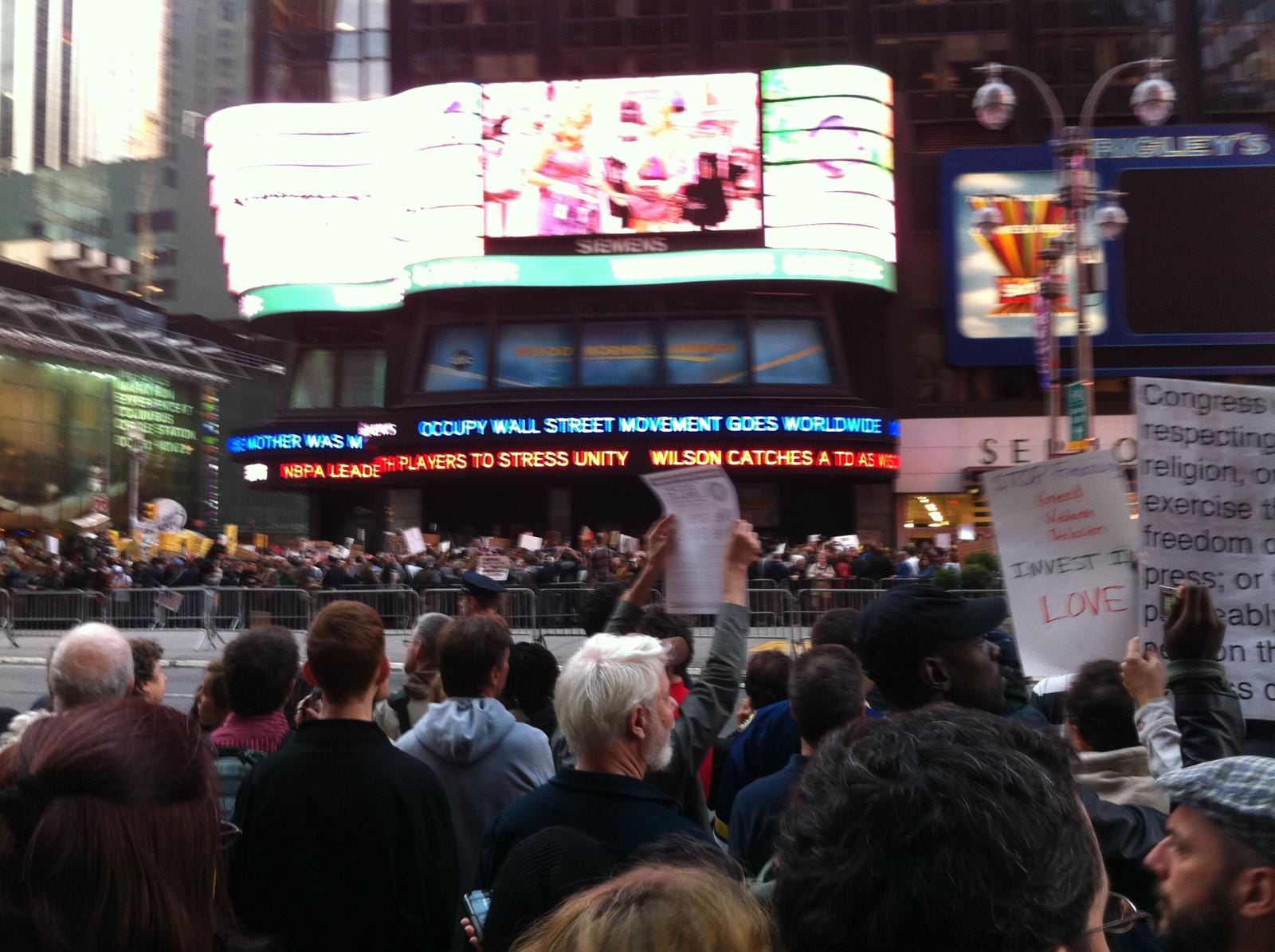
The ABC building across from where I am standing has a rolling ticker on its face, where breaking news scrolls across a massive screen, and suddenly, as if the world is responding to all these people here together, to our chants, to this dream, the ticker lights up. It puts out, in big, red, block letters: “OCCUPY WALL STREET GOES WORLDWIDE.” It feels like time has stopped.”
Dear readers, I was there that evening and here is the photo I took of that moment. It was indeed, quite a moment to be alive and in New York City, and it changed many lives, including Marom’s.
The next day, Marom recounts, the hard reality of Occupy’s internal contradictions came home to roost. Behind the scenes, he had built that October 15th action by coordinating the efforts of several hundred organizers via email and face-to-face planning meetings, but now other activists tell him that their work must stop because it wasn’t sanctioned by Occupy’s general assembly, the direct democracy heart of the movement. A few older activists urge him not to disband what he had so painstakingly and successfully built--“Why destroy something that’s working so well? Do you have any idea how hard it is to build a group like this? How rare this moment is? What an opportunity we have to expand this movement?” they implore--but he agrees with his younger and more idealistic peers, writing: “We are out of process…this was never meant to be a permanent body in the movement…it’s important to do our part to protect this grand experiment in direct democracy…it’s not right for me to have so much power…[and] that backing away from a large email list is a small price to pay for the privileges society has imparted on me at the expense of others.”
And so, Marom sends an email disbanding Occupy’s most effective working group. Later, at another one of the secret, informal strategy meetings that had much influence on Occupy’s direction, the argument between the movement’s purists and its pragmatists leads to a breaking point. Eventually, Marom realizes that his critics were also building a separate group claiming to truly speak for Occupy Wall Street but also violating their purported belief in direct democracy. “What was something big and dreamy and porous enough for anyone to be part of—even my parents at Times Square—has become now something official, and guarded, leading almost all of us to wonder simultaneously whether even we belong in it, wonder who decides.” By the time of Occupy’s next big action on November 17, the air is going out of its tires. Plus, winter is coming and the NYPD has been dumping homeless people at the Zuccotti encampment to create chaos. Soon, the mayors of big cities around the US coordinate on the mass evictions that end Occupy’s run.
I loved Marom’s retelling of Occupy’s rise and fall because of how well he goes inside the story that most of us only glimpsed edges of. But for Marom, Occupy was also “a taste of power,” the “louder days” that he yearns for, and a touchstone for many of the lessons he wants his readers to imbibe. Among them:
“Movement moments are really only possible when thousands and thousands of people see themselves as leaders, take agency, and move with purpose and creative to leverage their own skills and relationships to simply move the thing forward without waiting to be asked or seeking permission. You don’t get a vibrant mini-city like the one we had at Zuccotti Park through command structures.”
On the other hand, “Our mantra of leaderlessness was a farce. Of course people exercised great leadership to fill every vacuum they could identify, and those people who did it effectively and consistently over time emerged as leaders. This was normal and inevitable, something to be proud of in any other context….Pretending there were no leaders, then, made it impossible to really develop leadership in one another. How could we train new leaders if there weren’t supposed to be any leaders in the first place? Who even wants to be a leader…in a thing that hates leaders altogether?”
“Unless or until movements are in the position to depose and replace the power structure they are challenging, they need demands, a strategy for getting after them, the power to make their adversaries pay, the strategic wisdom to know when to exact those costs and when to compromise, a legitimate structure for negotiating with their opponents, and more.”
The rest of the book documents his experiences advising a wide array of progressive movement organizations on how to develop and execute their own strategies for building power, which is where all the thickets rise fed by the politics of powerlessness. This, Marom says, is the tendency of left activists to hyper-focus on small, internal battles over power centered on identity politics, language policing and so-called “white supremacy culture” rather than larger struggles to change the material conditions of people’s lives. Though he writes about most of these groups obliquely, without mentioning too many specifics, it’s no secret that as the founding director of the Wildfire Project (a movement consulting and facilitating group), he worked with the Dream Defenders, the Sunrise Movement, and Justice Democrats. He was also a founding member of IfNotNow.
And this is where For Louder Days turns deeply internal, exposing the many contradictions of contemporary leftist activism as well as Marom’s own intense wrestling with his quasi-privileged position as a white, upper-middle-class male, amidst it all. (I say “quasi” because despite all those markers of privilege Marom was not a funder, the class of people who wield the greatest amount of undemocratic power in movement organizing circles.)
What follows will likely feel familiar to anyone who has worked inside liberal-left organizations in the last ten years, or who read Ryan Grim’s “Elephant in the Zoom” article in the Intercept or Maurice Mitchell’s “Building Resilient Organizations.” Marom adds some fresh horror stories to the pile: a facilitation he led for a national organization derailed by a young Black staffer who accuses its mostly white leadership team of racism while himself failing to follow through on deadlines or meet expectations; another retreat where he ultimately was fired after a young woman of color said she was uncomfortable being facilitated by anyone other than a Black woman; an organizational retreat where an older man who didn’t understand what gender pronouns were was shamed brusquely by its facilitators. Marom resists the easy slams that come to mind in these encounters and tries his hardest to stay in relationship in these moments of tension, because he believes wholeheartedly in helping groups learn how to be honest with themselves and work through conflict, “moving toward greater understanding and depth and alignment that will allow them to go into the fire together.”
At the same time, he also does not flinch in telling the truth about the movements he loves. “Much of the way we organize ourselves in relation to identity, even though it is in response to systems that are real, is reductive and essentializing; it’s hurtful to everyone involved, and it is profoundly unstrategic,” he writes. “It is weakening our movements.” He adds, some pages later, “A movement that says that some people are worthy and others are not—based on the identity they are perceived to hold as opposed to the choices they make and their willingness to try to do better—is a movement in which no one is their biggest self, really; in which no one is safe. It is a losing movement.”
Speaking just for myself, Marom’s many stories left me wondering who could possibly ever survive let alone thrive in today’s progressive movement culture? If ,as Oscar Wilde said, “The trouble with socialism is that it takes up too many evenings,” today’s enemy of empire, racial capitalism, patriarchy etc, must be superhuman and give up sleeping too, not just evenings.
Marom ends For Louder Days with two vignettes that present countervailing scenarios of possibility and impossibility. The first is about his experience joining a local pick-up softball game in his Brooklyn neighborhood and being reminded that it can be easy and fun to be part of a community: “The guys at softball didn’t ask me to follow rules that made me feel small and doubt whether I knew anything at all, to recant previous experiences or renounce large parts of myself, nor to guard the perimeters with them. They did the opposite. They invited me to join, trusted that inside me was the capacity to meet the purpose, reminded me how to do it, and pushed me to play hard and try to do right by my team, even if I wasn’t any good. They encouraged me to invite friends. They invited me to show up but didn’t need me to prove myself by always being there or always being good. All of that was accompanied by the unspoken belief that I would gradually improve if given the chance, which made it possible for me to simply play.” Amen to all that!
The second is about the fracture among progressives after October 7, 2023. “I have perhaps never felt more confused about my own belonging before, more disappointed by people I love, more alone really, than in the sleepless nights of the last week,” Marom writes about the days after Hamas’s brutal attack and the left’s response, as he joins the fledgling “Jews for Ceasefire” in their first direct action at the Biden White House on October 16. And he’s also angry at everyone from the “vast swaths” of Israeli society who “want as much Palestinian death as they can get” to Israeli liberals who now say they have no space in their hearts for the Palestinians, to the broad swath of American Democratic and Republican leaders and mainstream Jewish organizations who give Israeli warmongers cover, to his “friends and acquaintances in the movement [who] defend and honestly, celebrate the violence of October 7th on social media, in protests, and in person:
“A speaker at a rally jokes about how the militants ‘took at least several dozen hipsters’ at a rave, to a chuckling crowd of people I am sure I have been to protests with,” Marom writes. (He’s talking about the same October 8 NYC rally that Darializa Avila Chevalier, the congressional candidate endorsed by DSA and Mayor Zohran Mamdani who is running today to unseat incumbent Democratic Rep. Adriano Espaillat, attended and which she doesn’t express regrets for.) He continues: “A Palestinian activist and thinker I have always admired wrote, while Israeli civilians were still being shot and dragged out of their homes by militants, about how proud he was of his people. A prominent organization comes out with a statement about how all Israelis are settlers and therefore legitimate targets for decolonial violence, and I can’t read it any other way than as a justification for the death even of children, who have never made a choice about much of anything, just because of where they were born.”
This is brave and necessary, and Marom pushes further, asking if the people who embrace Hamas’ actions as “Palestinian resistance” and “decolonial violence” would also agree that “those of us who live here in New York or Detroit or Des Moines—with our own settler colonialism and genocide and chattel slavery, we who wear clothes sewn together by child slaves and walk by houseless people freezing to death outside our doors, who pay taxes that fund prisons and pay for Immigration and Customs Enforcement agents that abduct our neighbors off the street? Are we not all of us then, by this logic, legitimate targets for this kind of violence? And our kids?...And what about those of us who have spent decades fighting against systems of oppression, like the peace activists who were murdered on the 7th along with the others, and my friends in the movement here? Or is it just some of us, just the most complicit? And if just some, then who decides, and based on what? And what kind of world will be left after the reckoning?”
It’s tempting to respond to all of this—not just the post-October 7 hyperpolarization but also the many prior examples of the politics of powerlessness recounted in the book—by shutting down. And as he concludes his memoir, Marom admits that he has started to protect himself from all the minefields strewn across the left landscape, and the danger that someone he might sit with might not care about the same people in the same way as him, and that he is “too afraid to find out; too afraid to disagree” and to think less of that person and be less well thought of, that he is starting “to put little walls around my heart.”
His answer is to call on the power of love, which of course can be a great healer. One has to admire his faith in the value of turning toward each other rather than away. And it is most definitely love that has held our most vital movements together, from the civil rights days to the “neighborism” of Minnesota winter of 2026.
But love without structured community-based groups with clear leadership that is accountable in transparent ways to a clear membership – I think that kind of love will always get broken by the contradictions of mass participation without mass organization. From Occupy to Sunrise to IfNotNow, the movements that Moram has worked with most closely have been bedeviled by frequent internal rancor, high leadership turnover, and confusion about what they stand for--even as they have chased the high visibility moments of the whirlwind made possible by our hyper-mediated age. Dysfunction among progressive activists also isn’t new; just look at how the anti-Vietnam movement and the “New Politics” movement of the late 1960s struggled for coherence and pushed away as many good leaders as they attracted. But today our movements struggle for traction because they are all in a war with each other for scarce attention, and these days everyone can imagine themselves a revolutionary or a disrupter, just with the power of a tweet or a snippet of embarrassing video.
As I’ve written here many times, I think there are other models for purposeful organizing that are making headway despite these challenges, like the groups featured in the Civic Power report put out last year by the Democracy and Power Innovation Fund. Marom himself is making a clear argument for structure over “leaderlessness” one can only hope resonates widely. The eternal optimist has nothing but respect for the people, like Marom, who are still trying to figure out “what is to be done” at a time when nothing we do seems anywhere close to matching the challenges we face. In service of that goal, For Louder Days is more than a cautionary tale; it’s a prayer and a primer for what could come next.
No posts
Comments
Nothing yet. Say the first thing.
Sign in to join the conversation.