
Upon its return from summer recess, the US Supreme Court will hear oral arguments in one of the most significant climate court cases of the year. The question before the justices is whether state courts have the power to issue monetary damages over climate change – or whether that’s exclusively a matter concerning federal courts, Congress, or the president.
There are reasons to believe the Supreme Court's 6-3 conservative majority will rule against the city of Boulder, Colorado, which is suing major oil companies Suncor Energy and ExxonMobil to recover millions of dollars in climate change-related damages. After all, as Earthjustice's Senior Vice President for Programs Sambhav Sankar recently noted, the court has repeatedly shown a willingness to bypass procedural technicalities and sidestep long-standing legal traditions to rapidly rewrite the law in line with the Trump administration’s priorities. And when it comes to climate cases, “It’s not so much that the current Court has made it harder for environmentalists... It’s that they’ve made it much, much easier for our opponents.”
Suncor v. Boulder is taking center stage this summer, and for good reason: a ruling against the oil companies could clear the path for roughly two dozen similar lawsuits filed by states, counties, and cities nationwide trying to hold energy corporations financially liable for localized climate impacts like floods and wildfires. That would deal a huge blow to Trump and his allies, who have made it their mission to block not just state but also federal courts from bringing litigation against the very companies that for decades have intensified the global climate breakdown (and lied about their responsibility).
Among the dozens of entities that have taken a side in the story, one in particular has caught my attention: the insurance industry.
The American Property Casualty Insurance Association, the Complex Insurance Claims Litigation Association, and the Reinsurance Association of America have filed a joint amicus brief asking the Supreme Court to rule that federal law overrides state-level claims seeking damages from energy companies. Together, these associations represent most of the country’s commercial and personal lines insurance and reinsurance companies.
The move exposes a bizarre double standard: the very companies refusing to insure home remedies against wildfires and floods are fighting in court to protect fossil fuel giants causing them.
Their argument rests upon the unproven claim that if local governments can sue oil companies for climate costs, it creates profound financial instability for the energy industry and secondary market risks for their insurers. They write:
By imposing liability based on fossil fuel production and use across the globe and across generations, these state law claims for harms from GHG emissions create a chaotic liability landscape and with it, difficulty in underwriting and insuring (and in procuring insurance for) climate change-related risks.
In the energy sector, where insurance is often required by contract or regulation, the erosion of affordable coverage can constrain investment, impede infrastructure development, and distort markets without any corresponding improvement in safety or accountability.
The brief also advances a familiar line of defense – one long favored by fossil fuel companies: the claim that localized climate impacts cannot be linked to, or blamed on, a single entity:
Climate change is driven by countless individual and industrial activities across the world: energy production, transportation, manufacturing agriculture, and land-use practices. No single source or location can be said to “own” the problem. Instead, climate change results from the cumulative effect of emissions over time and across jurisdictions.
This cumulative nature means that even if a particular locality were to eliminate emissions within its borders entirely, it would still experience climate-related impacts caused by emissions originating elsewhere.
There is also the assumption that a strong national economy relies on cheap, reliable energy from a diverse mix of sources. And so, the associations argue that if they cannot accurately price or handle the uncertainty created by state-level climate lawsuits, this ultimately threatens the availability and affordability of energy for the whole country:
The nation is best served when energy is the most affordable and reliable, and energy is made more affordable and reliable by a diverse portfolio of energy sources, consistent with any constraints that may be imposed by federal policies on energy and the environment. This in turn is made possible by a robust insurance market that supports the energy industry, while encouraging environmental risk avoidance by pricing coverage commensurate with risk. But the level of unpredictability and uncertainty created by localized state climate tort litigation impairs the ability to assess risk and therefore is constraining the insurance market for industries contributing to GHG emissions.
A healthy insurance marketplace contributes to both promoting a reliable energy system and enabling society to respond constructively to climate change.
It sounds like a complex legal debate, but the reality is straightforward. Understanding it starts with a simple question: How do insurance companies actually make money?
Over one-third of weather-related insured losses over the last two decades, totaling $600 billion, can be attributed to climate change. In 2025, these losses reached $107 billion, with the US accounting for more than 80%, driven primarily by the devastating Los Angeles wildfires.
Insurers are private, for-profit businesses, and as such, their primary goal is to generate profit for their owners or shareholders. They do so in three main ways:
Charging customers a so-called premium before any claims happen.
Keeping costs low by paying out less in claims than they take in (policyholders today are paid proportionally less than they were forty years ago: $0.62 for every $1 vs. $0.80 for every $1 in the 1980s and 1990s).
Investing these premiums and the surplus capital they hold in safe assets like bonds to earn interest.
Here’s how that plays out.
As extreme weather events grow more frequent and intense, US insurers are responding by hiking property rates and dropping policyholders. In places like California and Florida, which are particularly and increasingly exposed to climate disasters, state regulations prevent insurance companies from raising prices in their policy renewals after disaster hits, making certain places unprofitable to them. Insurance companies are responding by pulling out entirely, leaving homeowners to cope with the double whammy of uncertainty.
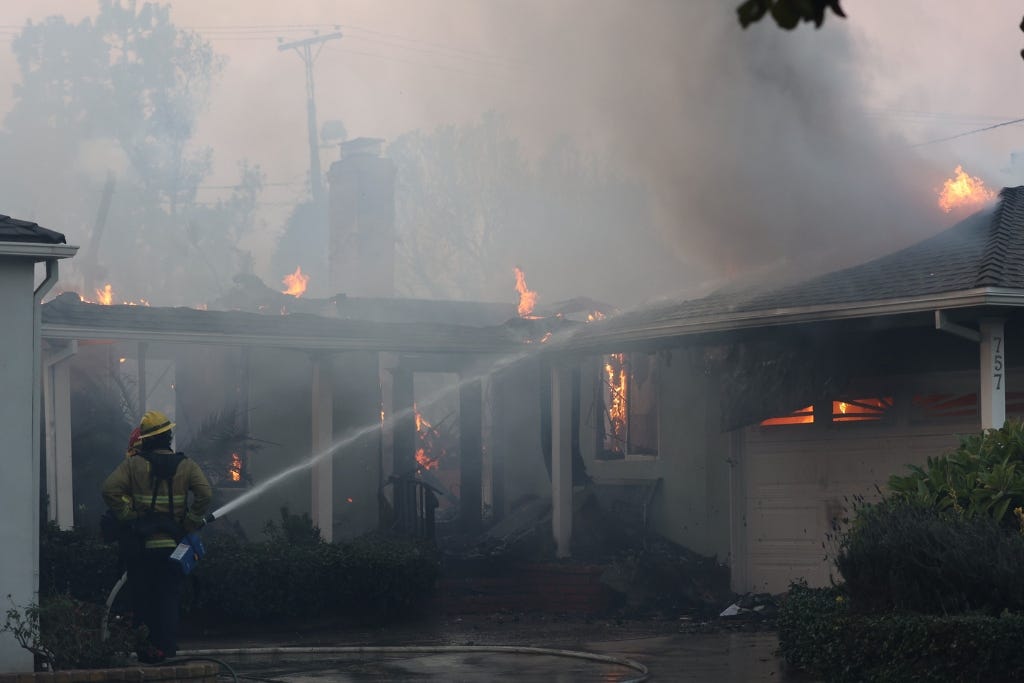
In California, nearly 400,000 policies have been canceled since 2021, while the average annual property insurance premium had already risen to more than $4,200 in Florida at the end of 2022, some three times the national average.
Countrywide, the share of uninsured homes has more than doubled between 2019 and now, with nearly 1 in 7 homes currently uninsured. That’s 12.2 million of 86.6 million owner-occupied homes, or 14.1%.
Far beyond driving people out of climate-vulnerable areas, these tactics are adding fuel to an already raging housing crisis: without affordable coverage, property values plunge and prospective buyers lose access to mortgages and other forms of credit, which are only available to borrowers who have insurance.
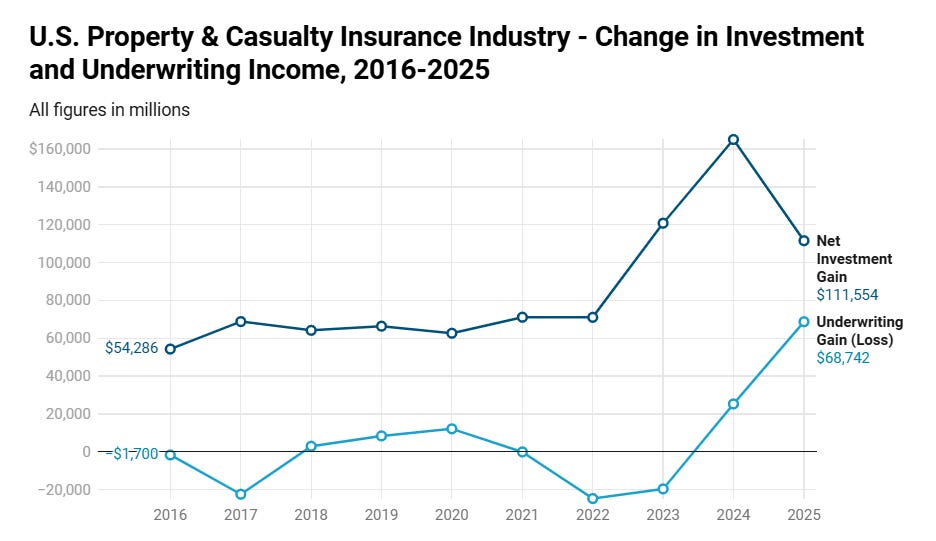
But while policyholders are left to bear the brunt of losses attributable to climate change, insurers are pulling in record profits from two main sources: underwriting income (profits from their core operations after paying out claims and expenses) and investment income (earned by investing collected customer premiums into financial assets like bonds, stocks, and real estate).
Last year, the US property and casualty insurance sector cashed in $68.7 billion from underwriting in what was the most profitable underwriting year in more than two decades. Investments brought in $111.6 billion.
The insurance industry’s alignment with fossil fuel producers is a self-serving business strategy. Insurers funnel billions into fossil fuel projects, fuel the very climate disasters that threaten communities, and then profit by proving that heightened risk directly back into consumer premiums.
The numbers don’t lie: the US insurance sector alone holds over $500 billion in fossil fuel-related assets. In 2023, only three major insurers wrote more direct premiums for renewable energy than fossil fuels. Overall, the renewable energy insurance market was still under 30% of the size of the fossil fuel insurance market.
According to a 2024 scorecard on 30 major insurers and their involvement in the industry, climate-attributed losses for 28 top property and casualty insurers ($10.6 billion) approached the fossil fuel premiums they collected ($11.3 billion) in 2023 – and for more than half the companies, they exceeded them.
But as fossil fuels face structural decline while climate losses will rise, some industry players have begun divesting from planet-warming fossil fuels. The scorecard recognized some notable first movers. Italy’s Generali, for example, adopted restrictions across the oil and gas value chain; Zurich defined a policy on metallurgical coal, excluding both new mines and their developers; and Japanese MS&AD set an absolute target to reduce a portfolio of insured emissions – a first in Asia.
The insurance associations themselves acknowledged this shift in their brief: “Major insurance companies that previously offered substantial limits, often exceeding $100 million, have significantly reduced their capacity. Some have even capped their offerings at $20 million or less.”
But a full industry retreat from fossil fuels remains a distant reality, given that many insurers, particularly massive industry giants, are still moving in the wrong direction: for instance, between 2014 and 2023, American giants Berkshire Hathaway and State Farm increased their fossil fuel positions by around $200 billion.
It is baffling to watch insurance companies defend fossil fuel corporations under the guise of avoiding “legal uncertainty.”
Uncertainty is the very core of the insurance business model. Individuals, companies, homeowners need insurance because the future is uncertain. Insurance exists precisely because human activity involves unpredictable, probabilistic risks. The entire business model of insurance is taking on other people’s uncertainty, pricing that risk using math and probability, and profiting from managing it.
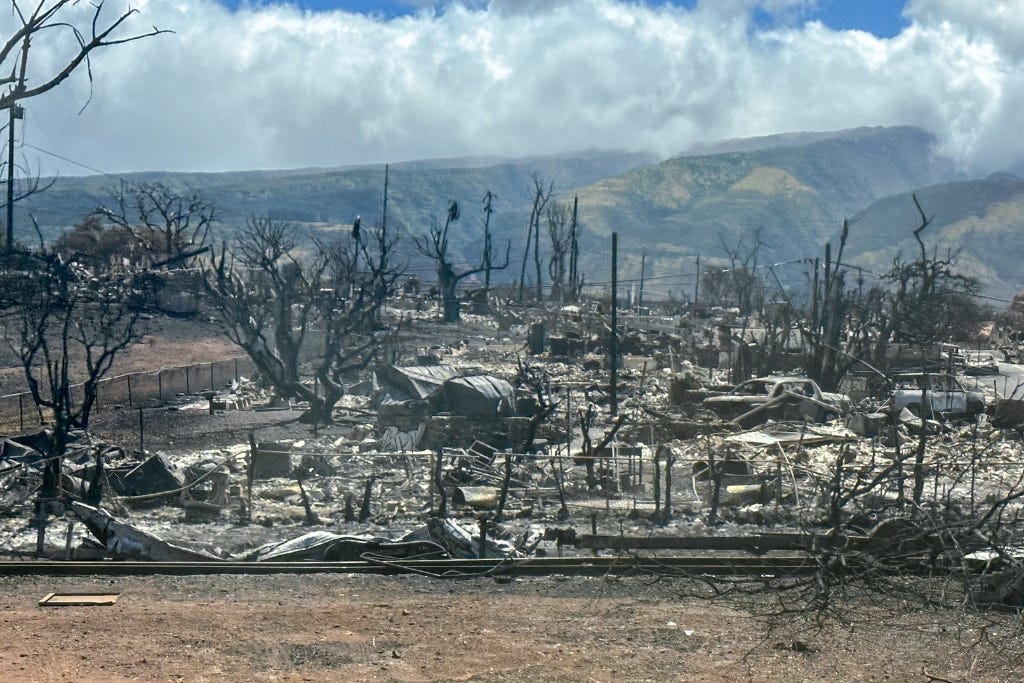
In a contradicting amicus brief filed in the Supreme Court, former California Insurance Commissioner Dave Jones also argues that the real “uncertainty threat” to insurance and to the policyholders and members of the public who rely on it comes not from efforts to make responsible parties pay for climate harm, but from climate change itself. It is the risks that climate change poses to people, property, the energy sectors and the markets that drive that uncertainty.
As Jones argues, the insurance companies' warnings are a baseless distraction, masking their true role in the climate crisis. Insurers aren’t protecting the energy market – they are directly causing property insurance to skyrocket and disappear.
There’s more to it.
Liability policies sold to energy companies typically contain pollution exclusions, Jones notes. These clauses specifically state that the insurer will not pay for damages caused by environmental pollution or carbon emissions, which are intentional wrongdoings rather than accidents.
Lawsuits challenging fossil fuel companies often rest upon the argument of intentional deception (they knew about the risks but misled the public about them), which insurers wouldn’t cover anyway. The claim that state lawsuits will destabilize energy company insurance or collapse the broader insurance market simply doesn’t hold water.
We cannot let the industry rewrite the narrative and pretend they are the victims here. The true victims of this crisis are the homeowners, renters, and local communities left holding the bill for an unlivable future. We pay insurance companies to give us peace of mind against an uncertain future, yet they are actively investing in the industry making that future far more dangerous and unpredictable.
The Supreme Court’s decision on the Boulder case will tell us a lot about who the law is designed to protect.
Before I go, I want to briefly highlight a breaking development out of New Zealand, where the right-wing coalition government just passed a highly contested law that blocks lawsuits seeking to hold companies liable for climate change harm. It was introduced in response to a lawsuit filed by Indigenous Māori elder and climate activist Michael Smith against six prominent New Zealand companies for their contribution to environmental harm linked to climate change. Its passing effectively ends Smith’s legal action and marks, to use his words, a "dark day for democracy.”
While effectively blocking that case and future climate harm claims, the law doesn’t stop other climate litigation cases. The vote came on the eve of the Supreme Court’s concluding hearing of Smith v Attorney-General, another prominent climate change lawsuit brought by Smith that challenges the adequacy of the government's legislative and policy response under the Climate Change Response Act 2002, alleging breaches of the New Zealand Bill of Rights Act and obligations under Te Tiriti o Waitangi (the Treaty of Waitangi).
Meanwhile, an independent climate advisory body last month warned that government policies could lead to New Zealand missing its emissions reduction targets.
Thanks for reading The Climate Record! This post is public so feel free to share it.
Comments
Nothing yet. Say the first thing.
Sign in to join the conversation.