
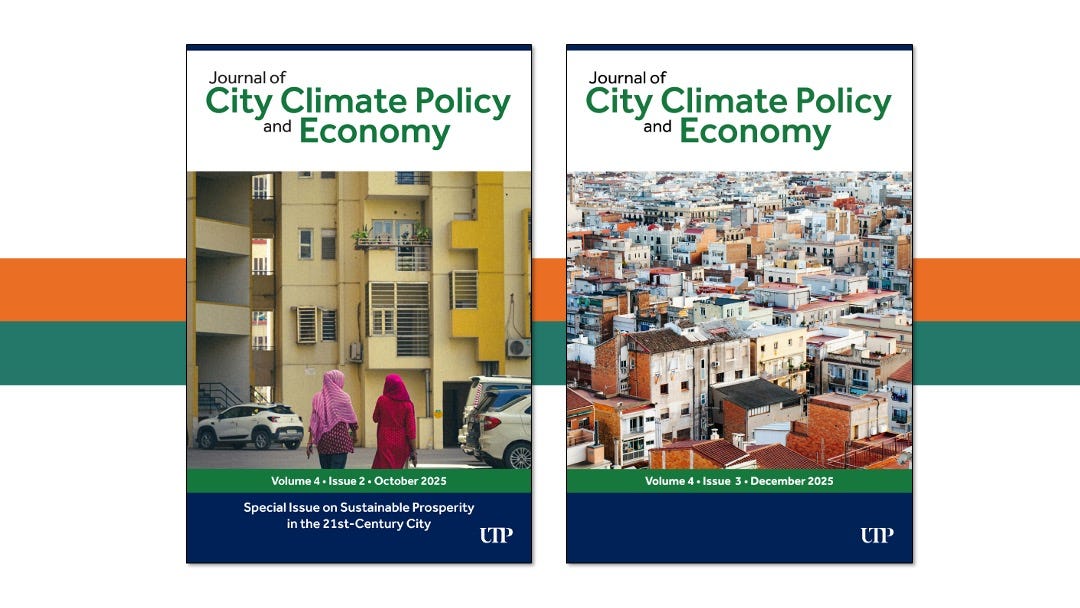
I am pleased to share the Special Issue on Special Issue on Sustainable Prosperity in the 21st-Century City as well as the latest, open-call issue of the Journal of City Climate Policy and Economy.
The Journal of City Climate Policy and Economy is available to read without charge through a Subscribe to Open model which aims to achieve the goals of broad dissemination of content valued by scholars and researchers. The content of this issue is available to all without any cost to authors. Please consider subscribing, or where appropriate, recommending the Journal to your Institution’s Library to access future issues as soon as they’re published.
Here is a selection of articles from both issues:
[Policy Guideline] Transitioning to Post-Growth Cities. By Angelos Varvarousis, Giorgos Kallis, and Maria Kaika
Cities around the world depend on growth, but such growth has become, to use Herman Daly’s term, uneconomic—the costs of growth, within and beyond the cities’ boundaries, far exceed the benefits. Post-growth cities are cities that thrive without growth, serving equitably the needs of their population without exceeding their share of planetary boundaries. What does an urban post-growth vision look like and what policies would it entail? The authors present seven policy-oriented guidelines for cities that want to commit to a post-growth transition
[Original Research] Doughnut Economics in Local Governments: An Overview of Emerging Practice. By Leonora Grcheva and Michele Vianello
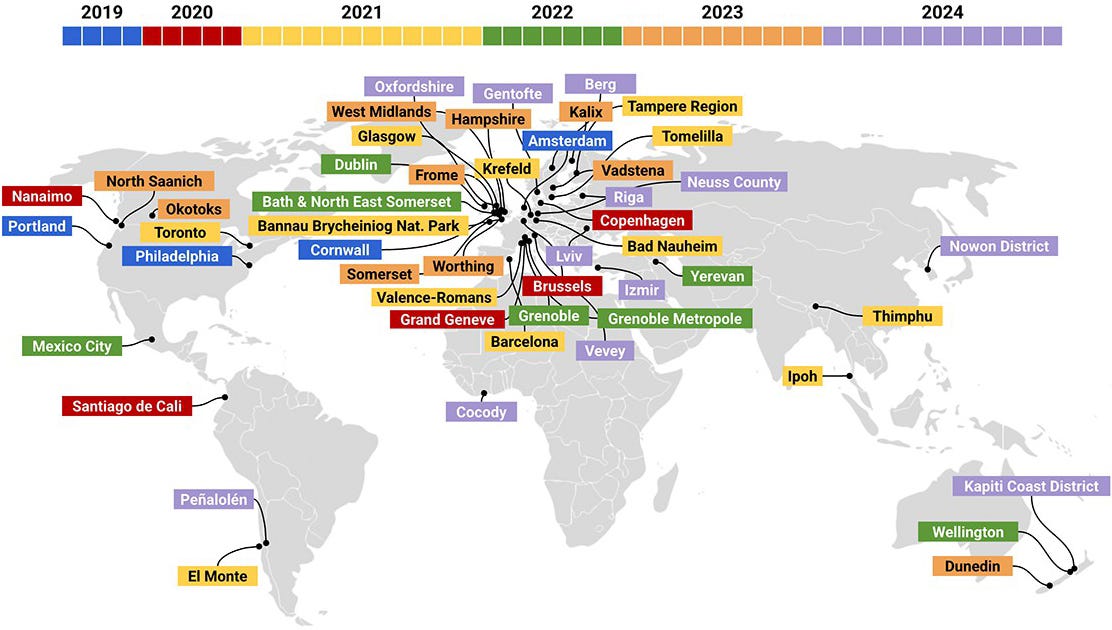
The authors, one of whom is the Cities & Regions lead at the Doughnut Economics Action Lab, provide a first overview of policy approaches informed by Doughnut Economics in 50 local governments worldwide that have engaged with it in their own processes, strategies, and plans. The main reported benefits of adopting Doughnut Economics in local government include enhanced cross-departmental collaboration and silo breaking, a shift toward systems/integrated thinking and doing, and support for the formulation of a new narrative to help facilitate informed collective debates.
[Original Research] Deriving the Ecological Footprint and Biocapacity of Ontario Cities and Rural Areas. By Peri Dworatzek, Eric Miller, and Danielle Letang
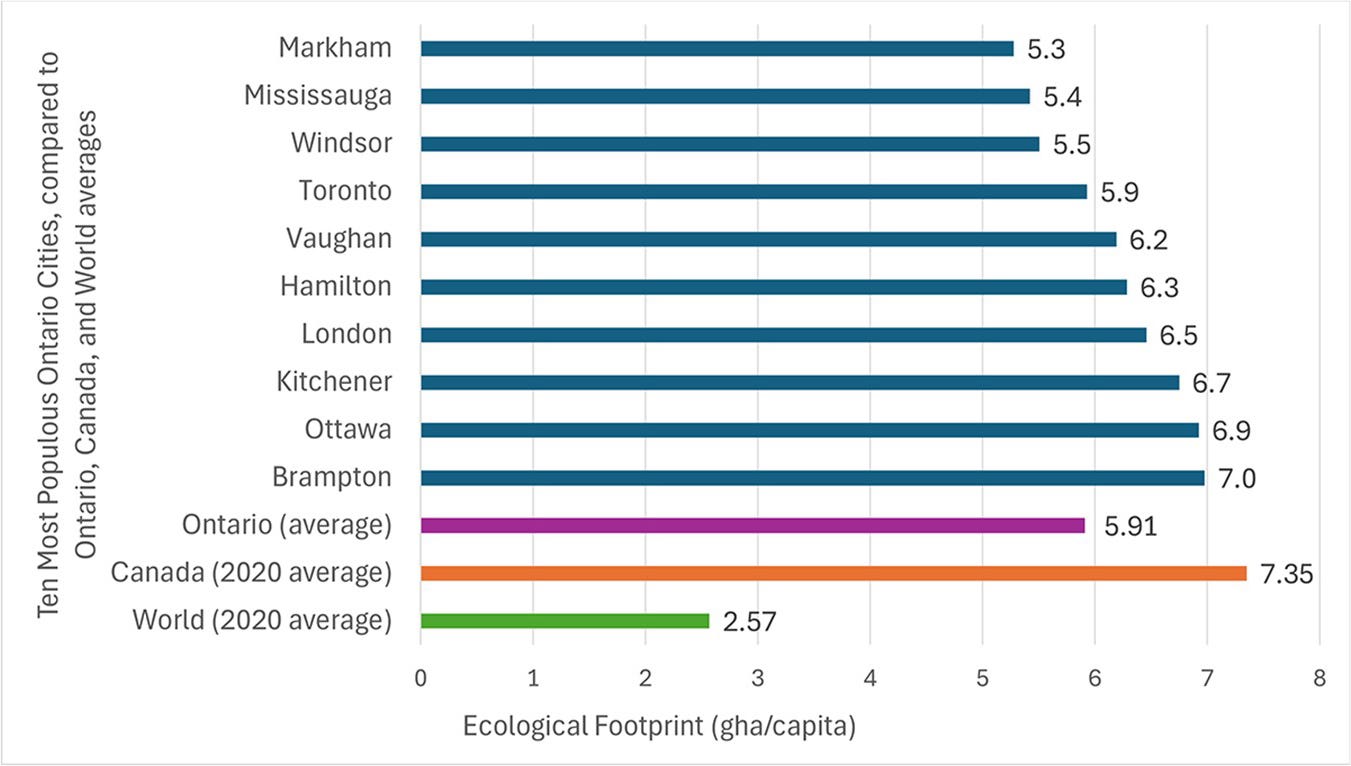
This study generated a new ecological footprint and biocapacity data tool for all census subdivisions in Ontario, Canada. Ecological footprint data provides a holistic perspective on humanity’s overuse of the earth’s natural resources. Biocapacity provides a non-monetary valuation of ecosystem services for a given area—this single-indicator metric goes beyond measuring carbon emissions to also include human uses of forest land, agricultural land, inland and marine waters for fishing, and land for built-up development and consumption. These new and publicly available data can inform opportunities to conserve or enhance biocapacity, and to understand the potential and limitations of local efforts to affect ecological footprints.
[Original Research] Co-Mapping Vulnerability to Climate Gentrification in the Context of Urban Heat: A Participatory Index at the Metropolitan Scale. By Amalia Calderón-Argelich, Isabelle Anguelovski, Eider Etxeberria, Lisa Hannuschke, Andréanne Chu Breton-Carbonneau, Antonio López-Gay, Galia Shokry, Emilia Oscilowicz, Josh Lown, Patrice C. Williams, Elena Lacort, and Minerva Campos
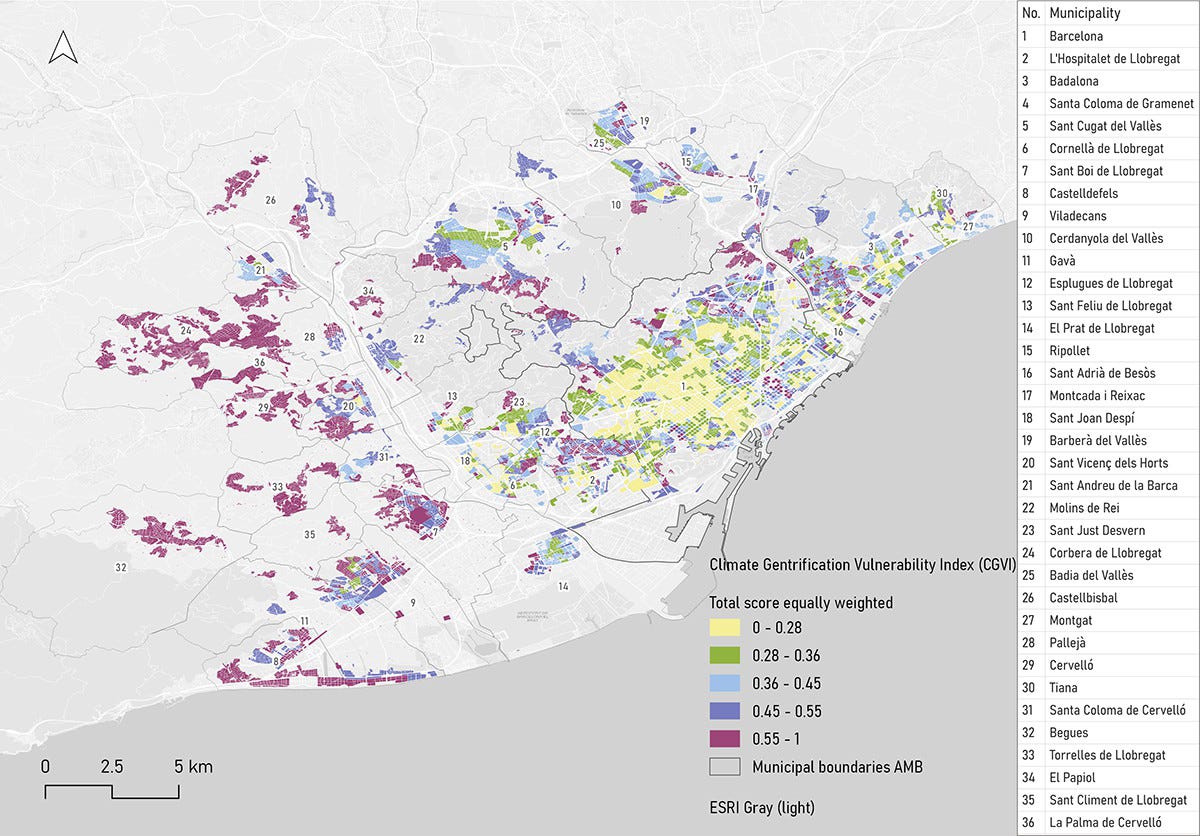
Climate gentrification involves the displacement of historically marginalized residents not only through adaptation interventions but also through the increasing desirability and privilege of certain urban areas in the face of climate change and urban heat. As cities invest in cooling infrastructure, green space, and energy-efficient housing, these improvements can trigger real estate speculation, rising housing costs, and new forms of socio-spatial exclusion. This study introduces a participatory, multiscalar vulnerability index designed to anticipate climate gentrification risks linked to heat exposure in the Barcelona metropolitan region.
[Original Research] Mobilizing Private Finance for Adaptation and Resilience Priorities across Cities: Mexico City Case Study. By Ana F. González Guerrero and Nicola Ranger
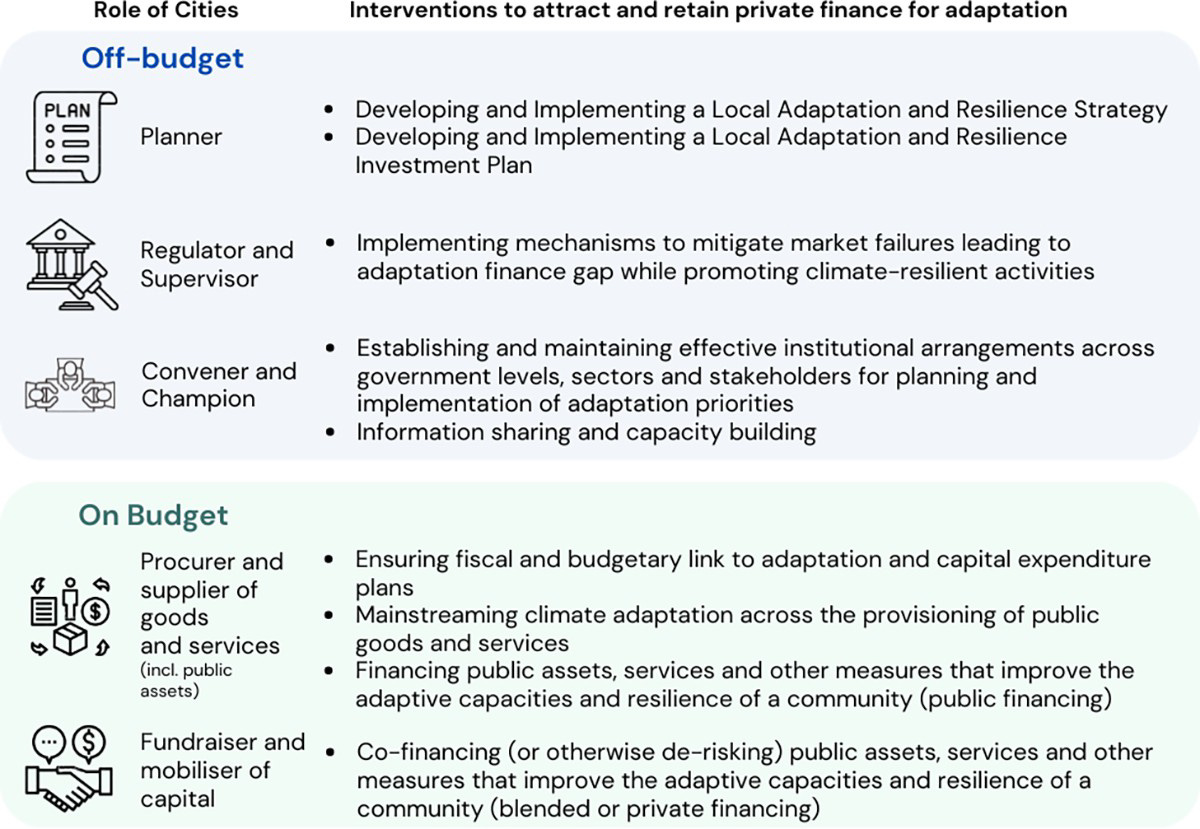
The cost of adapting to the impacts of climate change is rising faster than the finance destined for it, creating a widening adaptation finance gap. Cities are at the forefront of adapting to climate change and have, to varying degrees, tools to address market failures contributing to the underinvestment in adaptation. By understanding the barriers and opportunities to engage the private sector, this research introduces a diagnostic framework to help cities create an enabling environment to mobilize private finance for resilience.
As the climate crisis intensifies, the world’s cities are faced with multiple financial challenges: the requirement for capital to finance sustainable development, adaptation to rising temperatures and climate change mitigation, and the urgent need to divest from carbon-intensive infrastructure. How can the widening gap between these demands and financial reality be addressed while ensuring that human wellbeing, equity and planetary boundaries are prioritised? This Special Issue of the Journal of City Climate Policy and Economy invites contributions that explore approaches to these challenges.
If you are interested, please submit your abstract by 30 June 2026.
Can a city be a global tech hub and a climate leader simultaneously, and does unchecked data centre growth risk emissions targets?
Our interview with Hannah Daly, Professor of Sustainable Energy at University College Cork, was recorded as Ireland was rocked by protests about energy prices. She joins host David Miller in The Cloud vs. The Climate: Lessons from Ireland on the Data Centre Debate, out now on all main podcast platforms.
Going Steady with Herman Daly: How to unbreak the economy (and the planet), the miniseries we launched last year, has reached the semi-finals of the Quill Podcast Awards in two categories - Podcast of the Year and Best Science and Medicine Podcast.
We would be grateful for your vote, which you can cast at this link (voting closes 8th May 2026).
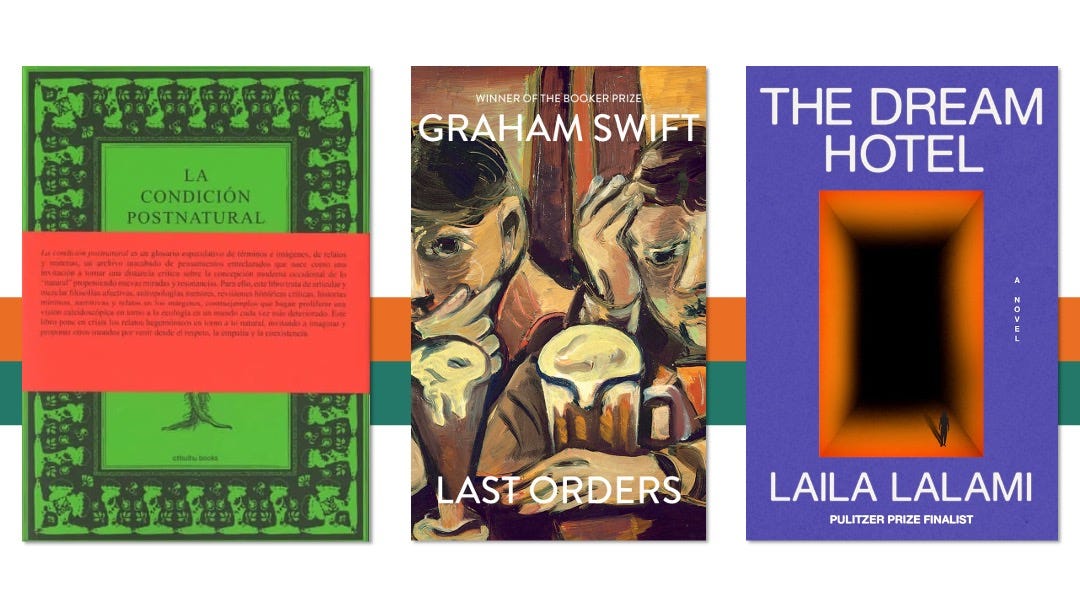
Chiara Morfeo: I’m reading La Condición Postnatural by Clara Benito. It presents a speculative glossary of terms and images that explore questions such as How to understand the socio-climatic crisis? Where to look for new narratives for a desirable future? And what is the relationship between contemporary ecology and artistic practices? It is written in Spanish and some of the theory is dense but 70% of the book is pictures! So perhaps also something for people learning Spanish.
David Miller: I have just re-read Last Orders, the brilliant novel by Graham Swift that chronicles the journey of four friends to disperse their colleague’s ashes in Margate, England. Told from the different perspective of each person, it portrays the peculiar nature of male to male relationships and the hidden complications of long term friendships.
Francesco Mellino: upon Chiara’s suggestion, I’m reading The Dream Hotel by Laila Lalami. A dystopian novel about a near-future world where law enforcement relies on an algorithm that processes personal data (from infractions to social media posts to dreams) to arrest perspective criminals, before any crime has taken place. Effectively, a cross between Philip K. Dick’s novella The Minority Report and an version of China’s social credit system taken to the extreme.
No posts
Comments
Nothing yet. Say the first thing.
Sign in to join the conversation.